
ISO 42001 Certification in San Jose, California
The ISO 42001 certification audit process conducted by CertPro for San Jose-based organizations follows a structured, multi-stage program designed to assess conformance with ISO/IEC 42001:2023. Each stage of the ISO 42001 AIMS audit produces documented findings that contribute to the overall certification decision. The process is sequential: no stage is bypassed, and the certification committee reviews the complete audit record before a certificate is issued.
OUR CLIENTS










ISO 42001 Certification for San Jose and Silicon Valley AI Organizations
San Jose, California, is the global epicenter of artificial intelligence development, semiconductor design, enterprise software, and hyperscale cloud infrastructure. Organizations operating in this ecosystem — including AI-native startups, SaaS vendors, cloud service providers, and enterprises deploying large-scale AI systems — face structured procurement, vendor assurance, and regulatory expectations that ISO 42001 Certification in San Jose, California directly addresses. CertPro, a Licensed CPA Firm, conducts independent ISO 42001 certification audits for San Jose-based organizations, evaluating AI Management System (AIMS) design and operating effectiveness against ISO/IEC 42001:2023 requirements. Certification is issued by an independent certification committee — not by the audit team — preserving the objectivity and integrity of every certification decision.
San Jose as a Global AI Hub and the Case for ISO 42001
San Jose and the broader Silicon Valley region host more AI-focused organizations per square mile than any other metropolitan area in the world. Semiconductor manufacturers, hyperscale cloud providers, enterprise software vendors, and venture-backed AI startups all develop or deploy AI systems that interact with sensitive personal data, financial records, healthcare information, and critical infrastructure. ISO 42001 Certification in San Jose, California provides a structured, internationally recognized framework — ISO/IEC 42001:2023 — under which organizations can demonstrate that their AI governance, risk management, and accountability practices meet rigorous third-party evaluation standards.
For San Jose organizations that sell to enterprise customers, participate in government procurement, or operate in regulated sectors, ISO 42001 compliance is increasingly embedded into vendor qualification and third-party risk management processes. The standard establishes requirements for an AI Management System (AIMS) that addresses AI risk identification, control selection, transparency obligations, accountability structures, and continuous monitoring. All of these elements are verified through an independent ISO 42001 audit conducted by a Licensed CPA Firm such as CertPro.
CertPro’s Role as an Independent Certification Body in San Jose
CertPro operates exclusively as an independent third-party certification body. ISO 42001 Certification in San Jose is issued only after a structured audit program — comprising Stage 1 and Stage 2 audits — has been completed and reviewed by an independent certification committee. CertPro does not provide consulting, implementation, control design, or readiness services. Its function is limited to assessment, audit, and certification decision-making under ISO/IEC 42001:2023.
This structural independence is foundational to the credibility of every certificate issued. San Jose-based organizations that engage CertPro for an ISO 42001 AIMS audit receive an objective evaluation of their AI Management System’s conformance with all applicable standard requirements — including AIMS policy, AI risk assessment, AI risk treatment, Annex A controls, and management review obligations. The certification decision is made by a committee that was not part of the audit team, ensuring that no single individual controls both the evidence-gathering and the certification outcome.
ISO/IEC 42001:2023 — The Standard Behind the Certification
ISO/IEC 42001:2023 is the first internationally published management system standard specifically designed for artificial intelligence. Published by the International Organization for Standardization (ISO) and the International Electrotechnical Commission (IEC), the standard specifies requirements for establishing, implementing, maintaining, and continually improving an AI Management System within organizations that develop, provide, or use AI-based products and services.
The standard follows the High-Level Structure (HLS) common to ISO management system standards, covering context of the organization, leadership, planning, support, operation, performance evaluation, and improvement under Clauses 4 through 10. Annex A of ISO/IEC 42001:2023 provides a set of reference controls addressing AI governance, data quality, system transparency, AI risk management, accountability, and human oversight. For San Jose technology companies, alignment with this standard signals that AI systems are subject to documented governance processes and independently evaluated operational controls — a critical differentiator in enterprise sales and regulatory engagement.

ISO 42001 Certification Audit Process in San Jose, California
The ISO 42001 certification audit process conducted by CertPro for San Jose-based organizations follows a structured, multi-stage program designed to assess conformance with ISO/IEC 42001:2023. Each stage of the ISO 42001 AIMS audit produces documented findings that contribute to the overall certification decision. The process is sequential: no stage is bypassed, and the certification committee reviews the complete audit record before a certificate is issued.
The Stage 1 audit is a documentation-focused review conducted to determine whether the organization’s AI Management System has been designed in conformance with ISO/IEC 42001:2023 requirements and whether the organization is ready to proceed to Stage 2 assessment. During this phase, auditors evaluate the AIMS scope statement, AI policy, AI risk assessment methodology, AI risk treatment plan, and supporting documentation covering Annex A controls selected by the organization.
For San Jose technology organizations — which typically operate complex AI system portfolios spanning multiple product lines, cloud environments, and jurisdictions — the Stage 1 audit examines whether the documented AIMS adequately reflects the actual scope of AI activities. This includes development pipelines, training data governance, model deployment practices, and human oversight mechanisms. Auditors issue a Stage 1 findings report identifying any documentation gaps or areas where the AIMS design does not yet meet standard requirements. These findings must be addressed before Stage 2 commences.
The Stage 2 audit is an on-site or remote ISO 42001 assessment that evaluates whether the AI Management System is operating effectively in practice. Auditors collect and test evidence demonstrating that AIMS controls — including those selected from Annex A — are functioning as designed. Evidence examined during Stage 2 includes AI risk registers, control testing records, management review minutes, incident logs related to AI system failures or bias events, training and competency records, and supplier or third-party AI evaluation documentation.
For San Jose organizations deploying AI in customer-facing applications, financial services platforms, or healthcare technology, auditors assess whether the organization’s AI transparency practices, accountability structures, and monitoring mechanisms are operating consistently and can be substantiated through objective evidence. Nonconformities identified during Stage 2 are classified and reported. The organization must respond with corrective actions before the certification committee proceeds to a certification decision.
Following the completion of Stage 1 and Stage 2 audits and satisfactory resolution of any identified nonconformities, the complete audit record is submitted to CertPro’s independent certification committee for review. The certification committee — which operates separately from the audit team — evaluates whether the evidence and audit findings support the conclusion that the organization’s AIMS conforms to ISO/IEC 42001:2023.
If the committee determines that conformance has been demonstrated, an ISO 42001 certificate is issued. The certificate specifies the certification scope, the applicable standard (ISO/IEC 42001:2023), the certificate issuance date, and the certificate expiry date. ISO 42001 certificates issued following this process are valid for a defined period subject to ongoing surveillance audit obligations. San Jose organizations that achieve certification can present the certificate to enterprise customers, procurement teams, and regulators as objective evidence of an independently evaluated AI Management System.
| Audit Stage | Key Activities | Output |
|---|---|---|
| Stage 1 Audit | Review of AIMS documentation, scope, AI policy, risk assessment, and Annex A control selection | Stage 1 findings report; readiness determination for Stage 2 |
| Stage 2 Audit | On-site or remote ISO 42001 operational effectiveness assessment; evidence collection and testing across AIMS controls | Nonconformity report; corrective action requirements |
| Nonconformity Review | Evaluation of corrective actions submitted in response to ISO 42001 audit findings | Closure confirmation or further review requirements |
| Certification Committee Review | Independent review of complete audit record by committee separate from audit team | ISO 42001 certification decision (grant, defer, or decline) |
| Certificate Issuance | Formal issuance of ISO 42001 certificate specifying scope, standard, and validity period | ISO/IEC 42001:2023 certificate |
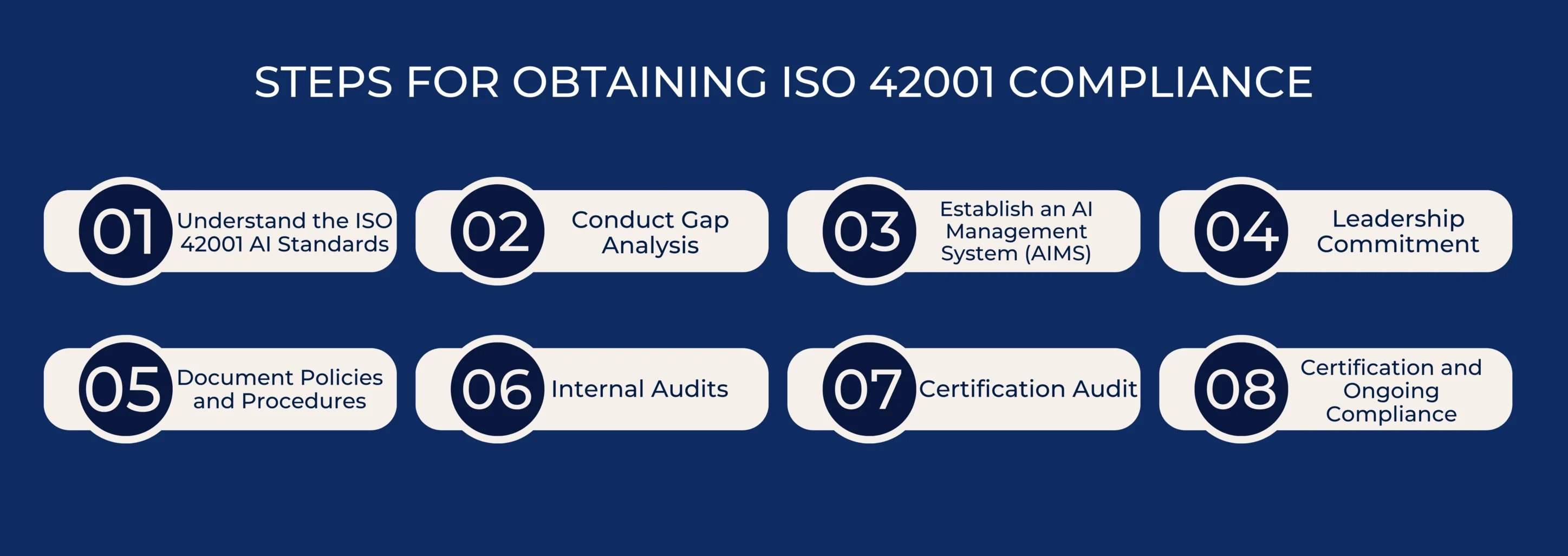
- ✓Stage 1 Audit: Documentation and Readiness Review
- ✓Stage 2 Audit: Operational Effectiveness Assessment
- ✓Certification Committee Decision and Certificate Issuance
ISO 42001 Requirements: What San Jose Organizations Must Demonstrate
ISO/IEC 42001:2023 establishes specific requirements across its management system clauses and Annex A controls. During an ISO 42001 audit, auditors evaluate whether each requirement is met through documented evidence and observed operational practices. Understanding these requirements is essential for San Jose organizations preparing to enter the ISO 42001 assessment process.
ISO/IEC 42001:2023 follows the High-Level Structure shared by ISO 9001, ISO 27001, and ISO 14001. Clauses 4 through 10 establish requirements for the management system framework.
Clause 4 requires organizations to define the internal and external context relevant to their AI activities, identify interested parties (including regulators, customers, and AI system users), and establish the AIMS scope. Clause 5 establishes leadership obligations — including the requirement for top management to demonstrate commitment to the AIMS, assign roles and responsibilities, and maintain an AI policy. Clause 6 covers planning requirements, including AI risk assessment: the process by which organizations identify AI-specific risks, evaluate likelihood and impact, and determine appropriate risk treatment measures.
Clause 7 addresses support requirements: resources, competence, awareness, communication, and documented information. Clauses 8 through 10 cover operational planning, performance evaluation (including internal audits and management review), and continual improvement requirements. During the ISO 42001 AIMS audit, each of these clause areas is evaluated through documentation review and evidence testing.
Annex A of ISO/IEC 42001:2023 provides a reference set of controls covering AI-specific governance domains. Unlike the controls in ISO 27001 Annex A — which focus on information security — ISO 42001 Annex A controls address the unique risks introduced by AI systems, including algorithmic bias, lack of explainability, data quality degradation, unintended AI system behavior, and inadequate human oversight.
Control areas in Annex A include AI system impact assessment, AI risk and impact management, data quality and provenance governance, AI system transparency and documentation, accountability and oversight structures, supplier and third-party AI system evaluation, and AI system performance monitoring. Organizations are required to produce a Statement of Applicability (SoA) documenting which Annex A controls apply to their AIMS scope and the justification for any controls excluded.
For San Jose technology organizations with complex AI supply chains — where training data, model components, and inference infrastructure may be sourced from multiple vendors — the third-party AI evaluation controls are particularly relevant and receive focused attention during the ISO 42001 audit.
- ✓AIMS scope statement defining the AI systems, organizational units, and locations covered by certification
- ✓AI policy signed by top management and communicated across the organization
- ✓AI risk assessment records documenting identified AI risks, evaluation criteria, and risk owners
- ✓AI risk treatment plan specifying selected controls, treatment owners, and implementation status
- ✓Statement of Applicability (SoA) listing all Annex A controls with applicability determinations and justifications
- ✓Internal audit records demonstrating that AIMS performance has been evaluated against ISO/IEC 42001:2023 requirements
- ✓Management review minutes evidencing top-level review of AIMS performance, risks, and improvement actions
- ✓Corrective action records documenting organizational responses to identified nonconformities
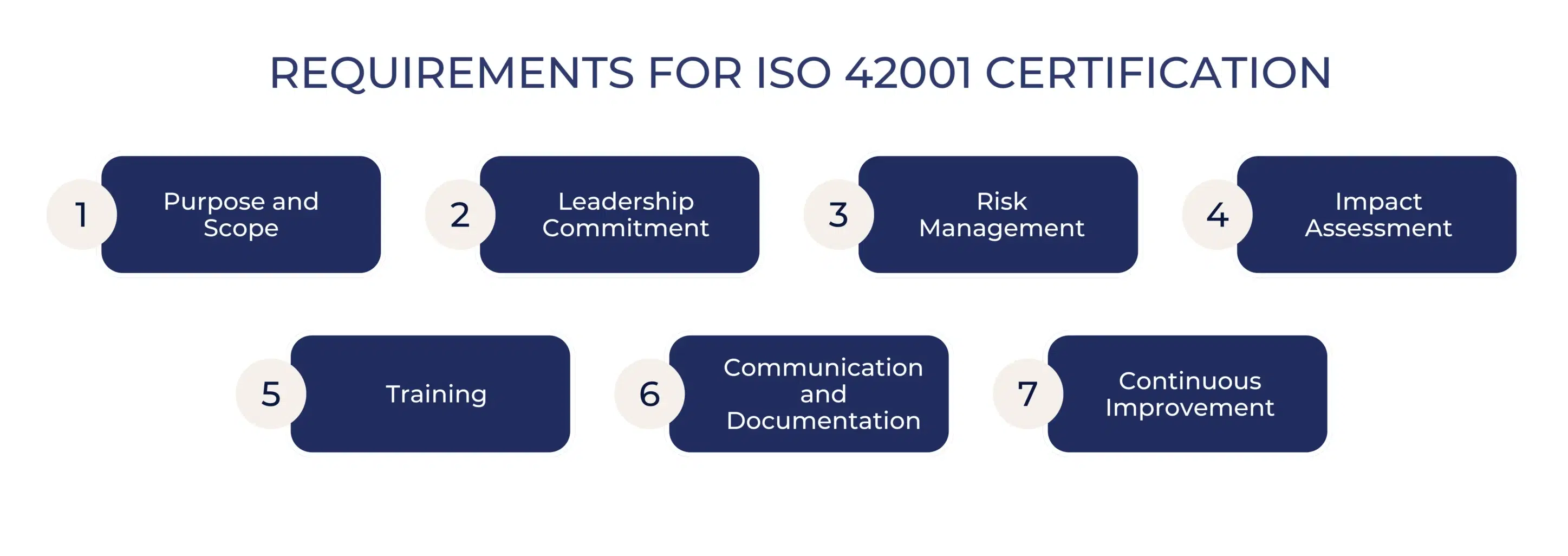
- ✓Management System Clause Requirements (Clauses 4–10)
- ✓Annex A Controls: AI-Specific Governance Requirements
- ✓Key AIMS Documentation Requirements
Why San Jose Technology Companies Pursue ISO 42001 Certification
ISO 42001 Certification in San Jose, California is pursued by organizations across the technology sector for reasons that extend well beyond regulatory compliance. The certification addresses specific commercial, operational, and governance drivers that are particularly acute in the Silicon Valley ecosystem, where enterprise customers, institutional investors, and regulatory bodies increasingly scrutinize AI governance practices as part of vendor qualification and risk management programs.
Enterprise Procurement and Vendor Assurance Requirements
San Jose-based SaaS vendors and AI platform providers frequently sell to Fortune 500 enterprises, financial institutions, healthcare organizations, and federal government agencies — all of which operate third-party risk management programs that evaluate vendor AI governance practices. In a typical enterprise procurement scenario, a San Jose AI company responding to a vendor security questionnaire or RFP may be required to demonstrate that its AI systems are subject to documented risk management processes, independent control evaluation, and ongoing oversight.
ISO 42001 Certification in San Jose provides an independently verified credential that satisfies these requirements without requiring the enterprise customer to conduct its own AI governance audit of the vendor. The certification certificate and associated audit scope documentation can be provided directly to procurement teams, significantly reducing friction in vendor onboarding reviews. This is particularly relevant in sectors such as financial services, insurance, and healthcare, where third-party AI risk assessments are increasingly mandated by internal risk committees and external regulators.
Regulatory and Policy Alignment in California and the U.S.
California has established itself as the leading state-level jurisdiction for AI governance policy in the United States. Legislative activity in Sacramento — including bills addressing automated decision-making, algorithmic accountability, and AI transparency — creates compliance expectations for San Jose organizations that develop or deploy AI systems affecting California residents.
While ISO 42001 compliance does not substitute for specific statutory obligations, the standard’s requirements for AI risk assessment, transparency documentation, and accountability structures align closely with the governance principles embedded in emerging California and federal AI policy frameworks. Organizations that have achieved ISO 42001 Certification in San Jose, California can demonstrate to state regulators, legislative oversight bodies, and institutional stakeholders that their AI governance practices have been independently evaluated against an internationally recognized standard. This alignment is particularly relevant for organizations operating in sectors subject to federal oversight, including financial services (OCC, CFPB), healthcare (FDA AI/ML guidance), and critical infrastructure.
International Market Access and Cross-Border AI Governance
San Jose technology companies frequently operate globally, serving enterprise customers in the European Union, United Kingdom, Japan, Singapore, and Australia — jurisdictions that have adopted or are actively developing AI governance regulations aligned with international standards. The EU AI Act, which establishes a risk-based regulatory framework for AI systems, references international standards as a mechanism for demonstrating conformance with certain requirements.
ISO 42001 Certification for San Jose technology companies operating in EU markets provides a documented basis for demonstrating that AI governance practices have been evaluated against ISO/IEC 42001:2023 — a standard that shares core governance principles with the EU AI Act’s requirements for high-risk AI systems. For San Jose-headquartered companies expanding into regulated international markets, the certification serves as a portable, internationally recognized credential that supports market access and reduces the burden of jurisdiction-specific AI governance assessments.
ISO 42001 Certification Scope and Independent Decision Framework
The scope of an ISO 42001 certification defines the boundaries within which the AI Management System operates and has been audited. For San Jose organizations with complex AI system portfolios, scope definition is a critical element of the ISO 42001 assessment process. The certification scope must be clearly defined before Stage 1 audit activities commence and is reflected on the face of the certificate issued upon successful certification.
Defining Certification Scope for AI-Intensive San Jose Organizations
ISO/IEC 42001:2023 requires organizations to document the boundaries of their AIMS, including the AI systems covered, the organizational units involved, and any exclusions from scope with documented justifications. For San Jose technology organizations — which may operate dozens of AI models across multiple product lines, cloud regions, and customer segments — scope definition requires careful analysis of which AI systems are material to the certification objectives and which can be justifiably excluded.
A San Jose enterprise software vendor, for example, may choose to scope its ISO 42001 certification around its AI-powered analytics platform while excluding internal HR automation tools that do not interact with customer data. Auditors evaluate whether the documented scope accurately represents the organization’s AI activities and whether any exclusions are justified under the standard’s requirements. Scope decisions made at the outset of the ISO 42001 Certification in San Jose, California process directly determine the evidence population that auditors will examine during Stage 2 assessment.
Surveillance Audits and Certificate Maintenance
ISO 42001 certification is not a one-time event. Following initial certification, organizations are subject to periodic surveillance audits conducted by CertPro to verify that the AI Management System continues to operate in conformance with ISO/IEC 42001:2023. Surveillance audits are typically conducted annually during the three-year certification cycle and focus on confirming that controls remain effective, that identified nonconformities have been addressed, and that the AIMS continues to evolve in response to changes in the organization’s AI activities, risk environment, and applicable regulatory requirements.
For San Jose technology companies — where AI product releases, model updates, and infrastructure changes occur frequently — surveillance audits provide a structured mechanism for maintaining documented evidence that the AIMS remains current and effective. At the end of the three-year certification cycle, a recertification audit is conducted to renew the certificate. Recertification requires a full re-evaluation of AIMS design and operating effectiveness against ISO/IEC 42001:2023 requirements.
Certificate Suspension and Withdrawal Conditions
ISO 42001 certification may be suspended or withdrawn if an organization fails to maintain conformance with ISO/IEC 42001:2023 requirements during the certification period. Conditions that may trigger suspension include failure to complete surveillance audits within the required timeframe, failure to address major nonconformities identified during the ISO 42001 audit, significant changes to the certified scope without notification to the certification body, or evidence that the AIMS is no longer operating effectively.
Certificate withdrawal occurs when suspension conditions are not resolved within the specified remediation period or when the organization voluntarily discontinues certification. For San Jose organizations that have incorporated ISO 42001 certification into contractual commitments with enterprise customers or regulatory submissions, maintaining continuous certification status requires active management of AIMS obligations — including timely completion of surveillance audits and prompt corrective action in response to audit findings.
Benefits of ISO 42001 Certification for San Jose, California-Based Organizations
ISO 42001 Certification in San Jose, California produces verifiable outcomes across commercial, operational, and governance dimensions. The benefits described below reflect the direct results of achieving and maintaining an independently certified AI Management System and are applicable across the range of technology sectors represented in the Silicon Valley ecosystem.
The most direct benefit of ISO 42001 certification is independent, third-party verification that the organization’s AI Management System has been evaluated against ISO/IEC 42001:2023 by a Licensed CPA Firm operating as a certification body. This verification is distinct from self-assessments, internal audits, or vendor-commissioned reports in that it is conducted by an entity with no financial or operational interest in the certification outcome.
For San Jose technology companies that market AI systems to enterprise buyers, financial institutions, or government agencies, the certificate provides objective evidence that AI governance controls have been evaluated by an independent party. This reduces the evidentiary burden placed on the organization by customer due diligence processes and regulatory inquiries. The ISO 42001 AIMS audit San Jose organizations undergo through CertPro produces a documented audit record that can be referenced in vendor due diligence responses, board-level governance reporting, and regulatory correspondence.
ISO 42001 certification requires organizations to maintain documented AI risk assessments, risk treatment plans, and control effectiveness records. The certification process creates a structured, auditable record of how the organization identifies AI-specific risks — including bias, explainability failures, data quality degradation, and unintended system behavior — and what controls have been selected and evaluated to address those risks.
For San Jose organizations operating in sectors where AI system failures carry significant legal, financial, or reputational consequences, this documentation framework provides a defensible basis for AI governance decisions. In the event of an AI-related incident, a certified organization can demonstrate to regulators, customers, and legal counsel that the AI system in question was subject to a documented governance program independently evaluated by a third party. This documentation trail is increasingly recognized as a critical element of corporate AI accountability in California and across the United States.
- ✓Provides a recognized, independently verified credential for use in enterprise vendor qualification processes and RFP responses
- ✓Reduces friction in customer security questionnaire and third-party risk assessment processes by substituting an ISO 42001 certificate for extensive self-reported documentation
- ✓Supports international market access for San Jose technology companies expanding into EU, UK, Singapore, and other regulated jurisdictions where AI governance standards are referenced in procurement
- ✓Demonstrates to institutional investors and board-level stakeholders that AI governance is subject to structured, independently evaluated oversight
- ✓Differentiates San Jose AI companies in competitive markets where buyers increasingly evaluate AI governance maturity as part of product selection criteria
- ✓Provides a documented basis for regulatory engagement with California, federal, and international authorities reviewing AI system governance practices
- ✓Supports board and executive-level ESG and responsible AI reporting with independently verified ISO 42001 compliance credentials
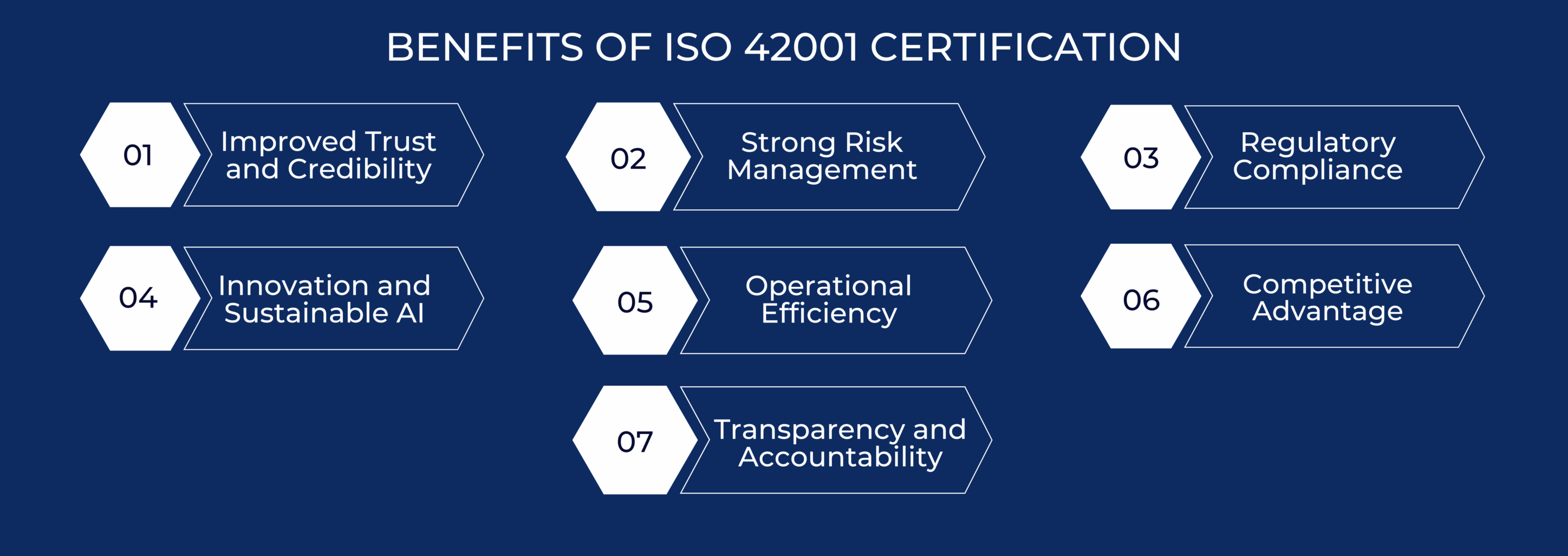
- ✓Independent Verification of AI Governance Controls
- ✓Structured AI Risk Management and Accountability Documentation
- ✓Commercial and Market Positioning Benefits
Industries in San Jose, California Seeking ISO 42001 Certification
ISO 42001 certification audit engagements in San Jose, California span a wide range of industries that develop, deploy, or rely on AI systems as part of their core operations. The Silicon Valley ecosystem creates particular concentration in several sectors where AI governance certification is especially relevant to commercial and regulatory requirements.
AI-Native Technology Companies and SaaS Providers
San Jose and Silicon Valley are home to a dense population of AI-native startups and established SaaS providers that embed machine learning models, large language models (LLMs), and AI-driven automation into their core product offerings. These organizations face direct commercial pressure to demonstrate AI governance credentials as enterprise buyers tighten vendor qualification requirements.
ISO 42001 Certification in San Jose, California for SaaS providers offers a structured framework for documenting and independently verifying how AI capabilities are governed across the product development lifecycle — from training data selection and model validation to production deployment and ongoing performance monitoring. The ISO 42001 assessment covers the full AIMS scope, including how the organization manages AI-specific risks such as model drift, adversarial inputs, and unintended outputs. Certification enables SaaS providers to respond to enterprise security questionnaires with a certificate reference rather than extensive self-reported documentation, streamlining the sales process in enterprise-focused market segments.
Semiconductor, Hardware, and Cloud Infrastructure Organizations
San Jose is the headquarters city for several of the world’s leading semiconductor companies and hyperscale cloud infrastructure providers. These organizations play a foundational role in the global AI supply chain — designing the processors, hardware accelerators, and cloud computing services that underpin AI model training and inference at scale.
ISO 42001 compliance for semiconductor and cloud infrastructure companies in San Jose addresses the AI governance obligations that arise from their position in the AI value chain. This includes responsibilities related to AI system documentation, transparency to downstream AI developers, and supply chain accountability for AI-enabling technologies. Cloud service providers that offer AI platform services — including managed model training, AI inference APIs, and AI development tools — are increasingly subject to customer-imposed AI governance requirements that ISO 42001 certification directly addresses. The ISO 42001 AIMS audit evaluates how these organizations govern their AI-related offerings, including data handling, model documentation, and service transparency practices.
Enterprise Software Vendors and Managed Service Providers
Enterprise software vendors headquartered in San Jose that incorporate AI capabilities into their products — including ERP systems, CRM platforms, supply chain management tools, and financial analytics applications — face AI governance scrutiny from regulated enterprise customers in financial services, healthcare, and government sectors. Managed service providers (MSPs) operating in the Silicon Valley region that deliver AI-powered services to regulated industries are similarly subject to third-party risk management evaluations that examine AI governance practices.
ISO 42001 Certification in San Jose provides these organizations with an independently verified AI governance credential that satisfies the third-party risk requirements of enterprise customers and regulated sector buyers. The certification scope for enterprise software vendors typically covers the AI features embedded in the vendor’s products, the data governance practices applied to customer data used in AI model training or inference, and the monitoring and accountability structures maintained over AI system behavior in production environments.
ISO 42001 Compliance Monitoring and Ongoing Obligations in San Jose
ISO 42001 compliance in San Jose, California is not achieved solely through initial certification. The standard requires ongoing performance evaluation, continual improvement, and periodic third-party review through surveillance audits. Understanding the ongoing obligations associated with maintaining ISO 42001 certification is essential for San Jose organizations that incorporate the certificate into contractual commitments or regulatory filings.
Internal Audit and Management Review Requirements
ISO/IEC 42001:2023 Clause 9 requires certified organizations to conduct internal audits of the AIMS at planned intervals to verify that the system conforms to both the organization’s own requirements and the standard’s requirements, and that the AIMS is effectively implemented and maintained. Internal audit findings must be documented and reported to management.
Clause 9 also requires management reviews — formal meetings at which top management reviews AIMS performance data, internal audit results, corrective action status, and changes in the internal or external context relevant to the AIMS. Management review outputs must include decisions and actions related to continual improvement opportunities and any changes needed to the AIMS. For San Jose technology organizations operating in rapidly evolving AI environments, management review processes are particularly important for capturing how changes in AI product capabilities, regulatory requirements, or risk profiles affect the AIMS. CertPro’s surveillance auditors examine internal audit records and management review minutes as primary evidence of ongoing AIMS performance during annual surveillance visits.
Responding to AI System Changes and Nonconformities
San Jose technology organizations that release frequent AI model updates, expand into new AI use cases, or modify their AI system architecture during the certification period are required to assess whether such changes affect the AIMS scope, risk profile, or control design. Material changes to AI systems within the certified scope must be reflected in updated risk assessments, revised control documentation, and — where scope changes are significant — formal notification to CertPro as the certification body.
Nonconformities identified through internal audits, customer complaints, AI incident reviews, or surveillance audits must be addressed through documented corrective actions. ISO/IEC 42001:2023 Clause 10 requires organizations to react to nonconformities by taking action to control and correct them, evaluating the root cause, implementing corrective actions, and reviewing the effectiveness of those actions. Documented corrective action records are reviewed by CertPro auditors during surveillance and recertification visits as evidence that the AIMS includes functional mechanisms for identifying and resolving ISO 42001 compliance gaps.
FAQ
▶
What is ISO 42001 certification and why does it matter for San Jose organizations?
▶
Which organizations in San Jose need ISO 42001 certification?
▶
What is the difference between Stage 1 and Stage 2 in an ISO 42001 audit?
▶
How long is an ISO 42001 certificate valid?
▶
What documentation is required for the ISO 42001 audit in San Jose?
▶
Does ISO 42001 certification satisfy California AI regulatory requirements?
▶
How does ISO 42001 compliance differ from ISO 27001 compliance?
▶
What is the role of surveillance audits in maintaining ISO 42001 certification?
ISO 42001 CERTIFIED: WHY AI GOVERNANCE CERTIFICATION IS BECOMING A BOARD-LEVEL REQUIREMENT
ISO 42001 Certified: Board-Level AI Governance Guide | CertPro CPA LLC HERO ══════════════════════════════ –> src=”https://certpro.com/wp-content/uplo…
Get In Touch
have a question? let us get back to you.