
ESTONIA
ISO CERTIFICATION IN ESTONIA
Estonia is a country in northern Europe with a varied topography and a quickly expanding economy. Estonia has demonstrated its dedication to high standards by requiring ISO certification. Estonia’s vast area is home to a growing industrial sector and a rich cultural legacy. Estonia occupies a distinct geopolitical position in Europe, bordering Russia to the east and Latvia to the south. The importance of ISO certification in Estonia highlights its commitment to upholding global standards. With an emphasis on commerce, innovation, and technology, the economic landscape of the nation has changed.
One factor adding to Estonia’s attraction is the beautiful scenery along its southern border with Latvia. Estonia, a nation known for its progressiveness and attention to quality, places a high value on ISO certification, even though it is a minor country. Estonia has had a remarkable economic transformation, moving from a largely rural to an urbanized and technologically sophisticated nation. An important factor that contributes significantly to GDP and emphasizes the need for ISO certification in Estonia is the service industry. Estonia is a strong economic force in industries like manufacturing, telecommunications, and information technology. The nation has drawn interest from around the world by positioning itself as a center for innovation. ISO certification in Estonia enables the company to maintain the caliber and viability of its goods and services.
The nation’s commitment to research and development is evident through substantial investments. Estonia’s scientific community actively engages in various fields, including space exploration and technology. ISO certification in Estonia is particularly crucial in areas like aerospace, where the nation strives for excellence. Estonia, with its well-educated population, places a strong emphasis on literacy and higher education. The country’s commitment to knowledge and skill development is reflected in its investment in the education sector, which is equivalent to a significant percentage of its GDP. A monument to the country’s commitment to excellence, innovation, and global standards, ISO certification in Estonia is more than just a legal obligation. The nation’s transformation into a technologically sophisticated and dynamic economy highlights the need to uphold ISO standards for long-term growth and international competitiveness.






WHY ISO CERTIFICATION IN ESTONIA?
Securing ISO certification is imperative for organizations in Estonia seeking to optimize operational efficiency, ensure quality, and instill confidence. The attainment of ISO accreditation signifies an organization’s steadfast dedication to upholding rigorous standards across various Estonian industries. Notably, the importance of ISO 9001 certification shines through, as it empowers Estonian enterprises to develop reliable, customer-centric products and services through effective quality management. Equally vital is the role of ISO 14001 in addressing environmental management, a significant consideration for Estonia as it strives for sustainable development amid rapid industrial expansion. In the midst of Estonia’s digital transformation, ISO certification, especially ISO 27001, assumes growing importance in safeguarding sensitive data within the dynamic digital landscape.
These certifications are especially important in Estonia’s heterogeneous market since they boost consumer confidence and give companies a competitive advantage in the global marketplace. An ISO certification demonstrates a dedication to strict standards, improving product dependability while reducing waste. It also simplifies procedures, which promotes higher productivity and lower expenses.
Estonia is home to several ISO certification bodies, all of which help businesses successfully navigate the certification process by providing certification services, advice, and tests. Basically, companies that obtain ISO certification in Estonia are able to build strong frameworks, follow international best practices, and actively encourage security, sustainability, and excellence—all of which help the nation develop.
UNDERSTANDING ISO CERTIFICATION IN ESTONIA
Obtaining ISO 9001 certification in Estonia is a definite sign of a company’s commitment to providing dependable and excellent goods and services. The ISO 14001 standard is becoming more and more popular in unison with Estonia’s changing industrial landscape. It focuses on sustainable growth and addresses environmental concerns. One of the main goals of ISO 27001 is data security, which fits in well with Estonia’s current efforts to undergo digital transformation. The diversified Estonian market benefits greatly from ISO certification, which increases customer trust and makes it possible for businesses to compete successfully on a worldwide scale. Beyond demonstrating compliance with strict standards, ISO certification improves product reliability through process simplification, waste reduction, and inefficiency elimination.
Related Links
SOC 2 in Estonia
ISO 27701 in Estonia
GDPR in Estonia
ISO 27018 in Estonia
HIPAA in Estonia
CCPA in Estonia
PIPEDA in Estonia
ISO 17025 in Estonia
ISO 13485 in Estonia
CE Mark in Estonia
GDP in Estonia
GLP in Estonia
ISO 9001 in Estonia
ISO 14001 in Estonia
ISO 45001 in Estonia
ISO 22000 in Estonia
HACCP in Estonia
ISO 22301 in Estonia
ISO 21001 in Estonia
ISO 41001 in Estonia
ISO 20000-1 in Estonia
Companies in Estonia are able to create strong frameworks that are in line with international best practices thanks to ISO certification. Companies that put quality, sustainability, and security first not only improve their own status but also Estonia’s standing abroad. Through ISO certification, the International Organization for Standardization (ISO) formally recognizes that a business’s management system, practices, products, or services fulfill set criteria. This internationally renowned, independent organization creates and distributes standards to guarantee effectiveness, safety, and quality in a range of sectors.
The extensive implementation of ISO standards gives Estonian companies more credibility and makes it simpler for them to enter global markets. Businesses that display their dedication to quality and ongoing development by obtaining ISO certification frequently enjoy a competitive edge. Estonia’s focus on sustainability and environmental management is in line with ISO 14001 certification, and ISO standards’ emphasis on customer requirements improves customer satisfaction and retention.
An important consideration for Estonian suppliers involved in global supply chains is ISO certification. Continuous improvement is an essential component of ISO certification, helping Estonian businesses stay competitive and streamline their operations. In the end, ISO certification improves a company’s image by proving that it adheres to global quality standards, which inspires trust in Estonia and beyond among clients and associates.

THE ESSENTIAL STEPS OF THE ISO CERTIFICATION PROCESS IN ESTONIA INCLUDE THE FOLLOWING:
Preparation and Awareness: The initial stage involves acquiring a comprehensive grasp of the specific ISO standard relevant to your industry and business goals. Familiarize yourself with the advantages, prerequisites, and implementation procedures associated with the standard.
Planning: Develop a comprehensive strategy that delineates the necessary actions to align your processes with the ISO standard. Formulate an implementation schedule and assign responsibilities accordingly.
Documentation: Generate or revise the essential documentation, encompassing policies, procedures, work instructions, and records, to ensure their alignment with the requirements of the ISO standard.
Implementation: Incorporate the documented processes and procedures of your organization across the entire structure. To ensure a successful implementation, closely monitor the proceedings and make any necessary adjustments.
Internal Audit: Perform an internal audit to identify any non-conformities and evaluate the effectiveness of the implemented processes. Address these issues and make the necessary adjustments.
Management Review: Evaluate the progress, effectiveness, and relevance of the ISO management system implementation through a management review. Determine whether any changes or improvements are necessary.
Certification Body Selection: Choose a reputable certifying body to conduct the external assessment. The certifying body will meticulously review your policies, practices, and implementation to ascertain your readiness for certification.
Stage 1 Audit (Document Review): The initial assessment of your documentation and procedures by the certification organization verifies their compliance with the requirements of the ISO standard.
Stage 2 Audit (On-Site Audit): To validate the implementation of your ISO management system and evaluate the adherence of your processes to standard standards, the certification authority carries out an on-site audit.
Certification Decision: The certification body determines whether to grant certification based on the audit findings. If your business adheres to the standards specified in the standard, it will be conferred with an ISO certificate.
Surveillance Audits: To ensure ongoing compliance with the ISO standard, the certifying body conducts regular surveillance audits. Typically, these audits occur once a year.
Throughout the entire process, strict adherence to the certification organization’s criteria and close communication with them are essential.
POPULAR ISO STANDARDS IN ESTONIA
Several ISO standards have been widely adopted in Estonia’s diverse industries, leading to the improvement of efficiency, safety, and quality standards. The ISO 9001:2015 standard is noteworthy for emphasizing the use of quality management systems to guarantee the provision of trustworthy and consistent products and services. In keeping with Estonia’s dedication to sustainability, ISO 14001:2015 covers environmental management systems and encourages moral behavior in the midst of the country’s continuous industrial growth.
The significance of ISO 27001:2013 has increased in the context of Estonia’s ongoing digital transformation, especially with regard to data security. This standard helps businesses protect sensitive data, which supports Estonia’s efforts in the area of digital security. To improve road safety, the automotive industry depends on ISO 26262 to guarantee the functional safety of electrical and electronic systems.
Moreover, the ISO 45001:2018 standard places a high priority on occupational health and safety, which is consistent with Estonia’s commitment to employee well-being. ISO 22000:2018, which covers food safety management systems in the food business, guarantees consumer protection. Estonia’s dedication to sustainable energy practices is in line with ISO 50001:2018, which focuses on energy management. These ISO standards complement Estonia’s technological progress, adherence to laws, and development goals. As such, they are essential to the advancement of industry standards and the achievement of international recognition for Estonian businesses.
BENEFITS OF ISO CERTIFICATION IN ESTONIA
In Estonia, ISO certification guarantees that products and services meet global quality standards, improving customer satisfaction and giving companies a competitive edge. Furthermore, by assuring proper process execution, ISO certification reduces the chance of business failure. For Estonian companies, the ISO certification process fosters enhanced growth, credibility, and operational excellence, all of which are significant benefits.
The main benefit of ISO certification is that it strengthens a company’s standing in the marketplace by attesting to its compliance with international standards, which in turn fosters customer confidence and increases overall credibility. This increased dependability strengthens the company’s position in the market by increasing client loyalty and retention.
Estonia can more easily access worldwide markets thanks to ISO certification, which lowers trade obstacles, creates a standard of quality, and makes it easier to enter foreign markets. This is especially helpful for Estonian companies looking to expand internationally and investigate commercial prospects abroad. Additionally, by standing out from rivals and drawing in potential customers and business partners with their dedication to effectiveness, quality, and ongoing development, ISO-certified Estonian enterprises are able to achieve a competitive advantage in the market.
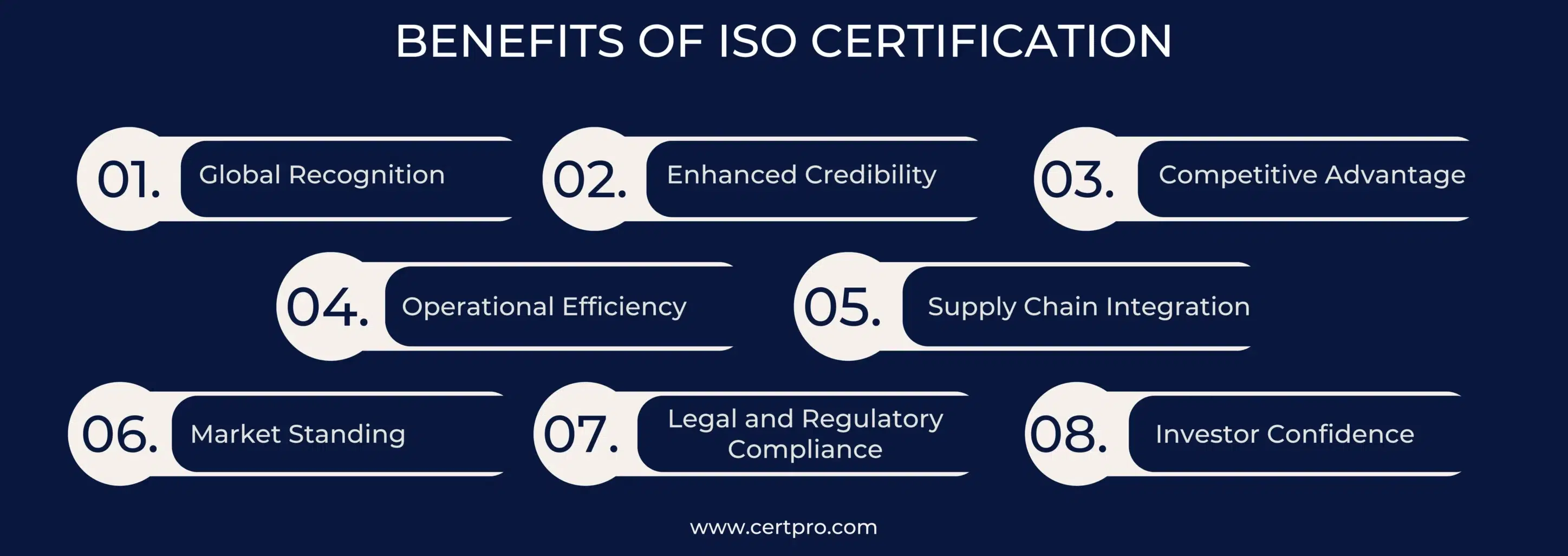
- Global Recognition: The international recognition of ISO certification creates opportunities for Estonian businesses, allowing them to engage in international trade and expand their market presence abroad. This acknowledgement provides Estonian companies with a notable competitive edge, enabling them to conduct business with authenticity and trustworthiness in foreign markets.
- Enhanced Credibility: It enhances the credibility and trust of clients, partners, and investors on both national and global scales.
- Competitive Advantage: ISO-certified companies surpass their competitors by demonstrating their commitment to excellence and quality.
- Operational Efficiency: Enhancing processes contributes to an overall improvement in operational effectiveness.
- Supply Chain Integration: ISO accreditation is essential for numerous international supply chains, providing opportunities for collaboration with partners abroad.
- Market Standing: Achieving ISO certification enhances a company’s market reputation, attracts more clients, and expands business opportunities.
- Legal and Regulatory Compliance: ISO certification simplifies compliance with both national and international laws.
- Investor Confidence: Showing dedication to best practices enhances investor confidence.
ISO certification in Estonia facilitates success in a competitive environment, fosters trust in international markets, upholds ethical and sustainable business practices, and enables ongoing operational improvement for long-term success.
INDUSTRIES THAT BENEFIT FROM ISO CERTIFICATION IN ESTONIA
Many Estonian companies understand that ISO certification is essential to success in a variety of industries because of all the benefits it offers. These certifications indicate a deep dedication to sustainability, quality, and security—beyond just being status symbols. For example, manufacturing companies that have received ISO 9001 accreditation experience observable advantages like improved product quality and increased operating efficiency. As a symbol of dependability, ISO accreditation gives businesses a competitive advantage in the market and increases customer satisfaction by promoting a culture of continuous improvement.
As data becomes more valuable, ISO 27001 certification becomes increasingly important in Estonia’s quickly changing IT sector. This accreditation enhances risk management and data security procedures, in addition to enabling the sector to benefit from technological breakthroughs while protecting sensitive data. Beyond commercial success, ISO 27001 certification plays a significant role in creating client confidence across multiple situations. The ISO/TS 16949 standard, designed specifically for the automotive industry, strengthens Estonia’s position as a leading global producer of premium automobiles by ensuring the robustness and safety of vehicles. Precision, compliance with the law, and strict adherence to standards raise the country’s healthcare system even further.
These certifications have an impact that goes beyond a single company; they support the development of environmentally friendly building technology and the promotion of sustainable construction practices. Businesses seek the assistance of ISO consultants in Estonia to guide them through the certification process and guarantee conformity to ISO standards. This commitment includes certifications that uphold Estonian privacy, data security, and healthcare regulations. A few of these that stand out are Estonia’s ISO 27001 Certification in Estonia, SOC 2 Certification in Estonia, GDPR Certification in Estonia, HIPAA Certification in Estonia, and PIPEDA Certification. Seeking ISO certification in Estonia demonstrates a commitment to wider societal and environmental well-being in addition to business success. The engagement of ISO consultants highlights the strategic direction businesses look for in order to successfully traverse the certification terrain.
FAQ
What is the significance of ISO certification in Estonia?
In Estonia, ISO certification holds paramount importance as it signifies a commitment to upholding global standards, promoting sustainability, and ensuring operational excellence across diverse industries.
How can a company in Estonia obtain ISO certification?
To obtain ISO certification in Estonia, a company must undergo processes such as certification preparation, applying ISO standards, internal audits, selecting a certification body, and concluding external audits.
What are the benefits of ISO certification in Estonia?
ISO certification in Estonia offers benefits such as enhanced market reputation, increased client trust, and expanded business opportunities. It also contributes to operational efficiency and compliance with international standards.
Why is ISO 9001 certification significant for manufacturing companies in Estonia?
ISO 9001 certification is crucial for manufacturing companies in Estonia as it leads to improved product quality, increased operational efficiency, and a competitive advantage in the market, fostering customer satisfaction.
How does ISO 27001 certification contribute to Estonia's IT sector?
ISO 27001 certification is essential for Estonia’s IT sector as it enhances data security, supports technological advancements, and ensures compliance with international standards, contributing to overall industry resilience.
IS SOC 2 THE SAME AS ISO 27001?
In today's digital landscape, ensuring the safeguarding of client data is paramount for businesses. Adhering to recognized compliance standards is vital to meeting this demand. ISO 27001 vs. SOC 2 represent two prominent benchmarks in the realm of data security with...
WHO NEEDS ISO 27001 CERTIFICATION AND WHY?
The esteemed ISO 27001 security framework is designed to evaluate the effectiveness of an organization's Information Security Management System (ISMS) in safeguarding its data. Obtaining ISO 27001 certification is a practical way for a corporation to demonstrate its...
IS ISO 27001 RISK ASSESSMENT VITAL FOR SECURITY MEASURES?
The ISO 27001 standard provides a framework for information security, highlighting the importance of a thorough risk assessment procedure. Organizations use the methodical and complex ISO 27001 risk assessment process to identify and assess information security...