
SOC 2 Certification in Auckland
SOC 2 Certification in Auckland encompasses two distinct report types, each serving different purposes within the attestation framework. Understanding the difference between a Type 1 and a Type 2 report is essential for Auckland organizations planning a SOC 2 audit engagement and for customers interpreting the resulting attestation documentation.
OUR CLIENTS










What Is SOC 2 Certification and What Does It Establish for Auckland Organizations?
SOC 2 Certification in Auckland is an independent attestation examination conducted by a Licensed CPA Firm under the American Institute of Certified Public Accountants (AICPA) Trust Services Criteria (TSC). The examination evaluates whether an organization’s internal controls — covering security, availability, processing integrity, confidentiality, and privacy — are suitably designed and, in the case of a Type 2 report, operating effectively over a defined observation period.
SOC 2 attestation does not constitute regulatory certification, automatic legal compliance, or a guarantee of information security outcomes. Instead, it produces an independently verified attestation report that documents control design and operational effectiveness as assessed by a Licensed CPA Firm under AICPA attestation standards.
For organizations operating in Auckland and across New Zealand, SOC 2 Certification has become a foundational requirement across multiple industries and procurement contexts. Technology companies in Wynyard Quarter, SaaS providers in the Auckland CBD, fintech businesses in Newmarket, cloud service providers on the North Shore, healthcare technology organizations, government technology suppliers, AI companies, e-commerce platforms, telecommunications providers, data center operators, agritech businesses, and logistics and supply-chain enterprises all increasingly encounter SOC 2 report requirements.
These requirements arise from enterprise customers, financial institutions, government procurement processes, and international partners. The SOC 2 attestation report serves as independently verified documentation that an organization’s control environment has been examined by a Licensed CPA Firm against defined Trust Services Criteria standards.
The AICPA’s Trust Services Criteria define five categories under which controls are assessed during a SOC 2 examination. Security — formally designated as the Common Criteria — is mandatory for every SOC 2 examination. The remaining four categories (availability, processing integrity, confidentiality, and privacy) are selected based on the organization’s specific service commitments, contractual obligations, and the nature of the data it processes and transmits.
Auckland organizations handling personal information must also consider the New Zealand Privacy Act 2020 and its Information Privacy Principles. However, SOC 2 attestation does not automatically establish compliance with New Zealand, Australian, United States, or any other jurisdiction’s privacy or data protection legislation. The scope of a SOC 2 examination is defined by the service organization’s system description, which specifies system boundaries, service commitments, and the Trust Services Criteria categories in scope.
CertPro CPA LLC is a Licensed CPA Firm that conducts independent SOC 2 examination and attestation engagements for organizations across Auckland and New Zealand. Engagements are performed under AICPA attestation standards — specifically AT-C Section 205 (Examination Engagements) and the AICPA’s Guide to Service Organization Controls Reporting.
CertPro’s role is strictly that of an independent examiner, evaluating management’s assertions regarding control design and operating effectiveness against the applicable Trust Services Criteria. The resulting SOC 2 attestation report is issued under the authority of a Licensed CPA Firm, providing the independent third-party verification that enterprise customers, financial institutions, healthcare organizations, and government procurement bodies in Auckland, across New Zealand, Australia, the United States, and international markets require when assessing the control environments of service organizations handling sensitive data.

ENQUIRE NOW
Related Resources
Related Services in Auckland
SOC 2 Type 1 and Type 2 Reports: Definitions and Distinctions
SOC 2 Certification in Auckland encompasses two distinct report types, each serving different purposes within the attestation framework. Understanding the difference between a Type 1 and a Type 2 report is essential for Auckland organizations planning a SOC 2 audit engagement and for customers interpreting the resulting attestation documentation.
SOC 2 Type 1 Report: Point-in-Time Design Assessment
A SOC 2 Type 1 report evaluates the suitability of an organization’s control design as of a specific date. The Licensed CPA Firm conducting the SOC 2 examination assesses whether the controls described in management’s system description are suitably designed to meet the applicable Trust Services Criteria at that point in time. A Type 1 report does not assess whether controls operated effectively over a period — it addresses design adequacy only.
For Auckland organizations that have recently established a control environment or are pursuing SOC 2 Certification for the first time, a Type 1 report provides a structured baseline. However, many enterprise customers, financial institutions, and government technology procurement processes in New Zealand and internationally require a Type 2 report, as it provides evidence of sustained control operation rather than design alone.
SOC 2 Type 2 Report: Operating Effectiveness Over an Observation Period
A SOC 2 Type 2 report evaluates both the suitability of control design and the operating effectiveness of controls over a defined observation period. The AICPA recommends a minimum observation period of six months, though twelve-month periods are common for established organizations and are typically required by enterprise customers conducting vendor security reviews.
During the SOC 2 examination, the Licensed CPA Firm tests controls through inspection of documentation, inquiry, observation, and re-performance to gather sufficient evidence of operating effectiveness. For Auckland SaaS companies, fintech organizations, healthcare technology providers, and cloud service operators, a Type 2 report carries substantially greater evidentiary weight in customer due diligence, financial sector procurement, government vendor assurance processes, and third-party risk management programs than a Type 1 report. The observation period and report issuance date are explicitly stated in the attestation report.
| Attribute | SOC 2 Type 1 | SOC 2 Type 2 |
|---|---|---|
| Assessment Scope | Control design as of a specific date | Control design and operating effectiveness over an observation period |
| Observation Period | None — point-in-time assessment | Minimum 6 months; typically 12 months |
| Evidence Collected | Design documentation and management assertions | Design documentation, operational evidence, and control testing |
| Primary Use | Baseline attestation for new control environments | Enterprise customer requirements, vendor assurance, and procurement |
| Report Authority | Licensed CPA Firm under AICPA attestation standards | Licensed CPA Firm under AICPA attestation standards |
Trust Services Criteria: The Framework Governing SOC 2 Examination
The Trust Services Criteria (TSC) issued by the AICPA form the evaluative framework for every SOC 2 examination. Each category within the TSC contains specific criteria, points of focus, and supplemental guidance that the Licensed CPA Firm applies when assessing a service organization’s control environment. Auckland organizations pursuing SOC 2 Certification must understand both the mandatory Common Criteria and the additional criteria applicable to their chosen scope categories.
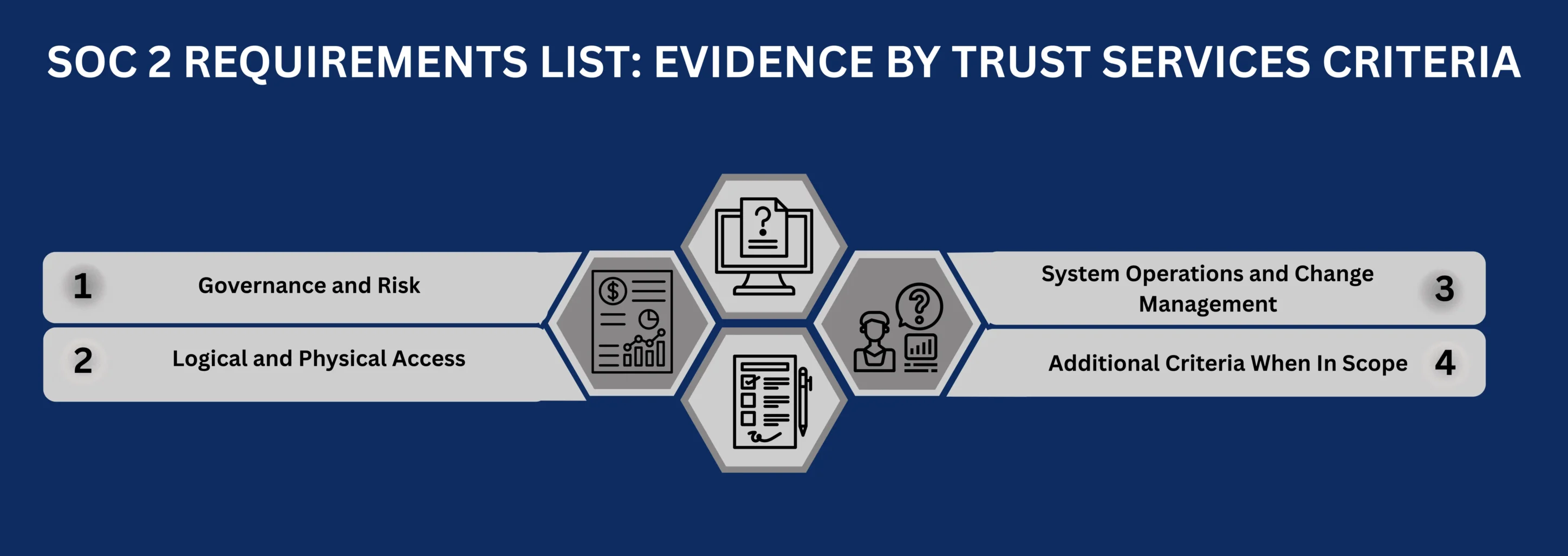
The Security category — designated as the Common Criteria (CC) — is mandatory in every SOC 2 examination, regardless of which additional Trust Services Criteria categories are included in scope. The Common Criteria are organized across nine control domains: control environment, communication and information, risk assessment, monitoring of controls, control activities, logical and physical access controls, system operations, change management, and risk mitigation.
Each domain contains numbered criteria. For example, CC6.1 governs logical access security software, infrastructure, and architectures, while CC7.2 addresses the detection and monitoring of system components. For Auckland technology organizations, fintech companies, cloud providers, and healthcare technology firms, the Common Criteria requirements address the core security controls that enterprise customers and government procurement bodies evaluate when reviewing vendor SOC 2 attestation reports as part of third-party risk management and vendor security review programs.
Beyond the Common Criteria, Auckland organizations may include availability, processing integrity, confidentiality, and privacy categories based on their service commitments and the nature of their operations.
The Availability category (A1) addresses whether systems are available for operation and use as committed or agreed — particularly relevant for data center operators, cloud infrastructure providers, and telecommunications organizations in the Auckland metropolitan area. The Processing Integrity category covers whether system processing is complete, valid, accurate, timely, and authorized, making it relevant for fintech payment processors and SaaS transactional platforms. The Confidentiality category addresses controls over information designated as confidential. The Privacy category — which references the AICPA’s Generally Accepted Privacy Principles — evaluates controls over the collection, use, retention, disclosure, and disposal of personal information. This provides documented control assessment relevant to New Zealand Privacy Act 2020 considerations, without establishing automatic regulatory compliance.
- ✓The Common Criteria: Security as the Mandatory Foundation
- ✓Additional Trust Services Criteria Categories
SOC 2 Audit Process in Auckland: Stages and Methodology
The SOC 2 audit process follows a structured sequence of stages governed by AICPA attestation standards. Each stage produces defined outputs that collectively form the SOC 2 examination record and support the Licensed CPA Firm’s attestation opinion. The following stages define a standard SOC 2 audit engagement as conducted by CertPro CPA LLC for Auckland organizations.
The SOC 2 examination begins with scope definition. During this stage, the service organization and the Licensed CPA Firm establish the system boundaries, applicable Trust Services Criteria categories, and the observation period for a Type 2 engagement. The service organization prepares a system description that identifies the services provided, system components (infrastructure, software, data, people, and procedures), and the control activities relevant to the selected Trust Services Criteria.
For Auckland SaaS companies, fintech organizations, and cloud service providers, the system description must accurately reflect the boundaries of the system under examination — including third-party service providers and subservice organizations that perform functions relevant to the criteria in scope. The Licensed CPA Firm reviews the system description for completeness and accuracy relative to the defined system boundaries before formal examination activities commence.
Following scope definition, the Licensed CPA Firm develops the audit program. This document specifies the control objectives, specific controls to be tested, testing procedures, sample sizes, and evidence types required for each criterion. SOC 2 examination evidence is collected through four primary procedures: inquiry of personnel with relevant knowledge, inspection of documentation and records, observation of control activities, and re-performance of control procedures.
For Auckland organizations undergoing a SOC 2 audit, evidence typically includes logical access records, change management logs, vulnerability assessment records, incident response documentation, configuration management records, encryption implementation evidence, backup and recovery test records, and vendor management documentation. The audit program is calibrated to the organization’s control environment, system complexity, and the observation period defined for the examination.
Control testing constitutes the substantive phase of the SOC 2 examination. The Licensed CPA Firm executes the audit program by testing selected controls against the applicable Trust Services Criteria, evaluating both design suitability and — for Type 2 engagements — operating effectiveness across the observation period.
Where testing identifies control deviations or exceptions, the examiner evaluates their nature, cause, frequency, and potential impact on the overall attestation opinion. The nonconformity review process determines whether identified exceptions are isolated occurrences or systemic deficiencies, and whether they affect the examiner’s conclusion regarding the criterion in question.
Following completion of control testing and nonconformity review, the Licensed CPA Firm formulates the attestation opinion — unqualified, qualified, adverse, or disclaimer — and issues the SOC 2 attestation report. The report includes management’s assertion, the system description, the examiner’s opinion, and for Type 2 reports, a description of tests performed and results obtained.
- Scope Definition: Establish system boundaries, applicable TSC categories, and observation period with the Licensed CPA Firm
- System Description Preparation: Document infrastructure, software, data, people, procedures, and relevant controls
- Audit Program Development: Determine control objectives, testing procedures, sample sizes, and evidence requirements
- Evidence Collection: Gather documentation, conduct inquiries, perform observations, and execute re-performance procedures
- Control Testing: Evaluate design suitability and operating effectiveness against applicable Trust Services Criteria
- Nonconformity Review: Assess identified exceptions for nature, frequency, and impact on the attestation opinion
- Attestation Opinion Formulation: Licensed CPA Firm determines opinion classification based on examination findings
- SOC 2 Report Issuance: Deliver completed attestation report including system description, management assertion, and examiner opinion
- ✓Scope Definition and System Description Review
- ✓Audit Program Determination and Evidence Collection
- ✓Control Testing, Nonconformity Review, and Attestation Issuance
SOC 2 Certification Requirements for Auckland Organizations
SOC 2 compliance in Auckland requires organizations to establish and maintain a defined set of controls across the selected Trust Services Criteria categories. Requirements for a SOC 2 examination span organizational, technical, and documentation dimensions. Auckland organizations undertaking a SOC 2 audit must address each of the following requirement areas as part of their control environment.
The AICPA’s Common Criteria require Auckland organizations to demonstrate a defined control environment that establishes the tone, governance structure, and accountability mechanisms supporting the Trust Services Criteria. Specific requirements include:
A defined organizational structure with assigned information security responsibilities; documented risk assessment processes that identify threats and vulnerabilities relevant to the system in scope; a functioning monitoring program that detects and addresses control deficiencies over time; and clearly defined policies governing logical access, change management, system operations, and incident response.
The control environment must be supported by evidence that management communicates security objectives and accountability expectations to personnel. For Auckland organizations in financial services, healthcare technology, and government technology sectors, the control environment documentation must also address how information security governance aligns with sector-specific expectations — including third-party risk management requirements from financial services regulators and government procurement standards.
Technical controls constitute a significant component of SOC 2 examination requirements. Under the Common Criteria, Auckland organizations must demonstrate implemented controls across logical access management — including multi-factor authentication for privileged access, role-based access provisioning and deprovisioning procedures, and periodic access reviews.
System operations requirements address monitoring for anomalous activity, incident detection and response procedures, and vulnerability management processes. Change management controls must document authorization procedures, testing requirements, and rollback capabilities for system changes. Encryption requirements address data in transit and at rest for confidential information.
For organizations including the Availability category in their SOC 2 scope, technical requirements extend to capacity planning, backup and recovery procedures with documented and tested recovery time objectives, and redundancy configurations. Cloud service providers and data center operators across Auckland typically address availability controls with particular depth, given the infrastructure-dependent nature of their services.
Documentation requirements for SOC 2 compliance Auckland engagements are extensive. The Licensed CPA Firm’s examination depends on documentary evidence to support conclusions about control design and operating effectiveness. Required documentation includes formal information security policies, procedures for each in-scope control activity, risk assessment records, system architecture documentation, access control matrices, change management records, incident response logs, vendor management documentation for subservice organizations, and monitoring reports demonstrating ongoing control oversight.
For Type 2 examinations, documentation must span the full observation period — typically twelve months for Auckland organizations seeking SOC 2 attestation for enterprise customer procurement purposes. The completeness and contemporaneity of documentation directly affects the Licensed CPA Firm’s ability to form and support an attestation opinion, making systematic records management a foundational operational requirement for organizations undergoing SOC 2 Certification in Auckland.
- ✓Organizational and Control Environment Requirements
- ✓Technical Control Requirements
- ✓Documentation and Evidence Requirements
Benefits of SOC 2 Certification for Auckland-Based Organizations
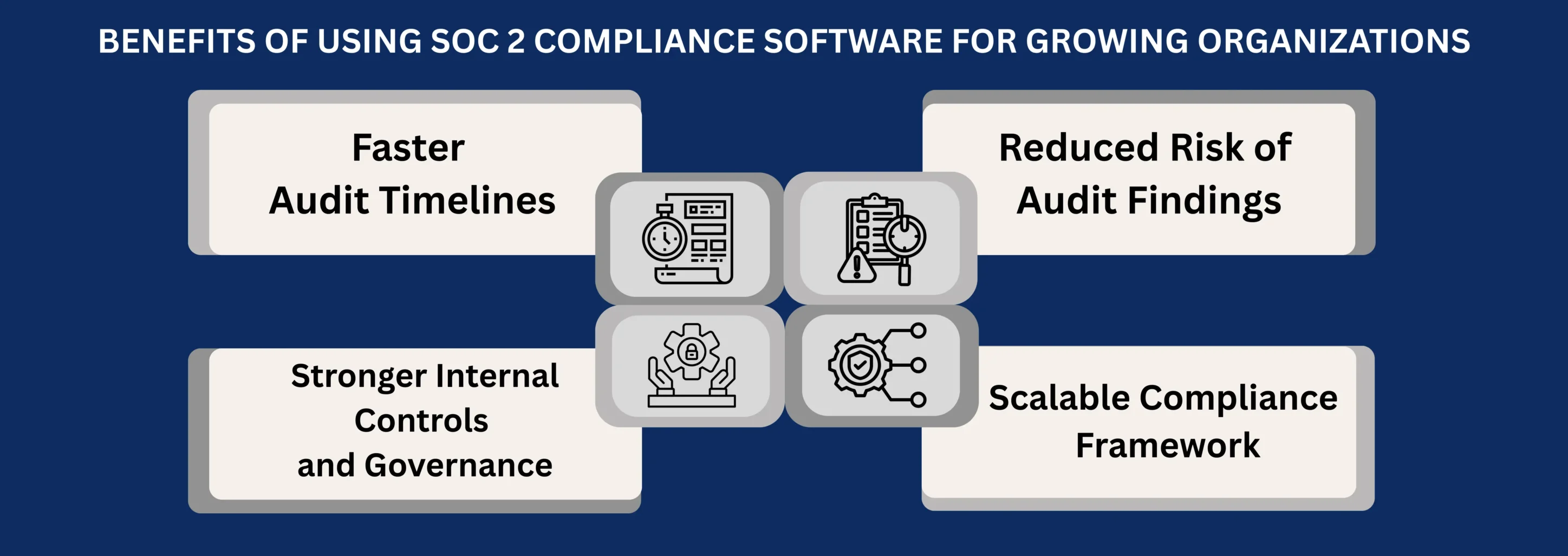
SOC 2 Certification in Auckland delivers independently verified documentation of control effectiveness that carries direct commercial, operational, and reputational value across multiple dimensions. The following benefits apply broadly to Auckland organizations across technology, financial services, healthcare, government technology supply, and related sectors.
SOC 2 Certification is required by a significant proportion of enterprise customers and financial institutions when evaluating technology vendors, cloud service providers, and SaaS organizations for procurement. For Auckland SaaS companies, fintech organizations, and cloud infrastructure providers seeking contracts with New Zealand financial institutions, Australian enterprise customers, United States technology companies, or international organizations subject to third-party risk management requirements, the SOC 2 attestation report provides independently verified control documentation required to advance through vendor security review processes.
Organizations without a current SOC 2 attestation report frequently encounter procurement delays, exclusion from request-for-proposal processes, or heightened customer due diligence requirements that extend sales cycles. Obtaining SOC 2 Certification in Auckland resolves this barrier by providing a standardized, AICPA-governed attestation report recognized across enterprise vendor security review programs globally.
Third-party risk management programs operated by financial institutions, government agencies, and large enterprises in New Zealand and internationally increasingly require SOC 2 attestation reports from technology vendors and service providers as a condition of approved vendor status. The SOC 2 attestation report documents the results of an independent examination by a Licensed CPA Firm, providing vendor assurance evidence that satisfies the independent verification requirement inherent in robust third-party risk management frameworks.
For Auckland organizations supplying technology services to New Zealand government agencies, the SOC 2 report provides structured evidence relevant to information security and data protection requirements under government procurement and vendor assurance standards. Health technology organizations operating under the Health Information Privacy Code 2020 and organizations subject to financial sector oversight benefit from the structured control documentation the SOC 2 examination produces — though the attestation does not establish automatic compliance with those regulatory frameworks.
The SOC 2 examination process produces findings and observations that give management an independently assessed view of control design and operating effectiveness across the Trust Services Criteria in scope. Organizations that undergo annual SOC 2 audit cycles in Auckland typically develop more systematic control monitoring practices, more rigorous change management disciplines, and more consistently maintained documentation as a direct result of examination requirements.
The observation period structure of a Type 2 engagement requires controls to operate consistently throughout the year, which encourages practices oriented toward continuous control effectiveness rather than point-in-time preparation. The internal governance benefits of sustained SOC 2 compliance include clearer accountability structures, more structured vendor management practices, and improved incident detection and response capabilities — outcomes that benefit the organization’s overall information security posture independent of the commercial value of the attestation report itself.
- ✓Provides independently verified attestation documentation for enterprise customer and government procurement processes
- ✓Satisfies third-party risk management and vendor assurance requirements from financial institutions and enterprise customers
- ✓Establishes a documented control baseline assessed against AICPA Trust Services Criteria
- ✓Supports market access to New Zealand, Australian, United States, and international enterprise customer segments
- ✓Produces structured SOC 2 examination findings that inform internal control improvement activities
- ✓Demonstrates organizational commitment to information security governance and data protection to stakeholders
- ✓Enables annual SOC 2 audit cycles that maintain current vendor assurance documentation for ongoing procurement relationships
- ✓Differentiates Auckland technology organizations in competitive procurement processes where SOC 2 Certification is a stated requirement
- ✓Enterprise Customer Requirements and Procurement Qualification
- ✓Third-Party Risk Management and Vendor Assurance
- ✓Operational Control Improvement and Internal Governance
SOC 2 Certification for Auckland’s Key Industry Sectors
SOC 2 Certification in Auckland is pursued across a diverse range of industries and organizational types. The relevance and application of SOC 2 attestation varies by sector. Different Trust Services Criteria categories and evidence requirements take priority depending on the nature of services provided and the regulatory and commercial environment in which the organization operates.
SaaS, Cloud, Fintech, and Technology Organizations
Auckland fintech organizations, SaaS providers, and cloud service companies represent the largest segment pursuing SOC 2 Certification in Auckland. Technology companies concentrated in Wynyard Quarter, the Auckland CBD, and the North Shore frequently encounter SOC 2 report requirements from enterprise customers in financial services, healthcare, government, and telecommunications sectors.
For Auckland SaaS companies, the Security and Availability criteria are typically the minimum scope, with Confidentiality added where the platform processes commercially sensitive customer data. Fintech organizations processing payment data or providing financial infrastructure services typically include Processing Integrity to provide customers with documented assurance over transaction accuracy and completeness. Financial services technology providers — including banking technology suppliers, insurance technology organizations, and investment platform operators — routinely require SOC 2 Type 2 reports to satisfy financial sector vendor assurance and third-party risk management requirements from regulated financial institutions in New Zealand and Australia.
Healthcare Technology, Government, and Critical Infrastructure Sectors
Healthcare technology organizations operating in Auckland — including health information system providers, telehealth platforms, and health data analytics companies — increasingly pursue SOC 2 Certification as evidence of control effectiveness over systems processing health information. The Privacy category under the Trust Services Criteria is particularly relevant for healthcare technology providers, as it addresses controls over the collection, use, retention, disclosure, and disposal of personal information.
While SOC 2 attestation does not establish compliance with the Health Information Privacy Code 2020, the examination produces documented control evidence that is relevant to organizational data protection obligations. Government technology suppliers, AI companies handling government datasets, and cybersecurity firms providing managed services to public sector organizations in Auckland also pursue SOC 2 Certification to satisfy New Zealand government procurement vendor assurance requirements. Data center operators, agritech technology platforms, logistics and supply-chain technology providers, and telecommunications organizations across the Auckland metropolitan area similarly rely on SOC 2 attestation reports to demonstrate control effectiveness to enterprise customers and regulated sector clients.
SOC 2 vs. ISO 27001: Selecting the Appropriate Framework for Auckland Organizations
Auckland organizations frequently evaluate SOC 2 Certification alongside ISO 27001 certification when determining which information security attestation or certification framework best serves their market requirements, customer base, and operational context. The two frameworks differ in fundamental structure, scope, and the nature of the assurance they provide.
Structural and Scope Differences Between SOC 2 and ISO 27001
SOC 2 is an attestation examination conducted by a Licensed CPA Firm under AICPA standards. It produces a report that describes the specific controls tested, the procedures applied, and the results obtained for the defined observation period. The SOC 2 examination tests specific controls against the Trust Services Criteria based on the organization’s service commitments and system boundaries.
ISO 27001 is a management system standard issued by the International Organization for Standardization. It results in a certificate of conformity issued by an accredited certification body after an audit against the standard’s requirements. ISO 27001 addresses information security management system (ISMS) structure, risk treatment processes, and Annex A controls across the organization’s defined scope.
SOC 2 attestation is predominantly required by United States, Canadian, and increasingly Australian and New Zealand enterprise customers, financial institutions, and technology procurement processes. ISO 27001 carries broader global recognition — particularly in Europe, the Middle East, Asia-Pacific government, and international enterprise procurement contexts outside the North American technology sector.
Choosing Between SOC 2 and ISO 27001 for Auckland Market Requirements
Auckland organizations should base framework selection primarily on customer requirements and target market characteristics. Organizations primarily serving United States enterprise customers, North American technology companies, or financial institutions with North American procurement standards should prioritize SOC 2 attestation. Organizations with significant European, Middle Eastern, or Asia-Pacific government customer bases — or those pursuing global enterprise market access — may find ISO 27001 certification more broadly recognized.
Many Auckland technology organizations, particularly those with mixed international customer portfolios, pursue both SOC 2 attestation and ISO 27001 certification concurrently or sequentially. The control environments required by each framework have substantial overlap, and the decision is not mutually exclusive. Organizations operating across multiple international markets frequently maintain both attestation and certification documents as part of their vendor assurance portfolio.
| Dimension | SOC 2 Attestation | ISO 27001 Certification |
|---|---|---|
| Governing Body | AICPA — Trust Services Criteria | ISO/IEC — International Standard |
| Report Type | Attestation report by Licensed CPA Firm | Certificate of conformity by accredited body |
| Scope Basis | Service commitments and system boundaries | Defined ISMS scope across the organization |
| Primary Market Recognition | United States, Canada, New Zealand, Australia | Global — Europe, APAC, Middle East, government |
| Observation Period | Defined period (Type 2, minimum 6 months) | Annual surveillance audits, 3-year recertification cycle |
Report Validity, Annual Audit Cycles, and Ongoing SOC 2 Compliance
SOC 2 attestation reports are time-bounded documents. Understanding report validity periods, annual SOC 2 audit cycles, and ongoing control maintenance requirements is essential for Auckland organizations managing SOC 2 compliance as a sustained business practice rather than a one-time engagement.
SOC 2 Report Validity and Currency Requirements
A SOC 2 attestation report does not carry perpetual validity. Enterprise customers, financial institutions, and government procurement bodies typically require that SOC 2 reports be current — generally issued within the preceding twelve months — to satisfy vendor assurance and third-party risk management requirements.
A SOC 2 Type 2 report covering a twelve-month observation period ending in a given month provides current assurance for that period only. As the report ages beyond twelve months, customers may request an updated bridge letter or may require a new attestation report before renewing vendor-approved status. Auckland organizations maintaining active enterprise customer relationships, participating in ongoing government contracts, or operating in regulated sectors must maintain a continuous annual SOC 2 audit cycle to ensure attestation documentation remains current throughout the customer relationship lifecycle.
Management Responsibilities for Ongoing SOC 2 Compliance
Ongoing SOC 2 compliance between annual examination cycles requires management to maintain the control activities, documentation practices, monitoring programs, and operational procedures that formed the basis of the prior examination. Management’s responsibilities include ensuring that access reviews are performed on schedule, change management procedures are followed consistently, incident response processes are executed and documented for all relevant events, vendor management activities are conducted for subservice organizations, and the system description remains accurate relative to any system changes occurring during the year.
For Auckland organizations, changes to system architecture, material additions of new subservice organizations, significant modifications to access control procedures, or changes in the nature of services provided may require assessment of their impact on the prior SOC 2 report’s representations. Such changes may also affect the scope or timing of the next examination cycle. The Licensed CPA Firm conducting the annual SOC 2 audit assesses control continuity across the observation period, making sustained management attention to control operation an examination requirement rather than a discretionary practice.
FAQ
▶
What is SOC 2 Certification and who conducts it in Auckland?
▶
How long does a SOC 2 audit take for an Auckland organization?
▶
What is the difference between SOC 2 Type 1 and Type 2 reports?
▶
Which Trust Services Criteria categories should Auckland organizations include in their SOC 2 scope?
▶
Does SOC 2 attestation establish compliance with the New Zealand Privacy Act 2020?
▶
How frequently should Auckland organizations undergo a SOC 2 audit?
▶
What types of Auckland organizations typically pursue SOC 2 Certification?
▶
What is the SOC 2 examination and how does it differ from SOC 2 compliance?
SOC 1 VS SOC 2: WHICH REPORT YOUR CUSTOMERS ACTUALLY ASK FOR
If you sell SaaS or provide outsourced services, you have likely been asked for a SOC report. However, the follow-up question is rarely easy to answer…

AICPA Issues New Guidance for Peer Reviewers Evaluating SOC 2 Engagements
AICPA SOC 2 guidance has been issued to help peer reviewers identify quality risks associated with SOC 2 engagements as the use of compliance automati…
SOC 2 Certified: What Does It Mean for Your Business
For companies that handle sensitive data or run cloud-based services, the question “Can you provide your SOC 2 report?” carries enormous weight. Yet, …
Get In Touch
have a question? let us get back to you.