
SOC 2 Certification in Indonesia
SOC 2 audits are structured around five Trust Services Criteria defined by the AICPA. Security is the mandatory baseline criterion included in every SOC 2 audit. The remaining four criteria are incorporated based on the organization’s audit scope, service commitments, and system description. Each criterion governs a distinct domain of organizational control and is evaluated through documented evidence, interviews, and control testing performed by CertPro’s audit team.
OUR CLIENTS




What Is SOC 2 Certification in Indonesia?
SOC 2 Certification in Indonesia is a formal attestation standard developed by the American Institute of Certified Public Accountants (AICPA). It evaluates the internal controls of service organizations against five Trust Services Criteria: Security, Availability, Processing Integrity, Confidentiality, and Privacy. A SOC 2 report is issued exclusively by a Licensed CPA Firm following an independent audit of the organization’s systems and control environment. CertPro, operating as a Licensed CPA Firm, conducts SOC 2 audits and issues attestation reports for organizations throughout Indonesia and the broader Southeast Asian region.
Indonesia’s digital economy has expanded rapidly over the past decade, positioning the country as one of Southeast Asia’s most active technology markets. With a population exceeding 270 million and a growing ecosystem of unicorn companies, fintech platforms, SaaS providers, cloud infrastructure operators, and e-commerce enterprises, demand for internationally recognized security attestations has intensified. SOC 2 Certification in Indonesia serves as the primary mechanism through which Indonesian technology organizations demonstrate security compliance to enterprise clients, international partners, and global procurement teams that require third-party verification of data handling practices.
Definition and Governing Body
SOC 2, which stands for System and Organization Controls 2, is a voluntary attestation framework governed by the AICPA. Unlike ISO 27001 — which results in a certificate issued by an accredited certification body — a SOC 2 report is a formal attestation document produced by a Licensed CPA Firm after an independent audit of an organization’s systems and internal controls. The report does not certify compliance in the traditional regulatory sense. Instead, it provides independent assurance that the audited controls meet the defined Trust Services Criteria for the specified scope and time period.
CertPro is a Licensed CPA Firm authorized to conduct SOC 2 audits and issue SOC 2 attestation reports. Organizations in Jakarta, Surabaya, Bali, Bandung, and across Indonesia engage CertPro for SOC 2 audit execution and formal report issuance. The audit process examines control design, operational effectiveness, and adherence to AICPA Trust Services Criteria within the defined audit scope. CertPro’s deliverables — SOC 2 Type 1 and SOC 2 Type 2 attestation reports — serve as formal third-party evidence for enterprise clients, international business partners, and regulatory bodies requiring documented security assurance.
Trust Services Criteria — Full Breakdown
SOC 2 audits are structured around five Trust Services Criteria defined by the AICPA. Security is the mandatory baseline criterion included in every SOC 2 audit. The remaining four criteria are incorporated based on the organization’s audit scope, service commitments, and system description. Each criterion governs a distinct domain of organizational control and is evaluated through documented evidence, interviews, and control testing performed by CertPro’s audit team.
| Trust Services Criterion | Definition | Inclusion |
|---|---|---|
| Security | The system is protected against unauthorized access, both logical and physical, to meet the entity’s objectives. | Mandatory |
| Availability | The system is available for operation and use as committed or agreed to meet the entity’s objectives. | Optional |
| Processing Integrity | System processing is complete, valid, accurate, timely, and authorized to meet the entity’s objectives. | Optional |
| Confidentiality | Information designated as confidential is protected as committed or agreed to meet the entity’s objectives. | Optional |
| Privacy | Personal information is collected, used, retained, disclosed, and disposed of in conformity with the entity’s commitments and criteria. | Optional |
For Indonesian organizations operating in sectors such as financial technology, healthcare data management, cloud storage, and enterprise SaaS, the selection of applicable Trust Services Criteria is determined during the scoping phase of the SOC 2 audit. A fintech platform handling payment data may include Security, Confidentiality, and Availability. A healthtech company managing patient records may additionally include Privacy. CertPro’s audit team determines the applicable criteria based on the organization’s system description, service commitments, and contractual obligations with its clients — all established prior to audit commencement.

SOC 2 Type 1 vs. SOC 2 Type 2 in Indonesia
SOC 2 Certification in Indonesia is available in two distinct report types: Type 1 and Type 2. Understanding the difference between these two audit structures is essential for Indonesian organizations planning their attestation strategy. Each type serves different organizational needs, timelines, and client requirements. CertPro issues both SOC 2 Type 1 and SOC 2 Type 2 reports following completion of the respective audit program.
SOC 2 Type 1 — Point-in-Time Assessment
A SOC 2 Type 1 report evaluates the design of an organization’s controls at a specific point in time. The auditor assesses whether the controls described in the organization’s system description are suitably designed to meet the applicable Trust Services Criteria as of the audit date. The SOC 2 Type 1 certification pathway in Indonesia is appropriate for organizations that have recently implemented controls and need to demonstrate control design to clients or partners before completing a full Type 2 audit period. The Type 1 report does not test whether controls operated effectively over time — it confirms that the controls, as described, are appropriately structured to address the identified risks.
Indonesian startups, newly established cloud service providers, and SaaS companies entering enterprise markets for the first time often begin with a SOC 2 Type 1 audit to establish a formal baseline of control design documentation. This report provides immediate, independently verified evidence of security controls to prospective clients who require third-party assurance as part of their vendor qualification process. CertPro conducts SOC 2 Type 1 audits for Indonesian organizations through a structured fieldwork process, examining control design evidence and issuing a formal attestation report upon completion.
SOC 2 Type 2 — Operating Effectiveness Over Time
A SOC 2 Type 2 audit in Indonesia evaluates both the design and the operational effectiveness of controls over a defined audit period — typically six to twelve months. The auditor tests whether the controls described in the system description not only exist and are suitably designed, but also operated consistently and effectively throughout the observation period. The SOC 2 Type 2 report is the more rigorous and broadly recognized attestation, particularly among enterprise clients in the United States, European Union, and other markets with mature vendor security requirements.
For Indonesian organizations with established client bases, active B2B contracts with international enterprises, or procurement requirements from US-based or EU-based clients, the SOC 2 Type 2 report is the expected standard. A SOC 2 Type 2 audit engagement conducted by CertPro requires the organization to maintain consistent control operations throughout the audit window, with CertPro’s auditors sampling control evidence across the full observation period. Upon completion of fieldwork and review, CertPro issues the SOC 2 Type 2 attestation report, which remains valid for twelve months before renewal is required.
| Attribute | SOC 2 Type 1 | SOC 2 Type 2 |
|---|---|---|
| Evaluation Scope | Control design at a point in time | Control design and operating effectiveness over 6–12 months |
| Audit Duration | Shorter — weeks to a few months | Longer — minimum 6-month observation period |
| Best For | New organizations establishing controls | Established organizations with active enterprise clients |
| Report Validity | Single point-in-time attestation | Annual renewal cycle required |
| Market Recognition | Accepted as initial evidence | Broadly required by US and EU enterprise clients |
Who Needs SOC 2 Certification in Indonesia
SOC 2 Certification for Indonesian companies applies most directly to service organizations that store, process, or transmit customer data on behalf of other businesses. Indonesia’s technology sector encompasses a wide range of organizations that handle sensitive client data and are increasingly subject to vendor due diligence requirements from international buyers, enterprise clients, and regulated industries. The following categories represent the primary audience for SOC 2 attestation in Indonesia.
Technology and SaaS Providers
SOC 2 compliance for SaaS companies in Indonesia represents one of the most active demand segments. Indonesian SaaS providers that sell software subscriptions to enterprise clients in the United States, Australia, Singapore, or the European Union frequently receive requests for SOC 2 reports as a prerequisite for contract execution. Enterprise procurement teams use the SOC 2 Type 2 report to evaluate vendor security posture as part of third-party risk management programs. Without a current SOC 2 report, Indonesian SaaS companies may be disqualified from enterprise sales opportunities or required to complete extensive, time-consuming security questionnaires for each new client engagement.
Indonesia’s SaaS ecosystem has grown substantially, with companies developing enterprise HR platforms, ERP systems, payroll management tools, project management software, and customer data platforms. These products handle payroll records, employee data, financial transactions, and customer personally identifiable information (PII) on behalf of their business clients. The SOC 2 audit examines how these organizations protect that data across the Trust Services Criteria applicable to their system scope. CertPro conducts SOC 2 audits for Indonesian SaaS providers and issues attestation reports that satisfy enterprise client requirements across international markets.
Fintech and Financial Services Organizations
SOC 2 Certification demand from Indonesia’s fintech sector has increased alongside the growth of the country’s financial technology industry. Indonesia hosts one of Southeast Asia’s most active fintech ecosystems, with licensed payment processors, digital lending platforms, insurance technology companies, and open banking infrastructure providers operating at scale. These organizations process financial transactions, manage payment credentials, store account data, and handle credit and insurance records for millions of Indonesian consumers and businesses. International financial institution partners, payment network operators, and enterprise clients serving these fintech companies require SOC 2 attestation as evidence of security control adequacy.
Indonesian financial services organizations similarly benefit from SOC 2 attestation when serving institutional clients, regional banks, or global financial services groups that conduct formal vendor due diligence. A SOC 2 Type 2 report produced by CertPro as a Licensed CPA Firm provides the institutional-grade documentation required by financial services procurement and compliance teams. The report demonstrates that the Indonesian financial services organization’s security controls operated effectively over the full audit period — addressing both the design and operational dimensions of the control environment.
Cloud Service Providers and Data Centers
Indonesia has seen significant investment in data center infrastructure, driven by regulatory data localization requirements under the Government Regulation on Electronic System and Transaction Operations (PP 71/2019) and the Personal Data Protection Law. Cloud service providers operating data centers in Jakarta, Surabaya, Batam, and other Indonesian cities provide infrastructure services to both domestic and international clients. These cloud providers and data center operators require SOC 2 attestation to satisfy enterprise client vendor assessment requirements and to demonstrate the security, availability, and confidentiality controls governing the physical and logical infrastructure they operate on behalf of client organizations.
- ✓SaaS providers serving US, EU, or APAC enterprise clients
- ✓Cloud infrastructure and Platform-as-a-Service (PaaS) operators
- ✓Data center operators and colocation facility providers
- ✓Fintech platforms processing payment and lending data
- ✓Healthtech companies managing patient and clinical records
- ✓E-commerce platforms handling consumer payment and identity data
- ✓HR technology platforms processing payroll and employee records
- ✓Managed security service providers (MSSPs) serving enterprise clients
- ✓B2B software vendors with international enterprise sales pipelines
- ✓Digital banking and insurance technology providers
SOC 2 Certification Requirements in Indonesia
SOC 2 Certification requirements are defined by the AICPA Trust Services Criteria and structured by the audit scope established at the outset of the engagement. There is no single prescriptive list of controls that every organization must implement. Instead, the organization defines its system, identifies the applicable Trust Services Criteria, and documents the controls it has placed in operation to address those criteria. CertPro’s audit team then evaluates whether those controls are suitably designed (Type 1) and operating effectively (Type 2) against the AICPA standards.
Before initiating a SOC 2 audit, Indonesian organizations must establish a defined control environment that addresses the applicable Trust Services Criteria. This includes documented security policies, formally assigned roles and responsibilities for control ownership, access management procedures, incident response protocols, change management processes, and risk assessment documentation. The organization must also be able to produce evidence that these controls are operational — including system-generated logs, configuration records, access review records, training completion records, and vendor management documentation.
The organization is required to produce a System Description — a formal narrative that describes the system being audited, the services provided, the infrastructure components, the data flows, and the controls in place. The System Description is a critical document in the SOC 2 audit process because it defines the boundary and scope of the audit. CertPro’s audit team reviews the System Description during the scoping and fieldwork phases to ensure that the controls described are consistent with the actual control environment observed during the audit.
SOC 2 compliance requires organizations to maintain a documented and operational information security management environment. Technical requirements vary based on the Trust Services Criteria included in the audit scope, but typically encompass logical access controls, encryption standards, network security configurations, monitoring and alerting systems, backup and recovery procedures, physical access controls, and software development lifecycle security controls. All documentation must be current, version-controlled, and accessible to the audit team during fieldwork.
- Define the system scope and boundaries subject to the SOC 2 audit
- Identify applicable Trust Services Criteria based on service commitments and data types processed
- Document the System Description including infrastructure, software, data, people, and processes
- Implement and document information security policies aligned to applicable Trust Services Criteria
- Establish access management controls including user provisioning, de-provisioning, and periodic access reviews
- Deploy monitoring, logging, and alerting systems across in-scope infrastructure
- Implement incident response procedures and document incident management records
- Establish change management controls for system and configuration changes
- Conduct formal risk assessment and document the risk treatment process
- Maintain vendor management documentation for subservice organizations within scope
- Collect and retain control evidence throughout the audit observation period (for Type 2)
- Engage CertPro as the Licensed CPA Firm to execute the SOC 2 audit and issue the attestation report

- ✓Organizational Prerequisites
- ✓Technical and Documentation Requirements
SOC 2 Audit Process — Step-by-Step
The SOC 2 audit process conducted by CertPro follows a structured, sequential program that progresses from initial scope definition through final attestation report issuance. Each phase of the audit is performed by CertPro’s audit team in accordance with AICPA attestation standards. Indonesian organizations engaging CertPro for SOC 2 attestation in Indonesia proceed through the following defined audit stages.
The SOC 2 audit begins with scope definition, during which CertPro’s audit team and the organization jointly establish the system boundaries, applicable Trust Services Criteria, and audit period. The System Description is reviewed and finalized. CertPro determines the audit program — including the specific controls to be tested, the evidence types required, and the methodology for evaluating control design and operational effectiveness. For SOC 2 Type 2 audits, the observation period start date is established at this stage, initiating the control operation window that will be evaluated during fieldwork.
During the fieldwork phase, CertPro’s auditors collect and examine evidence supporting the organization’s control assertions. Evidence types include system configuration screenshots, access control logs, change management tickets, training completion records, vulnerability scan reports, penetration testing documentation, incident logs, and business continuity test results. Auditors conduct structured interviews with control owners to verify that documented procedures are understood and consistently followed by responsible personnel. For a SOC 2 Type 2 audit in Indonesia, the fieldwork phase spans the full observation period, with evidence sampled from across the six- or twelve-month window as defined in the audit program.
CertPro’s audit team applies professional skepticism throughout the evidence collection process, evaluating both the existence of controls and the consistency of their operation. Where evidence gaps or inconsistencies are identified, CertPro’s auditors document findings and assess their significance against the applicable Trust Services Criteria. Identified deficiencies are categorized as exceptions within the audit report, with management responses included in the final attestation document.
Following fieldwork completion, CertPro’s audit team conducts a comprehensive review of all findings, exception documentation, and control testing results. Nonconformities identified during the audit are assessed for materiality and their impact on the overall opinion. CertPro issues its certification decision based on the completeness and quality of the audit evidence reviewed. The outcome is reflected in the auditor’s opinion section of the SOC 2 attestation report — which may be an unqualified opinion (controls are suitably designed and operating effectively), a qualified opinion (certain exceptions noted with limited impact), or an adverse opinion (material deficiencies identified).
CertPro issues the formal SOC 2 attestation report upon completion of the review and certification decision process. The SOC 2 attestation report for Indonesian organizations includes the auditor’s opinion, the System Description, the description of controls tested, the test results for each control, and any identified exceptions with management responses. The report is delivered in a format suitable for sharing with clients, partners, and other authorized stakeholders under confidentiality agreements — as SOC 2 reports are not intended for unrestricted public distribution.
SOC 2 Type 2 reports cover a defined audit period and must be renewed annually to maintain current attestation status. Organizations that allow their SOC 2 report to lapse — meaning more than twelve months have passed since the end of the covered audit period — will be required to complete a new full audit cycle before a current report can be issued. CertPro supports Indonesian organizations through recertification audit cycles, maintaining continuity of attestation coverage aligned to client and partner expectations.
| Audit Stage | Activity | Typical Duration |
|---|---|---|
| Scope Definition | System description review, criteria selection, audit program development | 2–4 weeks |
| Observation Period (Type 2) | Control operation window during which evidence is accumulated | 6–12 months |
| Fieldwork | Evidence collection, control testing, interviews | 4–8 weeks |
| Review and Decision | Finding assessment, nonconformity review, opinion determination | 2–4 weeks |
| Report Issuance | Final attestation report drafted, reviewed, and delivered | 1–2 weeks |
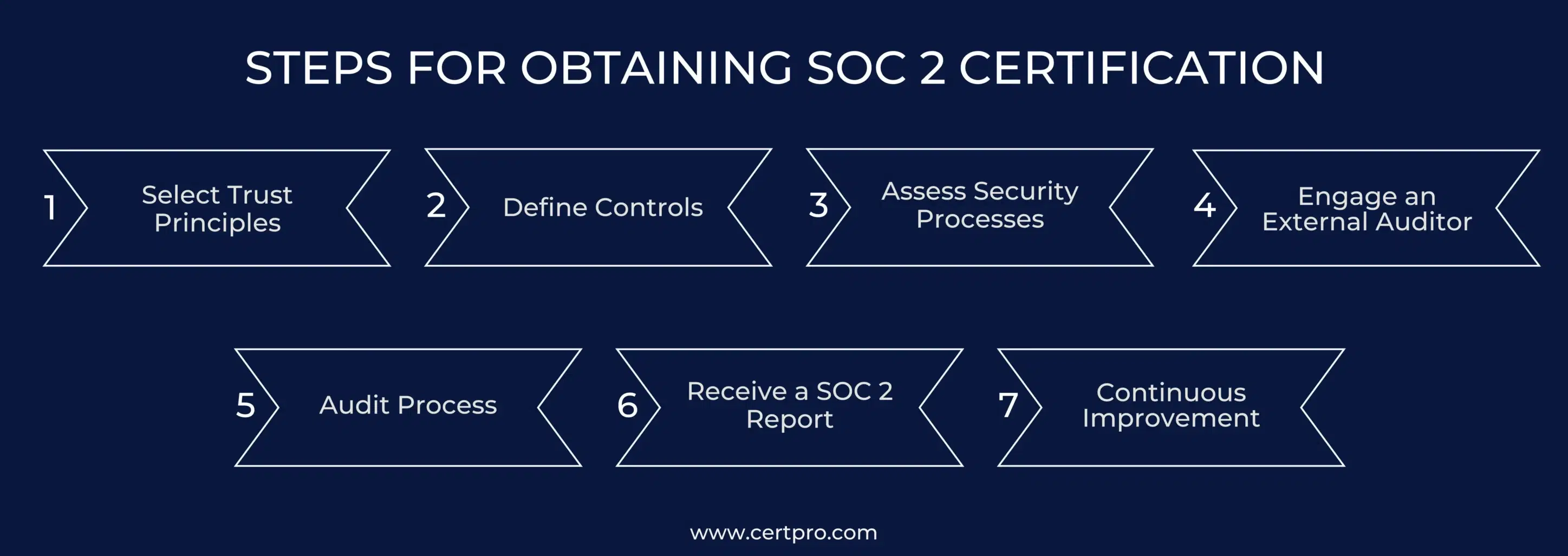
- ✓Stage 1 — Scope Definition and Audit Program Determination
- ✓Stage 2 — Evidence Collection and Fieldwork
- ✓Stage 3 — Nonconformity Review and Certification Decision
- ✓Stage 4 — Attestation Report Issuance and Recertification
Indonesia Regulatory Alignment — PDP Law and SOC 2 Compliance
Indonesia enacted the Personal Data Protection (PDP) Law (Law No. 27 of 2022) as the country’s primary legislative framework governing the collection, processing, storage, and disclosure of personal data. The PDP Law establishes obligations for personal data controllers and processors operating in Indonesia, including requirements related to data security, breach notification, data subject rights, and cross-border data transfer restrictions. The Ministry of Communication and Informatics (Kominfo) oversees implementation and enforcement of the PDP Law across Indonesian organizations.
How SOC 2 Complements the PDP Law
SOC 2 compliance does not replace or substitute for obligations under Indonesia’s PDP Law. These are distinct frameworks operating at different levels: the PDP Law is a binding legal regulation enforceable by Indonesian authorities, while SOC 2 is a voluntary international attestation standard issued by a Licensed CPA Firm. However, the Trust Services Criteria evaluated in a SOC 2 audit — particularly Security, Confidentiality, and Privacy — address security control requirements that directly support compliance with the PDP Law’s technical and organizational security obligations. Organizations that have completed a SOC 2 audit hold documented, independently verified security controls that address many of the same technical safeguarding requirements mandated by the PDP Law.
Specifically, the Privacy Trust Services Criterion within SOC 2 evaluates how personal information is collected, used, retained, disclosed, and disposed of — addressing data lifecycle management principles that align with PDP Law obligations for personal data controllers. The Security criterion addresses unauthorized access protections, breach prevention controls, and monitoring requirements that correspond to the PDP Law’s technical safeguard requirements. Indonesian organizations that undergo SOC 2 attestation in Indonesia build a documented control foundation that supports — though does not automatically satisfy — their PDP Law compliance obligations. Legal counsel should be engaged separately to address full PDP Law compliance requirements.
Data Localization and Cross-Border Transfer Considerations
Indonesia’s regulatory environment includes data localization requirements for certain categories of strategic and financial data, as well as cross-border data transfer restrictions under the PDP Law that require adequate protection standards in the receiving jurisdiction. Indonesian organizations that transfer data internationally as part of their service delivery model must evaluate these requirements as part of their overall compliance posture. A SOC 2 Type 2 report from CertPro demonstrates that the organization’s security controls meet a rigorous international standard, which may support negotiations with international partners regarding data transfer adequacy and vendor due diligence requirements.
Cloud service providers and data center operators in Indonesia that store data on behalf of international clients are frequently required by those clients to demonstrate adequate security controls through SOC 2 attestation. The SOC 2 audit framework provides a recognized, auditor-verified mechanism for demonstrating security control adequacy in the context of international data transfer relationships. CertPro’s SOC 2 attestation reports are recognized by enterprise procurement teams and legal compliance functions in the United States, European Union, Australia, Singapore, and other major trading partners of Indonesian technology companies.
Benefits of SOC 2 Certification for Indonesian Businesses
SOC 2 Certification in Indonesia delivers measurable operational and commercial benefits to service organizations that complete the attestation process. These benefits extend beyond the formal report document to encompass enterprise sales enablement, competitive market positioning, risk management maturity, and client relationship quality. The following sections describe the primary benefits experienced by Indonesian organizations following SOC 2 audit completion and attestation report issuance.
SOC 2 Certification in Indonesia directly enables enterprise sales by satisfying vendor security requirements at the procurement stage. Enterprise clients in the United States, Australia, Singapore, the United Kingdom, and the European Union frequently mandate SOC 2 Type 2 reports as a prerequisite for vendor selection. Indonesian technology companies that hold a current SOC 2 report can advance through enterprise procurement processes without completing time-consuming security questionnaires — accelerating contract execution timelines and reducing sales cycle friction. Organizations that lack SOC 2 attestation are frequently disqualified during vendor risk assessment stages, regardless of the quality of their underlying security practices.
Organizations in Jakarta, Surabaya, and across Indonesia increasingly leverage their SOC 2 attestation reports as active sales tools — referencing the SOC 2 Type 2 report in proposals, contract negotiations, and procurement submissions. The independently audited nature of the SOC 2 report, produced by CertPro as a Licensed CPA Firm, provides the third-party credibility that enterprise procurement teams require. Self-reported security questionnaires and internal attestations do not carry the same evidentiary weight as a formal SOC 2 audit report issued under AICPA attestation standards.
SOC 2 compliance provides existing clients with ongoing, auditor-verified evidence that the Indonesian service organization’s security controls remain operational and effective. Annual SOC 2 Type 2 renewal cycles ensure that clients receive updated attestation reports reflecting the most recent audit period, maintaining continuous assurance of control effectiveness. This annual verification cycle reduces client concerns about vendor security posture and decreases the frequency of ad hoc security assessments that clients would otherwise conduct independently. Organizations that maintain current SOC 2 attestation demonstrate a sustained commitment to security governance that differentiates them from competitors relying solely on self-assessment.
The SOC 2 audit process drives operational security maturity by requiring organizations to formalize, document, and consistently operate controls across the full scope of the Trust Services Criteria. Indonesian organizations undergoing their first SOC 2 audit frequently identify control gaps that, once addressed, reduce actual security risk exposure. The process of preparing for and completing a SOC 2 audit improves documentation quality, clarifies control ownership, and establishes accountability structures that persist beyond the audit period — strengthening the organization’s overall risk management posture well into the future.
- ✓Eliminates security questionnaire burden in enterprise sales cycles
- ✓Provides independently audited third-party evidence of security control effectiveness
- ✓Enables access to enterprise markets in the US, EU, Australia, Singapore, and other major economies
- ✓Supports vendor qualification in financial services, healthcare, and regulated industry procurement
- ✓Demonstrates control operating effectiveness over time through SOC 2 Type 2 annual cycles
- ✓Strengthens client confidence and reduces churn risk in B2B relationships
- ✓Improves internal security governance through formalized control documentation
- ✓Supports alignment with Indonesia’s PDP Law technical security obligations
- ✓Differentiates Indonesian technology companies in competitive Southeast Asian and global markets
- ✓Provides a structured foundation for subsequent ISO 27001 certification or other international standards

- ✓Enterprise Sales Enablement and Market Access
- ✓Client Trust and Retention
- ✓Operational Security Maturity and Risk Reduction
SOC 2 Certification Cost in Indonesia
The cost of SOC 2 Certification in Indonesia is determined by several organizational and audit scope factors. These include the size and complexity of the organization, the number of Trust Services Criteria included in the audit scope, the volume and complexity of in-scope systems and infrastructure, and whether the engagement covers a Type 1 or Type 2 audit. Larger organizations with complex multi-system environments, numerous in-scope user entities, or multiple data center locations will typically incur higher audit costs than smaller, single-system SaaS providers with a focused control environment.
Factors Influencing SOC 2 Audit Cost
The primary cost drivers for a SOC 2 audit in Indonesia include the number of Trust Services Criteria selected, the complexity of the system description and control environment, the number of control areas to be tested, the duration of the Type 2 observation period, and the volume of evidence auditors must review and evaluate. Organizations that maintain well-documented controls, organized evidence repositories, and experienced control owners who are responsive during fieldwork will typically complete the audit more efficiently — which can positively affect the overall engagement scope and cost. CertPro provides transparent, structured pricing for SOC 2 audit engagements, with costs defined based on the agreed audit scope prior to engagement commencement.
SOC 2 Type 1 audits generally carry lower associated costs than SOC 2 Type 2 engagements, due to the shorter audit scope — evaluating design at a point in time rather than operating effectiveness over a six- to twelve-month period. Indonesian organizations should factor in the ongoing investment of annual SOC 2 Type 2 renewal cycles when evaluating the total cost of maintaining SOC 2 attestation status. CertPro’s fixed pricing model provides Indonesian organizations with cost certainty from the outset of the engagement, eliminating variable billing structures that can create budget unpredictability during the audit process.
| Cost Factor | Impact on Audit Cost |
|---|---|
| Number of Trust Services Criteria | More criteria increase audit scope and testing volume |
| Organization Size and System Complexity | Larger environments with more infrastructure increase fieldwork duration |
| Type 1 vs. Type 2 Audit | Type 2 audits are more comprehensive and typically higher cost |
| Control Documentation Maturity | Well-documented controls reduce evidence collection time |
| Number of Subservice Organizations | Additional subservice entities within scope increase audit complexity |
CertPro SOC 2 Certification Services in Indonesia
CertPro is a Licensed CPA Firm authorized to conduct SOC 2 audits and issue formal SOC 2 attestation reports under AICPA attestation standards. CertPro’s SOC 2 audit practice serves organizations across Indonesia — including Jakarta, Surabaya, Bandung, Bali, Medan, and other major technology centers. CertPro delivers SOC 2 Certification in Indonesia through a structured audit program that encompasses scope definition, evidence collection, control testing, finding review, and attestation report issuance. CertPro does not provide consulting, advisory, or implementation services — CertPro’s role is exclusively that of an independent Licensed CPA Firm conducting the formal attestation audit.
Audit Deliverables and Report Structure
CertPro issues two primary deliverables under its SOC 2 audit service: the SOC 2 Type 1 attestation report and the SOC 2 Type 2 attestation report. Each report includes CertPro’s independent auditor’s opinion, the organization’s System Description, a description of the controls evaluated, and the results of control testing including any exceptions identified. For Type 2 reports, the testing results reflect control operation across the full observation period. The reports are produced in the format prescribed by AICPA attestation standards and are suitable for distribution to authorized recipients — enterprise clients, prospects, regulators, and business partners — subject to the organization’s confidentiality policies and non-disclosure agreements.
CertPro’s SOC 2 audit engagements in Indonesia are conducted by experienced audit professionals with deep expertise in information security controls, AICPA Trust Services Criteria, and the Indonesian technology sector. The audit team is structured to ensure independence, objectivity, and professional skepticism throughout the engagement. CertPro maintains audit documentation in accordance with AICPA quality control standards, ensuring that the evidentiary basis for the attestation report is complete, organized, and reviewable. Indonesian organizations that receive a SOC 2 attestation report from CertPro hold a document issued by a credentialed, independent Licensed CPA Firm — providing the institutional authority required by enterprise procurement and risk management functions.
Why Indonesian Organizations Choose CertPro
Indonesian organizations pursuing SOC 2 Certification in Indonesia select CertPro based on the firm’s established credential as a Licensed CPA Firm, its structured and transparent audit methodology, its deep familiarity with the Trust Services Criteria, and its direct experience with the operational realities of Indonesian technology organizations. CertPro’s audit professionals understand the complexity of managing SOC 2 compliance within Indonesia’s regulatory environment — including the intersection of the PDP Law, data localization requirements, and international client security expectations. CertPro applies a rigorous, evidence-based audit approach that produces attestation reports accepted by enterprise clients across the United States, Europe, Australia, and the broader Asia-Pacific region.
CertPro’s fixed pricing model for SOC 2 audit engagements in Indonesia provides cost certainty from the initial scope agreement, eliminating the billing uncertainty that can arise with variable-rate audit arrangements. The structured audit program ensures that Indonesian organizations understand exactly what stages the audit will progress through, what evidence will be required at each stage, and when the final attestation report will be issued. This predictability is particularly important for organizations managing SOC 2 timelines aligned to enterprise sales cycles, contract renewal dates, or annual compliance reporting cycles required by clients or partners.
SOC 2 vs. ISO 27001 — Key Differences for Indonesian Organizations
Indonesian organizations evaluating security attestation options frequently compare SOC 2 Certification with ISO 27001 certification. While both frameworks address information security management, they differ substantially in governing body, report format, geographic recognition, and the nature of the attestation they provide. Understanding these differences enables Indonesian organizations to select the appropriate attestation pathway based on their client base, target markets, and operational requirements.
| Attribute | SOC 2 Certification | ISO 27001 Certification |
|---|---|---|
| Governing Body | AICPA (American Institute of CPAs) | ISO/IEC (International Organization for Standardization) |
| Issuing Authority | Licensed CPA Firm (e.g., CertPro) | Accredited Certification Body |
| Report Type | Formal attestation report with auditor opinion | Certificate of conformance |
| Geographic Recognition | Primary in US, Canada, Australia, UK markets | Global recognition across all markets |
| Validity Period | Annual renewal required (Type 2) | 3-year certificate with annual surveillance audits |
Indonesian organizations primarily serving US-based enterprise clients, SaaS buyers, or financial services firms should prioritize SOC 2 attestation — as this is the security report format most commonly requested by North American procurement teams. Organizations pursuing global market expansion, particularly into European, Middle Eastern, or Asian markets beyond the United States, may find ISO 27001 more broadly recognized. Some Indonesian technology companies obtain both certifications to satisfy different client base requirements simultaneously. CertPro focuses exclusively on SOC 2 audit and attestation services, operating as a Licensed CPA Firm under AICPA standards.
FAQ
▶
What is SOC 2 Certification and who issues it in Indonesia?
▶
What is the difference between SOC 2 Type 1 and SOC 2 Type 2?
▶
How long does a SOC 2 audit take for an Indonesian organization?
▶
Which Indonesian businesses are most likely to need SOC 2 Certification?
▶
How does SOC 2 compliance relate to Indonesia’s PDP Law?
▶
What does a SOC 2 attestation report from CertPro include?
▶
How much does SOC 2 Certification cost in Indonesia?
▶
Can SOC 2 Certification be used to satisfy international client security requirements?

SOC 2 CERTIFICATION IN INDIA: STRATEGIES FOR TECH SECTOR COMPLIANCE IN 2026
The AICPA developed SOC 2 certification in India as a collection of guidelines to assist IT businesses in protecting client data. With the rapid growt…

THE IMPACT OF SOC 2 CERTIFICATION ON CUSTOMER RETENTION AND ACQUISITION
The world and businesses are changing together. Now, companies have transformed into online operations and transmitted data electronically. Therefore,…
Multi-Framework Compliance Guide: Best Practices and Strategies
Most compliance teams aren’t managing one framework. They’re managing three, four, sometimes five — simultaneously. A SaaS company selling to enterpri…
Get In Touch
have a question? let us get back to you.
–>