
SOC 2 Certification in Melbourne
The following questions address the most common enquiries received from Melbourne technology companies, fintech firms, healthcare organisations, and cloud service providers regarding the SOC 2 examination process, report types, observation periods, and management responsibilities under the AICPA attestation standards. If your question is not addressed below, contact CertPro directly to discuss your specific SOC 2 Certification requirements in Melbourne.
OUR CLIENTS










What Is SOC 2 Certification?
SOC 2 Certification in Melbourne refers to the formal attestation issued by a Licensed CPA Firm following an independent examination of a service organisation’s internal controls under the AICPA Trust Services Criteria. The examination evaluates whether an organisation’s controls are suitably designed and, in the case of a Type 2 examination, whether those controls operated effectively over a defined observation period.
The resulting SOC 2 attestation report provides customers, partners, and regulators with independently verified evidence of control effectiveness. This evidence spans one or more of the five Trust Services Criteria categories: Security, Availability, Processing Integrity, Confidentiality, and Privacy. For Melbourne-based service organisations, SOC 2 Certification has become a core component of enterprise vendor assurance programs across technology, financial services, and healthcare sectors.
Definition and Scope of SOC 2 Attestation
SOC 2 attestation is conducted under the American Institute of Certified Public Accountants (AICPA) AT-C Section 205 attestation standards. Unlike a compliance certification issued by a standards body, SOC 2 Certification is an attestation engagement performed exclusively by a Licensed CPA Firm. The examination scope is defined by the Trust Services Criteria applicable to the service organisation’s commitments to its customers and the systems used to deliver those services.
For Melbourne-based organisations, the scope typically encompasses cloud-hosted systems, SaaS platforms, data processing environments, and technology infrastructure components used to deliver services to downstream customers and business partners. Defining scope accurately at the outset of the SOC 2 examination is critical to producing an attestation report that reflects the full control environment in a meaningful and auditable way.
SOC 2 Type 1 and Type 2 Reports Explained
A SOC 2 Type 1 report evaluates the suitability of design of controls at a specific point in time. It answers whether the controls an organisation has implemented are appropriately designed to meet the applicable Trust Services Criteria as of the report date. A SOC 2 Type 2 report extends this evaluation across an observation period — typically six to twelve months — assessing both the suitability of design and the operating effectiveness of those controls throughout that period.
For Melbourne technology companies, fintech firms, and cloud service providers, enterprise customers most commonly require SOC 2 Type 2 reports as evidence of sustained control performance. A point-in-time snapshot is rarely sufficient for regulated-industry procurement. Understanding the difference between the two report types is a foundational step in planning your SOC 2 audit engagement effectively.
Trust Services Criteria: The Foundation of SOC 2 Compliance
The AICPA Trust Services Criteria provide the evaluative framework for every SOC 2 examination. The Security criterion — also called the Common Criteria — is mandatory for all SOC 2 engagements. It addresses logical and physical access controls, risk assessment, change management, monitoring, and incident response. The remaining four criteria — Availability, Processing Integrity, Confidentiality, and Privacy — are selected based on the nature of the services provided and the commitments made to customers.
Melbourne organisations processing healthcare data, financial transactions, or personal information frequently include the Confidentiality and Privacy criteria. This approach addresses obligations under the Privacy Act 1988 and Australian Privacy Principles, though SOC 2 attestation does not automatically establish compliance with Australian legislative requirements. Selecting the right criteria is a key part of structuring an effective SOC 2 compliance program from the ground up.
| Trust Services Criterion | Scope of Evaluation | Common Applicability |
|---|---|---|
| Security (Common Criteria) | Logical and physical access, risk management, monitoring, incident response | All SOC 2 engagements — mandatory for every SOC 2 audit |
| Availability | System uptime, performance monitoring, disaster recovery | SaaS providers, cloud platforms, managed service providers |
| Processing Integrity | Complete, accurate, timely, and authorised processing | Fintech, payments, and data processing organisations |
| Confidentiality | Protection of information designated as confidential | Enterprise technology, professional services, healthcare IT |
| Privacy | Collection, use, retention, and disclosure of personal information | Healthcare, e-commerce, and consumer platforms |

ENQUIRE NOW
Related Resources
Related Services in Melbourne
SOC 2 Certification Requirements in Melbourne
SOC 2 Certification requirements centre on demonstrating that controls exist, are suitably designed, and — for Type 2 examinations — have operated effectively throughout the observation period. Melbourne organisations preparing for a SOC 2 audit must establish a defined control environment that addresses the selected Trust Services Criteria, maintain documented policies and procedures, and collect evidence of control operation throughout the audit period.
The examination evaluates the control environment across people, processes, and technology. This means organisational structure, risk management practices, vendor oversight, and technical safeguards all fall within scope. Organisations that treat SOC 2 compliance as a continuous operational discipline — rather than a pre-audit sprint — consistently achieve stronger attestation outcomes and fewer exceptions in the final report.
Documentation requirements for SOC 2 compliance in Melbourne include formal written policies governing information security, access management, change management, incident response, business continuity, and vendor risk management. Each policy must be aligned with the applicable Trust Services Criteria and reflect actual operational practices within the organisation.
A common deficiency identified during SOC 2 audits is the existence of controls that function correctly in practice but are not formally documented — meaning the auditor cannot confirm the control through evidence. Organisations must establish evidence collection processes at the same time controls are implemented, not retrospectively. Log records, access reviews, change tickets, and incident reports all constitute audit evidence that the Licensed CPA Firm examines during the SOC 2 examination.
Technical requirements for SOC 2 Certification address the Security Common Criteria’s specific control points, including multi-factor authentication, encryption of data in transit and at rest, network segmentation, vulnerability management, and security monitoring. For Melbourne cloud service providers and SaaS organisations, technical controls must extend to the cloud infrastructure layer — including identity and access management configurations, logging and monitoring systems, and infrastructure-as-code change controls.
The SOC 2 examination does not prescribe specific technologies. Instead, the auditor evaluates whether the controls implemented — regardless of tooling — effectively meet the applicable Trust Services Criteria requirements given the nature and risk profile of the organisation’s systems. This technology-neutral approach makes SOC 2 audit procedures adaptable to a wide range of architecture patterns used by Melbourne technology companies.
SOC 2 compliance for Melbourne organisations operating on third-party infrastructure requires the evaluation of subservice organisations — cloud providers, data centres, or other vendors that perform functions relevant to the system under examination. The SOC 2 examination can address subservice organisations using either the inclusive method, where the subservice organisation’s controls are included within scope, or the carve-out method, where the subservice organisation is excluded from scope.
Melbourne technology companies using major cloud providers such as AWS, Azure, or Google Cloud typically use the carve-out method, relying on the cloud provider’s own SOC 2 reports as complementary evidence. Regardless of the method selected, effective subservice organisation oversight is a required component of any SOC 2 compliance program and is evaluated by the auditor during the examination.
- ✓Formal information security policy aligned to AICPA Trust Services Criteria
- ✓Documented access management procedures including provisioning, periodic review, and revocation
- ✓Change management processes with evidence of authorisation and pre-deployment testing
- ✓Incident response plan with records of incidents, response actions, and post-incident reviews
- ✓Vendor risk management program with evidence of subservice organisation oversight and assessment
- ✓Business continuity and disaster recovery plans with documented testing results
- ✓Audit log retention and monitoring procedures with evidence of regular log review
- ✓Risk assessment documentation identifying threats, vulnerabilities, and mitigating controls
- ✓Documentation and Policy Requirements
- ✓Technical Control Requirements
- ✓Vendor and Subservice Organisation Requirements
SOC 2 Certification Audit Process in Melbourne
The SOC 2 audit process in Melbourne follows a defined sequence of stages established under AICPA attestation standards. Each stage produces specific outputs that feed into subsequent phases, culminating in the issuance of a SOC 2 attestation report by the Licensed CPA Firm. Understanding each stage allows Melbourne service organisations to maintain appropriate readiness and fulfil management responsibilities throughout the SOC 2 examination lifecycle.
Organisations that engage early with a Licensed CPA Firm to understand the audit process — before the observation period begins — are significantly better positioned to collect the evidence needed for a clean SOC 2 Certification outcome. Preparation is not a pre-audit activity; it is an ongoing operational commitment.
The SOC 2 audit process begins with scope definition, during which the Licensed CPA Firm and the service organisation establish the boundaries of the examination. Scope encompasses the systems, infrastructure, processes, and personnel involved in delivering the services covered by the examination. The auditor then determines the audit program — the specific procedures, evidence requirements, and testing methodology to be applied across each selected Trust Services Criterion.
For Melbourne organisations, scope definition must account for systems hosted across multiple environments, including on-premises infrastructure, cloud platforms, and co-location facilities. The audit program reflects the risk profile of the system and the nature of commitments made to customers. A well-defined scope is essential to producing a SOC 2 attestation report that is both credible and commercially useful to downstream stakeholders.
During the control testing phase of the SOC 2 audit, the Licensed CPA Firm performs inquiry, observation, inspection, and re-performance procedures to evaluate each control. For a SOC 2 Type 2 examination, the observation period — typically six to twelve months — defines the timeframe over which operating effectiveness is assessed. The auditor selects samples of evidence from across this period to test whether controls operated consistently.
Evidence types include system-generated logs, access review records, change management tickets, security incident records, vulnerability scan results, and management review sign-offs. Melbourne organisations undergoing a SOC 2 Type 2 audit must maintain systematic evidence collection throughout the entire observation period — not only at audit time. Retrospective evidence collection is not accepted as a substitute for contemporaneous records during the SOC 2 examination.
Following control testing, the Licensed CPA Firm conducts a nonconformity review to assess any exceptions or deviations identified during the examination. Exceptions are documented in the SOC 2 report along with the auditor’s evaluation of their significance and the organisation’s compensating controls or remediation actions. The certification decision reflects the overall conclusion on control suitability and operating effectiveness.
Upon conclusion, the Licensed CPA Firm issues the SOC 2 attestation report, which includes the auditor’s opinion, a description of the system, management’s assertion, and detailed testing results. SOC 2 reports are typically valid for twelve months, after which organisations must complete a new SOC 2 examination to maintain current attestation status. Planning for annual renewal is an essential part of any long-term SOC 2 compliance strategy for Melbourne service organisations.
| Audit Stage | Key Activities | Output |
|---|---|---|
| Scope Definition | Define system boundaries, select Trust Services Criteria, identify subservice organisations | Agreed scope document |
| Audit Program Determination | Develop testing procedures, evidence requirements, and sampling methodology | Audit program and testing plan |
| Control Testing | Inquiry, observation, inspection, and re-performance across the SOC 2 observation period | Testing workpapers and exception log |
| Nonconformity Review | Assess exceptions, evaluate compensating controls, finalise audit conclusions | Exception report and auditor conclusions |
| Report Issuance | Issue SOC 2 attestation report with auditor opinion and full system description | Signed SOC 2 Type 1 or Type 2 report |
- ✓Scope Definition and Audit Program Determination
- ✓Control Testing, Evidence Collection, and Observation Period
- ✓Nonconformity Review, Report Issuance, and Ongoing Monitoring
Steps to Obtain SOC 2 Certification in Melbourne
Obtaining SOC 2 Certification in Melbourne involves a structured sequence of organisational and operational activities that precede, support, and follow the formal SOC 2 examination. The steps below reflect management responsibilities within the attestation process — distinct from the auditor’s examination procedures — and represent the actions a Melbourne service organisation must complete to engage successfully in a SOC 2 audit conducted by a Licensed CPA Firm.
Organisations that follow this sequence in order, and treat each step as an ongoing operational discipline rather than a one-time task, are best positioned to achieve and maintain SOC 2 Certification on an annual cycle without material exceptions.
- Identify the applicable Trust Services Criteria based on service commitments and customer requirements — Security is mandatory for all SOC 2 examinations; include Availability, Processing Integrity, Confidentiality, or Privacy as appropriate to your services.
- Define the system description boundaries, including all infrastructure, software, processes, data flows, and personnel involved in delivering in-scope services.
- Establish and document the internal control environment covering each applicable Trust Services Criterion, ensuring controls are fully operational and that evidence is being captured from the outset.
- Maintain systematic evidence collection throughout the observation period — including access logs, change records, incident reports, security review records, and vendor risk assessments.
- Engage a Licensed CPA Firm to conduct the independent SOC 2 examination under AICPA AT-C Section 205 attestation standards.
- Respond to auditor inquiries and provide requested evidence during the SOC 2 audit control testing phase, including making relevant personnel available for interview.
- Review the draft SOC 2 report, address any exceptions documented by the auditor, and provide management’s written assertion for inclusion in the final attestation report.
- Receive the issued SOC 2 attestation report and distribute it to customers, partners, and business stakeholders under appropriate confidentiality controls.
Selecting the appropriate Trust Services Criteria and report type is a foundational decision in the SOC 2 Certification process. Melbourne technology companies and SaaS providers typically begin with the Security Common Criteria for their first SOC 2 engagement, adding Availability or Confidentiality criteria as customer requirements evolve.
The decision between SOC 2 Type 1 and Type 2 depends on the organisation’s audit history and what customers require. First-time engagements may begin with a Type 1 report to establish a baseline attestation, followed by a Type 2 report covering a six-to-twelve-month observation period. Enterprise customers and regulated industries — including Melbourne financial services firms, healthcare organisations, and government contractors — almost universally require SOC 2 Type 2 reports as vendor assurance documentation. Selecting the wrong report type at engagement outset can result in significant delays and additional cost.
Management of the service organisation carries defined responsibilities throughout the SOC 2 examination. These include providing the auditor with access to systems, personnel, and documentation; making a written assertion regarding the fairness of the system description and the suitability of control design; and — for Type 2 engagements — asserting that controls operated effectively throughout the observation period.
Management’s assertion is included in the final SOC 2 attestation report alongside the auditor’s independent opinion. Melbourne organisations must ensure that named members of management are identified and available throughout the SOC 2 audit, that evidence is maintained in an auditable format, and that control exceptions are acknowledged and addressed through documented remediation actions rather than unsupported explanations. These responsibilities cannot be delegated to an external consultant — they are inherent to the management role within the attestation framework.
- ✓Selecting the Right Criteria and Report Type
- ✓Management Responsibilities During the SOC 2 Examination
Benefits of SOC 2 Certification for Melbourne-Based Organizations
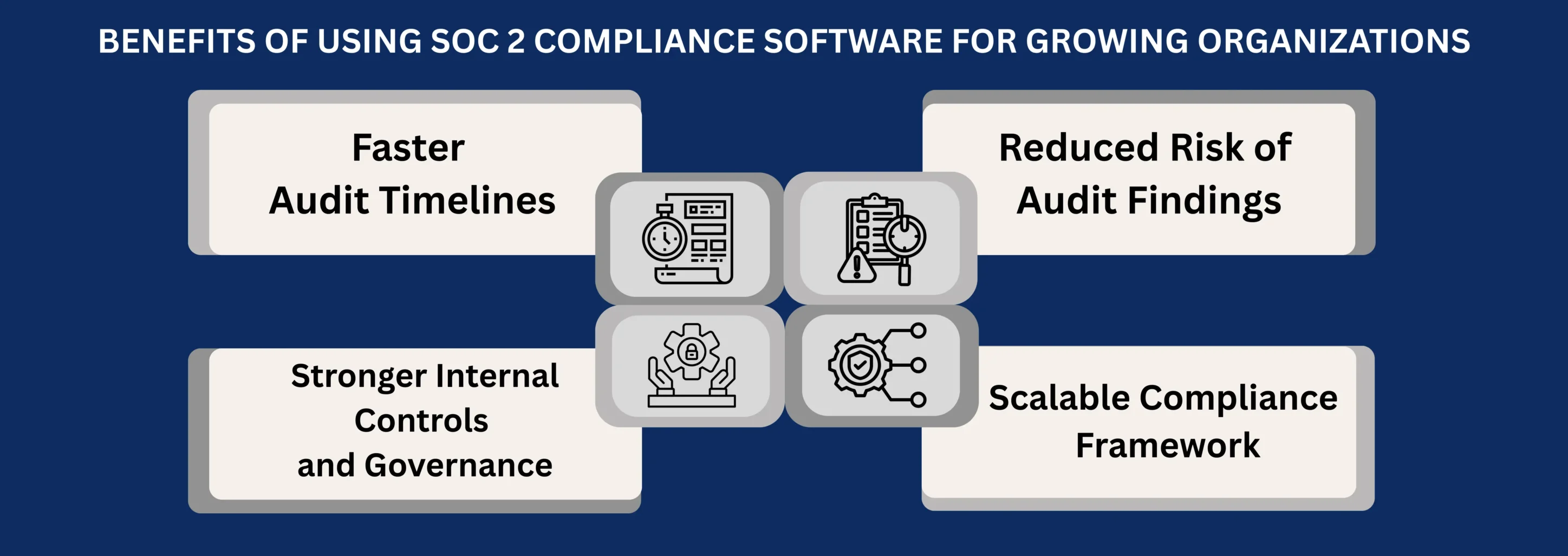
SOC 2 Certification in Melbourne delivers measurable commercial and operational benefits for service organisations operating in competitive technology, financial services, and healthcare markets. The independently verified SOC 2 attestation report provides evidence of control effectiveness that organisations cannot self-certify — giving customers and partners objective assurance rather than vendor-prepared documentation.
For Melbourne-based technology companies pursuing enterprise customers — particularly those in the United States, United Kingdom, and European Union — SOC 2 Certification has become a baseline procurement requirement rather than a differentiating feature. Organisations that hold a current SOC 2 Type 2 attestation report are better positioned to close enterprise deals faster, satisfy vendor risk programs, and demonstrate the operational maturity that regulated-industry customers demand.
The SOC 2 attestation report replaces time-consuming security questionnaire processes by providing a standardised, independently verified record of control performance. Enterprise customers — particularly those in financial services, healthcare, insurance, and government sectors — require SOC 2 Type 2 reports as part of their third-party risk management and vendor due diligence programs.
For Melbourne SaaS companies and cloud service providers, holding a current SOC 2 Type 2 report significantly reduces the friction associated with security reviews and vendor onboarding processes. The report demonstrates to customers that the organisation’s controls have been independently tested during a formal SOC 2 audit — not merely self-asserted — which is a material distinction in regulated-industry procurement decisions. This independently verified credibility is one of the most tangible commercial benefits of SOC 2 Certification.
SOC 2 Certification in Melbourne is particularly significant for organisations seeking to serve customers in the United States, where SOC 2 attestation is standard vendor assurance practice across the technology, financial services, healthcare, and professional services sectors. Melbourne fintech companies, AI startups, and cloud infrastructure providers pursuing US market entry regularly encounter SOC 2 Type 2 requirements early in enterprise sales conversations.
Beyond US market access, the SOC 2 examination process strengthens internal control environments in ways that are contextually aligned with Australian regulatory expectations — including the Privacy Act 1988, the Notifiable Data Breaches scheme, and Australian Prudential Regulation Authority (APRA) CPS 234 information security requirements. SOC 2 attestation does not constitute compliance with these frameworks, but the disciplines instilled through the SOC 2 compliance process are directly relevant to meeting Australian regulatory obligations.
The SOC 2 compliance process drives measurable improvements in internal control discipline across Melbourne organisations. Establishing documented access management, change control, and incident response processes — all required by the Trust Services Criteria — introduces operational rigour that reduces security incident frequency and improves response capability. Evidence collection disciplines instilled during SOC 2 audit cycles also improve record-keeping practices that benefit internal audit functions, regulatory examination responses, and cyber insurance underwriting.
Melbourne technology organisations that have completed SOC 2 Type 2 examinations consistently report improvements in cross-functional accountability for security controls. This accountability is driven by the requirement that control ownership and evidence be explicitly defined and maintained — rather than assumed — throughout the full observation period of the SOC 2 examination.
- ✓Independently verified evidence of control effectiveness for customer due diligence and procurement processes
- ✓Reduced security questionnaire burden through standardised SOC 2 attestation report distribution to customers and partners
- ✓Accelerated enterprise sales cycles in markets requiring SOC 2 Type 2 attestation as a procurement baseline
- ✓Strengthened internal control environment across access management, change control, and incident response disciplines
- ✓Improved third-party risk management through structured subservice organisation oversight and assessment
- ✓Contextual alignment with Australian information security and privacy regulatory expectations, including APRA CPS 234
- ✓Annual SOC 2 examination cycle that maintains current attestation status and demonstrates ongoing control performance to an expanding customer base
- ✓Customer Trust and Vendor Assurance
- ✓Market Access and Regulatory Alignment
- ✓Operational Improvements Through SOC 2 Compliance
SOC 2 Certification for Melbourne’s Technology and Fintech Sectors
Melbourne’s technology ecosystem — encompassing SaaS companies, AI startups, cloud infrastructure providers, fintech firms, healthtech organisations, e-commerce platforms, cybersecurity companies, and telecommunications providers — represents the primary concentration of SOC 2 Certification activity in Victoria. Organisations across these sectors handle sensitive customer data, process financial transactions, deliver regulated services, or operate infrastructure relied upon by downstream enterprises.
For these organisations, SOC 2 attestation is directly relevant to their customer relationships, vendor assurance obligations, and regulatory positioning. The SOC 2 compliance disciplines required by the AICPA Trust Services Criteria are well-matched to the risk profiles of technology-driven businesses operating in Melbourne’s competitive and internationally connected market.
SOC 2 Certification for Melbourne Fintech and Financial Services
SOC 2 Certification for Melbourne fintech and financial services organisations addresses control requirements across payment processing systems, banking platform integrations, open banking data flows, and financial data analytics environments. Fintech organisations operating under ASIC oversight, holding Australian Financial Services Licences, or providing technology services to APRA-regulated entities face heightened third-party risk scrutiny from their institutional customers.
SOC 2 Type 2 attestation — covering the Security, Availability, and Processing Integrity criteria — provides the independent control assurance that institutional banking partners and enterprise financial services customers require as part of vendor due diligence. Melbourne fintech companies pursuing expansion into US financial markets typically encounter SOC 2 Type 2 requirements at the initial enterprise sales stage, making early SOC 2 audit engagement a strategic priority for growth-oriented organisations.
SOC 2 Certification for Melbourne Healthcare and Life Sciences
Healthcare and life sciences organisations in Melbourne — including healthtech platforms, electronic health record providers, clinical data management companies, and medical device software vendors — regularly require SOC 2 attestation to satisfy vendor assurance demands from hospital networks, health insurance funds, and pharmaceutical companies. The Privacy criterion is frequently included in SOC 2 examinations for healthcare technology organisations, given that these entities process sensitive health information.
This health information is subject to the Privacy Act 1988, the Australian Privacy Principles, and the My Health Records Act 2012. SOC 2 attestation does not constitute compliance with these legislative frameworks, but the SOC 2 examination process evaluates controls that are directly relevant to the protection of health information and personal data. For Melbourne healthtech companies, achieving SOC 2 Certification is increasingly a prerequisite for hospital and health fund procurement processes.
SOC 2 for Cloud Providers, AI Startups, and SaaS Platforms
Cloud service providers, AI companies, and SaaS platforms headquartered in Melbourne face SOC 2 audit requirements from enterprise customers across Australia, the United States, and international markets. For AI organisations processing customer data through machine learning pipelines, the Processing Integrity and Confidentiality criteria are particularly relevant. Customers require assurance that data inputs are processed accurately and that confidential information is protected throughout the AI lifecycle.
SaaS companies delivering productivity, security, or business process automation tools to enterprise customers encounter SOC 2 Type 2 requirements as standard contractual provisions. The annual SOC 2 examination cycle — producing a new Type 2 report each year — allows Melbourne technology companies to demonstrate continuous control performance to an expanding customer base and maintain SOC 2 Certification as a permanent feature of their vendor assurance offering.
Understanding SOC 2 Compliance: Key Concepts for Melbourne Organisations
SOC 2 compliance in Melbourne is frequently misunderstood as a one-time certification event rather than an ongoing operational discipline. The SOC 2 examination evaluates a defined observation period, and the resulting attestation report reflects control performance during that specific window. Organisations that allow controls to lapse between audit cycles — or that implement controls immediately before a SOC 2 audit rather than maintaining them continuously — risk exception findings that undermine the value of the resulting report.
Understanding the distinction between SOC 2 compliance as a continuous operational state and SOC 2 attestation as the periodic independent examination of that state is fundamental to effective management of the certification lifecycle. Melbourne service organisations that embed SOC 2 compliance disciplines into their day-to-day operations consistently produce stronger attestation reports and experience fewer disruptions during the formal examination phase.
SOC 2 Compliance vs. SOC 2 Attestation: A Critical Distinction
SOC 2 compliance refers to the internal state of an organisation whose controls meet the applicable Trust Services Criteria — a condition that exists independently of whether an examination has been conducted. SOC 2 attestation, by contrast, is the formal output of an independent examination by a Licensed CPA Firm confirming that compliance state through evidence review and testing.
An organisation may be operationally compliant without holding a current SOC 2 attestation report, but customers and regulators cannot independently verify that state without an attestation. Conversely, SOC 2 attestation is only as current as the observation period covered by the most recent report. A SOC 2 Type 2 report issued twelve months ago does not attest to the organisation’s current control environment. Maintaining continuous SOC 2 compliance and scheduling timely attestation renewals are both essential to sustaining credible vendor assurance status in Melbourne’s enterprise market.
Annual Audit Cycles and Report Validity
SOC 2 reports do not carry perpetual validity. AICPA standards and market practice establish that SOC 2 Type 2 reports are considered current for the twelve-month period following the end of the observation period covered by the report. After that window, the report is considered stale, and customers requiring current vendor assurance documentation will request evidence of a more recent SOC 2 examination.
Melbourne organisations must therefore plan for annual SOC 2 audit cycles to maintain continuous attestation coverage. Annual cycles allow the Licensed CPA Firm to evaluate control performance across the most recent twelve-month observation period, producing an updated SOC 2 attestation report that reflects current control operation rather than historic practices. Aligning the observation period with the business calendar and key customer contract renewal schedules simplifies annual planning and ensures timely report availability.
Challenges in Achieving SOC 2 Certification in Melbourne
Achieving SOC 2 Certification in Melbourne presents operational and organisational challenges that are common across technology companies, regardless of size or technical maturity. The most frequently encountered challenges relate to evidence collection discipline, control ownership accountability, and the management of subservice organisations. Understanding these challenges in advance allows Melbourne service organisations to address them structurally — rather than discovering them during the SOC 2 examination itself, when the ability to remediate is constrained by the audit timeline.
Proactively addressing these areas before commencing a SOC 2 audit engagement reduces the likelihood of material exceptions in the final attestation report and strengthens the overall credibility of the SOC 2 Certification outcome.
Evidence Collection and Documentation Gaps
The most common deficiency identified during SOC 2 audits is the failure to collect and retain contemporaneous evidence of control operation. Controls that exist and function correctly — but are not documented through records, logs, or review sign-offs — cannot be confirmed through the auditor’s evidence inspection procedures. Melbourne technology organisations with engineering-driven cultures frequently implement strong technical controls but lack the systematic documentation practices required to produce audit evidence.
Access review records, change approval documentation, security training completion logs, and incident response records must all be maintained throughout the full SOC 2 observation period — not reconstructed after the fact. Auditors conducting the SOC 2 examination cannot accept recreated evidence as a substitute for contemporaneous records. Organisations that build evidence collection into their operational workflows from the start of the observation period avoid this common and preventable deficiency.
Control Ownership and Organisational Accountability
SOC 2 compliance requires that every control has a named owner responsible for its operation and evidence collection. In fast-growing Melbourne technology companies, control ownership frequently shifts as teams reorganise, personnel change, and product scope expands. When control owners change without a formal handover of evidence responsibilities, gaps in documentation appear within the observation period — creating the precise type of exception that is documented in SOC 2 audit reports.
Establishing a control ownership register, with periodic review and confirmation of ownership assignments, is an operational discipline that directly supports SOC 2 examination outcomes. The SOC 2 audit evaluates controls as they actually operated during the observation period — including any periods where ownership was unclear — not as they were intended to operate. Accountability structures must be real, documented, and consistently applied throughout the full observation period of the SOC 2 examination.
Scope Management and System Description Accuracy
The system description included in the SOC 2 report must accurately represent the organisation’s services, infrastructure, control environment, and subservice organisations as they existed throughout the observation period. Melbourne organisations that have undergone significant technology or infrastructure changes — such as cloud platform migrations, acquisitions, or major product releases — during the observation period must ensure those changes are reflected accurately in the system description.
Controls must also have remained effective throughout any transition period. Inaccurate or incomplete system descriptions represent a significant risk during the SOC 2 examination, as the auditor’s evaluation is anchored to the description provided. Material misrepresentations affect the credibility of the overall SOC 2 attestation and may result in a qualified opinion. Maintaining an up-to-date system description throughout the observation period — not only at report time — is an essential component of effective SOC 2 compliance management.
CertPro SOC 2 Audit Services in Melbourne
CertPro is a Licensed CPA Firm conducting independent SOC 2 examinations for service organisations across Melbourne and Victoria. SOC 2 Certification in Melbourne conducted by CertPro is performed under AICPA AT-C Section 205 attestation standards and the AICPA Trust Services Criteria, producing SOC 2 Type 1 and Type 2 attestation reports that reflect independent, evidence-based evaluation of the service organisation’s control environment.
CertPro’s SOC 2 examination services are available to Melbourne technology companies, fintech organisations, cloud service providers, healthcare technology platforms, AI startups, cybersecurity firms, telecommunications providers, e-commerce businesses, professional services firms, and enterprises processing sensitive information. Whether you are pursuing SOC 2 Certification for the first time or renewing an existing annual attestation, CertPro delivers structured, rigorous SOC 2 audit engagements aligned to your system boundaries, criteria selection, and customer requirements.
Independent SOC 2 Examination Under AICPA Standards
CertPro conducts SOC 2 examinations strictly as an independent attestation engagement — distinct from advisory, consulting, or implementation activities. The SOC 2 audit Melbourne organisations undergo through CertPro follows a structured audit methodology that includes scope determination, audit program development, control testing across inquiry, observation, inspection, and re-performance procedures, exception review, and formal report issuance.
CertPro’s Licensed CPA Firm status enables the issuance of SOC 2 attestation reports that carry the independent credibility required by enterprise customers, regulated-industry partners, and institutional procurement processes across Australia and international markets. The independence of the SOC 2 examination is the foundation of its value — and CertPro’s examination methodology is designed to preserve and demonstrate that independence throughout every stage of the audit engagement.
SOC 2 Examination Coverage for Melbourne’s Diverse Technology Ecosystem
CertPro’s SOC 2 examination services address the full spectrum of Melbourne’s technology and business ecosystem. SOC 2 audit engagements conducted by CertPro in Melbourne cover organisations operating cloud-native SaaS platforms, hybrid infrastructure environments, containerised application architectures, AI and machine learning platforms, payment processing systems, healthcare data management platforms, and managed security service operations.
The examination methodology is adapted to the technology environment and system boundaries of each engagement, ensuring that audit procedures are appropriately designed to evaluate the controls that are material to the Trust Services Criteria selected for the specific organisation. SOC 2 examination scope, criteria selection, and observation period are determined at engagement commencement based on the organisation’s service commitments and customer requirements. Contact CertPro to begin planning your SOC 2 Certification in Melbourne and establish the audit timeline that best aligns with your customer and commercial objectives.
FAQ
▶
What is SOC 2 Certification?
▶
What is the difference between SOC 2 Type 1 and SOC 2 Type 2?
▶
How long does the SOC 2 audit process take in Melbourne?
▶
Who can conduct a SOC 2 audit in Melbourne?
▶
Which Trust Services Criteria should Melbourne organisations select?
▶
Does SOC 2 attestation establish compliance with Australian privacy laws?
▶
How often must the SOC 2 examination be repeated?
▶
What happens if exceptions are found during the SOC 2 audit?
SOC 1 VS SOC 2: WHICH REPORT YOUR CUSTOMERS ACTUALLY ASK FOR
If you sell SaaS or provide outsourced services, you have likely been asked for a SOC report. However, the follow-up question is rarely easy to answer…

AICPA Issues New Guidance for Peer Reviewers Evaluating SOC 2 Engagements
AICPA SOC 2 guidance has been issued to help peer reviewers identify quality risks associated with SOC 2 engagements as the use of compliance automati…
SOC 2 Certified: What Does It Mean for Your Business
For companies that handle sensitive data or run cloud-based services, the question “Can you provide your SOC 2 report?” carries enormous weight. Yet, …
Get In Touch
have a question? let us get back to you.