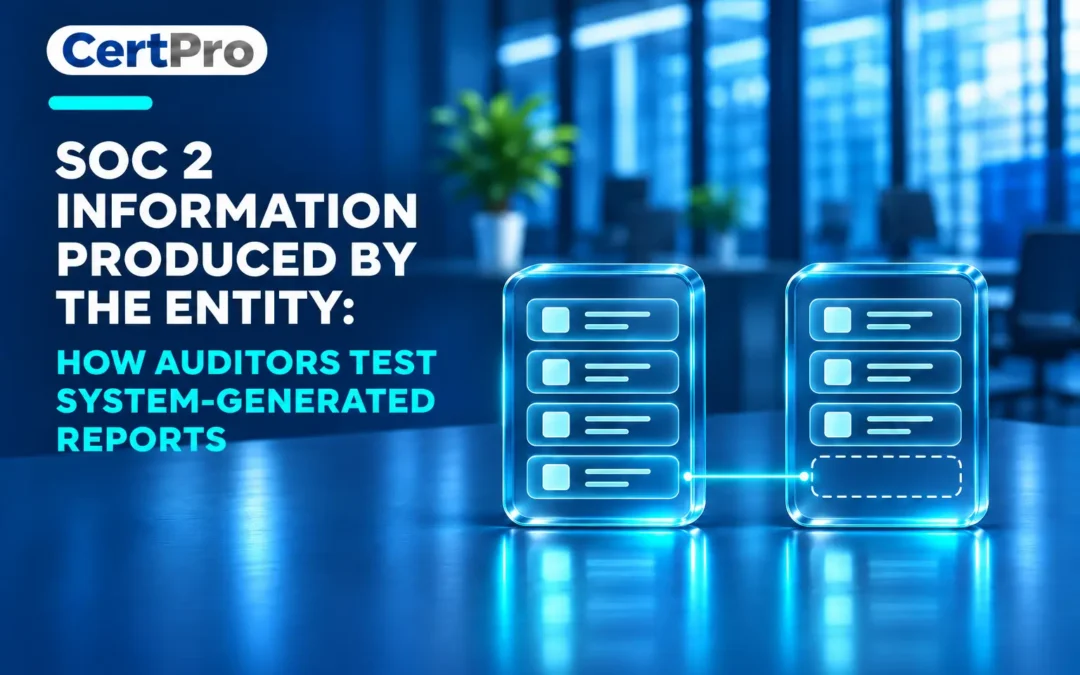

An IPE audit evaluates whether information produced by a service organization accurately and completely represents the underlying records. In SOC 2 examinations, auditors inspect system-generated reports, data extracts, and spreadsheets to assess population completeness, verify report accuracy, and determine whether the information provides reliable evidence of control performance.

Concern
Management can review every record in a report and still miss records the control was meant to cover. An incomplete export supplied to the service auditor can also leave relevant records out of the testing population.
Overview
In a SOC 2 examination, the service auditor evaluates whether information produced by the entity (IPE) is sufficiently reliable for the intended purpose, considering completeness, accuracy, and level of detail as applicable. An IPE audit considers which report management used to perform the control and which report supports audit testing.
Solution
Management can retain the original report used to perform the control, along with its source, filters, and date range, and document any edits made after export. The auditor may compare the report with underlying records and investigate whether discrepancies affect control performance, audit testing, or both.
The service auditor uses sampling to evaluate whether the population is appropriate for the test and whether the information used to identify that population is sufficiently reliable. An incomplete listing may exclude relevant records from the auditor's testing population and affect the conclusions drawn from sampling.
What Is IPE in a SOC 2 Examination?
IPE, or Information Produced by the Entity, refers to information a service organization generates for management or auditor use. An IPE audit may involve reports, extracts, dashboards, spreadsheets, or query results.
An access review may use an account listing; vulnerability management may use a scan report; security monitoring may use a SIEM alert listing; and change management may use a production-change report.
Management may use these records to perform controls; the service auditor may inspect them or select samples. The auditor therefore considers the information’s purpose, source, and detail.
Why Do Completeness and Accuracy Matter?
A population is the set of records for a control test. Population testing depends on a suitable population because the auditor may select samples from it. Sampling may not identify records that never enter the population.
Suppose the control owner used a report listing 500 privileged accounts, but 530 accounts met the review criteria at the time of the review. If the remaining 30 were also outside any other review, the control did not cover all in-scope accounts.
IPE completeness and population completeness overlap but address different questions. Population completeness asks whether the auditor has the full set of relevant items. What IPE completeness asks is whether entity-produced information captures relevant source records. Accuracy, here, asks whether reported records and attributes reflect the source correctly. An IPE audit also considers whether the report provides enough detail.
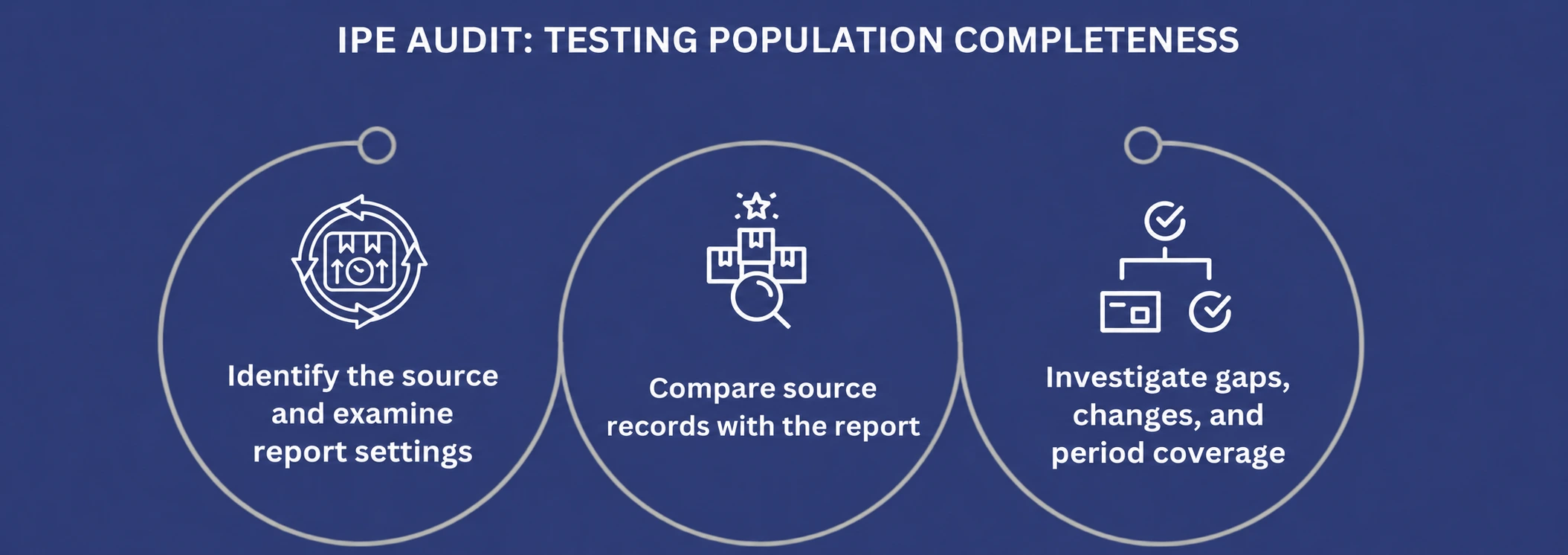
IPE Audit: Testing Population Completeness and Accuracy
The IPE audit definition becomes practical when the auditor links each report to a control and testing purpose. The auditor considers what IPE the control owner used, what IPE the auditor needs, and whether both uses require the same detail.
Identify the source and examine report settings
The auditor identifies the source system and considers whether other systems or interfaces hold relevant records.
The auditor may inspect queries, filters, date ranges, status selections, and environment limits. A vulnerability report, for example, may exclude cloud assets. The auditor evaluates whether exclusions align with scope. This IPE audit procedure helps identify omissions.
Compare source records with the report
Direction matters. Tracing report records back to the source can support accuracy and existence. Tracing source records into the report can support completeness.
The auditor may identify privileged accounts in the identity platform and check whether each appears in the review listing. The auditor may compare counts and investigate unmatched records. Matching totals alone may not establish that the report contains the correct records. In population testing, the auditor may also consider whether the source listing itself covers all relevant platforms, account types, and locations. A source-to-report comparison cannot identify records absent from the source.
Investigate gaps, changes, and period coverage
The auditor may inspect date gaps, interface failures, extraction errors, manual edits, and report changes. For security alerts, the auditor may inspect administrative access and configuration changes.
For a Type 2 examination, the IPE audit considers coverage across the examination period. A final-quarter report may not establish completeness for earlier quarters. The auditor tailors procedures to the report’s use, control frequency, and omission risks.
How Accuracy Is Evaluated
Accuracy asks whether the data in each record is correct. The auditor compares selected report fields with the underlying source records. These fields may include:
- Dates
- Approver names
- Account statuses, and
- User roles
The auditor also examines report logic changes during the examination period because modified queries may produce different populations under the same report name. When management exports data to a spreadsheet, the auditor evaluates whether the file accurately reflects the original system output and whether subsequent modifications affect its reliability.
How Can IPE Exceptions Affect SOC 2 Opinion?
The IPE audit also matters when the auditor evaluates management’s evidence. What IPE supports the control may differ from what IPE forms the sample frame. A dashboard may support daily monitoring while population testing may rely on a separate event export.
Evaluating the Effect of IPE Gaps on Control Testing
A discrepancy does not automatically mean that a control failed. The auditor evaluates its nature, extent, and whether other evidence addresses the gap. An omitted account, for example, may indicate an incomplete review population. The auditor investigates the omission and considers its effect on control testing.
The auditor may request a revised extract, inspect source records, or perform additional procedures. These steps may clarify whether the issue concerns the report, the control activity, or both. Population testing may require a revised sample if the original population omitted relevant items.
If management used the incomplete 500-account report to perform the review, the auditor investigates whether the other 30 accounts were reviewed through another process. If management reviewed all 530 accounts and only the extract supplied to the auditor omitted 30, the auditor evaluates whether the testing population and sample need to be revised.
If sufficient appropriate evidence remains unavailable, the auditor’s conclusion about operating effectiveness may be affected. If the service auditor cannot obtain sufficient appropriate evidence through alternative procedures, the unresolved gap may create a scope limitation. These procedures help the auditor establish whether the information provides reliable evidence for control testing and supports the examination conclusion.
Conclusion
System reports can provide evidence, but successful generation does not establish completeness or accuracy. In a SOC 2 examination, the auditor evaluates the source, extraction logic, report contents, and relevant changes before relying on IPE. CertPro, an independent CPA firm, evaluates whether information supports SOC 2 examination testing and conclusions.