International standards are one of the most powerful tools businesses have to build credibility, access global markets, and sustain long-term growth. Understanding the need for compliance in today’s world is the first step every organization must take before pursuing any certification. ISO standards support basic consumer rights the right to safety, the right to be informed, and the right to protection — by raising levels of quality, safety, reliability, efficiency, and interchangeability across industries worldwide.
They serve as an effective tool for consumer protection, providing a basis for national legislation and certification schemes. They are also widely regarded as best practice references used in business promotion, regulatory compliance, and legal proceedings. Organizations that embrace standardization don’t just meet requirements they gain a competitive edge through compliance certifications that drives sustained business growth and international trust.
Consumers’ Expectations from You
At a fundamental level, consumers want the best goods and services for the best value, available to the most people. But beneath this broad expectation lies a layered set of specific requirements that any compliant organization must understand. Compliance regulations vary by industry from healthcare and fintech to SaaS and manufacturing — making it essential to align your standardization strategy with your sector.
Products and services must meet consumers’ expectations in the following areas:
- Protection of safety and health
- Fitness for purpose and performance benchmarks
- Environmental protection and sustainability practices
- Ease of use and accessibility
- Quality, reliability, and consistency
- Compatibility and interoperability between products
- Transparent product information and accurate labelling
- Protection from false or misleading claims
- Fair competition and consumer choice
- Effective systems of redress, including complaints handling
- Consistency in service delivery
- Suitability for vulnerable populations — children, persons with disabilities, and the elderly
Consumer concerns have evolved significantly over time and so have the standards that address them. Organizations must continuously update their compliance documentation to remain aligned with these shifting expectations and regulatory demands.
how standards help
Standards provide specific requirements and guidance on addressing the consumer concerns outlined above. Because consumers can influence the development of standards, especially regarding how goods and services are produced, standards help products meet expectations in multiple ways. This principle forms the backbone of security and compliance across all regulated sectors.
Standards can include requirements or guidance on:
- Performance levels of the finished product
- Minimum dimensions, distances, or safety criteria for user protection
- Amount and type of required product information
- Instructions for correct packaging, labelling, and handling
- Adequate disposal or recycling methods
- Types of warnings and risk disclosures
- Product testing protocols to protect user safety and health
- The composition and material properties of products
ISO standards are designed to achieve desired outcomes. They are performance-based rather than prescriptive about design specifics — an approach that encourages technological innovation while still maintaining safety and quality floors. This performance-based model is why integrated management systems built on ISO frameworks continue to gain traction across global industries.
Newer issues that modern standards address include:
- Management of customer satisfaction and feedback loops
- Sustainable consumption and circular economy practices
- Accessible design for diverse and disabled user groups
- Personal data protection and privacy compliance
- Societal security and global privacy standards
- Social responsibility and ethical production practices
- Values-based labelling schemes and ESG disclosures
This reflects broader societal trends including globalization, digital transformation, and the widening scope of consumer rights that demand organizations go beyond minimum compliance toward genuine accountability.
how can you benefit from standardization?
Standards cover an extraordinary range of subjects from construction and nanotechnology to energy management, health and safety, and information security. They can be highly specific (applicable to a single product category) or broadly applicable (covering management practices across industries). The core purpose of any standard is to provide a reliable, shared baseline for what stakeholders can expect from a product or service.
Standardization benefits organizations by:
- Facilitating international and domestic trade by removing technical barriers
- Providing a framework to achieve economies of scale, operational efficiencies, and product interoperability
- Enhancing consumer protection and building lasting market confidence
Organizations across sectors leverage standards strategically:
- A quality management standard helps organizations work more efficiently, reduce product failures, and build customer trust
- An environmental management standard helps reduce environmental impact, minimize waste, and demonstrate sustainability commitments
- A health and safety standard reduces workplace accidents and demonstrates duty of care to employees and partners
- An IT security standard protects sensitive data, reduces breach risk, and enables trust with enterprise clients
- An energy management standard helps organizations cut consumption costs and meet sustainability targets
- A food safety standard prevents contamination and ensures safe product handling from production through distribution
- An accessibility standard helps make buildings and services usable by people with disabilities
- An interoperability standard ensures products like bank cards and ATMs function reliably across global networks
For startups and growing businesses, investing in the right certification early is a strategic decision. Compliance for startups is no longer optional — it is a growth enabler that opens enterprise sales conversations, accelerates regulatory approvals, and builds the internal discipline that scales.
using standards to improve your global trading prospects
The global business landscape is in constant flux — shaped by geopolitical shifts, rapid technological change, and evolving cultural expectations. A strategic approach using international standards allows businesses to capitalize on the benefits of international trade while strengthening operations, protecting brand reputation, and managing change with confidence. Staying current with top compliance trends is essential for any organization with international ambitions.
International standards from ISO and IEC form a cornerstone of the WTO rules-based trading system. Adopted through national bodies like BSI as British Standards, they create a common language for trading partners and deliver simpler market access globally. The majority of national standards today are international in origin — actively developed with input from global stakeholders to equip businesses of all sizes, including SMEs, for cross-border commerce.
International standards serve as a benchmark of best practice, providing a significant advantage when tendering for global business. They help organizations improve overseas trading prospects by providing reassurance on provenance, quality, and safety — factors that enterprise buyers and government procurement teams take seriously.
For the wider economy, standards that facilitate free trade can be transformative: they bring access to higher-quality, lower-priced goods; they drive competitiveness; and they fuel economic growth and job creation. They also support transparency and accountability — qualities that industries undergoing rapid change, driven by the fourth industrial revolution and the rise of AI, urgently need. Organizations must understand why cybersecurity matters and how standards like ISO 27001 anchor their information security posture against this evolving threat landscape.
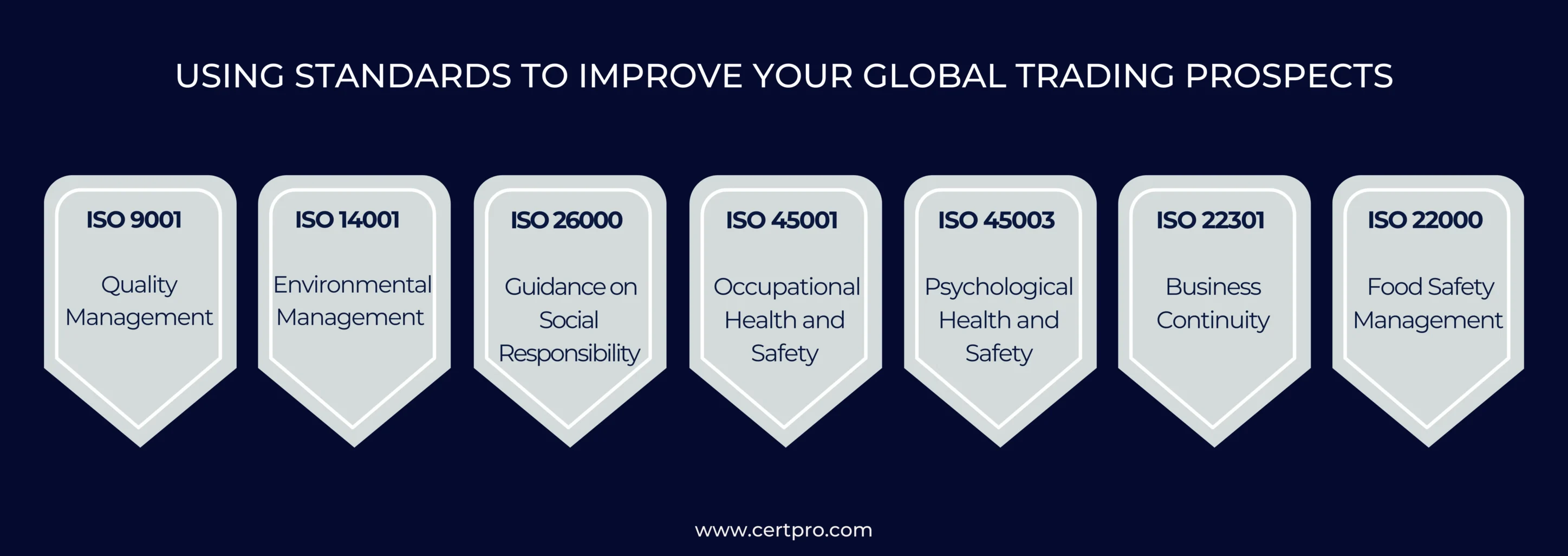
ISO 9001 – Quality Management
ISO 9001:2015 specifies requirements for implementing a Quality Management System (QMS) tailored to individual business needs while meeting regulatory requirements worldwide. It provides a globally recognized language of quality and demonstrates a commitment to excellence.
Underpinned by a robust QMS, businesses can improve the quality of their management systems and products while strengthening their prospects of winning new customers globally. Certification instils confidence in consumers and partners — it simplifies internal procedures, improves efficiency, reduces costs, and builds the brand credibility that sustains long-term growth. Understanding the differences between ISO 9001 and ISO 27001 helps organizations decide whether they need one, the other, or both as part of their compliance strategy.
ISO 14001 – Environmental Management
ISO 14001 helps organizations embed a culture of sustainability that meets the increasingly high environmental standards consumers expect from the businesses they buy from. Certification ensures legal and regulatory compliance while demonstrating genuine corporate responsibility — a factor that is growing in importance for enterprise procurement, investor relations, and ESG reporting.
ISO 26000 – Guidance on Social Responsibility
ISO 26000 provides guidance for implementing a social responsibility strategy, enabling organizations to fulfil policy commitments and reassure stakeholders that they operate in a socially responsible way. In an era where brand reputation is closely tied to ethical conduct, ISO 26000 helps organizations articulate their values with credibility and consistency — not just internally, but to partners, regulators, and the public.
ISO 45001 – Occupational Health and Safety & ISO 45003 – Psychological Health and Safety
ISO 45001 is the international standard for implementing the right occupational health and safety (OH&S) policy and practices. ISO 45003 extends this focus to psychological health in the workplace — an increasingly critical area as organizations grapple with remote work, burnout, and mental health awareness. Certification demonstrates that your organization genuinely cares about the working conditions of employees and partners, strengthening employer brand and stakeholder trust alike.
ISO 22301 – Business Continuity
ISO 22301 is the international standard for business continuity management. It provides organizations with a structured system for responding to unexpected disruptions — whether cyberattacks, natural disasters, supply chain failures, or pandemics — helping mitigate potential loss of revenue and reputational damage. A well-implemented risk management procedure aligned with ISO 22301 ensures your organization can absorb shocks and recover quickly, maintaining service delivery and stakeholder confidence.
ISO 22000 – Food Safety Management
ISO 22000 is the international standard for food safety management. It provides a systematic approach for safe food handling and helps organizations identify and define processes for safe food handling, processing, packaging, and distribution from farm to fork. As global supply chains grow more complex, this standard has become essential for food sector organizations operating across borders.
ISO 27001 – Information Security Management
In today’s digital-first world, information security is non-negotiable. ISO 27001 certification provides a rigorous framework for managing sensitive company and customer information securely. It establishes the policies, procedures, and controls necessary to identify risks, protect assets, and demonstrate compliance to regulators, enterprise clients, and partners.
The benefits of ISO 27001 certification span every area of the business — from reduced breach risk and faster sales cycles to lower cyber insurance premiums and stronger contractual standing with enterprise buyers. For organizations wondering who needs to be ISO certified, the answer increasingly spans all industries that handle sensitive data, provide digital services, or serve enterprise and government clients.
Modern IT compliance frameworks now expect ISO 27001 as a baseline. Pair it with compliance automation tools to maintain your controls continuously, reduce manual evidence collection, and stay audit-ready year-round without overburdening your team.
Building a Standardization Strategy with a GRC Framework
As organizations grow, managing multiple standards simultaneously becomes a governance challenge. A GRC framework — Governance, Risk, and Compliance — provides the structural backbone to align your standardization efforts, risk appetite, and compliance obligations into a unified, manageable system.
A well-designed GRC framework allows organizations to map controls across ISO 9001, ISO 27001, ISO 45001, ISO 22301, and other applicable standards, eliminating redundancy and reducing audit fatigue. Rather than treating each certification as a siloed initiative, organizations can build an integrated management system that satisfies multiple standards simultaneously — maximizing investment in compliance while minimizing operational disruption.
Effective vulnerability management is also central to sustaining any standards-based framework. Identifying, assessing, and remediating vulnerabilities across your technology stack and operational processes ensures that your standardization efforts translate into genuine risk reduction rather than checkbox compliance.
Standardization for ISO Certification: What to Expect
Pursuing ISO certification is a structured process that requires executive commitment, cross-functional participation, and documented evidence of compliance. Whether you are a startup seeking your first certification or an enterprise expanding your compliance portfolio, understanding the journey ahead ensures you allocate resources effectively and avoid common pitfalls.
A typical standardization and certification journey involves:
- Gap Assessment — benchmarking your current state against the requirements of your target standard to identify areas for improvement
- Policy and Procedure Development — drafting the documentation that governs how your organization meets each control requirement
- Implementation — embedding new controls into daily operations, training staff, and assigning accountability
- Internal Audit — testing the effectiveness of your controls before the formal certification audit
- Certification Audit — a two-stage external audit conducted by an accredited certification body
- Ongoing Surveillance — regular audits and continuous improvement to maintain your certified status
For startups and growth-stage companies, ISO certification accelerates enterprise sales readiness, reduces time spent on security questionnaires, and provides a credible foundation for expanding into regulated industries. Paired with a thoughtful compliance automation strategy, the ongoing cost of maintaining certification drops significantly.
Certpro as your standardization partner
As an organization, CertPro’s focus has always been on helping customers secure more customers. We believe every investment in compliance should deliver measurable returns — more enterprise deals closed, faster procurement approvals, stronger brand credibility, and lower operational risk. Our service packages are designed not just to achieve certification, but to help you extract maximum commercial value from it.
We work with organizations across industries and geographies to deliver ISO 27001 certification, SOC 2 compliance, HIPAA, GDPR, ISO 42001, and a full suite of compliance services — all performed by licensed CPAs and experienced auditors who understand what enterprise buyers and regulators actually look for.
Beyond achieving certification, we address marketing strategy: how to showcase your compliance status to international prospects, how to leverage your certificates in sales conversations, and how to build a compliance brand that reinforces trust at every touchpoint. We don’t just make you compliant — we help you turn compliance into a competitive advantage.
Our approach is rooted in regulatory compliance best practices built on years of experience auditing organizations from early-stage startups to large enterprises across the US, UK, EU, India, Australia, and Southeast Asia.
Work with CertPro today, and let’s grow together.