
A control that has never been tested is a claim, not a safeguard. Organizations write policies, deploy tools, and assign responsibilities, and then discover during an audit that the offboarding workflow skipped contractors for six months, or that the backup restore that everyone assumed worked has never actually been run. The discovery mechanism, in both directions, is the same discipline.
Control testing is how claims about controls become verified facts. It is the structured examination of whether a control is designed to achieve its objective and whether it actually operated, consistently, across a defined period. Every compliance audit is, at its core, a program of control testing performed by an independent party, and every mature compliance program runs the same testing on itself first.
This guide explains how the discipline works, the tests and methods auditors use, how testing plays out in SOC 2 and ISO 27001 engagements, and how to build an internal testing program that finds failures before an auditor does.
Concern
Most control failures are discovered by the wrong party at the wrong time: an external auditor during certification, or an attacker before that. Teams that deploy controls without testing them accumulate silent gaps, and testing performed only by outsiders means every failure arrives as a finding, with certification timelines, remediation deadlines, and customer questions attached.
Overview
Control testing evaluates two distinct questions: design effectiveness, whether the control would achieve its objective if it operated as described, and operating effectiveness, whether it actually operated throughout the period. The main tests are walkthroughs, control design testing, and tests of operating effectiveness, executed through four methods ranked by evidence strength: inquiry, observation, inspection, and re-performance. Testing extent scales with the control's risk and frequency.
Solution
Run internal control tests as an operating rhythm rather than a pre-audit project: map each control to its test procedure, schedule testing by risk and frequency, use the same four methods auditors use, document results with dated evidence, and route failures into root-cause corrective action. A program built this way converts external audits into confirmations of results the organization already knows.
What Is Control Testing?
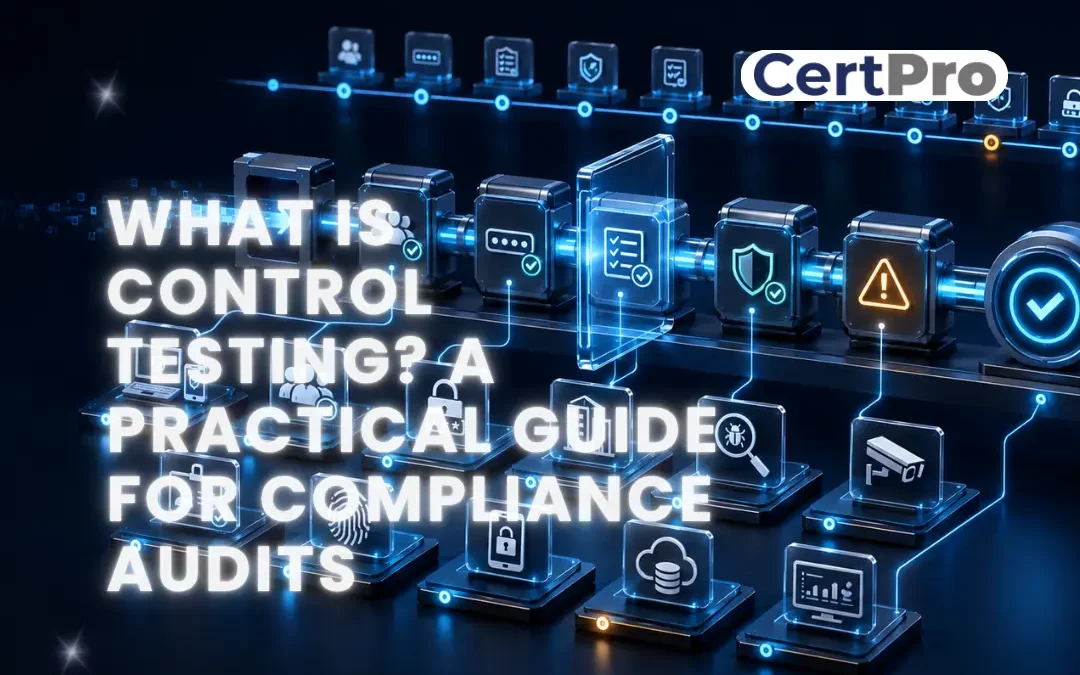
What is control testing? It is the structured evaluation of whether a control is suitably designed and operating effectively: whether the safeguard, as built, can achieve its stated objective, and whether it actually did so, consistently, across the period under review. Control testing produces the verified evidence on which audit opinions, certifications, and management assurances rest.
The two questions inside that definition are tested separately, and confusing them is a common source of audit friction. Design effectiveness asks whether the control makes sense: does requiring manager approval before access changes, if followed, actually prevent unauthorized access? A well-designed control can still fail in operation, and a faithfully operated control can still be badly designed. Auditors must satisfy themselves on both before relying on the control.
Timing distinguishes the two as well. Design can be evaluated at a point in time, through documentation review and a walkthrough of one instance end to end. Operating effectiveness requires evidence across the period, which is why testing for a Type II or certification engagement always reaches backward into months of records rather than settling for a demonstration on audit day.
Types of Control Testing
The tests map to the questions being answered: walkthroughs establish understanding, tests of design evaluate the control's construction, and tests of operating effectiveness verify consistent execution. Most engagements use all three in sequence.
- Walkthroughs
The auditor traces a single transaction or event through the entire control path, from initiation to completion, confirming their understanding of how the process actually works and where the control points sit. A walkthrough is not sufficient evidence on its own, but it anchors everything tested afterward and frequently surfaces the gap between the documented process and the real one.
- Tests of Design
Control design testing evaluates whether the control, as designed, addresses the risk it exists for: the right trigger, the right performer with the right competence and authority, the right frequency, and outputs that would actually catch or prevent the failure in question. Design deficiencies are among the most consequential findings, because no amount of consistent operation redeems a control that cannot achieve its objective.
- Tests of Operating Effectiveness
The center of gravity of a control testing audit: the auditor selects a sample from the full population of the control's occurrences and verifies each sampled instance operated as designed, on time, by the right person, with the required evidence. One control tested this way answers the question certifications exist to answer: not whether the organization can perform the control, but whether it did.
A further distinction cuts across all three: manual versus automated controls. A manual control, such as a quarterly access review, can drift with workload and personnel, so samples span the period. An automated control, such as a system-enforced password policy, operates identically every time, so testing concentrates on configuration plus the general IT controls that protect the configuration from unauthorized change. Misclassifying one as the other produces either wasted testing or false assurance.
Control Testing Methods: The Four Techniques
The four control testing methods, in ascending order of evidence strength, are inquiry, observation, inspection, and re-performance. The hierarchy is doctrine across assurance standards, and where a test sits on it determines how much weight its result carries.
- Inquiry
Asking the control performer how it works. Essential context, weakest evidence; inquiry alone never supports a conclusion on operating effectiveness.
- Observation
Watching the control performed in real time. Stronger, but proves only the observed moment, and people perform differently when watched.
- Inspection
Examining the records the control produced: tickets, exports, approvals, logs, configurations. The workhorse method, weighted by the integrity of the source that produced the record.
- Re-performance
Independently re-executing the control: re-running the calculation, re-checking the access list, re-tracing the workflow. The strongest evidence a test can produce.
In practice, auditors combine methods per control: inquiry to understand, a walkthrough to confirm, inspection of sampled records to verify the period, and re-performance where the risk justifies the effort. Whatever the mix, each test result must satisfy the standards for audit evidence, meaning the records examined are dated, attributable, and drawn from complete populations rather than curated examples. Testing built on weak evidence inherits the weakness.
Internal Control Tests Across SOC 2 and ISO 27001
Internal control tests serve both major frameworks from a single discipline, because both frameworks audit the same underlying practice of security controls testing through different structures. In SOC 2, controls map to the Trust Services Criteria, and the auditor tests each in-scope criterion through the controls management describes: access reviews for logical access criteria, approved tickets for change management, recovery tests for availability.
The Type II dimension adds time. The way SOC 2 auditors review evidence over time means tests of operating effectiveness sample deliberately across the review window, typically three to twelve months, so a control that lapsed mid-period surfaces regardless of how well it ran in audit month. Date clustering in the weeks before fieldwork is itself a signal auditors are trained to read.
ISO 27001 embeds internal control tests into the management system itself. Clause 9.2 makes the ISO 27001 internal audit mandatory, and certification bodies expect at least one full cycle before Stage 2: the organization tests its own Annex A controls and management clauses, documents findings, and closes them through corrective action. The certification auditor then re-tests independently, sampling controls and rotating coverage across the three-year cycle. An internal audit that found nothing does not read as strength; it reads as shallow testing.
Extent scales identically in both worlds: higher-risk controls draw larger samples, stronger methods, and lower tolerance for deviations. A failed test item is evaluated for cause, may expand the sample, and projects to the population, which is why one missed offboarding in a sample of twenty-five becomes a finding about the control rather than a note about one contractor. Control testing and sampling are two halves of the same mechanism.
Building a Compliance Control Testing Program
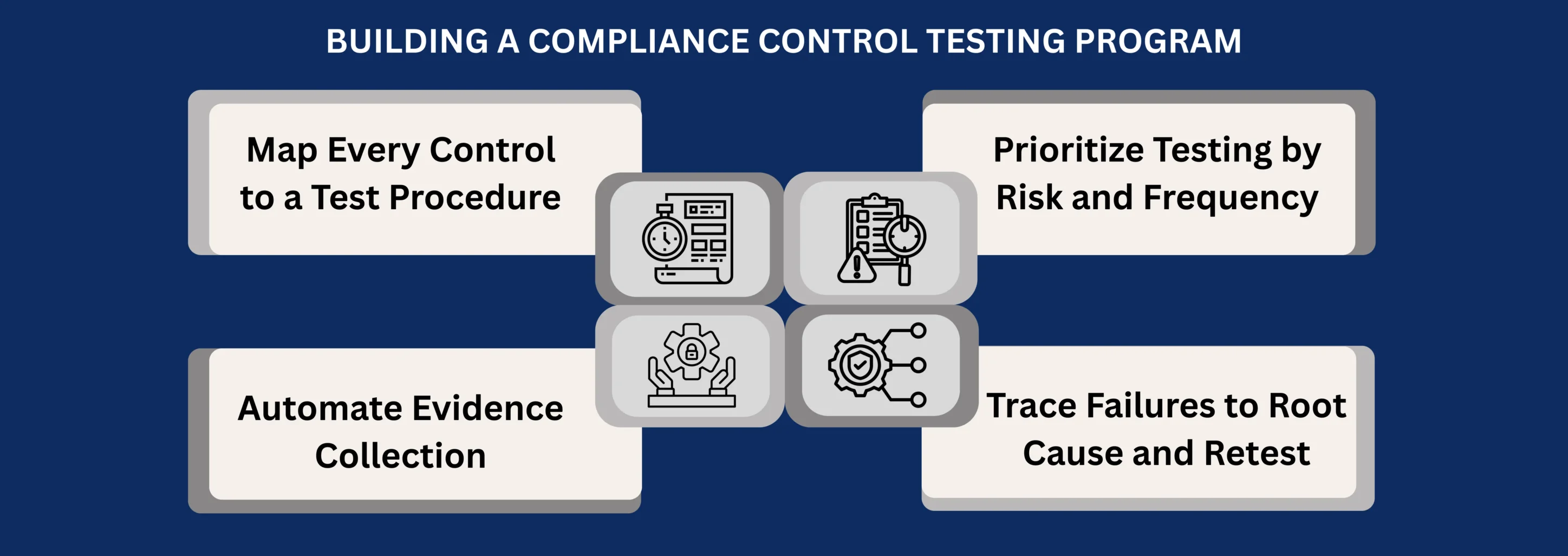
A compliance control testing program brings testing into a regular internal cycle. It helps external audits confirm established results rather than uncover basic control failures. Four practices make the program effective.
- Map Every Control to a Test Procedure
Define what will be tested, which method will be used, what population applies, how often testing occurs, and who performs it. This turns control testing into a repeatable process and gives auditors a clear view of the testing scope.
- Prioritize Testing by Risk and Frequency
Test daily and automated controls through configuration checks and periodic validation. Test recurring manual controls as their instances occur. Testing throughout the year creates evidence across the audit period and helps identify control drift early.
- Automate Evidence Collection
Automated evidence collection can pull populations and records from source systems on a defined schedule. This reduces manual evidence gathering and supports complete populations. The evaluation still requires human judgment to determine whether each sampled instance met the control objective.
- Trace Failures to Root Cause and Retest
A control failure requires more than correcting one instance. Identify why the control failed, address the underlying issue, and retest the control after the correction. The resulting test and corrective action records give auditors evidence of how control issues were identified and addressed.
Conclusion
Control testing is what separates a compliance program that assumes its controls work from one that has evidence. The discipline is straightforward: test design, test operation, select appropriate methods, scale testing to risk, document deviations, determine their cause, and retest where needed. Done consistently, control testing turns audit preparation from a last-minute exercise into an ongoing process.
The timing matters just as much. Controls may eventually face internal testing, external audit scrutiny, or an incident that exposes a failure. Internal testing gives organizations the earliest opportunity to find weaknesses, address them, and document the results before an external audit tests the same ground.
At CertPro, control testing forms a core part of our independent audit work. As a licensed CPA firm enrolled in the AICPA Peer Review Program, we test control design and operating effectiveness within SOC 2 attestations and ISO 27001 certification audits worldwide. Our auditors evaluate evidence, select appropriate samples, document deviations, and assess whether controls operated as required. For organizations preparing for an ISO 27001 certification audit, our ISO 27001 certification services provide independent conformity assessment across the certification cycle.