
ISO 27001 Certification in Australia
The ISO 27001 audit process in Australia follows a structured, multi-stage methodology consistent with ISO/IEC 17021-1 — the international standard for certification body requirements. CertPro conducts ISO 27001 audits in Australia as an independent third-party certification body, evaluating conformance with ISO/IEC 27001:2022 across all defined ISMS scope boundaries. The process moves through defined stages: from initial scope determination through to certification decision, annual surveillance, and recertification. Each stage generates documented findings that form the evidentiary basis for the certification decision.
OUR CLIENTS










What Is ISO 27001 Certification in Australia?
ISO 27001 Certification in Australia is the independently audited attestation that an organisation’s Information Security Management System (ISMS) conforms with ISO/IEC 27001:2022 — the internationally recognised standard for information security governance. Issued by an independent third-party certification body, the certificate provides verifiable evidence that an organisation has established, implemented, maintained, and continually improved a structured system for managing information security risks. CertPro, a Licensed CPA Firm, conducts ISO 27001 audits and issues ISMS certification to Australian organisations across all industry sectors, operating as a fully independent certification body with no advisory or consulting involvement in the organisations it certifies.
ISO/IEC 27001:2022 is published jointly by the International Organization for Standardization (ISO) and the International Electrotechnical Commission (IEC). The 2022 revision restructured the Annex A control set from 114 controls across 14 domains in the 2013 edition to 93 controls organised across four thematic domains: Organisational Controls, People Controls, Physical Controls, and Technological Controls. Certification bodies worldwide transitioned to the 2022 standard, with the transition deadline for existing 2013 certifications set at 31 October 2025. Australian organisations pursuing new ISO 27001 Certification or recertification must now demonstrate conformance with ISO/IEC 27001:2022.
For Australian organisations, ISO 27001 Certification in Australia carries direct market relevance. Enterprise procurement teams, federal and state government agencies, financial services regulators, healthcare bodies, and major cloud platform customers routinely require suppliers and vendors to hold current ISMS certification as a condition of contract. The certification signals that an organisation’s security posture has been evaluated against an objective international benchmark — not self-assessed or claimed through marketing materials. Sectors including fintech, SaaS, telecommunications, critical infrastructure, managed services, and legal services have seen demand for ISO 27001 Certification in Australia increase substantially as data breach incidents and supply chain security concerns have grown across the region.
ISO 27001 Certification in Australia operates within a broader Australian regulatory and legal context. The Privacy Act 1988 and the Australian Privacy Principles (APPs) impose obligations on organisations that handle personal information. The Notifiable Data Breaches (NDB) scheme requires eligible organisations to notify the Office of the Australian Information Commissioner (OAIC) and affected individuals when a data breach is likely to result in serious harm. The Security of Critical Infrastructure Act 2018 establishes risk management obligations for critical infrastructure sectors. The Australian Cyber Security Centre (ACSC) publishes the Essential Eight maturity framework as a baseline mitigation strategy for Australian entities. ISO 27001 Certification does not automatically establish legal compliance with these frameworks, but the structured risk assessment and control documentation required for ISMS certification provide an evidence base that organisations can reference when demonstrating their approach to regulatory obligations.
ISO 27001 Certification in Australia is relevant to organisations of all sizes — from large ASX-listed enterprises and federal government technology contractors in Canberra to SaaS startups in Sydney and Melbourne, fintech companies in Brisbane, healthcare providers in Perth, and AI businesses operating across multiple states. The standard is applicable regardless of organisational size, sector, or technology environment, and it is equally suited to organisations managing on-premise infrastructure, cloud-hosted systems, hybrid environments, or outsourced IT services. The scope of an ISMS certification is defined by the organisation and assessed by the certification body during the audit process.
What ISO/IEC 27001:2022 Requires
ISO/IEC 27001:2022 requires organisations to establish a documented ISMS that addresses the standard’s ten clauses. These clauses cover context of the organisation, leadership and commitment, planning, support, operation, performance evaluation, and improvement. Organisations must conduct a formal information security risk assessment, define a risk treatment plan, and implement Annex A controls selected on the basis of that assessment. A Statement of Applicability (SoA) must document which of the 93 Annex A controls apply to the organisation’s defined scope, which are implemented, and the justification for any exclusions. The SoA is a central document reviewed during every ISO 27001 audit.
Management commitment is a mandatory requirement under Clause 5 of the standard. Senior leadership must demonstrate active involvement in the ISMS through documented policies, defined roles and responsibilities, and management review processes that evaluate ISMS performance and drive continual improvement. Internal audit programs and corrective action processes must be operational and evidenced prior to the Stage 2 certification audit. These requirements ensure that ISMS certification reflects a genuinely embedded governance system — not merely a documentation exercise — and they form the basis of the evidence evaluated by CertPro’s audit team during every ISO 27001 assessment.
Annex A Controls and the Statement of Applicability
Annex A of ISO/IEC 27001:2022 contains 93 information security controls organised into four domains. Organisational Controls (37 controls) address policies, roles, responsibilities, threat intelligence, asset management, and supplier relationships. People Controls (8 controls) cover personnel screening, terms of employment, security awareness, and disciplinary processes. Physical Controls (14 controls) address physical security perimeters, equipment maintenance, and secure disposal. Technological Controls (34 controls) cover access management, cryptography, network security, malware protection, logging, monitoring, and secure development. Not all 93 controls are mandatory for every organisation — applicability is determined through risk assessment, and exclusions must be justified in the SoA.
During an ISO 27001 audit, the certification body evaluates the organisation’s SoA to verify that the control selection is consistent with the risk assessment findings and that implemented controls are operating effectively. For Australian organisations operating in cloud environments, controls relating to supplier relationships (A.5.19–A.5.22), network security (A.8.20–A.8.22), and data masking and deletion (A.8.11, A.8.10) are frequently scrutinised. The audit team examines documented evidence, interviews personnel, and tests the operational effectiveness of controls — not merely the existence of written policies.

ENQUIRE NOW
Related Resources
Related Services in Australia
ISO 27001 Certification Audit Process in Australia
The ISO 27001 audit process in Australia follows a structured, multi-stage methodology consistent with ISO/IEC 17021-1 — the international standard for certification body requirements. CertPro conducts ISO 27001 audits in Australia as an independent third-party certification body, evaluating conformance with ISO/IEC 27001:2022 across all defined ISMS scope boundaries. The process moves through defined stages: from initial scope determination through to certification decision, annual surveillance, and recertification. Each stage generates documented findings that form the evidentiary basis for the certification decision.
The Stage 1 audit is a documentation-focused review conducted before the full Stage 2 assessment. During Stage 1, the audit team evaluates the organisation’s ISMS documentation — including the scope statement, information security policy, risk assessment methodology, risk register, risk treatment plan, Statement of Applicability, and internal audit records. The objective is to determine whether the ISMS has been sufficiently developed and documented to proceed to Stage 2. Stage 1 identifies documentation gaps or design weaknesses that should be addressed before the Stage 2 ISO 27001 audit commences.
Stage 1 findings are documented in a formal audit report that identifies any concerns or areas requiring clarification. The audit team also confirms the Stage 2 audit plan — covering scope boundaries, sites or systems to be assessed, personnel to be interviewed, and the controls and processes to be tested. For Australian organisations with distributed operations across Sydney, Melbourne, Brisbane, or Perth, Stage 1 planning confirms how multi-site or multi-system environments will be addressed within the Stage 2 audit program.
The Stage 2 audit is the primary conformance assessment in which the audit team evaluates whether the organisation’s ISMS is operating effectively in practice. Auditors test implemented controls against the requirements of ISO/IEC 27001:2022 and the organisation’s SoA by reviewing documented evidence, conducting structured interviews with personnel at appropriate organisational levels, observing operational processes, and testing technical controls where applicable. The Stage 2 ISO 27001 audit produces a detailed finding record covering each clause of the standard and each applicable Annex A control.
Findings from the Stage 2 audit are classified as major nonconformities, minor nonconformities, or observations. Major nonconformities indicate a significant failure to meet a requirement of the standard and must be resolved before ISO 27001 Certification can be issued. Minor nonconformities indicate partial non-fulfilment and are subject to corrective action within a defined timeframe. Observations are documented for organisational awareness but do not prevent certification. Once nonconformities are addressed and verified, the certification body issues the ISO 27001 certificate, which is valid for three years subject to annual surveillance audits.
ISO 27001 Certification is valid for a three-year certification cycle. Annual surveillance audits are conducted in years one and two to verify that the ISMS continues to operate in conformance with ISO/IEC 27001:2022. Surveillance audits are shorter than the initial certification audit but assess key ISMS processes, internal audit outcomes, management review records, corrective actions, and any changes to the organisation’s scope, operations, or risk environment. Australian organisations that undergo significant changes — such as cloud platform migrations, acquisitions, or shifts in regulatory obligations — should notify the certification body so the surveillance scope can be adjusted accordingly.
Recertification occurs at the end of the three-year cycle and involves a full reassessment of the ISMS comparable in scope to the initial Stage 2 audit. Recertification evaluates the overall performance of the ISMS over the certification period — including the effectiveness of continual improvement activities, changes in the risk environment, and outcomes of internal audits and management reviews. Successful recertification renews the ISO 27001 Certification for a further three years. Organisations must maintain operational ISMS processes throughout the full certification cycle to sustain conformance at each surveillance and recertification audit.
| Audit Stage | Purpose | Typical Duration |
|---|---|---|
| Stage 1 Audit | ISMS documentation review and audit planning | 1–2 days |
| Stage 2 Audit | ISMS conformance and control effectiveness testing | 2–5 days |
| Surveillance Audit (Year 1 & 2) | Ongoing ISO 27001 conformance verification | 1–2 days |
| Recertification Audit | Full ISMS reassessment at end of 3-year cycle | 2–4 days |
- ✓Stage 1 Audit: Documentation Review and Readiness Assessment
- ✓Stage 2 Audit: ISMS Conformance and Control Effectiveness Testing
- ✓Surveillance Audits and Recertification
ISO 27001 Certification Requirements for Australian Organisations
Achieving ISO 27001 Certification in Australia requires an organisation to satisfy the documented requirements of ISO/IEC 27001:2022 across its defined ISMS scope. The requirements span governance, risk management, operational controls, and continual improvement, and they apply equally to organisations in every sector — including government technology contractors in Canberra, financial services firms in Sydney, healthcare providers in Melbourne, and cloud service companies operating nationally. The following requirements are assessed during every ISO 27001 audit conducted by CertPro.
ISO/IEC 27001:2022 mandates a defined set of documented information that must be maintained and available for audit review. Core mandatory documents include the ISMS scope statement, information security policy approved by senior leadership, risk assessment and treatment methodology, risk register and treatment plan, Statement of Applicability covering all 93 Annex A controls, internal audit program and results, management review records, and documented corrective actions. Each document must reflect the organisation’s actual operating environment — not a generic template. The audit team verifies that documents are version-controlled, reviewed at planned intervals, and accessible to relevant personnel.
Leadership and governance requirements under Clause 5 require the organisation’s top management to demonstrate visible commitment to the ISMS. This includes formally approving the information security policy, assigning information security roles and responsibilities, ensuring the ISMS is integrated into the organisation’s strategic direction, and actively participating in management review processes. Evidence reviewed during the ISO 27001 assessment includes board or executive meeting minutes, role assignment documentation, and management review outputs showing that ISMS performance data is reviewed and acted upon at the senior leadership level.
Risk assessment is the foundational process of the ISO/IEC 27001:2022 ISMS. The standard requires organisations to define and apply an information security risk assessment process that produces consistent, valid, and comparable results. The risk assessment must identify information security risks associated with the confidentiality, integrity, and availability of information within the ISMS scope, assess the likelihood and consequence of each identified risk, and evaluate risks against defined acceptance criteria. For Australian organisations, the risk assessment must account for the local threat landscape — including ransomware, supply chain attacks, business email compromise, and insider threats, all of which are documented concerns in the ACSC Annual Cyber Threat Report.
The risk treatment plan documents the controls selected to address each identified risk, cross-referenced to the applicable Annex A controls in the Statement of Applicability. Organisations must implement the controls specified in the treatment plan and retain evidence of implementation. Residual risk — the risk remaining after treatment — must be evaluated against the organisation’s risk acceptance criteria, and formal acceptance must be documented. The audit team evaluates the completeness and consistency of the risk assessment and treatment documentation as a core component of both Stage 1 and Stage 2 ISO 27001 audit activities.
- ✓Access control policies and user access provisioning and deprovisioning procedures with documented evidence of application
- ✓Cryptographic key management procedures covering encryption standards applied to data at rest and in transit
- ✓Network security controls including segmentation, firewall rule management, and monitoring of network activity
- ✓Incident management procedures with defined classification, escalation, response, and post-incident review processes
- ✓Business continuity and information security continuity plans tested at documented intervals
- ✓Supplier and third-party security requirements embedded in contracts and monitored through structured review processes
- ✓Physical security controls for facilities and equipment handling information within the ISMS scope
- ✓Logging and monitoring controls providing an audit trail for security-relevant events across in-scope systems
- ✓Documentation and Governance Requirements
- ✓Risk Assessment and Treatment Requirements
- ✓Operational and Technical Control Requirements
Benefits of ISO 27001 Certification for Australian Businesses
ISO 27001 Certification delivers verified, independently attested outcomes for Australian organisations that complete the certification process. The benefits extend across commercial, operational, regulatory, and reputational dimensions, making ISMS certification a strategic asset for organisations competing for enterprise contracts, government procurement, and regulated sector business. The following outcomes reflect the direct results of ISO 27001 Certification in Australia as evaluated through the audit and certification process.
ISO 27001 Certification in Australia is a formal procurement requirement in an increasing number of enterprise and government contracts. Australian federal and state government agencies apply vendor security requirements that reference ISO 27001 as an accepted security assurance framework — particularly for technology suppliers, managed service providers, and cloud platform operators. Enterprises in financial services, healthcare, legal services, and resources sectors require ISMS certification from suppliers handling sensitive data as a condition of contract execution or renewal. Holding a current ISO 27001 certificate issued by an independent certification body removes a significant procurement barrier and enables access to contracts that are not available to uncertified organisations.
For Australian SaaS companies, fintech businesses, and technology exporters, ISO 27001 Certification provides internationally recognised evidence of security governance that is accepted in procurement processes across the Asia-Pacific region, the United States, the United Kingdom, and the European Union. This international recognition means that a single ISO 27001 certification audit can satisfy security due diligence requirements across multiple markets simultaneously — reducing the duplication of bespoke security assessments demanded by individual enterprise customers. The efficiency gain is particularly significant for growth-stage Australian technology companies expanding into international markets.
The structured risk assessment and treatment process required for ISO 27001 compliance forces organisations to systematically identify, evaluate, and address information security risks before they materialise as incidents. Organisations that have implemented an ISO/IEC 27001:2022-conformant ISMS have documented processes for incident detection, classification, response, and post-incident review. These processes reduce the mean time to detect and respond to security events. The ACSC has consistently reported that Australian organisations with documented incident response capabilities experience materially better outcomes when cyber incidents occur — including reduced data exposure and faster restoration of services.
ISO 27001 compliance also requires organisations to assess and manage risks arising from supplier and third-party relationships — a critical area given the prevalence of supply chain attacks targeting Australian organisations. Annex A controls A.5.19 through A.5.22 require documented supplier security policies, security requirements in supplier contracts, and active monitoring of supplier security performance. When implemented and audited, these controls provide evidence of supply chain risk management that satisfies both the standard’s requirements and expectations under the Security of Critical Infrastructure Act for organisations in regulated sectors.
- ✓Documented information security controls provide an evidence base relevant to Privacy Act 1988 and APP compliance assessments
- ✓Incident management and data breach response procedures align with Notifiable Data Breaches scheme notification requirements
- ✓Supplier security controls documented under Annex A support APRA CPS 234 vendor management obligations for regulated financial entities
- ✓ISMS internal audit and management review evidence supports governance representations in annual reports and board disclosures
- ✓Third-party audited ISO 27001 Certification reduces customer security questionnaire burden by providing a standardised assurance artefact
- ✓Internationally recognised ISMS certification supports market entry into regulated sectors across the Asia-Pacific region, the EU, and the United States
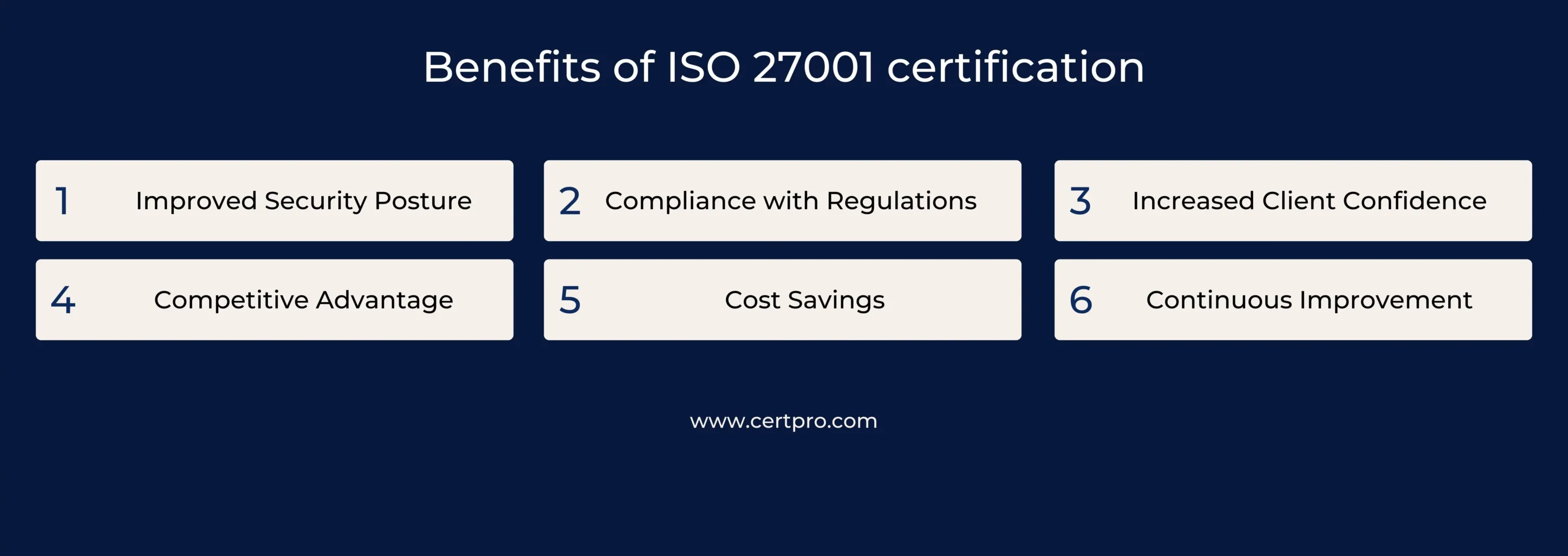
- ✓Commercial and Procurement Advantages
- ✓Risk Management and Incident Reduction
- ✓Regulatory Alignment and Customer Trust
ISO 27001 Certification in Australia — Industry Context
ISO 27001 Certification in Australia is pursued across a broad range of industries and organisational types. Demand for ISO 27001 audit services in Australia has grown in direct response to increased regulatory expectations, high-profile data breaches affecting Australian organisations, expanded government cybersecurity requirements, and enterprise supply chain due diligence requirements. The following industry contexts reflect the specific drivers and applications of ISO 27001 Certification in Australia across key sectors.
Financial Services and Fintech
Financial services organisations pursuing ISO 27001 Certification in Australia — including banks, insurance companies, superannuation funds, payment processors, and fintech businesses — face overlapping security obligations under the Privacy Act 1988, APRA Prudential Standard CPS 234, and the Notifiable Data Breaches scheme. Fintech companies increasingly pursue ISO 27001 compliance to demonstrate structured information security governance to institutional customers, enterprise clients, and APRA-regulated entities in their supply chain. While ISO 27001 Certification does not substitute for CPS 234 compliance, the risk assessment, access control, incident management, and supplier security controls documented under the standard align closely with CPS 234 requirements — enabling organisations to avoid duplicating control design and documentation work.
Australian fintech companies operating in the payments, lending, wealth management, and embedded finance sectors frequently require ISO 27001 ISMS certification to satisfy security due diligence requirements from banking partners, enterprise customers, and international market entry requirements. Sydney and Melbourne host the majority of Australia’s fintech sector, and ISO 27001 Certification in Australia has become a baseline expectation for fintech businesses operating at scale or seeking partnerships with major financial institutions. CertPro conducts ISO 27001 assessments for financial services and fintech organisations, evaluating conformance with ISO/IEC 27001:2022 across cloud-hosted and on-premise environments.
Government Contractors and Critical Infrastructure
ISO 27001 Certification for Australian government contractors is increasingly required by federal and state government agencies as a security assurance condition for technology procurement. The Australian Government’s Information Security Manual (ISM), maintained by the Australian Signals Directorate (ASD), references ISO 27001 as a relevant international standard. Many government procurement frameworks require suppliers to demonstrate ISO 27001-aligned security controls. For organisations providing ICT services, cloud platforms, data analytics, or digital infrastructure to government agencies in Canberra, Sydney, Melbourne, Brisbane, Perth, and Adelaide, ISO 27001 Certification provides third-party verified evidence that security governance meets an objective international benchmark.
Organisations operating in sectors defined as critical infrastructure under the Security of Critical Infrastructure Act 2018 — including energy, water, communications, financial services, healthcare, transport, and data storage and processing — face risk management program obligations that require documented, systematic approaches to managing security risks. ISO 27001 Certification in Australia provides an independently audited information security governance framework that supports these organisations in demonstrating structured risk management, documented controls, and continual improvement to regulators and government customers. CertPro’s ISO 27001 audit service covers organisations operating in critical infrastructure sectors across all Australian states and territories.
Healthcare, SaaS, and Technology Providers
Australian healthcare organisations handling patient records, clinical data, and health information face obligations under the Privacy Act 1988, the My Health Records Act 2012, and sector-specific security requirements from the Australian Digital Health Agency. ISO 27001 ISMS certification provides healthcare organisations with a structured framework for managing information security risks across electronic health record systems, clinical applications, and third-party digital health platforms. SaaS companies and cloud service providers operating in Australia — whether hosting data in Australian data centres or global cloud environments — frequently receive ISO 27001 Certification in Australia as a security assurance requirement from enterprise healthcare, legal, and financial services customers.
ISO 27001 Compliance Australia: Aligning With the Regulatory Landscape
ISO 27001 compliance in Australia encompasses the documented controls, risk management processes, and governance structures required to conform with ISO/IEC 27001:2022 within the Australian legal and regulatory environment. ISO 27001 compliance does not automatically establish compliance with Australian law, but the structured ISMS required for certification provides an operational foundation that organisations reference when demonstrating their approach to legal, regulatory, and contractual information security obligations. The following areas illustrate the relationship between ISO 27001 compliance and key Australian regulatory requirements.
Privacy Act 1988 and Australian Privacy Principles
The Privacy Act 1988 and the 13 Australian Privacy Principles (APPs) require APP entities to take reasonable steps to protect personal information from misuse, interference, loss, and unauthorised access, modification, or disclosure (APP 11). ISO/IEC 27001:2022 ISMS controls covering access management, encryption, incident response, and supplier security directly address the types of protective measures that regulators and courts consider when evaluating whether an organisation has taken reasonable steps. While ISO 27001 Certification is not a legal safe harbour under Australian privacy law, organisations holding current ISMS certification have documented, independently audited controls that support their response to OAIC investigations and regulatory inquiries.
The Notifiable Data Breaches scheme, introduced under Part IIIC of the Privacy Act 1988, requires eligible organisations to notify the OAIC and affected individuals when a data breach involving personal information is likely to result in serious harm. ISO 27001 compliance requires organisations to implement documented incident management procedures — including processes for detecting, classifying, and responding to security incidents. These procedures, when operational and evidenced, provide the organisational capability needed to identify eligible data breaches within the timeframes expected by the NDB scheme, and to conduct the containment and assessment activities necessary before a notification decision is made.
APRA CPS 234 and Financial Sector Alignment
APRA Prudential Standard CPS 234 Information Security applies to all APRA-regulated entities, including authorised deposit-taking institutions, general and life insurers, private health insurers, and superannuation trustees. CPS 234 requires these entities to maintain an information security capability commensurate with the size and extent of threats to their information assets, implement controls to protect those assets, and notify APRA of material information security incidents within 72 hours. ISO 27001 compliance for Australian financial services organisations involves implementing controls under the ISMS framework — including access management, incident response, supplier assessment, and vulnerability management — that directly map to CPS 234 requirements. This alignment reduces duplication and allows organisations to leverage their ISMS documentation in CPS 234 compliance activities, though each framework must be satisfied independently.
ISO 27001 Assessment Australia: What the Evaluation Covers
An ISO 27001 assessment conducted by CertPro in Australia evaluates an organisation’s ISMS against all applicable requirements of ISO/IEC 27001:2022, including all ten standard clauses and the Annex A controls identified as applicable in the organisation’s Statement of Applicability. The ISO 27001 assessment is performed by qualified auditors with sector-relevant experience, using structured audit protocols designed to generate objective, reproducible findings. The following describes the core evaluation areas covered in a CertPro ISO 27001 assessment.
ISMS Scope and Context Evaluation
The ISO 27001 assessment begins with evaluation of the organisation’s defined ISMS scope and the context analysis required under Clause 4 of the standard. Auditors assess whether the scope statement accurately reflects the boundaries of the ISMS — including the systems, processes, locations, and information assets included and excluded — and whether the scope is consistent with the organisation’s actual operations. The context analysis must address internal factors (organisational structure, strategic direction, culture) and external factors (regulatory environment, market expectations, threat landscape) that influence the ISMS. For Australian organisations, external context analysis is expected to reference the local cyber threat environment and relevant regulatory obligations.
Interested party requirements — the documented needs and expectations of customers, regulators, suppliers, and other stakeholders relevant to the ISMS — are evaluated for completeness and integration into the ISMS scope and objectives. Australian organisations operating in regulated sectors must demonstrate that interested party requirements include relevant regulatory obligations under the Privacy Act 1988, CPS 234, the Security of Critical Infrastructure Act, and applicable contractual security requirements from enterprise customers. The audit team verifies that these requirements are documented, that the ISMS addresses them, and that management review processes track ongoing conformance.
Control Testing and Evidence Review
Control testing during the Stage 2 ISO 27001 audit involves examination of documented evidence, direct observation of processes, and structured interviews with personnel responsible for control operation. The audit team selects a sample of applicable Annex A controls for detailed testing, with selection informed by the risk treatment plan and areas identified during Stage 1. For technological controls, auditors may review system configuration evidence, access logs, vulnerability scan outputs, patch management records, and monitoring alert documentation. For organisational and people controls, auditors examine policy documents, training records, personnel security agreements, and disciplinary process documentation.
The ISO 27001 assessment does not test individual technical systems for security vulnerabilities — this is distinct from penetration testing or vulnerability assessment services. The certification audit evaluates whether the organisation has implemented controls as documented in its SoA and risk treatment plan, and whether those controls are operating consistently and effectively. Evidence of control operation across the audit period — not just at the point of audit — is required to demonstrate that controls are embedded in operational practice. Internal audit records, management review outputs, and corrective action documentation all contribute to this evidence base.
Why Australian Organisations Choose CertPro for ISO 27001 Certification
CertPro is a Licensed CPA Firm operating as an independent third-party certification body for ISO 27001 Certification in Australia. CertPro conducts ISO 27001 audits with strict independence from any consulting, implementation, or advisory activities — ensuring that the certification issued is the product of objective, evidence-based evaluation rather than a commercial relationship with the certified organisation. CertPro’s ISO 27001 audit service is available to organisations across Sydney, Melbourne, Brisbane, Perth, Canberra, and Adelaide, as well as regional and remote locations, with audits conducted on-site, remotely, or through a hybrid approach determined during the audit planning stage.
Independent Certification Body Positioning
CertPro maintains strict operational separation between certification audit activities and any consulting or advisory services. This independence is a fundamental requirement of ISO/IEC 17021-1 — the standard governing certification body operations — and ensures that CertPro’s ISO 27001 certifications represent objective third-party evaluations that organisations, their customers, and regulators can rely upon as credible assurance artefacts. Organisations that have used the same provider for both implementation support and certification risk compromised independence. CertPro’s structure eliminates this risk entirely by operating exclusively as a certification body.
CertPro’s audit teams include professionals with sector-specific experience across financial services, technology, healthcare, government, and critical infrastructure — enabling the audit program to be calibrated to the organisation’s actual operating environment rather than applying a generic checklist approach. An ISO 27001 assessment conducted by CertPro produces a detailed finding report that organisations can provide to customers, procurement teams, and regulatory bodies as evidence of their independently verified information security governance posture. The three-year certification cycle, supported by annual surveillance audits, provides ongoing assurance that conformance is maintained beyond the initial ISO 27001 Certification point.
Audit Methodology and Structured Process
CertPro’s ISO 27001 audit methodology follows the structured process defined under ISO/IEC 17021-1 and ISO 19011 (guidelines for auditing management systems). Each audit engagement begins with a formal scope confirmation and audit program determination, followed by Stage 1 documentation review, Stage 2 conformance testing, nonconformity review, certification decision, and ongoing surveillance. All audit findings are documented in structured reports that identify the clause or control assessed, the evidence reviewed, the finding classification, and the corrective action requirement where applicable. This structured documentation approach ensures that ISO 27001 certification decisions are fully traceable and defensible against subsequent review.
Organisations undergoing their first ISO 27001 Certification in Australia through CertPro receive a detailed audit plan prior to the Stage 1 audit. This plan confirms the audit scope, the documents required for Stage 1 review, the proposed Stage 2 schedule, and the personnel and systems to be assessed. This planning transparency enables organisations to prepare their evidence portfolios systematically and ensures that the audit process proceeds efficiently within the planned timeframe. The certification decision is made independently by a reviewer who did not participate in the audit, providing an additional layer of quality assurance over the certification outcome.
FAQ
▶
What is ISO 27001 certification?
▶
What is ISO 27001 Certification in Australia?
▶
How long does the ISO 27001 audit process take in Australia?
▶
What is the difference between Stage 1 and Stage 2 of an ISO 27001 audit?
▶
Is ISO 27001 certification mandatory for Australian businesses?
▶
How does ISO 27001 relate to Australian privacy law and the NDB scheme?
▶
What is the Statement of Applicability in an ISO 27001 assessment?
▶
How long is an ISO 27001 certificate valid in Australia?
Get In Touch
have a question? let us get back to you.