
ISO 42001 Certification in Canada
CertPro is a Licensed CPA Firm conducting ISO 42001 certification audits across Canada. CertPro evaluates Artificial Intelligence Management Systems (AIMS) against ISO 42001 requirements for Canadian organizations operating under PIPEDA and federal AI governance frameworks, issuing formal certification upon successful audit completion and conformity determination.
OUR CLIENTS










Introduction to ISO 42001 Certification
ISO 42001 is the world’s first internationally recognized standard for Artificial Intelligence Management Systems (AIMS), published by the International Organization for Standardization in 2023. The standard establishes a structured framework for organizations that develop, deploy, or operate AI-based systems, defining requirements for responsible governance, risk management, transparency, and continual improvement. ISO 42001 certification in Canada confirms that an organization’s AIMS conforms to these internationally established requirements following an independent third-party audit conducted by an accredited certification body.
The rapid adoption of artificial intelligence across Canadian industries — including healthcare, financial services, SaaS, telecommunications, and public sector operations — has created an urgent need for a consistent, verifiable governance framework. ISO 42001 addresses this need by providing organizations with a systematic methodology for managing AI-related risks, ensuring ethical AI deployment, and demonstrating accountability to regulators, clients, and the public. For Canadian organizations subject to the Personal Information Protection and Electronic Documents Act (PIPEDA) and evolving federal AI policies, ISO 42001 certification provides a recognized mechanism for demonstrating compliance readiness.
What Is ISO 42001 and What Does It Cover?
ISO 42001 defines the requirements for establishing, implementing, maintaining, and continually improving an Artificial Intelligence Management System within the context of an organization. The standard applies to any organization — regardless of size, sector, or geographic location — that is involved in the provision or use of AI products and services. The scope of ISO 42001 encompasses AI system lifecycle management, risk identification and treatment, stakeholder engagement, data governance, transparency obligations, and the assignment of roles and responsibilities for AI oversight.
The standard is structured in alignment with ISO’s High-Level Structure (HLS), which means it shares a common architecture with ISO 27001 (Information Security Management) and ISO 9001 (Quality Management). This structural consistency allows Canadian organizations that already hold ISO 27001 or ISO 9001 certification to integrate ISO 42001 requirements into their existing management systems, reusing established policies, risk treatment processes, internal audit procedures, and management review mechanisms. The integration reduces duplication of effort and enables a unified governance posture that addresses information security, quality, and AI management simultaneously.
ISO 42001 includes normative requirements across ten clauses covering context of the organization, leadership and commitment, planning, support, operation, performance evaluation, and improvement. Annex A of the standard provides a reference control set of 38 controls organized across nine control domains, including AI policy, internal organization, resources for AI systems, assessing impacts of AI systems, AI system lifecycle, and data for AI systems. Organizations are required to produce a Statement of Applicability (SoA) identifying which controls are applicable and the justification for any exclusions, similar to the approach used in ISO 27001 certification audits.
ISO 42001 vs. Other AI Governance Frameworks in Canada
ISO 42001 differs from other AI governance frameworks in that it is a certifiable management system standard, meaning organizations can obtain formal third-party certification as evidence of conformity. Frameworks such as the NIST AI Risk Management Framework (AI RMF) or Canada’s Directive on Automated Decision-Making provide guidance and policy requirements but do not result in an independently audited and certified conformity attestation. ISO 42001 certification in Canada therefore carries a higher level of institutional credibility than self-declared adherence to non-certifiable frameworks.
ISO 42001 also maintains explicit alignment with the European Union’s AI Act, which classifies AI systems by risk level and imposes mandatory conformity requirements for high-risk applications. Canadian organizations that export AI products or services to EU markets, or that partner with EU-regulated entities, can use ISO 42001 certification as a foundational compliance instrument demonstrating adherence to internationally recognized AI governance principles. This cross-border relevance is particularly significant for Canadian fintech firms, health technology companies, and SaaS providers operating in both North American and European regulatory environments.
| Framework | Certifiable | Geographic Scope | AI-Specific | Integration with ISO Standards |
|---|---|---|---|---|
| ISO 42001 | Yes | International | Yes | Yes — aligns with ISO 27001, ISO 31000 |
| NIST AI RMF | No | United States | Yes | Partial |
| Canada Directive on Automated Decision-Making | No | Canada (Federal) | Partial | No |
| EU AI Act | Partial (conformity assessment) | European Union | Yes | Yes — references ISO 42001 |
| ISO 27001 | Yes | International | No | Yes — integrates with ISO 42001 |
Applicability of ISO 42001 to Canadian Industries
ISO 42001 certification is applicable to a broad range of Canadian organizations. In the financial services sector, banks, insurance companies, and fintech startups use AI for credit scoring, fraud detection, algorithmic trading, and customer service automation. These AI applications carry significant risks related to bias, opacity, and regulatory non-compliance under the Office of the Superintendent of Financial Institutions (OSFI) guidelines. ISO 42001 certification provides fintech and financial services organizations with a documented governance system demonstrating that AI risks are identified, assessed, and controlled in accordance with international standards.
In healthcare, Canadian organizations deploy AI systems for diagnostic imaging, patient triage, clinical decision support, and predictive analytics. These applications operate under provincial privacy legislation, federal health data regulations, and Health Canada’s evolving guidance on software as a medical device. ISO 42001 certification enables healthcare AI developers and operators to demonstrate that their AIMS incorporates systematic risk management, impact assessments, and transparency mechanisms required for regulatory acceptance and procurement eligibility. Public sector organizations at federal and provincial levels are also increasingly required to demonstrate AI governance maturity as a condition of technology procurement, making ISO 42001 certification a strategic asset in government contracting.

Steps for ISO 42001 Certification in Canada
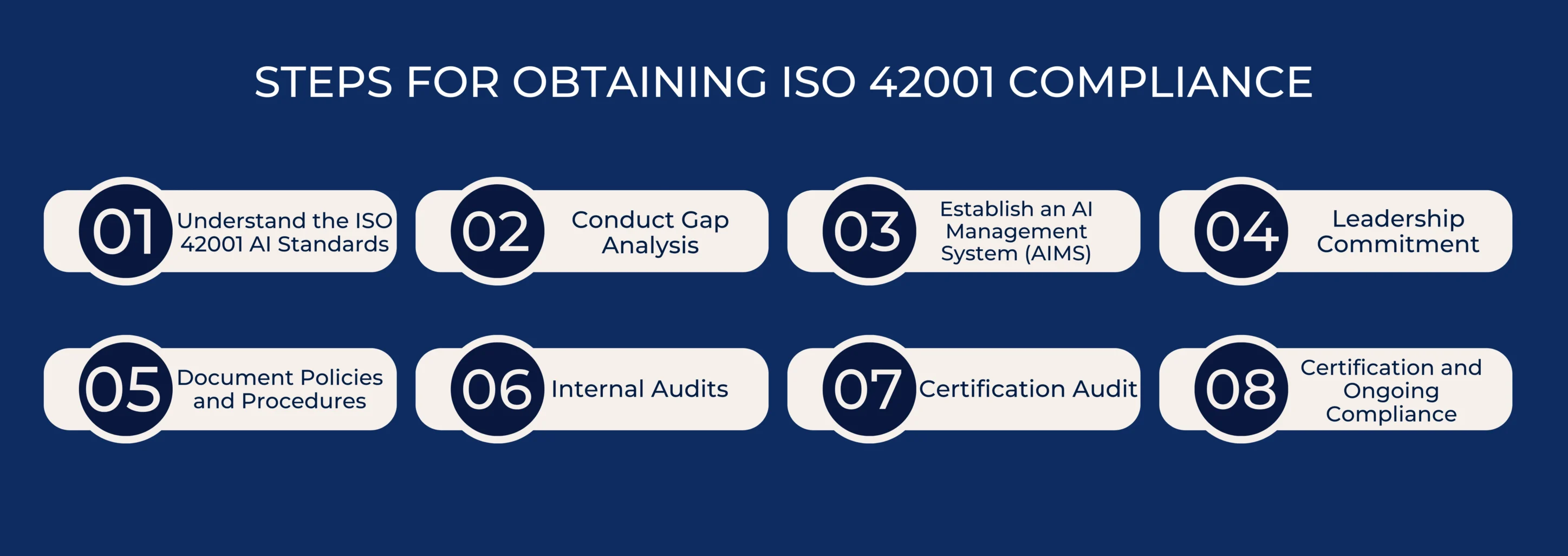
Organizations pursuing ISO 42001 certification in Canada follow a structured sequence of activities from initial scope definition through certification issuance. The following steps describe the end-to-end certification journey as executed under CertPro’s audit framework, with each step oriented toward building and evidencing a conformant AIMS prior to and during the formal audit process.
- Define the AIMS scope: Identify all AI systems, processes, organizational units, and geographic locations to be included within the certification boundary, and document the scope statement with reference to relevant internal and external context factors.
- Establish the AI policy: Develop and obtain top management approval for a documented AI policy that articulates the organization’s commitment to responsible AI governance, ethical AI use, and continual improvement of the AIMS.
- Conduct AI risk assessment: Identify AI-related risks and opportunities, evaluate their potential impact and likelihood, and document risk treatment decisions including selection of applicable Annex A controls.
- Complete AI impact assessments: Conduct documented assessments of the potential impacts of AI systems on individuals, groups, and society, particularly for high-risk AI applications subject to PIPEDA and sector-specific regulatory requirements.
- Develop and implement AIMS documentation: Create the Statement of Applicability, operational procedures, competence frameworks, and all other mandatory documented information required by ISO 42001.
- Operate and monitor the AIMS: Implement the documented procedures, operate AI governance controls, monitor AI system performance, and collect evidence of control operation over a defined operational period prior to the certification audit.
- Conduct internal AIMS audit: Perform a systematic internal audit of the AIMS covering all clauses and applicable controls, document findings, and initiate corrective actions for identified nonconformities.
- Conduct management review: Hold a formal management review meeting with top management to evaluate AIMS performance, review audit findings, assess resource adequacy, and make decisions regarding continual improvement priorities.
- Submit certification application to CertPro: Formally apply for ISO 42001 certification, providing scope documentation, organizational profile, and other required application information for audit program planning.
- Complete Stage 1 and Stage 2 audits: Participate in the CertPro-conducted Stage 1 documentation audit and Stage 2 conformity audit, providing access to documentation, personnel, and records as required by the audit program.
- Address nonconformities and submit evidence: Implement corrective actions for any nonconformities identified during the audit, document root cause analysis and corrective measures, and submit evidence to the auditor for verification.
- Receive ISO 42001 certification: Upon positive certification committee decision, receive the ISO 42001 certificate from CertPro and maintain the AIMS through annual surveillance audits and three-year recertification cycles.
ISO 42001 and AI Governance in Canada: Regulatory Context
Canada’s AI regulatory landscape is evolving rapidly, with multiple federal and provincial initiatives shaping the governance obligations of organizations that develop and deploy AI systems. ISO 42001 certification provides a durable governance foundation that adapts to regulatory developments, as the standard’s risk-based approach and management system structure can accommodate new requirements through scope updates, impact assessment revisions, and control additions rather than fundamental AIMS restructuring.
Canada’s Artificial Intelligence and Data Act (AIDA)
The Artificial Intelligence and Data Act (AIDA), proposed under Bill C-27, represents Canada’s first comprehensive federal AI legislation. AIDA, if enacted, would require operators of high-impact AI systems to implement risk assessment processes, maintain oversight mechanisms, monitor for harm, and report serious harms to designated regulators. The definitions of high-impact AI systems under AIDA would encompass AI applications in areas including employment decisions, credit and insurance, health services, administration of justice, and biometric identification — all sectors where Canadian organizations currently deploy ISO 42001-covered AI systems.
ISO 42001 certification positions organizations favorably relative to anticipated AIDA requirements by establishing documented risk management processes, impact assessments, monitoring controls, and accountability structures aligned with the obligations that high-impact AI system operators would face under the Act. While ISO 42001 certification is not currently referenced as a compliance mechanism under AIDA, the standard’s requirements substantially overlap with the governance measures that AIDA would mandate, making certification a proactive indicator of compliance readiness for the legislative framework that is expected to enter into force following parliamentary approval.
PIPEDA and Privacy-Integrated AI Governance
PIPEDA’s ten fair information principles — including accountability, identifying purposes, consent, limiting collection, limiting use, accuracy, safeguards, openness, individual access, and challenging compliance — create specific obligations for Canadian organizations processing personal information through AI systems. AI systems that make or influence decisions about individuals — such as credit scoring models, hiring algorithms, medical diagnostic tools, or behavioral targeting systems — must comply with PIPEDA’s requirements for consent, limiting use to identified purposes, and ensuring accuracy of personal information used in decision-making processes.
ISO 42001’s data governance controls and impact assessment requirements directly support PIPEDA compliance in AI contexts. Control 6.2 of Annex A addresses data for AI systems, requiring organizations to implement processes for data quality management, data provenance documentation, and data lifecycle controls. These controls create documented evidence of PIPEDA-aligned data governance practices that can be presented to the Office of the Privacy Commissioner during investigations or breach inquiries. ISO 42001 certification therefore functions as a complementary mechanism to PIPEDA compliance programs, providing third-party validation of AI-specific data governance maturity.
Sector-Specific AI Governance Requirements in Canada
Canadian financial institutions regulated by OSFI are subject to Guideline E-23 (Model Risk Management) and the evolving expectations of OSFI’s Technology and Cyber Security Risk Management Guideline. These guidelines establish expectations for model validation, model documentation, governance oversight of model development and use, and independent review of high-risk models. ISO 42001’s requirements for AI system lifecycle management, impact assessment, and performance monitoring are directly relevant to model risk management obligations under OSFI guidance. Banks, trust companies, and federally regulated insurers that hold ISO 42001 certification can demonstrate to OSFI examiners that AI model governance is managed within a systematic, audited framework.
ISO 42001 Certification for Specific Canadian Sectors
ISO 42001 certification addresses the distinct AI governance needs of different Canadian industry sectors, each of which faces unique regulatory requirements, risk profiles, and stakeholder expectations. The following sections describe how ISO 42001 certification applies within the context of Canada’s most significant AI-active sectors, reflecting the specific risks and compliance drivers relevant to each industry.
ISO 42001 Certification for Canadian Fintech and Financial Services
Canadian fintech companies and financial institutions deploy AI across a spectrum of applications including automated underwriting, anti-money laundering detection, robo-advisory platforms, payment fraud prevention, and customer service automation. These AI systems process sensitive personal and financial data, make or influence consequential decisions affecting individuals, and operate under OSFI, Financial Consumer Agency of Canada (FCAC), FINTRAC, and provincial securities regulatory oversight. ISO 42001 certification provides fintech organizations with a governance framework that addresses the intersection of AI risk, privacy risk, and financial services regulation within a single auditable management system.
For fintech companies seeking institutional banking partnerships, venture capital investment, or public listings, ISO 42001 certification provides an independent governance credential that satisfies due diligence requirements from partners, investors, and underwriters. The certification demonstrates that AI systems are governed by documented controls, managed by accountable personnel, and subject to regular independent audit — all characteristics that reduce perceived governance risk for sophisticated counterparties. Toronto’s MaRS Discovery District and Vancouver’s growing fintech ecosystem represent Canadian innovation hubs where ISO 42001 certification is increasingly recognized as a marker of institutional-grade AI governance maturity.
ISO 42001 Certification for Canadian Health Technology Organizations
Health technology organizations in Canada developing AI-powered diagnostic tools, clinical decision support systems, remote patient monitoring platforms, and health analytics applications face overlapping regulatory requirements from Health Canada’s medical device framework, provincial health privacy legislation, and professional regulatory bodies. ISO 42001 certification enables health technology organizations to demonstrate AI governance maturity to Health Canada during regulatory submission processes, to hospital procurement committees evaluating AI-enabled health IT systems, and to provincial health authorities assessing technology deployment proposals.
ISO 42001 Certification for Canadian SaaS and Technology Companies
Canadian SaaS providers and technology companies embedding AI capabilities into their products — including natural language processing, recommendation engines, predictive analytics, computer vision, and generative AI features — are increasingly subject to AI governance inquiries from their enterprise customers. B2B SaaS organizations selling to financial services, healthcare, government, and critical infrastructure clients face mandatory vendor security and governance assessments that include AI-specific questions about data use, model transparency, bias management, and incident response. ISO 42001 certification provides SaaS organizations with a comprehensive, audited response to these inquiries, reducing the time and resources required to complete multiple customer due diligence processes.
Why Choose CertPro for ISO 42001 Certification in Canada?
CertPro is a Licensed CPA Firm conducting ISO 42001 certification audits across Canada, with institutional certification authority and an audit methodology designed specifically for the requirements of AI management system conformity assessment. CertPro’s ISO 42001 audit program is structured to provide Canadian organizations with rigorous, credible certification that satisfies the due diligence expectations of regulators, enterprise clients, and institutional stakeholders. CertPro conducts ISO 42001 audits across Canada’s major business centers including Toronto, Vancouver, Montreal, Calgary, Ottawa, Edmonton, and Winnipeg, with both on-site and remote audit capabilities to accommodate geographically distributed organizations.
CertPro’s Audit Methodology and Certification Authority
CertPro’s ISO 42001 audit methodology is grounded in the requirements of ISO/IEC 17021-1, the international standard for conformity assessment bodies conducting management system certification, and incorporates sector-specific evaluation protocols developed to address the AI-specific risks relevant to Canadian industry contexts. CertPro’s audit team comprises professionals with expertise in AI governance, information security, risk management, and sector-specific regulatory requirements, enabling nuanced conformity assessment that goes beyond formulaic checklist evaluation. The certification committee that makes certification decisions is independent of the audit team, ensuring objective evaluation of audit evidence and nonconformity resolution.
CertPro’s ISO 42001 certifications are recognized by Canadian organizations’ clients, regulators, and partners as credible evidence of AIMS conformity. As a Licensed CPA Firm, CertPro brings an institutional audit culture characterized by documentation rigor, evidence-based findings, and professional accountability that aligns with the expectations of sophisticated organizational stakeholders. Organizations certified by CertPro can reference their certification in regulatory submissions, procurement responses, investor materials, and public communications with confidence in the certification’s institutional credibility.
CertPro’s Canadian Coverage and Sector Expertise
CertPro conducts ISO 42001 certification audits across Canada, with sector expertise spanning financial services, health technology, SaaS and software development, telecommunications, public sector technology, manufacturing, and retail. This sector breadth enables CertPro to apply contextually appropriate audit evaluation to organizations in each industry, assessing AI governance controls against the regulatory background and risk environment relevant to the specific sector. For multi-sector organizations with AI systems operating across different regulatory contexts, CertPro’s integrated audit approach addresses the full scope of applicable governance requirements within a single certification engagement.
FAQ
▶
What is ISO 42001 certification and what does it certify?
▶
How long does ISO 42001 certification take in Canada?
▶
Which Canadian organizations are required to obtain ISO 42001 certification?
▶
How does ISO 42001 relate to PIPEDA compliance for Canadian organizations?
▶
What is the difference between ISO 42001 and ISO 27001 for Canadian organizations?
▶
How are ISO 42001 surveillance audits conducted in Canada?
▶
Does ISO 42001 certification cover generative AI systems?
▶
What evidence does CertPro examine during an ISO 42001 audit?

MindSec Launches AI Compliance for Law 25 & ISO 42001
Excerpt from Barchart Article, Published on December 3, 2025 Today, Canadian organizations face increasing pressure to comply with stringent privacy a…

UNDERSTANDING ISO 42001: A GUIDE FOR RESPONSIBLE AI MANAGEMENT SYSTEMS
The invention of artificial intelligence (AI) has changed the operational processes of many industries. However, the rapid growth of technology increa…
ENSURING AI DATA PRIVACY COMPLIANCE WITH ISO 42001
According to Stanford’s AI report, the private AI investment in the U.S. alone reached more than $109 billion last year, which is equal to 12 times th…
Get In Touch
have a question? let us get back to you.