
SOC 2 Certification in Canada
The SOC 2 audit process in Canada follows a defined sequence of stages established under AICPA attestation standards. Each stage produces specific outputs that feed into subsequent stages, and the structured progression ensures that the final attestation report reflects a complete, documented examination of the organization’s control environment.The following stages describe the standard SOC 2 examination workflow conducted by a Licensed CPA Firm. Understanding each stage in advance helps Canadian organizations prepare efficiently and reduce delays during fieldwork.
OUR CLIENTS










What SOC 2 Certification in Canada Actually Means
SOC 2 Certification in Canada is a formal attestation issued by a Licensed CPA Firm confirming that an organization’s information security controls have been independently examined and validated against the AICPA Trust Services Criteria. The term “certified” reflects the outcome of a structured SOC 2 audit examination conducted under AICPA AT-C Section 205 attestation standards — not a self-assessed declaration, not an internal audit, and not a vendor-issued badge.
For Canadian organizations, this distinction carries material weight. Enterprise procurement teams, institutional customers, regulators, and third-party risk management programs treat a SOC 2 attestation as documentary evidence of independently verified control effectiveness. This is fundamentally different from internal policy documentation or self-reported compliance questionnaires.
The AICPA Trust Services Criteria define the control domains evaluated during a SOC 2 examination. Security is the mandatory baseline criterion, covering logical and physical access controls, system monitoring, incident response, and change management. Organizations may elect to include additional criteria — Availability, Processing Integrity, Confidentiality, and Privacy — based on the nature of their services, contractual obligations, and customer expectations.
Canadian SaaS providers, fintech firms, cloud service providers, healthcare technology organizations, and data center operators frequently include Availability and Confidentiality criteria. These additions address the specific assurance requirements of enterprise customers and regulated-industry clients.
SOC 2 Certification in Canada is pursued across the full spectrum of the Canadian technology and business ecosystem. Organizations headquartered in Toronto’s financial technology corridor, Vancouver’s cloud and AI sector, Montreal’s cybersecurity and software cluster, Ottawa’s government technology supply chain, Calgary’s energy technology market, and Edmonton’s growing SaaS sector all engage with the SOC 2 audit process in response to customer demands for documented, third-party-verified security assurance.
Canadian organizations serving U.S.-based enterprise customers face particularly structured SOC 2 requirements. U.S. procurement and vendor risk programs routinely require a current SOC 2 attestation report as a precondition for contract execution.
SOC 2 compliance for Canadian SaaS companies and technology service providers is not a one-time event. The attestation reflects a defined observation period — typically twelve months for a Type 2 report — during which auditors examine whether controls operated continuously and effectively, not merely whether they were designed correctly at a single point in time.
This temporal dimension is what distinguishes SOC 2 attestation from point-in-time security assessments or self-certification frameworks. Organizations must maintain documented control environments, evidence repositories, and operational procedures throughout the observation period to support the SOC 2 examination conducted by the Licensed CPA Firm.
For Canadian organizations operating under the Personal Information Protection and Electronic Documents Act (PIPEDA), Quebec’s Law 25, or sector-specific regulatory frameworks governing financial services, healthcare, and telecommunications, SOC 2 attestation provides a structured mechanism for demonstrating control effectiveness to customers and counterparties.
It is important to note that SOC 2 attestation does not automatically establish compliance with Canadian or provincial privacy legislation. However, the control disciplines examined during the SOC 2 audit — particularly under the Privacy and Confidentiality criteria — address many of the same information handling, access control, and data protection practices that Canadian privacy law requires organizations to maintain.

ENQUIRE NOW
Related Resources
Related Services in Canada
SOC 2 Type 1 and Type 2: Structural Differences and Selection Criteria
The SOC 2 framework produces two structurally distinct report types, and selecting the appropriate report type is one of the earliest scoping decisions in the SOC 2 audit process. Understanding the differences between a Type 1 and Type 2 report is essential for Canadian organizations planning their attestation program.
The two report types serve different assurance purposes and carry different evidential weight with customers and counterparties. Choosing the right format from the outset helps align the SOC 2 examination with enterprise customer expectations and internal readiness timelines.
A SOC 2 Type 1 audit Canada examination evaluates whether an organization’s controls are suitably designed to meet the applicable Trust Services Criteria as of a specific date. The auditor assesses the control environment, documents the description of the service organization’s system, and opines on whether the controls described are designed appropriately to achieve the stated control objectives.
The Type 1 report does not assess whether controls operated effectively over time — it reflects the state of the control environment on the report date. For organizations that have recently implemented a formal control framework and need to demonstrate foundational assurance to customers quickly, a Type 1 report serves as a practical initial attestation milestone. Canadian technology organizations entering new enterprise sales cycles, or those responding to vendor onboarding requirements for the first time, often initiate their SOC 2 program with a Type 1 examination.
A SOC 2 Type 2 audit Canada examination evaluates both the design and the operational effectiveness of controls over a defined observation period — typically six to twelve months for initial audits, and twelve months for recurring annual cycles. The auditor performs control testing across the observation period, examining evidence that controls operated consistently and effectively throughout.
Exceptions identified during testing are documented in the report, along with the organization’s response and any remediation taken. The Type 2 report provides substantially greater assurance than a Type 1 report and is the format most commonly required by enterprise customers, financial institutions, U.S.-based technology companies, and regulated-industry procurement programs. Canadian SaaS providers and cloud service organizations pursuing long-term enterprise relationships should treat the Type 2 report as the standard target for their ongoing SOC 2 compliance program.
| Dimension | SOC 2 Type 1 | SOC 2 Type 2 |
|---|---|---|
| Assessment Scope | Control design evaluated at a single point in time | Control design and operational effectiveness assessed over a defined observation period |
| Observation Period | None — single report date only | Typically 6–12 months (12 months for recurring annual cycles) |
| Evidence Testing | Design review and system description assessment | Control testing conducted across the full observation period |
| Assurance Level | Foundational — confirms design adequacy only | Higher — confirms operational continuity and sustained effectiveness |
| Typical Use Case | Initial attestation milestone for early-stage SOC 2 programs | Enterprise sales enablement, recurring vendor assurance, and third-party risk requirements |
- ✓SOC 2 Type 1 Audit Canada: Point-in-Time Design Assessment
- ✓SOC 2 Type 2 Audit Canada: Operational Effectiveness Over Time
SOC 2 Trust Services Criteria: The Examination Framework
The Trust Services Criteria (TSC), published by the AICPA, define the control domains against which a SOC 2 examination is conducted. Every SOC 2 audit must include the Security criterion — also referred to as the Common Criteria — which establishes the foundational control requirements applicable across all five criterion categories.
Canadian organizations select additional criteria based on their service commitments, contractual obligations, and the nature of the data they process and store. Aligning criterion selection to actual customer expectations ensures the SOC 2 attestation report delivers maximum assurance value.
The Security criterion addresses logical and physical access controls, system monitoring, change management, risk assessment, and incident response. It forms the mandatory baseline of every SOC 2 examination and is the criterion most directly aligned with general information security expectations.
The Availability criterion examines whether systems and services are available for operation and use as committed — covering infrastructure redundancy, capacity monitoring, backup procedures, and business continuity controls. Canadian cloud service providers, data center operators, and SaaS organizations with uptime commitments embedded in their service level agreements frequently include the Availability criterion in their SOC 2 audit scope. Doing so provides customers with documented, auditor-verified assurance of operational continuity practices.
The Processing Integrity criterion evaluates whether system processing is complete, accurate, timely, and authorized. This is a critical consideration for Canadian fintech organizations, payment processors, and healthcare data platforms where the accuracy of data processing carries direct regulatory and contractual significance.
The Confidentiality criterion examines controls protecting information designated as confidential under the organization’s policies and agreements — including encryption, access restriction, and data retention practices. The Privacy criterion assesses the organization’s practices for collecting, using, retaining, disclosing, and disposing of personal information in accordance with its privacy notice and applicable privacy principles.
For Canadian organizations subject to PIPEDA or Quebec’s Law 25, including the Privacy criterion in the SOC 2 examination scope provides a structured, externally validated assessment of personal information handling practices. This does not substitute for legal compliance determinations under those statutes, but it strengthens the organization’s documented accountability posture.
- ✓Security and Availability Criteria
- ✓Processing Integrity, Confidentiality, and Privacy Criteria
SOC 2 Certification Audit Process in Canada
The SOC 2 audit process in Canada follows a defined sequence of stages established under AICPA attestation standards. Each stage produces specific outputs that feed into subsequent stages, and the structured progression ensures that the final attestation report reflects a complete, documented examination of the organization’s control environment.
The following stages describe the standard SOC 2 examination workflow conducted by a Licensed CPA Firm. Understanding each stage in advance helps Canadian organizations prepare efficiently and reduce delays during fieldwork.
The first stage of the SOC 2 audit process involves defining the boundaries of the examination — identifying the systems, infrastructure components, applications, data flows, and organizational functions included within the audit scope. The scope definition determines which Trust Services Criteria apply and which controls will be subject to examination.
Concurrently, management develops the Description of the Service Organization’s System — a required component of the SOC 2 report. This document describes the boundaries of the system, the principal service commitments, relevant aspects of the control environment, and the controls in place to address each applicable criterion. The system description must be accurate and complete; misstatements or omissions are a reportable finding under the auditor’s SOC 2 examination procedures.
For a Type 2 examination, the Licensed CPA Firm conducts control testing across the defined observation period by examining documentary evidence, performing walkthroughs, conducting inquiries, and applying audit sampling procedures. Evidence types include access control logs, change management records, incident response documentation, vulnerability scan outputs, vendor management records, training completion records, and configuration documentation.
The auditor’s evidence collection procedures are designed to determine whether each control operated effectively throughout the observation period — not merely whether it was in place at a single point in time. Exceptions identified during testing are documented in the SOC 2 report along with their frequency and nature, enabling report users to assess materiality within their own risk frameworks.
Following the completion of control testing, the auditor and management review identified exceptions, assess their significance, and document management’s response. The Licensed CPA Firm then prepares the SOC 2 report, which includes the auditor’s opinion, the system description, the description of tests performed, the results of those tests, and any exceptions noted.
The auditor’s opinion — the SOC 2 attestation — states whether, in the auditor’s professional judgment, the controls were suitably designed (Type 1) and operated effectively (Type 2) during the examination period. The completed report is issued to the service organization and shared with specified user entities under confidentiality provisions. SOC 2 reports do not carry indefinite validity; organizations typically undergo annual audit cycles to maintain current attestation status and meet ongoing customer expectations.
- ✓Scope Definition and System Description Development
- ✓Control Testing, Evidence Collection, and Observation Period
- ✓Nonconformity Review, Report Issuance, and Attestation
Requirements for SOC 2 Certification in Canada
SOC 2 Certification in Canada requires organizations to satisfy a defined set of structural, documentary, and operational requirements before and during the audit examination. These requirements reflect the AICPA’s attestation standards and the operational expectations embedded in the Trust Services Criteria.
Understanding these requirements in advance enables organizations to structure their control environments and evidence practices in alignment with SOC 2 examination expectations — reducing preparation time and minimizing findings during fieldwork.
Organizations pursuing SOC 2 Certification in Canada must maintain a formally documented control environment that maps to the applicable Trust Services Criteria. This includes written information security policies, access management procedures, change management processes, incident response plans, risk assessment documentation, vendor management records, and business continuity and disaster recovery plans.
Each policy and procedure must be not only documented but demonstrably implemented — meaning controls must operate as written, with evidence generated through regular operations. Management assertion is a required component of the SOC 2 report: management must assert that the system description is accurate and that controls were suitably designed and, for Type 2 reports, operated effectively during the observation period. This assertion is subject to examination by the Licensed CPA Firm and carries formal accountability under attestation standards.
Technical requirements for SOC 2 compliance in Canada span multiple control domains under the Security criterion and any additional applicable criteria. Organizations must implement logical access controls restricting system access to authorized individuals, multi-factor authentication for privileged and remote access, encryption for data in transit and at rest, network security controls including firewalls and intrusion detection, vulnerability management programs with documented remediation timelines, and security monitoring with defined alerting and response procedures.
Change management controls must govern the development, testing, and deployment of system changes. Vendor and subservice organization management controls are required where third-party providers perform functions included within the system boundary. For Canadian organizations using cloud infrastructure — whether AWS, Microsoft Azure, or Google Cloud, all of which operate Canadian data center infrastructure — the vendor management controls within the SOC 2 audit scope must address the shared responsibility model applicable to the cloud services used.
- ✓Formally documented information security policies aligned to applicable Trust Services Criteria
- ✓Logical and physical access controls with documented authorization workflows and periodic review
- ✓Multi-factor authentication for privileged access and remote system entry
- ✓Encryption controls for data in transit and at rest, with documented key management procedures
- ✓Vulnerability management program with defined scanning frequency and remediation tracking
- ✓Incident response plan with documented detection, containment, and notification procedures
- ✓Change management controls governing development, testing, approval, and deployment
- ✓Vendor management program addressing subservice organization oversight and ongoing monitoring
- ✓Organizational and Documentation Requirements
- ✓Technical and Operational Control Requirements
Benefits of SOC 2 Certification for Canada-Based Organizations
SOC 2 Certification delivers a defined set of organizational outcomes directly tied to the attestation process. These outcomes result from the independent examination itself — not merely from the process of preparing for it — and are recognized by customers, regulators, and counterparties as evidence of verified control effectiveness.
For Canadian organizations competing for enterprise contracts, entering regulated markets, or managing third-party risk obligations, the benefits of SOC 2 Certification in Canada are concrete and commercially significant. The sections below outline the three most impactful outcome categories.
A current SOC 2 attestation report directly addresses the security assurance requirements embedded in enterprise vendor qualification programs. Canadian technology companies — particularly SaaS providers, cloud platforms, data analytics firms, and AI service organizations — regularly encounter SOC 2 report requests during procurement processes with large enterprises, financial institutions, healthcare organizations, and U.S.-based technology companies.
Without a current SOC 2 report, organizations must respond to customer security questionnaires individually — a process that consumes significant resources and often results in delayed or unsuccessful vendor approvals. A SOC 2 Type 2 report, issued by a Licensed CPA Firm, satisfies the independent assurance requirement embedded in most enterprise vendor risk frameworks. This enables faster procurement cycles and reduces the administrative burden associated with customer-specific security reviews.
Canadian financial institutions regulated by OSFI, healthcare organizations subject to provincial health information legislation, and telecommunications providers operating under CRTC oversight increasingly require their technology vendors to provide evidence of independent security control assessments. SOC 2 attestation provides a standardized, auditor-issued document that satisfies third-party risk management requirements across multiple regulated sectors — without requiring the service organization to undergo separate assessments for each customer relationship.
For Canadian organizations supplying services to U.S. financial institutions, healthcare organizations, or government contractors, SOC 2 attestation is frequently a baseline contractual requirement rather than a competitive differentiator. Organizations holding current SOC 2 attestation are also better positioned to respond to regulatory inquiries regarding information security practices, as the attestation provides documented evidence of independent examination rather than self-reported assurance.
The SOC 2 examination process produces a valuable secondary benefit: the documented control environment required to support the audit creates structural discipline in information security operations. Organizations that maintain evidence-generating controls — access review logs, change approval records, incident tracking, vendor assessment documentation — develop operational habits that reduce the likelihood of control failures and improve the ability to detect and respond to security events.
This internal control discipline also reduces the incremental effort required for subsequent annual SOC 2 audit cycles, as evidence collection becomes embedded in routine operations rather than assembled specifically for each examination period. For Canadian organizations subject to multiple compliance frameworks simultaneously — such as ISO 27001, PIPEDA, and SOC 2 — control documentation produced for the SOC 2 examination frequently satisfies parallel documentation requirements, reducing total compliance overhead.
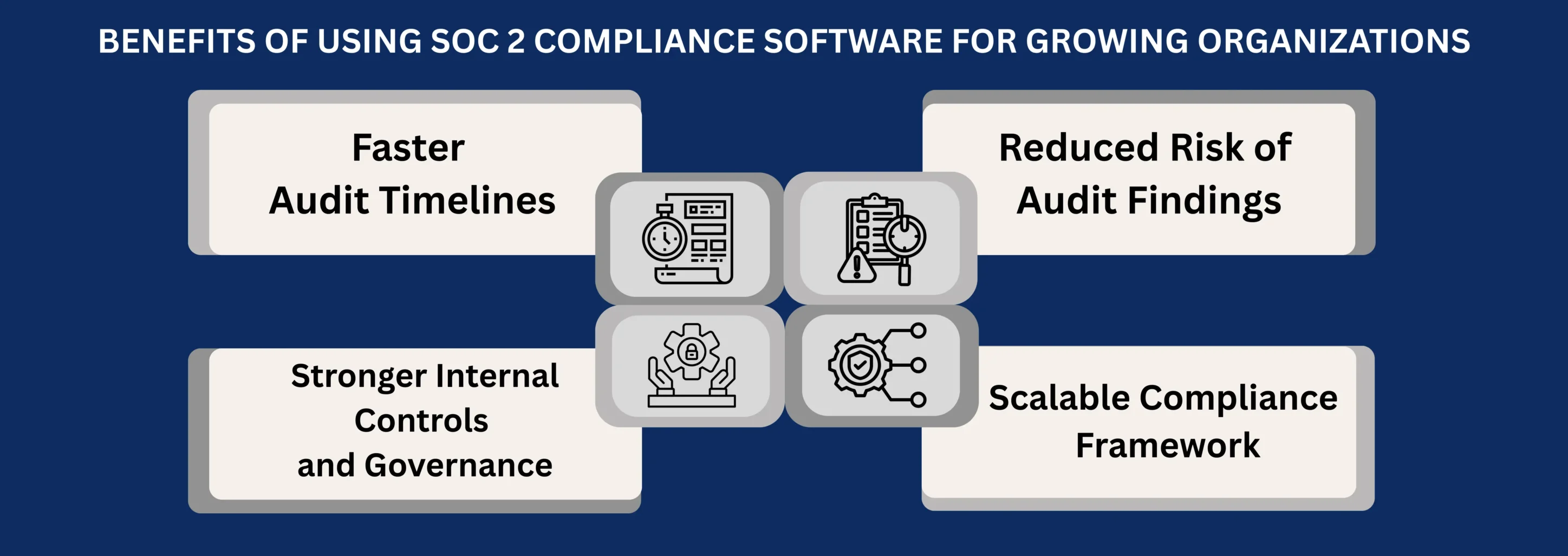
- ✓Enterprise Sales Enablement and Vendor Qualification
- ✓Regulatory Positioning and Third-Party Risk Management
- ✓Internal Control Discipline and Audit Efficiency
SOC 2 Certification for Canadian Industry Sectors
SOC 2 Certification in Canada is relevant across a broad range of industry sectors, each with distinct drivers for pursuing attestation. The following sector-specific considerations reflect the most common use cases encountered in the Canadian market, where SOC 2 audit engagements are concentrated in technology-intensive industries handling sensitive customer data, financial transactions, health information, and critical infrastructure operations.
SaaS, Cloud, and AI Organizations
Canadian SaaS providers and cloud service organizations represent the largest cohort of organizations pursuing SOC 2 Certification in Canada. These organizations typically process and store customer data across multi-tenant environments, making independent control verification a baseline expectation for enterprise customers. The SOC 2 audit scope for SaaS organizations typically includes the Security and Availability criteria, with Confidentiality added where the organization processes sensitive customer business data.
Canadian AI companies and machine learning platform providers face increasing customer and regulatory scrutiny regarding data governance, model training data handling, and output integrity. The SOC 2 Processing Integrity and Privacy criteria provide structured examination frameworks for these areas. Organizations operating across Toronto’s AI corridor, Vancouver’s cloud technology sector, and Montreal’s machine learning ecosystem are encountering SOC 2 compliance requirements at earlier stages of their enterprise sales cycles as institutional buyers formalize vendor risk programs.
Fintech, Financial Services, and Healthcare
Canadian fintech companies and financial services technology providers operate under heightened security assurance expectations driven by their customers’ regulatory obligations. Banks, credit unions, insurance companies, and investment firms that engage technology vendors are required by OSFI guidance and internal vendor risk frameworks to obtain evidence of independent security control assessments from their technology suppliers.
SOC 2 attestation — particularly a Type 2 report covering Security, Availability, and Confidentiality criteria — satisfies these requirements in a format recognized by financial sector risk and compliance functions. Canadian healthcare technology organizations, including electronic health record providers, clinical decision support platforms, and health data analytics companies, face parallel requirements under provincial health information protection legislation. SOC 2 examination engagements in the healthcare sector frequently incorporate the Privacy criterion to address the personal health information handling controls examined during the audit.
SOC 2 Certification and Canadian Privacy Law: Contextual Alignment
Canadian organizations subject to federal and provincial privacy legislation frequently evaluate the relationship between SOC 2 attestation and their statutory privacy compliance obligations. Understanding this relationship — and its limits — is essential for organizations communicating the scope of their SOC 2 report to customers, regulators, and legal counsel.
The sections below address how SOC 2 Certification in Canada intersects with PIPEDA, Quebec’s Law 25, and cross-border data transfer obligations.
PIPEDA, Quebec Law 25, and the SOC 2 Privacy Criterion
The Personal Information Protection and Electronic Documents Act (PIPEDA) governs the collection, use, and disclosure of personal information by private-sector organizations in federally regulated industries and in provinces without substantially similar provincial legislation. Quebec’s Law 25 establishes additional requirements including mandatory privacy impact assessments, data breach notification obligations, and the right to data portability.
The SOC 2 Privacy criterion, when included in the examination scope, evaluates an organization’s personal information handling practices against the AICPA’s Generally Accepted Privacy Principles — a framework addressing notice, choice, collection, use, retention, disclosure, and security of personal information. Controls examined under the Privacy criterion address many of the same practices required by PIPEDA and Law 25. However, SOC 2 attestation does not constitute a legal determination of compliance with Canadian or provincial privacy statutes. Organizations should not represent their SOC 2 report as establishing legal compliance with PIPEDA or Law 25 without independent legal assessment.
Data Residency and Cross-Border Transfer Considerations
Canadian organizations processing personal information in cross-border contexts — including those using U.S.-based cloud services, transferring data to U.S. parent companies, or serving customers in both Canada and the United States — face data residency and transfer accountability obligations under PIPEDA and provincial legislation. The SOC 2 system description must accurately identify where data is processed and stored, including the locations of subservice organizations and cloud infrastructure used within the system boundary.
For Canadian organizations using cloud infrastructure operated by AWS Canada (Central), Microsoft Azure Canada, or Google Cloud’s Montreal and Toronto regions, the system description should clearly document the geographic scope of data processing and any cross-border data flows. SOC 2 compliance examinations that include subservice organizations must address the controls at those organizations through either an inclusive scope approach or by relying on the subservice organization’s own SOC 2 report, depending on the auditor’s determination of appropriate examination methodology.
SOC 2 Audit Firms in Canada: Selecting a Licensed CPA Firm
SOC 2 attestation reports must be issued by a Licensed CPA Firm authorized to perform attestation engagements under applicable professional standards. In Canada, this means a firm holding a valid CPA license and possessing the technical competency to conduct examinations under AICPA AT-C Section 205 and the Trust Services Criteria.
Not all accounting firms have the specialized knowledge required to conduct SOC 2 examinations. The technical depth required to assess cloud security controls, multi-tenant architecture, cryptographic key management, and software development lifecycle controls demands examiners with information security expertise in addition to attestation qualifications. Selecting the right SOC 2 audit firm in Canada is a critical decision that affects both report quality and customer acceptance.
Auditor Independence, Scope, and Report Integrity
Auditor independence is a foundational requirement of the SOC 2 examination. A Licensed CPA Firm conducting a SOC 2 audit cannot have performed consulting, implementation, or advisory services for the same organization in the same period — doing so would impair the independence required for a valid attestation.
Organizations evaluating SOC 2 audit firms in Canada should confirm that the firm maintains strict independence, conducts examinations exclusively under AICPA attestation standards, and issues reports that clearly identify the firm’s CPA credentials and the attestation standard applied. SOC 2 reports issued by firms lacking required credentials — or reports that do not reference the applicable attestation standard — may not be accepted by enterprise customers or regulated-industry procurement functions. Users of SOC 2 reports should verify the issuing firm’s credentials before relying on the report for vendor assurance or risk management purposes.
Report Validity, Annual Cycles, and Ongoing SOC 2 Compliance
SOC 2 reports do not carry indefinite validity. Enterprise customers and vendor risk management programs typically treat a SOC 2 report as current if it covers an observation period ending within the prior twelve months. Organizations must complete annual audit cycles to maintain current attestation status and meet the ongoing expectations of customers and counterparties.
The annual cycle structure means that organizations with mature SOC 2 programs maintain continuous evidence collection processes aligned to the audit timeline, rather than assembling documentation specifically for each examination. For Canadian organizations that have completed their initial Type 1 attestation, the transition to an annual Type 2 cycle typically begins with an observation period of six to twelve months following the Type 1 report date, after which the full twelve-month annual cycle commences. Ongoing SOC 2 compliance requires not only maintaining controls but also updating the system description, management assertion, and control documentation to reflect material changes in the organization’s systems, services, or control environment.
FAQ
▶
What is SOC 2 Certification?
▶
What is SOC 2 Certification in Canada and who issues it?
▶
How long does the SOC 2 audit process take for a Canadian organization?
▶
What is the difference between SOC 2 certified and SOC 2 compliant?
▶
Which Trust Services Criteria should a Canadian organization include in its SOC 2 examination?
▶
Does SOC 2 attestation establish compliance with PIPEDA or Quebec’s Law 25?
▶
How often must a SOC 2 examination be conducted to maintain current attestation status?
▶
Can a small or early-stage Canadian company obtain SOC 2 Certification?
SOC 1 VS SOC 2: WHICH REPORT YOUR CUSTOMERS ACTUALLY ASK FOR
If you sell SaaS or provide outsourced services, you have likely been asked for a SOC report. However, the follow-up question is rarely easy to answer…

AICPA Issues New Guidance for Peer Reviewers Evaluating SOC 2 Engagements
AICPA SOC 2 guidance has been issued to help peer reviewers identify quality risks associated with SOC 2 engagements as the use of compliance automati…
SOC 2 Certified: What Does It Mean for Your Business
For companies that handle sensitive data or run cloud-based services, the question “Can you provide your SOC 2 report?” carries enormous weight. Yet, …
Get In Touch
have a question? let us get back to you.