
ISO 42001 Certification in Melbourne
CertPro is a Licensed CPA Firm conducting independent ISO 42001 certification audits for organisations in Melbourne. As a third-party audit body, CertPro delivers rigorous ISO 42001 assessment against ISO/IEC 42001:2023 requirements, evaluating AI Management Systems (AIMS) across governance structures, risk controls, lifecycle accountability, and AI system transparency. We serve technology, finance, and innovation-sector organisations throughout Melbourne seeking credible, independent ISO 42001 compliance verification.
OUR CLIENTS






What Is ISO 42001 Certification?
ISO 42001 certification is the internationally recognised standard for Artificial Intelligence Management Systems (AIMS), published by the International Organization for Standardization as ISO/IEC 42001:2023. It specifies requirements for establishing, implementing, maintaining, and continually improving an AI management system within an organisation. ISO 42001 certification in Melbourne provides a structured framework through which organisations can demonstrate that their AI systems are governed responsibly, ethically, and in accordance with established risk management principles. The standard applies to any organisation that develops, provides, or uses AI-based products or services, regardless of size, sector, or jurisdiction.
At its core, ISO/IEC 42001:2023 requires organisations to define the scope of their AI systems, identify associated risks and impacts, implement appropriate controls, and demonstrate accountability through documented evidence. The standard is structured around the Plan-Do-Check-Act (PDCA) cycle — common to other ISO management system standards — allowing organisations with existing ISO 27001 or ISO 9001 certifications to integrate AIMS requirements into their current governance infrastructure. ISO AIMS certification under this standard signals to regulators, clients, and stakeholders that an organisation’s AI operations meet globally recognised governance benchmarks.
The ISO/IEC 42001:2023 Standard Explained
ISO/IEC 42001:2023 was published in December 2023 as the first global management system standard specifically designed to address AI governance. The standard covers ten clauses aligned with the High-Level Structure (HLS) used across ISO management system standards, making it interoperable with ISO 27001, ISO 9001, and ISO 31000. Key clauses address context of the organisation, leadership and commitment, planning and risk assessment, support and resource management, operational control, performance evaluation, and continual improvement. Each clause mandates documented requirements that an independent audit body evaluates during ISO 42001 certification in Melbourne.
The standard introduces AI-specific concepts not present in other management system frameworks. These include AI system impact assessment, lifecycle management from design through decommissioning, transparency and explainability obligations, human oversight mechanisms, and clear accountability structures for AI-related decisions. Organisations seeking ISO 42001 certification must demonstrate that these concepts are embedded into operational policies — not merely documented in theory. The standard’s Annex A provides a reference control set of 38 controls across nine domains, each evaluated during the ISO 42001 audit process to verify effective implementation.
How ISO 42001 Differs from Other AI Governance Frameworks
ISO 42001 certification differs from AI ethics frameworks, voluntary guidelines, and regulatory checklists in one critical way: it requires third-party verification by a recognised audit body. Frameworks such as the OECD AI Principles, Australia’s AI Ethics Framework, and the EU AI Act provide policy direction, but none independently certify organisational conformance through structured audit procedures. ISO 42001 certification in Melbourne fills this gap by delivering an independent, evidence-based assessment of an organisation’s AIMS against internationally defined criteria. This distinction is especially important for Melbourne-based organisations operating in regulated sectors such as finance, healthcare, and government services.
ISO 42001 also differs from ISO 27001 in scope and focus. While ISO 27001 governs information security management, ISO 42001 governs the entire lifecycle of AI systems — including how they are designed, trained, validated, deployed, monitored, and retired. Organisations holding ISO 27001 certification have established information security controls that can be mapped to certain ISO 42001 requirements, reducing duplication of effort during the ISO 42001 assessment. However, ISO 42001 requires additional controls specific to AI risk, algorithmic transparency, and AI-specific impact assessment that go beyond information security. ISO AIMS certification therefore represents a distinct and complementary credential alongside existing management system certifications.
AI Management System (AIMS) Framework Overview
An AI Management System (AIMS) is the structured set of policies, procedures, roles, controls, and governance mechanisms through which an organisation manages its AI systems. ISO/IEC 42001:2023 defines the requirements an AIMS must satisfy to achieve certification. The AIMS framework encompasses four primary dimensions: governance and leadership, establishing senior accountability for AI decisions; risk management, identifying and controlling AI-related harms; operational control, governing how AI systems are built, tested, and deployed; and performance evaluation, measuring AIMS effectiveness through internal audits, management reviews, and continual improvement cycles. For organisations pursuing ISO 42001 certification in Melbourne, the AIMS must be formally scoped, documented, and subject to independent third-party evaluation.
| AIMS Dimension | Key Requirements | ISO 42001 Clause Reference |
|---|---|---|
| Governance & Leadership | AI policy, roles, responsibilities, top management commitment | Clause 5 |
| Risk Management | AI impact assessment, risk treatment, opportunity identification | Clause 6 |
| Operational Control | AI lifecycle management, data governance, supplier controls | Clause 8 |
| Performance Evaluation | Internal audit, management review, KPIs for AI systems | Clause 9 |
| Continual Improvement | Nonconformity management, corrective actions, AIMS updates | Clause 10 |

Why ISO 42001 Certification Matters for Melbourne Organisations
Melbourne has emerged as one of Australia’s most active centres for AI adoption, with a concentration of technology companies, fintech institutions, research universities, healthcare systems, and professional services firms deploying AI at scale. This rapid AI proliferation creates significant governance challenges that ISO 42001 certification in Melbourne directly addresses. Organisations deploying machine learning models, automated decision systems, natural language processing tools, or AI-driven analytics now face increasing scrutiny from regulators, institutional clients, and the public. ISO 42001 certification provides a structured mechanism to demonstrate that these systems are governed with appropriate controls and accountability structures.
Australia’s regulatory environment is evolving rapidly in response to AI-related risks. The Government’s voluntary AI Ethics Framework, Privacy Act reforms expanding automated decision-making accountability, and APRA’s heightened focus on algorithmic risk in financial services all create pressure on Melbourne organisations to demonstrate AI governance maturity. ISO 42001 compliance provides a recognised evidentiary basis for satisfying regulatory expectations, particularly as regulators increasingly reference international AI governance standards. For Melbourne-based fintech companies, insurtech platforms, and healthcare technology providers, ISO 42001 certification in Melbourne represents a credible and documented response to regulatory inquiries about AI risk management.
Melbourne’s AI Ecosystem and Certification Demand
Melbourne’s technology and innovation sector includes a mature fintech ecosystem spanning financial services, insurance, payments, and wealth management — industries increasingly deploying AI-driven products. The city hosts major financial institutions, superannuation funds, and digital lending platforms that use algorithmic models for credit decisioning, fraud detection, and customer personalisation. These applications carry significant regulatory and reputational risk when AI systems operate without documented governance controls. ISO 42001 certification for Melbourne companies in financial services provides objective, third-party validation that AI models are subject to appropriate risk assessment, monitoring, and accountability frameworks — aligned with both international standards and Australian regulatory expectations.
Beyond finance, Melbourne’s higher education and health technology sectors represent significant sources of ISO 42001 assessment demand. Universities and research institutions deploying AI in research outputs, student assessment, or administrative processes require AIMS frameworks addressing research ethics, data privacy, and bias prevention. Healthcare organisations using AI-assisted diagnostics, patient risk stratification, or clinical decision support systems require particularly robust AI governance given the direct implications for human welfare. ISO 42001 certification in Melbourne for these sectors demonstrates that AI use is subject to human oversight, documented impact assessment, and systematic risk management — criteria aligned with sector-specific regulation and community expectations of responsible AI deployment.
Regulatory Alignment and Australian AI Governance Context
ISO 42001 compliance aligns with multiple dimensions of Australia’s emerging AI regulatory landscape. The Australian Privacy Act 1988 and its ongoing reforms require organisations to manage personal data used in automated decision-making with transparency and accountability — requirements directly addressed by ISO 42001’s controls on data governance, human oversight, and AI impact assessment. APRA’s Prudential Practice Guides on technology and operational risk require financial institutions to maintain documented risk management frameworks for AI and algorithmic systems, creating a natural alignment with ISO 42001’s risk management requirements. For organisations subject to multiple regulatory frameworks, ISO 42001 assessment provides a consolidated mechanism for demonstrating governance maturity across these overlapping obligations.
International trade and procurement contexts are also increasingly relevant for Melbourne organisations. Government procurement guidelines, enterprise client requirements, and international supply chain standards are beginning to reference AI governance credentials explicitly. Organisations holding ISO AIMS certification are better positioned to respond to procurement questionnaires, regulatory inquiries, and due diligence requests from international partners. Melbourne’s position as a gateway to the Asia-Pacific technology market makes this international recognition particularly valuable, as ISO 42001’s global standing provides a common language for AI governance that transcends individual national regulatory frameworks.
Competitive Positioning Through ISO 42001 Certification
ISO 42001 certification in Melbourne delivers measurable competitive differentiation in procurement processes, enterprise sales cycles, and partnership negotiations. Enterprise clients and government agencies conducting vendor due diligence on AI-powered service providers now routinely request evidence of AI governance frameworks. An ISO 42001 certificate issued by an independent audit body provides objective, third-party verified evidence of AIMS conformance that internal attestations and self-assessments cannot match. For Melbourne SaaS companies, AI platform providers, and technology consultancies, ISO 42001 certification signals a level of governance maturity that clearly distinguishes certified organisations from uncertified competitors in tenders, RFP responses, and strategic partnership discussions.
ISO 42001 Certification Requirements
Achieving ISO 42001 certification requires organisations to satisfy a comprehensive set of documented requirements across governance, risk management, operational control, and performance evaluation domains. ISO 42001 compliance is not achieved through documentation alone — organisations must demonstrate that requirements are operationalised within actual AI system management practices and that conformance evidence is available for independent audit verification. The requirements are derived from the ten clauses of ISO/IEC 42001:2023 and the 38 controls in Annex A, each assessed during the ISO 42001 audit process conducted by CertPro as an independent audit body.
ISO 42001 requires top management to demonstrate active commitment to the AIMS by establishing an AI policy, defining roles and responsibilities for AI governance, and ensuring that AIMS objectives are integrated into the organisation’s strategic direction. The AI policy must address the organisation’s commitment to responsible AI use, ethical principles, legal and regulatory compliance, and continual improvement. Top management must also ensure the AIMS has sufficient resources — including personnel, technology infrastructure, and documented procedures — to function effectively. During the ISO 42001 audit, evidence of top management engagement is verified through policy documents, governance committee records, meeting minutes, and interviews with responsible executives.
Organisations must designate specific roles with defined accountability for AI system governance. These include an AI governance function responsible for overseeing AIMS implementation, an operational owner for each AI system within scope, and defined escalation paths for AI-related incidents, nonconformities, and risk decisions. The standard does not prescribe specific job titles but requires that accountability be formally assigned, documented, and understood by relevant personnel. For Melbourne organisations with complex AI portfolios spanning multiple business units, this may require a tiered governance structure with central oversight and business-unit-level accountability for individual AI applications.
ISO 42001 requires organisations to conduct systematic AI risk assessments and AI impact assessments for each AI system within the AIMS scope. AI risk assessment involves identifying risks from AI system operation — including model errors, data quality failures, adversarial attacks, and unintended discrimination — and evaluating their likelihood and consequence. AI impact assessment evaluates the potential effects of AI decisions on individuals, communities, and broader society, including analysis of fairness, privacy implications, and human rights considerations. Both processes must be documented, reviewed at defined intervals, and updated when AI systems are materially changed or when new risks are identified.
Risk treatment under ISO 42001 requires organisations to select and implement controls from Annex A that address identified risks to an acceptable level. Residual risks must be formally accepted by authorised personnel, and the risk treatment plan must be reviewed as part of the management review process. Organisations must also maintain documented evidence of risk assessment outcomes, treatment decisions, and residual risk acceptance records. These records form a critical component of the ISO 42001 audit evidence package and are reviewed in detail during the Stage 2 audit to verify that risk management is genuinely operationalised — not merely theoretical.
ISO 42001 requires organisations to establish documented controls for each stage of the AI system lifecycle — from initial design and data acquisition through model development, testing and validation, deployment, monitoring, and decommissioning. Operational controls must address data quality and governance requirements for training and operational data, model validation procedures verifying performance before deployment, change management processes for model updates or retraining, and monitoring mechanisms that detect performance degradation, bias drift, or unexpected behaviour in production. These lifecycle controls must be documented in procedures accessible to relevant personnel and subject to review during internal audits.
- ✓Documented AI system scope definition and context analysis
- ✓Formal AI policy approved by top management
- ✓Designated AI governance roles with defined accountability
- ✓AI risk assessment and risk treatment documentation
- ✓AI impact assessment for each AI system in scope
- ✓AI lifecycle management procedures from design to decommissioning
- ✓Data governance controls for training and operational data quality
- ✓Model validation and testing procedures before deployment
- ✓Human oversight mechanisms for AI-driven decisions
- ✓Internal audit programme covering all AIMS requirements
- ✓Management review records demonstrating AIMS performance evaluation
- ✓Documented corrective action processes for nonconformities
ISO 42001 certification requires organisations to maintain a defined set of documented information serving as evidence of AIMS implementation and conformance. Mandatory documented information includes the AIMS scope statement, AI policy, AI risk assessment records, AI impact assessment records, risk treatment plans, evidence of control implementation, internal audit reports, management review records, and records of nonconformities and corrective actions. Additionally, organisations must maintain documentation required by specific Annex A controls — such as AI system inventories, data governance records, supplier assessments for AI component providers, and incident records for AI-related events.
Documentation must be controlled through a documented information management procedure addressing creation, review, approval, version control, access restrictions, and retention periods. During the ISO 42001 audit, auditors verify that documented information is current, authorised, accessible to relevant personnel, and accurately reflects actual operational practices. Discrepancies between documented procedures and observed practices constitute potential nonconformities that must be resolved before certification can be issued. Organisations should ensure their document control systems can produce audit evidence efficiently, as auditor access to documented information is a critical component of the ISO 42001 assessment process.
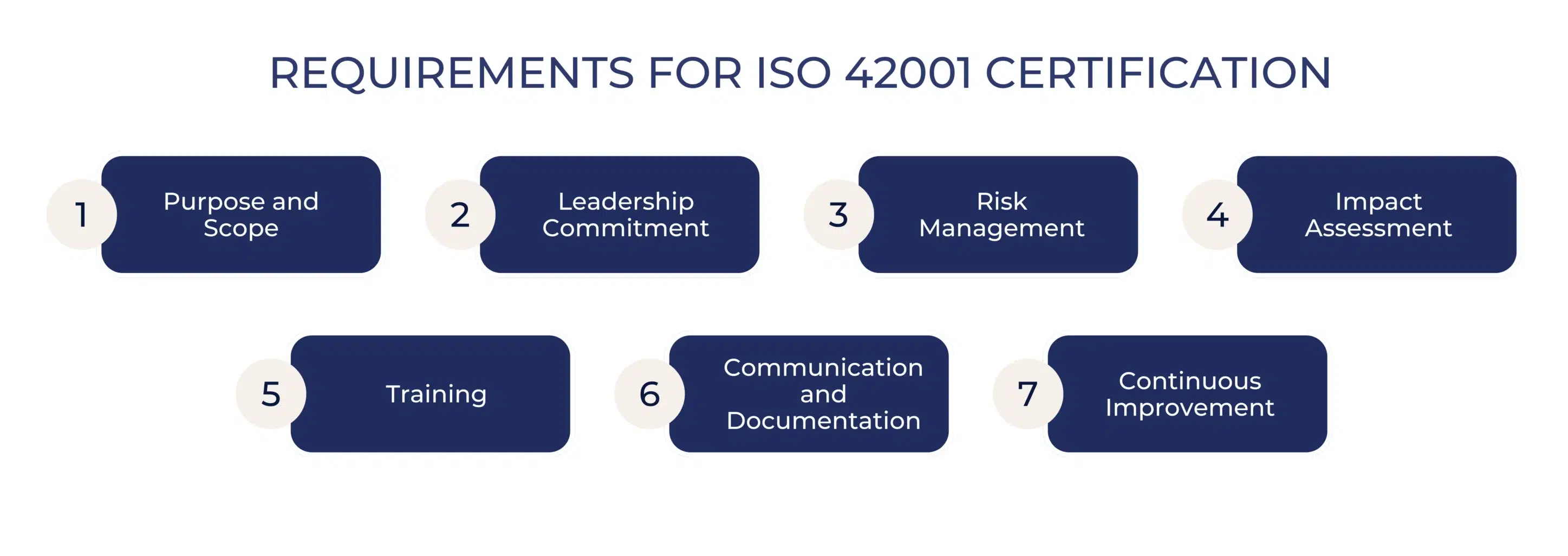
- ✓Governance and Leadership Requirements
- ✓Risk Management and AI Impact Assessment Requirements
- ✓AI Lifecycle and Operational Control Requirements
- ✓Documentation and Evidence Requirements
The ISO 42001 Certification Process
The ISO 42001 certification process conducted by CertPro as a Licensed CPA Firm follows a structured, multi-stage audit methodology designed to independently verify AIMS conformance with ISO/IEC 42001:2023 requirements. The process is sequenced to allow systematic evaluation of documented AIMS implementation before on-site or remote operational audit activities confirm that controls are functioning effectively in practice. ISO 42001 certification in Melbourne is awarded only upon successful completion of all required audit stages and satisfactory resolution of any nonconformities identified during the audit process.
The ISO 42001 audit process begins with a formal scope definition exercise in which the organisation and CertPro jointly establish the boundaries of the AIMS to be certified. The scope defines which AI systems, organisational units, geographic locations, and business processes are included in the certification. Scope definition is a critical step — it determines the extent of audit coverage and the applicable Annex A controls to be evaluated. Organisations with large or complex AI portfolios may choose to certify a subset of AI systems initially, with plans to expand scope in subsequent certification cycles. The scope must be documented and made available to relevant stakeholders.
Following scope definition, CertPro conducts a Stage 1 documentation review to assess whether the organisation’s AIMS documentation satisfies ISO/IEC 42001:2023 requirements and whether the organisation is sufficiently prepared for Stage 2 audit activities. The Stage 1 review examines the AIMS scope statement, AI policy, risk assessment methodology and records, AI impact assessment documentation, control implementation evidence, and internal audit and management review records. The Stage 1 audit produces a report identifying areas of conformance, areas requiring clarification, and any significant gaps that must be addressed before Stage 2 activities can proceed. This stage is essential for identifying documentation deficiencies early in the ISO 42001 assessment process.
The Stage 2 ISO 42001 audit is the primary conformance evaluation activity in which CertPro auditors assess whether the AIMS is implemented effectively in operational practice. Stage 2 involves interviews with key personnel, observation of AI system management processes, testing of selected Annex A controls, and review of operational evidence including logs, monitoring records, incident reports, and change management records. Auditors evaluate each applicable ISO/IEC 42001:2023 clause and Annex A control against documented criteria, gathering objective evidence of conformance or nonconformity. The Stage 2 audit is conducted on-site at Melbourne facilities or remotely for distributed or cloud-based AI operations, depending on the nature of the AIMS.
During the ISO 42001 audit in Melbourne, auditors pay particular attention to operational controls for AI lifecycle management, data governance practices, human oversight mechanisms, and incident management capabilities. Evidence evaluation includes review of model testing and validation records to verify quality assurance before deployment, examination of monitoring logs to confirm production performance tracking, and assessment of escalation and override procedures to verify that humans can intervene in AI-driven decisions when necessary. The Stage 2 audit report documents all findings — including conformances, observations, minor nonconformities, and major nonconformities.
Following the Stage 2 audit, identified nonconformities are classified as major or minor. Major nonconformities represent a failure to satisfy a fundamental AIMS requirement and must be resolved with documented corrective action evidence before certification can be issued. Minor nonconformities represent partial conformance or isolated failures and must be addressed through a corrective action plan accepted by CertPro within a defined timeframe — typically ninety days. Observations and improvement opportunities noted during the ISO 42001 audit do not prevent certification but should be considered as inputs to the continual improvement process. CertPro’s audit team reviews corrective action evidence before making the certification recommendation to the certification decision function.
The certification decision is made by a CertPro reviewer independent of the audit team, who evaluates the complete audit record including Stage 1 report, Stage 2 report, nonconformity records, and corrective action evidence. Upon a positive certification decision, CertPro issues the ISO 42001 certificate specifying the certified scope, applicable standard (ISO/IEC 42001:2023), certificate validity period, and the organisation’s name and location. The certificate is valid for three years subject to satisfactory annual surveillance audits. Organisations achieving ISO 42001 certification in Melbourne receive a certificate that can be referenced in public communications, client proposals, and regulatory submissions as third-party verification of AIMS conformance.
ISO 42001 certification is maintained through annual surveillance audits conducted by CertPro in the first and second years of the three-year certification cycle. Surveillance audits verify that the AIMS continues to conform with ISO/IEC 42001:2023 requirements, that corrective actions from previous audits have been effectively implemented, and that the organisation’s AI systems and governance practices have not materially changed in ways that affect AIMS conformance. Surveillance audits are typically narrower in scope than the initial certification audit, focusing on high-risk areas, changes to AI systems, and the functioning of continual improvement processes including internal audit and management review.
Recertification audits are conducted at the end of the three-year certificate validity period and involve a comprehensive re-evaluation of the AIMS comparable in scope to the initial certification audit. Organisations must initiate the recertification process sufficiently in advance of certificate expiry to ensure continuity of certification status. Failure to complete recertification before expiry results in lapse of ISO 42001 certification status, requiring the organisation to undergo a full initial certification process to regain the credential. CertPro maintains a recertification schedule for Melbourne clients and provides formal notification of upcoming surveillance and recertification audit dates within the annual audit programme.
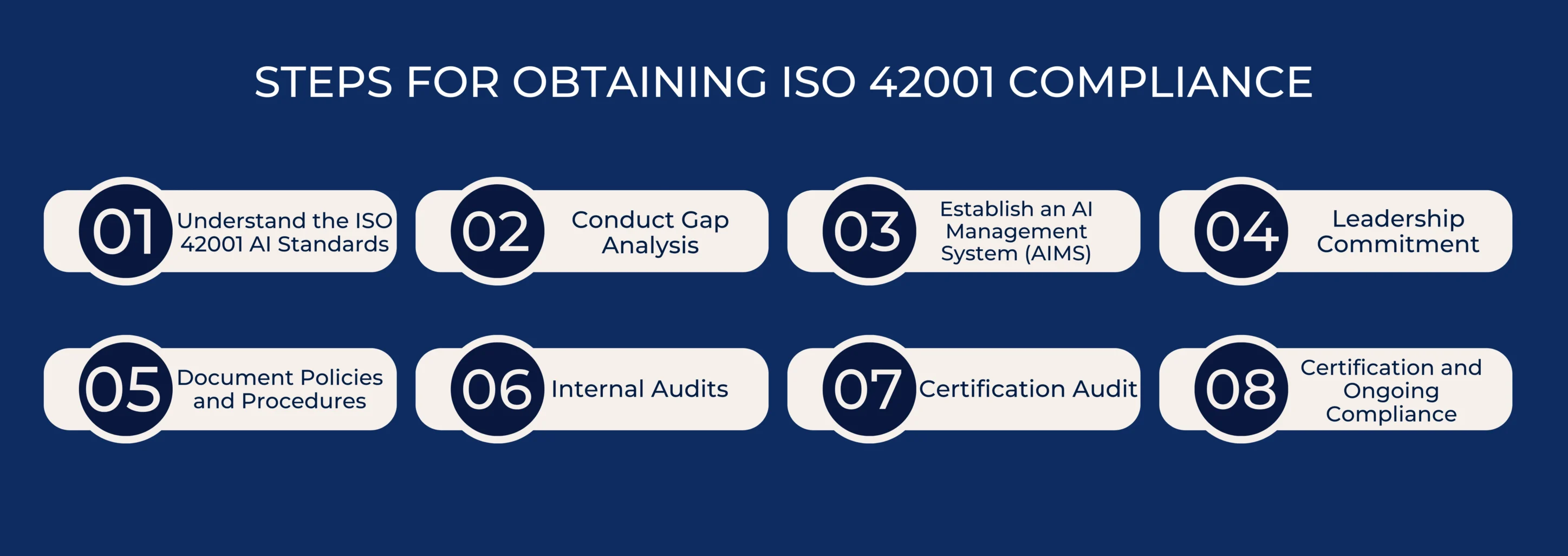
- ✓Stage 1: Scope Definition and Documentation Review
- ✓Stage 2: On-Site AIMS Audit and Control Evaluation
- ✓Nonconformity Resolution and Certification Decision
- ✓Surveillance Audits and Recertification
ISO 42001 Certification Steps for Melbourne Organisations
Organisations pursuing ISO 42001 certification in Melbourne should follow a defined sequence of preparatory and audit activities to ensure a structured path to certification. The steps below outline the standard progression from initial CertPro engagement through to certificate issuance. Each step involves specific organisational activities and produces documented outputs that form part of the ISO 42001 audit evidence base.
- Define the AIMS scope by identifying all AI systems, organisational units, and processes to be included in the certification boundary.
- Conduct an internal AI system inventory documenting each AI application, its purpose, data inputs, decision outputs, and operational context.
- Establish AI governance structures including an AI policy, defined roles and responsibilities, and top management commitment documentation.
- Complete AI risk assessments and AI impact assessments for each AI system within the defined AIMS scope.
- Implement Annex A controls selected as risk treatment measures and document evidence of control operation.
- Establish and execute an internal audit programme covering all ISO/IEC 42001:2023 clauses and applicable Annex A controls.
- Conduct a management review of AIMS performance using internal audit results, risk assessment updates, and performance metrics as inputs.
- Engage CertPro for Stage 1 documentation review and address any identified documentation gaps or nonconformities.
- Complete Stage 2 on-site or remote AIMS audit conducted by CertPro’s independent audit team.
- Resolve any nonconformities identified during the Stage 2 audit with documented corrective action evidence.
- Receive certification decision from CertPro’s independent reviewer and obtain the ISO 42001 certificate.
- Maintain AIMS conformance through annual surveillance audits and plan for recertification at the end of the three-year cycle.
ISO 42001 requires organisations to establish, implement, and maintain an internal audit programme that covers all clauses of the standard and applicable Annex A controls at planned intervals. The internal audit programme must be risk-based, with higher-risk areas or AI systems receiving more frequent audit attention. Internal auditors must be competent in ISO/IEC 42001:2023 requirements and independent of the activities they audit — meaning personnel cannot audit their own work. Internal audit reports must document findings including conformances, nonconformities, and observations, and must be reported to top management as inputs to the management review process.
For Melbourne organisations with limited internal audit resources, the internal audit programme can be designed to distribute audit activities across the year rather than conducting a single annual audit event. This approach reduces the administrative burden while ensuring continuous AIMS oversight throughout the certification cycle. Internal audit records — including audit plans, checklists, reports, and corrective action tracking records — are reviewed by CertPro auditors during both the Stage 1 documentation review and the Stage 2 ISO 42001 audit to verify that the internal audit programme is functioning as required by ISO/IEC 42001:2023.
- ✓Internal Audit Programme Requirements
Benefits of ISO 42001 Certification in Melbourne
ISO 42001 certification in Melbourne delivers tangible benefits to organisations across the full spectrum of AI use cases — from customer-facing AI products to internal operational AI applications. These benefits extend across commercial, regulatory, operational, and reputational dimensions, creating value that compounds as AI governance maturity increases. The benefits of ISO AIMS certification are particularly significant for Melbourne organisations operating in competitive markets where AI governance credentials increasingly influence procurement decisions and enterprise relationships.
- ✓Independent third-party verification of AI governance maturity through structured ISO 42001 audit evaluation
- ✓Demonstrated ISO 42001 compliance with international AI governance standards recognised by regulators and enterprise clients
- ✓Strengthened stakeholder confidence in AI system safety, fairness, and accountability through certified AIMS controls
- ✓Competitive differentiation in procurement processes where AI governance credentials are evaluated by enterprise and government buyers
- ✓Reduced AI-related regulatory risk through documented conformance with internationally recognised AI management requirements
- ✓Structured framework for identifying and managing AI-related risks before they materialise as operational incidents or regulatory findings
- ✓Integration capability with existing ISO 27001, ISO 9001, or ISO 31000 management systems through the High-Level Structure
- ✓Defined accountability structures that clarify responsibility for AI decisions and reduce ambiguity in governance ownership
- ✓Enhanced data governance practices that improve AI model quality, reliability, and auditability over the AI system lifecycle
- ✓Systematic continual improvement mechanism that keeps AIMS controls current with evolving AI technologies and regulatory expectations
ISO 42001 compliance provides Melbourne organisations with a structured evidence base for demonstrating AI governance to regulators, reducing the risk of enforcement action related to AI system failures, discriminatory outcomes, or inadequate human oversight. As Australian regulators — including the OAIC, ASIC, APRA, and the ACCC — increasingly focus on AI-related harms and automated decision-making accountability, organisations with documented and certified AIMS frameworks are better positioned to respond to regulatory inquiries and information requests. ISO 42001 certification in Melbourne provides evidence that AI risks have been assessed, controls implemented, and governance subject to ongoing monitoring — evidence that is difficult to produce quickly without a structured AIMS.
The legal risk reduction dimension of ISO 42001 certification is particularly relevant for Melbourne organisations facing potential liability from AI-driven decisions that adversely affect individuals. Organisations that can demonstrate ISO 42001 compliance — including documented impact assessments, bias controls, and human oversight mechanisms — are in a stronger legal position when AI decisions are challenged. The certification provides evidence of due diligence in AI system governance. This protection is valuable across sectors including financial services, employment, healthcare, and insurance, where AI decisions directly affect individual rights and financial interests.
Beyond regulatory and reputational benefits, ISO 42001 certification delivers direct operational improvements through the structured governance controls it requires. AI systems subject to documented lifecycle management, validation procedures, and performance monitoring are more reliable and less prone to unexpected behaviour changes in production. The data governance requirements of ISO 42001 improve the quality and consistency of training data, which directly enhances AI model performance. Incident management and corrective action processes required by the standard create systematic mechanisms for identifying and resolving AI system issues before they escalate into major operational failures or customer-facing incidents.
Commercially, Melbourne fintech and technology organisations holding ISO 42001 certification benefit from shortened enterprise sales cycles where AI governance due diligence requirements can otherwise delay contract execution by months. Organisations can provide potential clients with the certificate as evidence of AIMS conformance, reducing the time and cost of responding to extended AI governance questionnaires and vendor assessments. This efficiency benefit is measurable in terms of reduced sales cycle duration and lower pre-sales compliance overhead — particularly for Melbourne SaaS companies selling AI-enabled products to enterprise clients in financial services, government, and healthcare sectors.
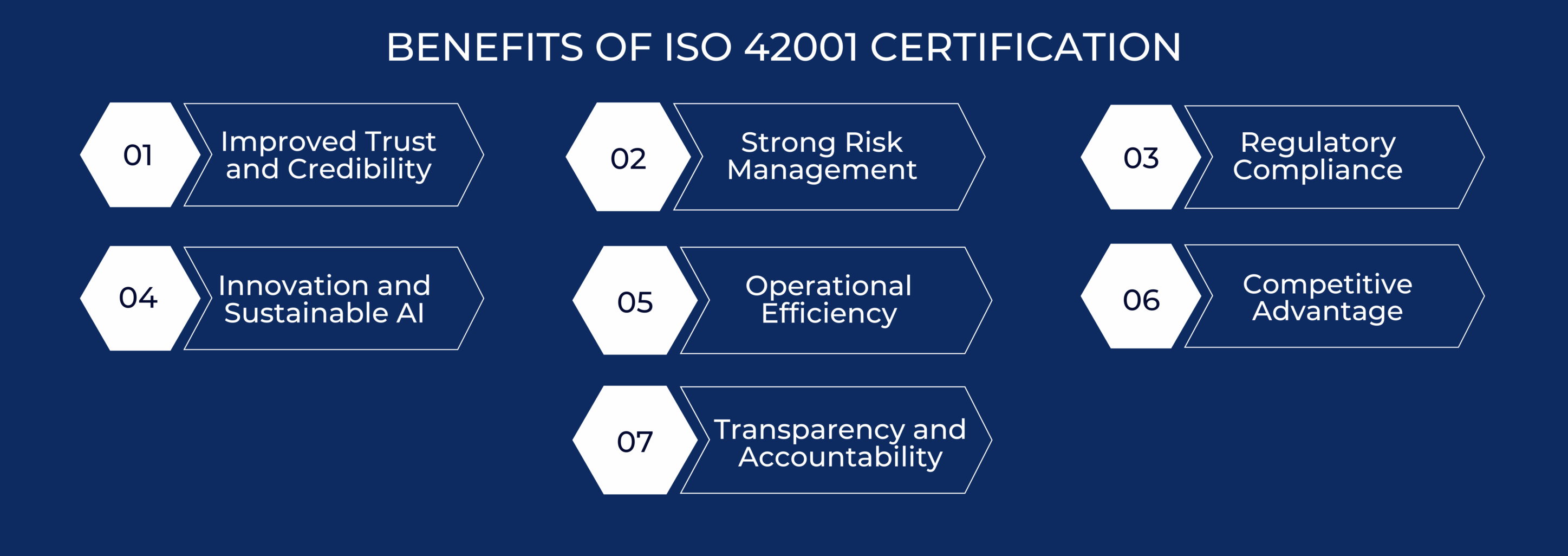
- ✓Regulatory and Legal Risk Reduction
- ✓Operational and Commercial Benefits
ISO 42001 Certification Cost in Melbourne
The cost of ISO 42001 certification in Melbourne is determined by multiple factors specific to each organisation’s AIMS scope, complexity, and current governance maturity. CertPro provides transparent, fixed-fee pricing for ISO 42001 audit services, determined following an initial scope assessment that establishes the full audit programme requirements. The primary cost drivers for ISO 42001 certification in Melbourne include the number of AI systems within scope, organisational size and personnel involved in AIMS governance, the complexity of AI technologies deployed, geographic distribution of operations, and the maturity of existing management system frameworks that can be leveraged during the certification process.
Factors Influencing ISO 42001 Certification Cost
Organisations with a limited number of well-defined AI systems operating within a single business unit typically incur lower ISO 42001 certification costs than organisations with diverse AI portfolios spanning multiple departments, geographies, or technology stacks. The scope of the Annex A control set applicable to the certified AIMS directly influences audit duration and therefore cost. Organisations with complex AI systems involving third-party components, algorithmic training pipelines, or real-time decision engines require more extensive control evaluation than those using pre-built AI tools with limited customisation. Existing ISO 27001 or ISO 9001 certification reduces ISO 42001 assessment costs by establishing a documented evidence infrastructure that can be partially leveraged during the AIMS audit.
| Organisation Profile | AIMS Complexity | Estimated Audit Duration | Key Cost Factors |
|---|---|---|---|
| Small technology firm, 1-3 AI systems | Low to Medium | 3-5 audit days | Scope definition, documentation review, Stage 2 audit |
| Mid-size fintech, 4-8 AI systems | Medium to High | 6-10 audit days | Multiple system evaluation, data governance, model validation |
| Enterprise, 9+ AI systems or multi-site | High | 10-15+ audit days | Multi-site audit, complex control set, multiple AI lifecycle stages |
| Research institution with AI research outputs | Medium | 5-8 audit days | Research ethics, data governance, publication accountability |
CertPro’s fixed-fee pricing model for ISO 42001 certification in Melbourne provides cost certainty from the outset of each certification engagement. Following the initial scope assessment, CertPro provides a detailed audit programme specifying audit stages, estimated audit days, and fixed fees for Stage 1, Stage 2, annual surveillance audits, and recertification. This transparency allows Melbourne organisations to budget accurately for ISO 42001 certification as a defined compliance investment with predictable three-year cycle costs. Contact CertPro to obtain a scope-based pricing proposal tailored to your organisation’s specific AIMS configuration and certification objectives.
ISO 42001 Compliance for Specific Melbourne Industry Sectors
ISO 42001 compliance requirements and audit focus areas vary by industry sector based on the specific AI applications deployed, the regulatory environment governing those applications, and the risk profile of AI-driven decisions within each sector. Melbourne’s diverse economy encompasses multiple industry verticals where AI adoption is advanced and where ISO 42001 certification delivers sector-specific compliance value. CertPro’s ISO 42001 audit methodology accommodates sector-specific control evaluation requirements across the following key Melbourne industry segments.
Financial Services and Fintech
Melbourne’s financial services sector — including banking, superannuation, insurance, lending, and payments — represents one of the most AI-intensive industry segments in Australia. Financial services organisations deploy AI for credit scoring, fraud detection, anti-money laundering monitoring, customer segmentation, investment recommendation, and regulatory reporting automation. Each of these applications carries significant risk if AI systems produce inaccurate, biased, or unexplainable outcomes. The ISO 42001 assessment for Melbourne fintech organisations evaluates controls specific to algorithmic decision transparency, model validation for high-stakes financial decisions, data lineage for training datasets, and human override mechanisms for credit and lending decisions subject to regulatory requirements.
APRA’s operational risk framework and ASIC’s responsible lending obligations create specific governance requirements for AI systems used in financial decision-making that align closely with ISO 42001 controls on human oversight, explainability, and bias assessment. ISO 42001 certification in Melbourne for fintech organisations provides documented evidence of AIMS conformance that can be referenced in APRA prudential reviews, ASIC supervisory engagements, and client due diligence processes. For superannuation funds using AI in investment management or member services, ISO AIMS certification demonstrates governance maturity aligned with Australian Prudential Standard SPS 220 operational risk requirements.
Healthcare and Life Sciences
Healthcare organisations in Melbourne deploying AI for clinical decision support, diagnostic imaging analysis, patient risk stratification, or administrative automation require robust AI governance given the direct implications for patient safety and health outcomes. The ISO 42001 assessment in this sector evaluates controls on AI system validation for clinical use, human clinical oversight requirements, patient data governance for AI training datasets, and incident management for AI system failures affecting clinical outcomes. The Therapeutic Goods Administration (TGA) and the Australian Digital Health Agency have both signalled increasing regulatory attention to AI-based medical devices and clinical decision support tools, making ISO 42001 compliance documentation increasingly relevant for Melbourne’s health technology organisations.
Technology, SaaS, and AI Platform Providers
Melbourne SaaS companies and AI platform providers offering AI-enabled products or services to enterprise clients face growing demands for AI governance evidence from both clients and procurement frameworks. For these organisations, ISO 42001 certification in Melbourne provides a market-facing credential demonstrating commitment to responsible AI development and deployment throughout the product lifecycle. The ISO 42001 audit for AI platform providers evaluates controls on AI model development governance, training data quality and sourcing, model versioning and change management, client-facing transparency disclosures, and mechanisms through which client organisations can exercise human oversight over AI outputs delivered through the platform.
ISO 42001 Assessment: Key Audit Focus Areas
The ISO 42001 assessment conducted by CertPro evaluates AIMS conformance across a defined set of audit focus areas reflecting the critical requirements of ISO/IEC 42001:2023 and the 38 controls in Annex A. Understanding these focus areas allows Melbourne organisations to prioritise their AIMS implementation efforts and ensure that the most critical governance requirements receive appropriate attention before the ISO 42001 audit. The following audit focus areas represent the areas of greatest significance in CertPro’s ISO 42001 audit methodology.
AI System Transparency and Explainability Controls
Transparency and explainability represent core governance principles in ISO/IEC 42001:2023 and are evaluated as a dedicated focus area during the ISO 42001 assessment. Organisations must demonstrate that AI systems operate in a manner understandable to relevant stakeholders — including individuals affected by AI decisions, personnel responsible for AI governance, and external oversight bodies. This does not necessarily require full algorithmic transparency for all AI systems, but does require the organisation to have documented the intended purpose, decision criteria, and operational boundaries of each AI system. Affected individuals must also be able to obtain meaningful explanations of AI-driven decisions that materially affect them.
The ISO 42001 audit evaluates documentary evidence of transparency controls — including AI system purpose statements, explainability policies, disclosure mechanisms for individuals subject to AI decisions, and records of stakeholder communication about AI system operation. For Melbourne organisations using complex machine learning models where individual decision explanation is technically challenging, the audit assesses whether appropriate compensating controls — such as enhanced human review requirements or population-level fairness monitoring — are in place. Organisations are required to acknowledge and document transparency limitations rather than assert full explainability where it does not technically exist.
Data Governance and Training Data Quality
Data governance is a critical focus area in the ISO 42001 assessment because AI system performance, fairness, and reliability are fundamentally dependent on the quality, representativeness, and governance of training and operational data. The ISO 42001 audit evaluates controls on data sourcing and selection for AI training, data quality assessment procedures, bias detection in training datasets, data lineage documentation, and governance of data used in production AI operations. Organisations must demonstrate that training data is subject to documented quality criteria, that bias assessment has been conducted before model deployment, and that data governance responsibilities are clearly assigned within the AIMS governance structure.
Third-Party AI Component and Supplier Governance
Many Melbourne organisations deploy AI systems incorporating third-party components — including pre-trained foundation models, AI APIs from cloud providers, licensed algorithmic components, or AI platform services from SaaS vendors. ISO 42001 requires organisations to extend their AIMS governance to these third-party components through documented supplier assessment and monitoring processes. The ISO 42001 audit evaluates whether organisations have identified AI-related risks from third-party components, assessed suppliers’ AI governance practices, established contractual requirements for AI system transparency and accountability, and implemented monitoring processes to detect changes in third-party AI component behaviour that may affect AIMS conformance.
For Melbourne organisations using large language models (LLMs) or foundation models from major cloud AI providers as components within their AI systems, the ISO 42001 assessment focuses on whether the organisation has documented the boundaries of its governance responsibility relative to the AI component provider, implemented appropriate controls at the integration layer, and established monitoring mechanisms for detecting unexpected LLM behaviour in production. The organisation cannot delegate its ISO 42001 compliance obligations to AI component suppliers but must demonstrate governance controls that account for the inherent limitations and risks of third-party AI components within the overall AIMS framework.
CertPro ISO 42001 Certification Services in Melbourne
CertPro is a Licensed CPA Firm providing independent ISO 42001 certification audit services to organisations across Melbourne and the broader Australian market. As a third-party audit body, CertPro evaluates AI Management Systems against ISO/IEC 42001:2023 requirements through structured, evidence-based audit processes that produce objective assessments of AIMS conformance. CertPro’s ISO 42001 audit services are strictly limited to certification audit activities — evaluation, assessment, and certification determination — and do not include AIMS design, policy development, control implementation, or any advisory or consulting activities that would compromise CertPro’s independence as an audit body.
CertPro’s Audit Methodology and Independence
CertPro’s ISO 42001 audit methodology is designed to ensure objectivity, consistency, and rigour in AIMS conformance evaluation. Audit teams are composed of lead auditors with documented competence in ISO/IEC 42001:2023 requirements and AI system governance, supported by technical specialists where AI systems involve complex technology domains such as machine learning model governance, AI ethics assessment, or AI risk quantification. The CertPro audit programme is developed specifically for each client engagement based on the defined AIMS scope, ensuring audit coverage is proportionate to the complexity and risk profile of AI systems within scope. Certification decisions are made by CertPro personnel independent of the audit team to maintain separation of audit and decision functions.
CertPro maintains strict conflict of interest policies that prohibit audit personnel from having financial, personal, or professional relationships with client organisations that could impair audit independence. These policies align with international requirements for certification body independence and ensure that ISO 42001 certification issued by CertPro carries the objective credibility expected by regulators, clients, and other stakeholders who rely on certification as an independent assurance mechanism. Melbourne organisations selecting CertPro for ISO 42001 certification receive independent audit evaluation by a Licensed CPA Firm with structured audit methodology, documented auditor competence, and clear separation between audit and certification decision functions.
Integration with Other CertPro Certification Services
Melbourne organisations holding or pursuing other CertPro certifications — including ISO 27001, ISO 9001, or SOC 2 — can leverage the High-Level Structure alignment between ISO/IEC 42001:2023 and these frameworks to achieve integration efficiencies in their AIMS audit programme. CertPro can coordinate integrated audit programmes that evaluate multiple management system standards concurrently, reducing the total audit burden while maintaining the rigour and independence required for each individual certification. Organisations that already hold ISO 27001 certification benefit from existing documented information controls, internal audit infrastructure, and management review processes that satisfy parallel requirements in ISO/IEC 42001:2023 — allowing ISO 42001 audit focus to concentrate on AI-specific requirements rather than repeating evaluation of shared management system elements.
Securing ISO 42001 Certification in Melbourne with CertPro
ISO 42001 certification in Melbourne represents a substantive governance milestone for organisations committed to responsible, accountable, and transparent AI operations. As AI systems become increasingly embedded in Melbourne’s technology, financial services, healthcare, and public sector landscapes, the demand for independent, third-party verified AI governance credentials will continue to grow. CertPro, as a Licensed CPA Firm with structured ISO 42001 audit methodology, provides Melbourne organisations with the independent certification evaluation required to demonstrate AIMS conformance to ISO/IEC 42001:2023. The certification process is rigorous, evidence-based, and designed to produce a credential that carries genuine credibility with regulators, enterprise clients, and institutional stakeholders.
Organisations pursuing ISO 42001 certification in Melbourne should engage with CertPro’s audit team to initiate the scope assessment process, which establishes the AIMS boundaries, audit programme requirements, and fixed-fee pricing for the full three-year certification cycle. CertPro’s independent ISO 42001 audit approach ensures that certification decisions are based exclusively on objective evidence of AIMS conformance — providing Melbourne organisations and their stakeholders with the assurance that ISO 42001 certification reflects genuine governance maturity rather than procedural compliance. Contact CertPro to initiate your ISO 42001 assessment engagement and advance your organisation’s AI governance certification programme.
ISO 42001 compliance is not a destination but a continual commitment to improving AI governance as technologies, regulations, and stakeholder expectations evolve. Organisations that establish robust AIMS frameworks and subject them to independent ISO 42001 audit scrutiny are better positioned to adapt AI governance practices as the AI landscape changes, to demonstrate regulatory responsiveness in a dynamic regulatory environment, and to build the long-term stakeholder trust that underpins sustainable AI-driven business operations. CertPro’s structured three-year certification cycle — encompassing initial certification, annual surveillance, and recertification — provides Melbourne organisations with an ongoing governance assurance mechanism that keeps AIMS conformance current and credible throughout the AI system lifecycle.
FAQ
▶
What is ISO 42001 and what does it certify?
▶
Who needs ISO 42001 certification in Melbourne?
▶
How long does the ISO 42001 certification process take?
▶
What is the difference between ISO 42001 audit Stage 1 and Stage 2?
▶
How does ISO 42001 certification relate to Australian AI regulations?
▶
Can ISO 42001 be integrated with an existing ISO 27001 certification?
▶
What is ISO AIMS certification and is it the same as ISO 42001?
▶
What happens after ISO 42001 certification is issued?
ISO 42001 CERTIFIED: WHY AI GOVERNANCE CERTIFICATION IS BECOMING A BOARD-LEVEL REQUIREMENT
AI is now an inevitable component of major business activities in the current corporate world. To elaborate, it is now part of product design, custome…

MindSec Launches AI Compliance for Law 25 & ISO 42001
Excerpt from Barchart Article, Published on December 3, 2025 Today, Canadian organizations face increasing pressure to comply with stringent privacy a…

UNDERSTANDING ISO 42001: A GUIDE FOR RESPONSIBLE AI MANAGEMENT SYSTEMS
The invention of artificial intelligence (AI) has changed the operational processes of many industries. However, the rapid growth of technology increa…
Get In Touch
have a question? let us get back to you.