
ISO 42001 Certification in Sydney
CertPro is a Licensed CPA Firm delivering accredited ISO 42001 certification audits for organisations in Sydney, Australia. Certification assessments are conducted against the ISO/IEC 42001:2023 standard for AI Management Systems (AIMS), covering governance, risk management, accountability, and responsible AI deployment across all applicable organisational contexts.
OUR CLIENTS



What Is ISO 42001?
ISO 42001 is the international standard published by the International Organization for Standardization (ISO) that specifies requirements for establishing, implementing, maintaining, and continually improving an Artificial Intelligence Management System (AIMS) within an organisation. Published in December 2023 as ISO/IEC 42001:2023, the standard provides a structured framework for organisations that develop, provide, or use AI-based products and services to manage AI-related risks and opportunities in a responsible, transparent, and accountable manner.
Definition and Scope of ISO 42001
ISO 42001 defines the requirements for an AI Management System (AIMS) as a set of interrelated or interacting elements of an organisation to establish AI-related policies, objectives, and processes to achieve those objectives. The standard applies to any organisation, regardless of type, size, or sector, that develops AI systems, integrates AI into its operations, or procures AI-enabled products and services from third parties. The scope of ISO 42001 encompasses the full lifecycle of AI systems, including design, data governance, deployment, monitoring, and decommissioning.
The standard addresses four primary governance dimensions of AI management. First, organisational governance requires that leadership establish clear accountability structures and policies for AI use. Second, risk management requires systematic identification, assessment, and treatment of AI-specific risks including algorithmic bias, data quality failures, model drift, and unintended outputs. Third, accountability requires that organisations demonstrate traceability of AI decisions and maintain documentation sufficient for internal review and external audit. Fourth, responsible AI deployment requires that AI systems are operated in a manner consistent with human rights, fairness, transparency, and societal wellbeing.
ISO 42001 and the Australian Regulatory Landscape
ISO 42001 certification aligns directly with Australia’s regulatory and ethical AI expectations. The Australian Government’s AI Ethics Framework, published by the Department of Industry, Science, Energy and Resources, establishes eight core AI Ethics Principles: safety, security and reliability; transparency; explainability; contestability; fairness; accountability; privacy; and human, societal and environmental wellbeing. ISO 42001’s AIMS requirements map to each of these principles, making certification a demonstrable mechanism for organisations to evidence alignment with the national AI Ethics Framework.
The Privacy Act 1988 (Cth) governs the collection, use, storage, and disclosure of personal information by Australian organisations. AI systems that process personal data — including automated decision-making systems, recommendation engines, and predictive analytics tools — are subject to the Australian Privacy Principles (APPs) under the Privacy Act. ISO 42001 certification requires organisations to embed data governance controls within their AIMS, directly supporting compliance obligations under the Privacy Act 1988 (Cth). Sydney-based organisations deploying AI systems involving personal data processing benefit from ISO 42001 certification as evidence of structured data governance practices.
The Australian Prudential Regulation Authority (APRA) has issued guidance through Prudential Practice Guide CPG 234 on information security and is developing further guidance on model risk management relevant to AI-driven decision-making in financial services. Organisations operating within APRA’s regulatory perimeter — including authorised deposit-taking institutions, insurers, and superannuation funds — increasingly reference ISO 42001 as a structured approach to AI governance that supports APRA expectations. ISO 42001 certification in Sydney provides financial services organisations with independently verified evidence of AIMS maturity.
| ISO 42001 Element | Australian Regulatory Alignment |
|---|---|
| AI Risk Management | Privacy Act 1988 (Cth) — Australian Privacy Principles |
| AI Governance Framework | Australian AI Ethics Framework — 8 Core Principles |
| Data Quality Controls | Privacy Act 1988 (Cth) — APP 10 (Quality of Personal Information) |
| Accountability & Traceability | APRA CPG 234 — Model Risk and AI Decision Governance |
| Transparency & Explainability | Australian AI Ethics Principle — Transparency and Explainability |
ISO 42001 Requirements
ISO 42001 certification requirements are structured across ten clauses, following the ISO High-Level Structure (HLS) used across all ISO management system standards. Clauses 1 through 3 establish scope, normative references, and definitions. Clauses 4 through 10 specify mandatory requirements that organisations must satisfy to achieve and maintain ISO 42001 certification. Each clause maps to specific AIMS implementation outcomes that are assessed during the certification audit.
Clause 4 of ISO 42001 requires organisations to determine internal and external issues relevant to their AI activities and the AIMS. Organisations must identify interested parties — including regulators, customers, employees, and affected communities — and understand their requirements in relation to AI systems. The organisation must define the scope of its AIMS, specifying which AI systems, processes, and organisational units are included within the certification boundary. AIMS scope documentation is a primary audit artefact reviewed during Stage 1 of the ISO 42001 certification audit.
Context determination under Clause 4 also requires Sydney-based organisations to account for sector-specific regulatory environments. A fintech organisation must identify the Australian Securities and Investments Commission (ASIC) as an interested party, while a healthcare AI provider must identify the Therapeutic Goods Administration (TGA) and relevant clinical governance bodies. The AIMS scope must reflect the actual operational environment, including cloud-based AI deployments, third-party AI model integrations, and data pipelines that cross organisational boundaries.
Clause 5 establishes mandatory leadership and commitment requirements for AI governance. Top management must demonstrate commitment to the AIMS by establishing an AI policy, assigning roles and responsibilities for AI governance, and integrating AIMS requirements into organisational processes. The AI policy must be documented, communicated within the organisation, and made available to relevant interested parties. ISO 42001 requires the AI policy to include commitments to responsible AI use, compliance with applicable legal and regulatory obligations, and continual improvement of the AIMS.
Leadership accountability under ISO 42001 extends to the designation of an AI management function or role responsible for AIMS oversight. This requirement ensures that AI governance is embedded at the organisational level rather than delegated solely to technical teams. Audit evidence for Clause 5 includes board or executive resolutions establishing the AI governance function, documented AI policies with version control, and records of management review meetings where AIMS performance is evaluated at the leadership level.
Clause 6 requires organisations to address risks and opportunities within their AIMS through structured AI risk assessment and treatment processes. Organisations must establish and maintain an AI risk register that identifies AI-specific risks — including model bias, data poisoning, adversarial attacks, and regulatory non-compliance — and documents the risk treatment decisions for each identified risk. Risk assessment criteria, risk acceptance thresholds, and risk treatment plans must be documented and subject to periodic review.
Planning under ISO 42001 also requires the establishment of AIMS objectives. These objectives must be measurable, monitored, communicated, and updated as appropriate. Organisations must determine what actions are needed to achieve AIMS objectives, allocate resources, assign responsibilities, and establish timelines for completion. The relationship between AI risk treatment decisions and AIMS objectives forms a critical audit trail assessed during ISO 42001 certification, linking risk management outputs to operational planning outcomes.
Clause 7 specifies resource, competence, awareness, communication, and documented information requirements for the AIMS. Organisations must determine and provide the resources needed for AIMS establishment and operation, including human resources with AI-specific competencies, technological infrastructure, and financial resources. Competence requirements must be documented, and personnel involved in AI development, deployment, and governance must demonstrate appropriate qualifications through training records, credentials, or work experience documentation.
Documented information requirements under Clause 7 are extensive and constitute a primary focus of Stage 1 audit activities. ISO 42001 requires organisations to maintain documented information to support AIMS operations and retain documented information as evidence of AIMS performance. This includes AI system inventories, data governance records, model documentation, impact assessments, and performance monitoring logs. Document control procedures must demonstrate version management, access controls, and retention schedules aligned with applicable regulatory requirements including the Privacy Act 1988 (Cth).
Clause 8 governs operational planning and control, requiring organisations to plan, implement, control, and review processes for AI system development and deployment. Clause 8 introduces the AI system impact assessment requirement, mandating that organisations evaluate potential societal, ethical, and operational impacts of AI systems prior to deployment. Operational controls must address data management, model testing, human oversight mechanisms, and incident response procedures specific to AI system failures or unexpected outputs.
Clause 9 requires performance evaluation through monitoring, measurement, analysis, and evaluation of AIMS effectiveness. Organisations must conduct internal AIMS audits at planned intervals and perform management reviews to assess AIMS performance against established objectives. Clause 10 mandates continual improvement, requiring organisations to respond to nonconformities, implement corrective actions, and systematically improve AIMS processes over time. Together, Clauses 9 and 10 establish the audit evidence base for ongoing certification validity and surveillance audit activities.
- Clause 4 — Context of the Organisation: Define AIMS scope, identify interested parties and regulatory context
- Clause 5 — Leadership: Establish AI policy, assign governance roles, demonstrate top management commitment
- Clause 6 — Planning: Conduct AI risk assessment, define AIMS objectives and treatment plans
- Clause 7 — Support: Provide resources, document competencies, establish documented information controls
- Clause 8 — Operation: Implement AI system impact assessments, operational controls, and incident response
- Clause 9 — Performance Evaluation: Conduct internal audits, management reviews, and AIMS performance monitoring
- Clause 10 — Improvement: Manage nonconformities, implement corrective actions, drive continual AIMS improvement
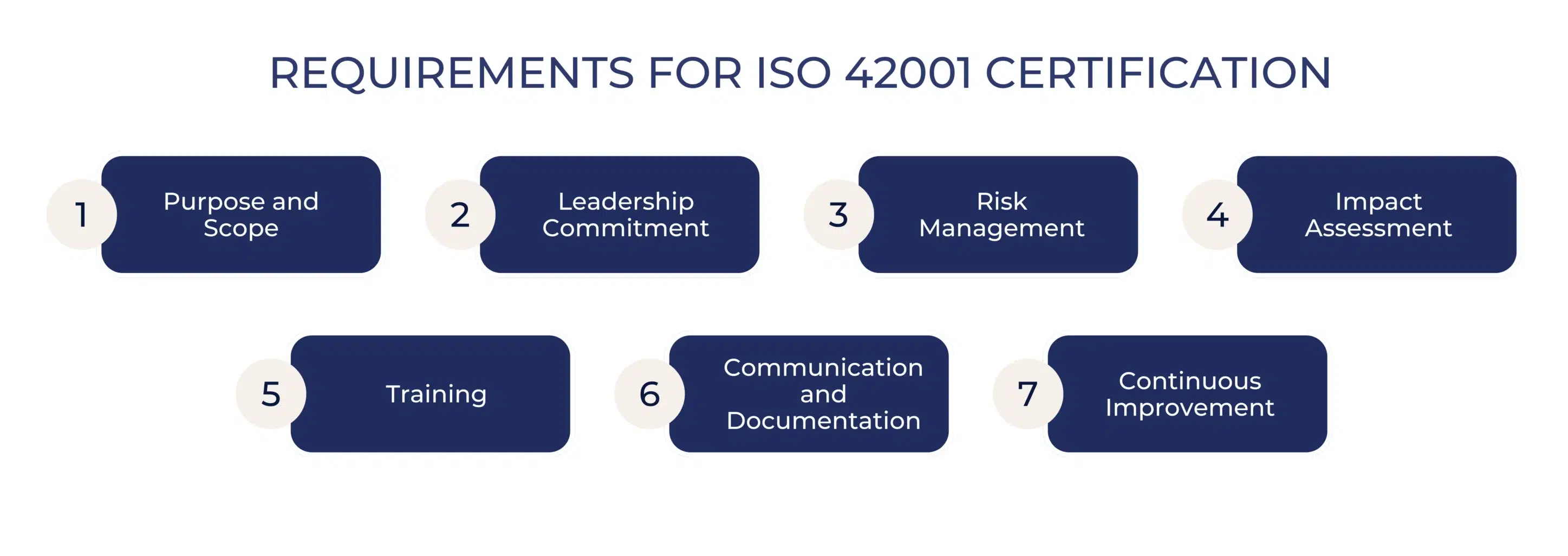
- ✓Clause 4: Context of the Organisation
- ✓Clause 5: Leadership
- ✓Clause 6: Planning
- ✓Clause 7: Support
- ✓Clauses 8–10: Operation, Performance Evaluation, and Improvement
Who Needs ISO 42001 Certification in Sydney?
ISO 42001 certification in Sydney is applicable to any organisation that develops, deploys, integrates, or procures AI-enabled systems as part of its operations. Sydney functions as Australia’s primary technology and financial services hub, hosting a concentration of AI startups, fintech companies, SaaS providers, enterprise technology organisations, healthcare technology firms, and government contractors that collectively represent the core addressable market for ISO 42001 certification. The Australian AI governance landscape is evolving rapidly, with regulatory, procurement, and investment due diligence requirements increasingly referencing AI management system standards.
AI Startups and Technology Companies
Sydney’s AI startup ecosystem, concentrated in precincts including the Sydney StartupHub, Surry Hills technology corridor, and the Barangaroo financial district, comprises organisations at the forefront of AI system development. AI startups that develop AI-as-a-service (AIaaS) platforms, machine learning APIs, natural language processing tools, and computer vision solutions require ISO 42001 certification to satisfy enterprise customer due diligence requirements. Enterprise procurement teams increasingly mandate AI governance certifications as a prerequisite for vendor onboarding, positioning ISO 42001 certification as a commercial necessity for Sydney AI startups seeking enterprise contracts.
Investor due diligence frameworks for AI companies increasingly include AI governance maturity assessments. Venture capital and private equity investors with portfolio companies in Sydney’s AI sector reference ISO 42001 certification as evidence of governance infrastructure, reducing perceived regulatory and reputational risk. For AI startups preparing for Series A and beyond, ISO 42001 certification in Sydney provides a structured, internationally recognised credential that supports both enterprise sales and investor relations activities.
Fintech and Financial Services Organisations
Sydney’s financial services sector, the largest in Australia, encompasses major banks, insurance companies, superannuation funds, wealth management firms, and a growing fintech ecosystem. Financial services organisations deploy AI systems across credit decisioning, fraud detection, customer segmentation, algorithmic trading, robo-advisory platforms, and claims processing. These AI applications directly affect consumer financial outcomes and are subject to heightened regulatory scrutiny from ASIC, APRA, and the Australian Financial Complaints Authority (AFCA). ISO 42001 certification provides financial services organisations with a structured framework for AI risk governance that aligns with APRA’s emerging model risk management expectations.
Fintech companies operating under Australian Financial Services Licence (AFSL) or Australian Credit Licence (ACL) obligations face specific accountability requirements for automated decision-making systems under the Corporations Act 2001 (Cth) and the National Consumer Credit Protection Act 2009 (Cth). ISO 42001 certification in Sydney for fintech organisations provides documented evidence of AI governance controls, risk treatment procedures, and accountability mechanisms that support regulatory compliance obligations. ISO 42001 compliance in Sydney’s fintech sector is increasingly referenced in ASIC regulatory technology (RegTech) guidance.
Healthcare Technology, Legal Tech, and SaaS Providers
Healthcare technology organisations in Sydney deploying AI for clinical decision support, medical imaging analysis, patient triage, and electronic health record management are subject to TGA regulatory requirements for Software as a Medical Device (SaMD) and face significant accountability obligations under the My Health Records Act 2012 (Cth). ISO 42001 certification provides healthcare AI providers with a structured framework for managing the safety, reliability, and explainability of AI systems in clinical environments. The standard’s requirements for AI system impact assessments are directly applicable to the safety-critical nature of healthcare AI deployments.
SaaS companies and legal technology providers in Sydney embedding AI into contract analysis, legal research, compliance monitoring, and document automation platforms are subject to professional obligations under the Legal Profession Uniform Law (NSW) and face increasing client due diligence requirements regarding AI governance. Government contractors deploying AI in public service delivery contexts are subject to the Australian Government’s Mandatory Guardrails for AI in Government, which reference ISO 42001 as a relevant governance framework. ISO 42001 certification is a qualifying criterion in an increasing number of Commonwealth and NSW Government procurement processes.
- ✓AI startups seeking enterprise customer contracts requiring AI governance certification
- ✓Fintech companies operating under ASIC and APRA regulatory oversight with AI-driven decisioning systems
- ✓SaaS providers embedding AI features into B2B platforms serving regulated industries
- ✓Healthcare technology organisations deploying AI in clinical or patient-facing environments
- ✓Legal technology companies automating legal processes with AI and machine learning
- ✓Government contractors deploying AI under Commonwealth Mandatory Guardrails for AI
- ✓Enterprises integrating third-party AI into core operational workflows
- ✓Organisations subject to international AI governance procurement requirements (e.g., EU AI Act-aligned customers)
- ✓Professional services firms using AI for client-facing advisory, risk, or analytical functions
- ✓Educational technology organisations using AI for student assessment or personalised learning
ISO 42001 Audit Process
The ISO 42001 audit process conducted by CertPro follows a structured, stage-based certification methodology consistent with ISO/IEC 17021-1:2015 requirements for certification body operations. CertPro operates as an independent certification body, not a consultant or management system implementer. The audit process is designed to objectively evaluate whether an organisation’s AIMS conforms to the requirements of ISO/IEC 42001:2023. Certification outcomes are determined solely on the basis of audit evidence and are not predetermined or guaranteed.
Stage 1 of the ISO 42001 audit is a documentation review conducted to assess the organisation’s readiness for Stage 2 audit activities. During Stage 1, the CertPro audit team reviews the organisation’s AIMS documentation to determine whether the management system has been designed and documented in accordance with ISO/IEC 42001:2023 requirements. Key documents reviewed during Stage 1 include the AIMS scope statement, AI policy, AI risk register, AI system inventory, documented information controls index, internal audit records, and management review minutes.
Stage 1 results in a documented Stage 1 audit report identifying the organisation’s readiness status for Stage 2, including any significant gaps in documentation or AIMS design that represent potential major nonconformities. The Stage 1 report also establishes the agreed audit program for Stage 2, including audit scope, audit team composition, planned audit dates, and the sampling approach for AI systems and controls to be assessed. Stage 1 does not result in a certification decision but provides the organisation with structured feedback on AIMS documentation completeness.
Stage 2 is the main certification audit, conducted on-site at the organisation’s Sydney premises, remotely via secure video conferencing, or in a hybrid format depending on the nature of the AI systems in scope and the organisation’s operational model. During Stage 2, the CertPro audit team evaluates the implementation and operational effectiveness of the AIMS against all applicable clauses of ISO/IEC 42001:2023. Audit activities include interviews with key personnel, observation of AI system operations, review of operational records, and testing of control effectiveness through evidence sampling.
Stage 2 audit activities specifically address AI system impact assessment implementation, data governance controls, model monitoring records, incident response procedures, internal AIMS audit evidence, management review records, and corrective action status. The audit team assesses conformity at the process level — verifying that documented procedures are implemented consistently in practice — rather than solely reviewing documentation. Stage 2 concludes with a closing meeting at which the lead auditor presents audit findings, identifies nonconformities, and explains the path to certification decision.
Nonconformities identified during Stage 2 are classified as major or minor. A major nonconformity represents a failure to meet a mandatory ISO 42001 requirement or a systematic breakdown in AIMS implementation that presents significant risk. A minor nonconformity represents a partial failure to meet a requirement or an isolated lapse in AIMS implementation. Major nonconformities must be resolved with verified corrective actions before a certification decision is made. Minor nonconformities must be addressed within an agreed timeframe specified in the corrective action plan.
The certification decision is made by a CertPro certification review function independent of the audit team. The certification decision is based exclusively on audit evidence and the verified status of nonconformity resolution. Possible certification outcomes are: certified, where the organisation’s AIMS fully conforms to ISO/IEC 42001:2023 requirements; not certified, where major nonconformities have not been resolved within the required timeframe; or conditionally certified, where minor nonconformities remain open with an accepted corrective action plan. Certified organisations receive an ISO 42001 certificate valid for three years, subject to annual surveillance audits.
ISO 42001 certified organisations are subject to annual surveillance audits conducted by CertPro during the three-year certification cycle. Surveillance audits assess continued AIMS conformity, implementation of corrective actions from previous audits, changes to the AIMS scope or AI system inventory, internal audit and management review activity, and AIMS performance against objectives. Surveillance audits are typically narrower in scope than initial certification audits but must verify that the AIMS continues to operate effectively and that the organisation maintains conformity with ISO/IEC 42001:2023.
Recertification audits are conducted prior to the expiry of the three-year certification cycle and involve a comprehensive reassessment of the entire AIMS against ISO/IEC 42001:2023 requirements. Recertification audits evaluate AIMS performance over the full certification period, assess the effectiveness of continual improvement activities, and determine whether the organisation’s AI governance framework has evolved in response to changes in AI technology, regulatory requirements, and organisational context. Successful recertification extends the ISO 42001 certificate for a further three-year period.
- Scope Determination: Define AIMS certification boundary and applicable AI systems
- Stage 1 Audit: Documentation review and AIMS design conformity assessment
- Stage 1 Report: Issue findings report and confirm Stage 2 readiness
- Stage 2 Audit: On-site or remote AIMS implementation and effectiveness assessment
- Audit Findings Report: Identify nonconformities classified as major or minor
- Nonconformity Resolution: Organisation submits verified corrective action evidence
- Certification Decision: Independent certification review determines outcome
- Certificate Issuance: ISO 42001 certificate issued for three-year validity period
- Year 1 Surveillance Audit: Annual AIMS conformity assessment
- Year 2 Surveillance Audit: Annual AIMS conformity assessment
- Recertification Audit: Comprehensive AIMS reassessment prior to certificate expiry
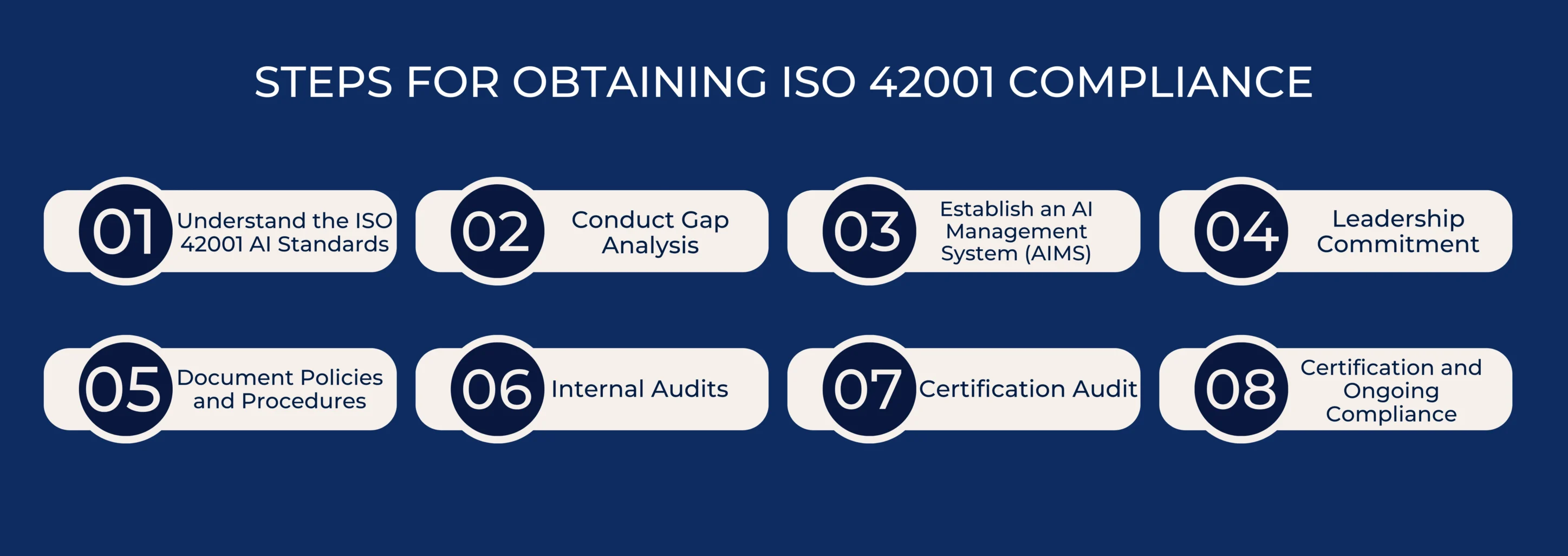
- ✓Stage 1: Documentation Review and Scope Determination
- ✓Stage 2: On-Site or Remote Certification Audit
- ✓Nonconformity Resolution and Certification Decision
- ✓Surveillance Audits and Recertification
Benefits of ISO 42001 Certification
ISO 42001 certification in Sydney delivers measurable organisational outcomes across regulatory alignment, risk governance, market access, and operational accountability. Benefits are grounded in the structural requirements of the standard and the operational outcomes of AIMS implementation, not in advisory promises. The following benefits represent documented outcomes for organisations that have achieved ISO 42001 certification and maintained conformity with the standard’s requirements over time.
ISO 42001 certification provides Sydney organisations with a structured mechanism to demonstrate alignment with Australia’s AI Ethics Framework and the Privacy Act 1988 (Cth). Certified organisations maintain documented evidence of AI risk assessments, data governance controls, accountability structures, and continual improvement activities that are directly relevant to regulatory compliance obligations. As Australian AI regulation continues to evolve — including the Australian Government’s 2024 interim response to the Safe and Responsible AI consultation and prospective AI-specific legislative frameworks — ISO 42001 certification positions organisations to demonstrate proactive governance ahead of mandatory compliance timelines.
The international recognition of ISO 42001 as a globally accepted AI governance standard is particularly valuable for Sydney organisations operating across multiple jurisdictions. The EU AI Act, which entered into force in August 2024, establishes risk-based requirements for AI systems deployed in the European market. ISO 42001 certification provides a governance baseline that supports EU AI Act compliance for Sydney organisations exporting AI-enabled products and services to European customers, as the standard addresses many of the technical and organisational measures required under the EU AI Act’s high-risk AI provisions.
AIMS implementation required for ISO 42001 certification delivers substantive AI risk reduction outcomes. Organisations that establish structured AI risk registers, implement AI system impact assessments, and deploy operational controls for model monitoring and incident response are demonstrably better positioned to identify and respond to AI-related failures before they result in regulatory action, reputational damage, or operational disruption. The requirement for documented corrective action procedures ensures that AI governance deficiencies are systematically addressed rather than managed informally.
AI governance maturity achieved through ISO 42001 certification reduces exposure to specific AI-related risks including algorithmic bias in hiring, lending, or service delivery decisions; data poisoning attacks on machine learning models; model drift resulting in degraded AI performance over time; and unintended AI outputs that may cause harm to individuals or third parties. Certified organisations maintain ongoing monitoring programs for deployed AI systems, providing early warning of emerging risks that would otherwise remain undetected until they cause adverse outcomes.
ISO 42001 certification provides independently verified evidence of AI governance maturity that satisfies stakeholder due diligence requirements across enterprise customers, government procurement agencies, investors, and regulators. Enterprise technology procurement processes increasingly include AI governance assessments as part of vendor qualification criteria. ISO 42001 certified organisations in Sydney are eligible to respond to tender opportunities that specify AI management system certification as a mandatory or preferential qualification criterion. This procurement eligibility represents a direct commercial benefit quantifiable in expanded addressable market access.
Public-sector procurement under NSW Government and Commonwealth frameworks increasingly references AI governance standards. The Digital NSW AI Framework and the Commonwealth’s Digital Transformation Agency AI governance guidance both emphasise the importance of structured AI management for government technology suppliers. ISO 42001 certification in Sydney provides technology suppliers to government with an independently audited credential that supports compliance with government AI procurement requirements, reducing the documentation burden associated with individual agency AI governance assessments.
- ✓Demonstrated alignment with the Australian AI Ethics Framework and Privacy Act 1988 (Cth)
- ✓Independently audited evidence of AIMS conformity for regulatory and investor due diligence
- ✓Eligibility for government and enterprise procurement requiring AI governance certification
- ✓Structured AI risk identification and treatment reducing exposure to algorithmic and data governance failures
- ✓Internationally recognised credential supporting cross-border market access including EU AI Act alignment
- ✓Documented accountability structures satisfying APRA model risk management expectations
- ✓Continuous monitoring and improvement framework for deployed AI systems
- ✓Reputational differentiation through third-party certification of responsible AI practices
- ✓Reduced cyber liability and D&O exposure associated with unmanaged AI governance risks
- ✓Structured incident response capability for AI system failures and unexpected outputs
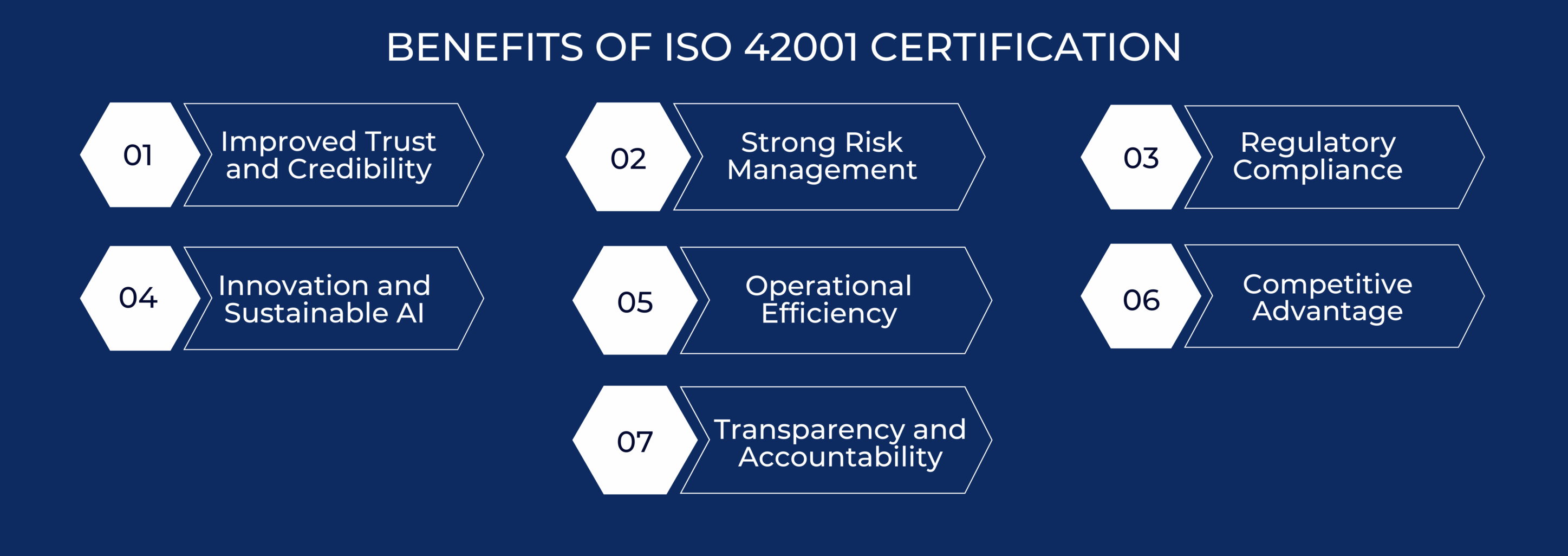
- ✓Regulatory Alignment and Compliance Readiness
- ✓AI Risk Reduction and Governance Maturity
- ✓Stakeholder Trust, Procurement Eligibility, and Market Access
AI Governance and Compliance in Sydney
Sydney’s AI governance and compliance landscape is shaped by intersecting national regulatory frameworks, sector-specific regulator guidance, state government digital policy, and emerging international AI governance obligations. Organisations operating in Sydney across financial services, healthcare, education, government, and technology sectors face an evolving matrix of AI-related compliance obligations that increasingly reference structured management system approaches. ISO 42001 certification provides a unified framework for addressing this compliance landscape through a single, internationally recognised management system standard.
Australian Government AI Policy and Regulatory Framework
The Australian Government’s approach to AI governance is anchored in the Australia’s AI Ethics Framework, comprising eight AI Ethics Principles developed by the Department of Industry, Science, Energy and Resources. The framework is voluntary for private sector organisations but mandatory for Commonwealth agencies under the Department of Finance’s guidance on responsible AI use. The 2024 Australian Government interim response to the Safe and Responsible AI consultation signalled the likely introduction of mandatory guardrails for high-risk AI applications, with reference to international standards including ISO 42001 as compliance mechanisms.
The National AI Centre (NAIC), operated by CSIRO’s Data61 and located in Sydney, functions as the primary government body for AI capability development and governance advocacy. NAIC initiatives including the Responsible AI Network and the AI Governance Toolkit reference ISO 42001 as a relevant governance standard for Australian organisations. Sydney-based organisations that align their AIMS with ISO 42001 requirements are positioned to engage constructively with NAIC programs and to benefit from government-facilitated AI governance resources and peer networks.
NSW Government Digital AI Governance Obligations
The NSW Government’s Digital NSW strategy and the associated Artificial Intelligence Strategy establish governance expectations for AI deployment across NSW public sector agencies and their technology suppliers. The NSW AI Strategy references responsible AI principles aligned with ISO 42001’s accountability and transparency requirements. NSW Government technology suppliers — including SaaS providers, managed service operators, and AI platform vendors — are increasingly required to demonstrate AI governance credentials as part of NSW Procurement Policy Framework compliance.
The NSW Privacy and Personal Information Protection Act 1998 (PPIPA) and the Health Records and Information Privacy Act 2002 (HRIPA) establish additional privacy obligations for organisations handling NSW public sector data, including AI-processed personal information. ISO 42001 certification’s data governance requirements directly address these obligations, providing NSW Government technology partners with documented evidence of privacy-by-design in AI system operations. This regulatory alignment is particularly relevant for Sydney-based organisations providing cloud-based AI services to NSW Health, NSW Education, Transport for NSW, and other major public sector entities.
Sector-Specific AI Compliance Drivers in Sydney
Sydney’s financial services sector faces the most concentrated AI compliance obligations of any industry in Australia. APRA’s Prudential Standard CPS 234 requires all APRA-regulated entities to maintain information security capability commensurate with their cyber risk profile, which explicitly includes AI and machine learning systems. ASIC’s regulatory guidance on digital advice (RG 255) and its ongoing review of artificial intelligence in financial services establish accountability expectations for AI-driven financial product recommendations and credit decisioning. ISO 42001 certification provides APRA and ASIC-regulated entities with a structured framework for meeting these AI-specific regulatory expectations.
In the healthcare sector, the TGA’s regulatory framework for Software as a Medical Device (SaMD) increasingly intersects with AI governance obligations as AI-powered diagnostic and clinical decision support tools proliferate. ISO 42001’s requirements for AI system impact assessments and ongoing monitoring of AI system performance are directly applicable to the safety-critical governance requirements for AI-enabled medical devices. Healthcare organisations in Sydney’s medical technology and digital health ecosystem benefit from ISO 42001 certification as complementary to TGA SaMD regulatory compliance, demonstrating comprehensive AI management system governance that addresses both product safety and organisational accountability dimensions.
| Sector | Key Sydney AI Compliance Driver | Relevant Regulator/Framework |
|---|---|---|
| Financial Services | AI-driven credit and investment decisioning accountability | APRA CPS 234, ASIC RG 255 |
| Healthcare Technology | AI in clinical decision support and SaMD governance | TGA SaMD Framework, My Health Records Act |
| Government Technology | Mandatory AI guardrails for government procurement | Commonwealth AI Guardrails, Digital NSW Strategy |
| SaaS / Cloud Providers | Enterprise customer AI governance due diligence | Australian Privacy Principles, Customer Contracts |
| Legal Technology | AI accountability in legal process automation | Legal Profession Uniform Law (NSW) |
ISO 42001 Certification Cost in Sydney
ISO 42001 certification costs in Sydney vary based on a range of organisation-specific factors. CertPro does not publish fixed pricing schedules for ISO 42001 certification audits, as cost determination requires assessment of the specific characteristics of each organisation’s AIMS scope and AI deployment environment. Factors that influence ISO 42001 certification cost include organisational size measured by headcount and revenue, the number and complexity of AI systems within the AIMS scope, the degree of AIMS documentation completeness at audit commencement, geographic distribution of operations, and the audit delivery format selected.
Factors Influencing ISO 42001 Certification Cost
Organisational size is the primary determinant of ISO 42001 certification cost. Smaller Sydney organisations — including AI startups and SMEs with fewer than 50 employees and a limited AI system inventory — typically incur lower audit costs than large enterprises with extensive AI deployments across multiple business units and operational sites. The number of AI systems within the AIMS scope directly affects audit duration, as each AI system requires individual review of impact assessments, data governance records, model documentation, and monitoring evidence. Organisations with a single AI system or a small number of homogeneous AI applications generally require fewer audit days than organisations with diverse, complex AI portfolios.
AI system complexity significantly influences the depth and duration of Stage 2 audit activities. High-risk AI systems — such as AI-driven credit decisioning models, medical diagnostic algorithms, or autonomous process control systems — require more extensive audit evidence review than lower-risk AI applications such as chatbots or content recommendation systems. Multi-site organisations with AI operations distributed across Sydney CBD, metropolitan Sydney, and interstate locations may require additional audit days or remote audit components to cover all AIMS scope locations. Audit format selection — on-site, remote, or hybrid — also affects cost, with fully remote audits generally delivering cost efficiencies compared to on-site engagements.
Certification Investment and Return
ISO 42001 certification investment for Sydney organisations should be evaluated against the measurable returns associated with certification outcomes. These returns include procurement contract eligibility in government and enterprise markets that specify AI governance certification requirements, reduced due diligence costs associated with repeated customer or investor AI governance questionnaires, and reduced regulatory remediation costs associated with AI governance deficiencies identified outside of a structured AIMS framework. Organisations that have achieved ISO 42001 certification report reduced vendor assessment burden, accelerated enterprise sales cycles, and improved investor confidence during fundraising processes.
The total cost of ISO 42001 certification encompasses initial certification audit fees for Stage 1 and Stage 2 activities, annual surveillance audit fees for Year 1 and Year 2 of the certification cycle, and recertification audit fees in Year 3. Internal resource costs associated with AIMS documentation development, personnel training, and ongoing AIMS maintenance are borne by the organisation. CertPro provides certification cost estimates based on a scoping questionnaire that captures the relevant organisational characteristics determining audit program scope and duration. Organisations are encouraged to contact CertPro directly to obtain a tailored certification cost estimate for their specific AIMS scope. [Link: Contact CertPro Sydney]
Why Choose CertPro for ISO 42001 Certification in Sydney?
CertPro is a Licensed CPA Firm providing independent, accredited ISO 42001 certification audits for organisations in Sydney and across Australia. CertPro’s certification activities are conducted exclusively in the capacity of an independent certification body, with full separation between audit and management system implementation functions. CertPro auditors do not provide management system design, documentation preparation, or operational guidance — all audit activities are strictly evaluative and evidence-based, ensuring the integrity and independence of the certification process.
Licensed CPA Firm and Audit Independence
CertPro’s Licensed CPA Firm status distinguishes it from non-accredited certification providers operating in the Sydney AI governance market. Licensed CPA Firms are subject to professional standards obligations under the Accounting Professional and Ethical Standards Board (APESB) framework, including mandatory independence requirements, quality control obligations, and continuing professional development standards. These obligations reinforce the independence and objectivity of CertPro’s ISO 42001 certification audit activities, providing Sydney organisations and their stakeholders with confidence in the integrity of the certification process.
Audit independence is a foundational requirement of ISO/IEC 17021-1:2015, the standard governing certification body operations. CertPro maintains documented impartiality procedures that prevent conflicts of interest between certification audit activities and any related management system services. CertPro auditors assigned to ISO 42001 certification engagements in Sydney are subject to independence declarations and conflict-of-interest reviews prior to appointment. The CertPro certification decision function is structurally separate from the audit team, ensuring that certification decisions are made on the basis of audit evidence alone.
ISO 42001 Audit Expertise and Sector Knowledge
CertPro’s ISO 42001 audit team comprises auditors with demonstrated expertise in AI management systems, data governance, information security, and the regulatory frameworks applicable to AI deployment in Australia. Auditors hold relevant professional qualifications including Certified Information Systems Auditor (CISA), Certified Information Security Manager (CISM), ISO/IEC 27001 Lead Auditor, and AI governance credentials. Sector-specific audit expertise is matched to client organisations based on industry context, ensuring that auditors assessing AI management systems in financial services, healthcare, government technology, and SaaS environments bring relevant sector knowledge to the evaluation.
CertPro’s audit methodology for ISO 42001 in Sydney is grounded in the requirements of ISO/IEC 42001:2023 and the guidance provided in ISO/IEC TR 24028 (AI trustworthiness overview), ISO/IEC 23894 (AI risk management guidance), and ISO/IEC 42001 Annex A controls. This comprehensive standards-based approach ensures that CertPro’s ISO 42001 audits assess AIMS conformity against the full breadth of the standard’s requirements, including the technical AI governance controls specified in Annex A and the AI-specific risk management guidance in Annex B. Organisations seeking ISO 42001 certification in Sydney benefit from CertPro’s depth of standards knowledge and the rigour of its evidence-based audit methodology.
Accredited Certification Process and Global Recognition
CertPro’s ISO 42001 certification process is aligned with the requirements of ISO/IEC 17021-1:2015 for management system certification bodies, ensuring that certificates issued by CertPro are recognised by accreditation bodies and accepted in international markets. ISO 42001 certificates issued by CertPro are valid in jurisdictions that recognise ISO management system certifications, including the European Union, the United Kingdom, the United States, and Singapore, supporting Sydney organisations with international AI governance compliance requirements. CertPro maintains a register of ISO 42001 certified organisations accessible to customers, regulators, and other interested parties for verification purposes.
CertPro’s certification services portfolio extends across ISO 42001, ISO 27001, ISO 9001, ISO 27701, and SOC 2 attestation, providing Sydney organisations with a unified certification partner for their complete management system compliance program. Organisations that hold multiple management system certifications benefit from integrated audit programs that leverage existing documented information and control evidence across standards, reducing audit duration and associated organisational resource requirements. [Link: Other ISO Certifications] [Link: ISO 42001 Overview]
ISO 42001 vs Other Management System Standards
ISO 42001 occupies a distinct position in the management system standards landscape, specifically addressing AI governance requirements that are not covered by existing information security, quality, or privacy management system standards. Sydney organisations evaluating their management system certification portfolio should understand the scope boundaries and complementary relationships between ISO 42001 and other relevant standards, particularly ISO 27001 (information security), ISO 9001 (quality management), and ISO 27701 (privacy information management).
ISO 42001 Compared to ISO 27001
ISO 42001 differs from ISO 27001 in scope, focus, and the specific risks it addresses. ISO 27001 is the international standard for Information Security Management Systems (ISMS), addressing confidentiality, integrity, and availability of information assets across all technology systems. ISO 42001 specifically addresses the governance, ethics, and risk management dimensions of AI systems — including algorithmic bias, model transparency, AI accountability, and responsible AI deployment — that are not within the scope of ISO 27001’s information security controls. An organisation may hold both ISO 27001 and ISO 42001 certifications, as the standards are complementary rather than overlapping.
ISO 27001:2022 includes specific controls for AI-related information security risks in its updated Annex A control set, but these controls address AI security (e.g., protecting AI systems from attack) rather than AI governance (e.g., ensuring AI systems are used ethically and accountably). ISO 42001’s AIMS requirements extend significantly beyond ISO 27001’s AI security controls to encompass impact assessments, stakeholder accountability, AI objective-setting, and continual improvement of AI governance practices. Sydney organisations that hold ISO 27001 certification and are deploying AI systems should consider ISO 42001 certification as a necessary extension of their management system portfolio.
ISO 42001 and ISO 27701 Integration
ISO 27701 is the international standard for Privacy Information Management Systems (PIMS), extending ISO 27001 to address privacy governance requirements. ISO 42001 and ISO 27701 are complementary standards with significant overlap in the area of AI-processed personal data. ISO 42001’s data governance requirements and ISO 27701’s privacy information management requirements address different dimensions of the same underlying challenge — responsible management of personal information in AI system contexts. Sydney organisations processing personal data through AI systems may benefit from integrated AIMS and PIMS certification programs that address both AI governance and privacy management obligations through a coordinated management system framework.
| Standard | Scope | AI-Specific Coverage | Complementary to ISO 42001? |
|---|---|---|---|
| ISO 42001 | AI Management Systems (AIMS) | Full AI governance, ethics, risk, accountability | Primary standard |
| ISO 27001 | Information Security Management Systems | AI security controls (Annex A 8.27) | Yes — addresses AI security gaps |
| ISO 27701 | Privacy Information Management Systems | Personal data in AI processing | Yes — addresses AI privacy gaps |
| ISO 9001 | Quality Management Systems | AI in quality processes | Yes — addresses AI quality governance |
Steps to Achieve ISO 42001 Certification in Sydney
Achieving ISO 42001 certification in Sydney requires structured preparation of the AIMS before the certification audit commences. Organisations must establish their AIMS in conformity with ISO/IEC 42001:2023 requirements across all applicable clauses. The following steps describe the organisational preparation activities required prior to engaging CertPro for the formal certification audit process. These preparation activities are the organisation’s own responsibility and are distinct from CertPro’s independent certification audit activities.
The first organisational step toward ISO 42001 certification is defining the AIMS scope. AIMS scope definition requires organisations to specify the organisational units, processes, and AI systems included within the certification boundary. Scope definition must accurately reflect the organisation’s AI deployment environment and must not artificially exclude high-risk or complex AI systems to simplify the certification process. Certification bodies assess scope adequacy during Stage 1 and will identify scope gaps that could affect the validity of the certification.
AI system inventory development is a prerequisite for AIMS scope definition. Organisations must catalogue all AI systems in use — including internally developed models, commercially licensed AI platforms, third-party AI APIs, and embedded AI features in SaaS applications — and classify each system by risk level, application domain, data types processed, and business criticality. The AI system inventory serves as the foundational documented information artefact for the AIMS and is reviewed as a primary document during Stage 1 of the ISO 42001 certification audit.
AIMS documentation development encompasses the creation of all documented information required by ISO/IEC 42001:2023. Core AIMS documents include the AI policy, AIMS scope statement, AI risk assessment methodology, AI risk register, AI system impact assessment templates and completed assessments, data governance procedures, model monitoring procedures, AI incident response procedures, internal AIMS audit program, management review procedure and records, and nonconformity and corrective action records. Each document must demonstrate compliance with the specific clause requirements of ISO 42001 and must be subject to document control procedures.
Before engaging CertPro for external certification audit activities, organisations must complete at least one cycle of internal AIMS audit and management review. The internal AIMS audit must cover all clauses of ISO/IEC 42001:2023 applicable within the AIMS scope and must be conducted by auditors who are competent in ISO 42001 requirements and are independent of the activities being audited. Internal audit findings, including identified nonconformities and the corrective actions taken, must be documented and retained as AIMS records.
Management review must be conducted by top management to evaluate AIMS performance against established objectives, review internal audit findings, assess changes in external context including regulatory developments, and determine resource requirements for AIMS continual improvement. Management review minutes must document the inputs reviewed, discussions held, and decisions made, including any AIMS improvement actions allocated to responsible persons with completion timelines. Completion of internal audit and management review prior to Stage 1 demonstrates organisational commitment to AIMS operation and readiness for external certification assessment.
- Define AIMS scope and document organisational context per ISO 42001 Clause 4
- Develop and document AI policy with top management approval per Clause 5
- Conduct AI risk assessment and establish AI risk register per Clause 6
- Develop AIMS documentation suite including all required documented information per Clause 7
- Complete AI system impact assessments for all in-scope AI systems per Clause 8
- Implement operational controls for data governance, model monitoring, and incident response per Clause 8
- Conduct internal AIMS audit covering all applicable ISO 42001 clauses per Clause 9
- Conduct management review with documented outputs per Clause 9
- Address internal audit nonconformities with documented corrective actions per Clause 10
- Engage CertPro for Stage 1 documentation review and Stage 2 certification audit
- ✓AIMS Scope Definition and AI System Inventory
- ✓AIMS Documentation Development
- ✓Internal AIMS Audit and Management Review
FAQ
▶
Q: What is ISO 42001 certification?
▶
Q: How long does ISO 42001 certification take in Sydney?
▶
Q: What is the difference between ISO 42001 and ISO 27001?
▶
Q: How much does ISO 42001 certification cost in Sydney?
▶
Q: Does ISO 42001 apply to small and medium enterprises (SMEs) in Sydney?
▶
Q: How often are ISO 42001 surveillance audits required?
▶
Q: What AI systems are covered by ISO 42001 certification?
▶
Q: Is ISO 42001 mandatory in Australia?

MindSec Launches AI Compliance for Law 25 & ISO 42001
Excerpt from Barchart Article, Published on December 3, 2025 Today, Canadian organizations face increasing pressure to comply with stringent privacy a…

UNDERSTANDING ISO 42001: A GUIDE FOR RESPONSIBLE AI MANAGEMENT SYSTEMS
The invention of artificial intelligence (AI) has changed the operational processes of many industries. However, the rapid growth of technology increa…
ENSURING AI DATA PRIVACY COMPLIANCE WITH ISO 42001
According to Stanford’s AI report, the private AI investment in the U.S. alone reached more than $109 billion last year, which is equal to 12 times th…
Get In Touch
have a question? let us get back to you.