
ISO 42001 Certification in California
ISO 42001 Certification is the formal third-party attestation that an organization has established, implemented, maintained, and continually improved an Artificial Intelligence Management System (AIMS) in conformance with ISO/IEC 42001:2023. Published in December 2023, ISO/IEC 42001:2023 is the first internationally recognized standard specifically designed to govern the development, deployment, and ongoing operation of AI systems within organizational settings. ISO 42001 Certification in California demonstrates that a certified entity has met auditable governance requirements for responsible AI use across its operations.
OUR CLIENTS





What Is ISO 42001 Certification?
ISO 42001 Certification is the formal third-party attestation that an organization has established, implemented, maintained, and continually improved an Artificial Intelligence Management System (AIMS) in conformance with ISO/IEC 42001:2023. Published in December 2023, ISO/IEC 42001:2023 is the first internationally recognized standard specifically designed to govern the development, deployment, and ongoing operation of AI systems within organizational settings. ISO 42001 Certification in California demonstrates that a certified entity has met auditable governance requirements for responsible AI use across its operations.
Defining ISO/IEC 42001:2023 and Its Scope
ISO/IEC 42001:2023 specifies requirements for an AIMS applicable to any organization — regardless of type, size, or sector — that develops, provides, uses, or has an interest in AI systems. The standard defines an AI Management System as the set of policies, processes, roles, responsibilities, plans, and documented controls through which an organization governs its AI-related activities. The AIMS framework explicitly addresses AI risk management, AI system impact assessments, transparency obligations, data governance for AI inputs, and ongoing monitoring of AI system performance and fairness.
The standard adopts the ISO High-Level Structure (HLS), making it architecturally compatible with ISO 27001 for information security and ISO 31000 for enterprise risk management. This compatibility enables integrated management system deployments that reduce duplicative compliance effort across governance frameworks.
ISO 42001 Certification applies to organizations at every point in the AI value chain. A technology company in San Francisco that develops machine learning algorithms, a healthcare system in Los Angeles that deploys AI-assisted diagnostic tools, and a financial institution in San Jose that uses AI for credit scoring all fall within the standard’s scope.
The certification boundary is defined during the scoping exercise and may encompass a single AI application, a product line, or the organization’s entire AI portfolio. The scope statement is audited and published as part of the certification record, providing verifiable, public accountability for the organization’s AI governance commitments.
AI Governance and Organizational Accountability Under ISO 42001
AI governance, as defined under ISO/IEC 42001:2023, is the structured system of policies, accountability frameworks, and control mechanisms through which an organization directs, evaluates, and monitors its AI-related activities. ISO 42001 establishes explicit accountability structures: top management must demonstrate leadership and commitment by assigning AI governance roles, approving the AI policy, and ensuring resources are allocated for AIMS operation and improvement.
This accountability chain is audited during every ISO 42001 audit cycle, creating verifiable evidence that AI oversight reaches executive leadership rather than remaining siloed in technical teams.
AI risk management under ISO 42001 requires organizations to identify AI-related risks and opportunities, assess their significance, and implement controls proportionate to the risk level. The standard explicitly requires documented AI system impact assessments — analogous to Data Protection Impact Assessments (DPIAs) under privacy law — that evaluate potential harms including unfair outcomes, discrimination, safety failures, and privacy violations.
These impact assessments are reviewed during each ISO 42001 audit and become part of the organization’s permanent governance record. For California-based companies operating under the California Consumer Privacy Act (CCPA) and preparing for evolving U.S. AI governance frameworks, these documented assessments serve as dual-purpose compliance artifacts.
AIMS Versus General AI Compliance Frameworks
ISO AIMS certification differs fundamentally from self-assessment frameworks, internal AI ethics charters, and voluntary industry codes of conduct. Unlike self-declared compliance, ISO 42001 Certification requires independent third-party audit conducted by an accredited certification body. The audit produces objective evidence — not organizational assertions — that the AIMS meets the standard’s requirements.
This distinction is critical for California organizations seeking to demonstrate AI governance credibility to enterprise customers, government procurement bodies, investors, and regulators. An ISO AIMS certification certificate carries the authority of international standardization and independent audit verification, which self-certification frameworks cannot replicate.
ISO 42001 also differs from ISO 27001 in its specific focus on AI system governance rather than general information security. While ISO 27001 addresses the confidentiality, integrity, and availability of information assets, ISO 42001 addresses AI-specific concerns including algorithmic transparency, AI model lifecycle management, AI training data governance, and the societal impacts of automated decision-making.
Organizations that hold both certifications operate an integrated management system addressing both information security and responsible AI — a combination increasingly demanded by enterprise procurement standards and public sector contracting requirements across California and the broader United States.

Why ISO 42001 Certification in California Is Essential
California is the world’s leading hub for artificial intelligence research, development, and commercialization. The state is home to more than 35% of U.S. AI startups, hosts global technology headquarters across Silicon Valley, and operates the most extensive private cloud and data center infrastructure in North America. This concentration of AI activity creates proportional governance obligations.
ISO 42001 Certification in California provides organizations with a recognized, auditable framework to demonstrate that their AI operations meet international governance standards — a competitive and regulatory necessity in the state’s technology-driven economy.
California’s Regulatory Environment and AI Governance Obligations
California’s regulatory landscape creates specific, enforceable obligations for organizations that use AI systems to process personal information or make consequential automated decisions. The California Consumer Privacy Act (CCPA) and its amendment, the California Privacy Rights Act (CPRA), require organizations to disclose automated decision-making practices, provide opt-out rights for certain automated decisions, and maintain records of data processing activities.
ISO 42001 compliance directly supports CCPA/CPRA adherence by establishing documented AI system inventories, data governance controls for AI inputs, and transparency mechanisms — all of which map to CCPA disclosure and opt-out requirements.
Beyond CCPA, California has enacted multiple AI-specific statutes including AB 2013 (AI training data transparency requirements for generative AI), SB 1047 (foundational model safety obligations), and the Automated Decision Systems Accountability Act. While these statutes impose specific obligations, ISO 42001 assessment processes provide organizations with a structured methodology to identify which statutory requirements apply to their AI systems, document compliance evidence, and maintain the ongoing monitoring necessary to demonstrate sustained conformance.
Organizations holding ISO 42001 Certification in California are demonstrably better positioned to respond to regulatory inquiries, demonstrate good-faith compliance efforts, and avoid enforcement actions.
Competitive Differentiation in California’s AI Market
Enterprise procurement standards in California’s technology sector increasingly require vendors and AI service providers to demonstrate third-party certified AI governance. Fortune 500 companies headquartered in California — including those in financial services, healthcare, and technology sectors — are embedding ISO 42001 compliance requirements into vendor qualification criteria.
For AI startups and scale-ups seeking enterprise contracts, ISO AIMS certification in California provides objective proof of governance maturity that accelerates procurement approval cycles and eliminates due diligence barriers that would otherwise delay or prevent contract awards.
California’s venture capital ecosystem is also incorporating AI governance criteria into investment due diligence frameworks. Investors evaluating AI companies now examine governance infrastructure alongside technical capability and revenue growth, recognizing that AI governance failures create material liability, regulatory risk, and reputational damage.
ISO 42001 Certification provides investors with an independently verified governance signal that reduces investment risk perception and supports higher valuation assessments. For AI startups in the Bay Area, Los Angeles, and San Diego seeking Series A funding and beyond, ISO AIMS certification in California has become a recognized indicator of organizational governance maturity.
Alignment With U.S. Federal AI Governance Expectations
At the federal level, the National Institute of Standards and Technology (NIST) AI Risk Management Framework (AI RMF) and the Biden-era Executive Order on AI Safety establish expectations for responsible AI development and deployment that align closely with ISO 42001’s requirements. Organizations that have achieved ISO 42001 Certification in California can demonstrate alignment with NIST AI RMF’s four core functions — Govern, Map, Measure, and Manage — through their certified AIMS controls.
This alignment supports federal contracting eligibility, GSA procurement compliance, and FISMA-related AI governance requirements for organizations that serve U.S. government clients from California operations.
ISO 42001 Certification Requirements
ISO 42001 compliance requires organizations to satisfy a structured set of requirements organized across ten clauses of ISO/IEC 42001:2023. Requirements span organizational context, leadership, planning, support, operation, performance evaluation, and continual improvement. The following requirements are evaluated during every ISO 42001 audit and must be demonstrably satisfied through documented evidence for certification to be awarded.
Organizations seeking ISO 42001 Certification must formally determine the internal and external context relevant to their AI activities. This includes identifying interested parties — customers, regulators, employees, affected communities — and their AI-related expectations and requirements. The organization must document the scope of its AIMS with sufficient precision to define which AI systems, business processes, organizational units, and geographic locations are included within the certification boundary.
For California organizations, the scope statement typically references applicable California privacy law obligations and may specify which AI applications are within scope for audit purposes.
The standard requires organizations to identify and document their AI-specific roles — whether developer, provider, operator, or deployer — as these roles carry different obligations under the AIMS framework. A Silicon Valley SaaS company that both develops and operates AI-powered products holds dual-role obligations that must be reflected in its AIMS scope, policy, and controls.
This role classification is reviewed during the ISO 42001 assessment and directly influences which controls from Annex A — the standard’s normative reference for AI controls — are applicable to the organization.
Top management must establish and approve an AI policy that is appropriate to the organization’s purpose, aligns with strategic direction, provides a framework for setting AI objectives, and commits to continual improvement of the AIMS. The AI policy must address responsible AI principles including fairness, transparency, accountability, safety, and privacy.
This policy is a primary audit artifact — auditors verify that it is documented, communicated to all personnel within the AIMS scope, and operationally implemented rather than aspirationally stated. For California fintech companies and technology firms, the AI policy must reflect the specific AI applications in use and the governance obligations those applications create.
- ✓Documented AIMS scope statement specifying included AI systems, organizational units, and geographic locations
- ✓AI policy approved by top management and communicated across the AIMS scope
- ✓Assigned AI governance roles with documented responsibilities (AI Owner, AIMS Manager, etc.)
- ✓AI risk assessment methodology documented and applied to all in-scope AI systems
- ✓AI system impact assessments conducted and documented for significant AI applications
- ✓Annex A control evaluation: Statement of Applicability documenting applicable and excluded controls with justification
- ✓AI objectives established, documented, and measured with defined metrics and timelines
- ✓Competence records for personnel performing AI governance roles
- ✓Internal audit program with documented audit plans, findings, and corrective actions
- ✓Management review records demonstrating top management oversight of AIMS performance
At the operational level, the ISO 42001 assessment evaluates whether the organization has implemented controls across the AI system lifecycle — from design and data acquisition through training, validation, deployment, monitoring, and decommissioning. Organizations must document AI system specifications, maintain records of training data provenance and quality controls, and implement mechanisms to detect and respond to AI system performance degradation or bias emergence.
For AI management system certification in California, these operational requirements must also address data residency obligations, cross-border data transfer restrictions, and third-party AI supplier management where external AI components are integrated into the organization’s products or services.
The standard’s Annex A contains 38 controls organized across eight control domains: AI policies, internal organization, resources for AI systems, assessing AI system impact, AI system lifecycle, responsible AI supply chain, documentation of AI systems, and transparency of AI systems. During the ISO 42001 audit, the organization’s Statement of Applicability — which documents which of these 38 controls are applicable, which are implemented, and which are excluded with justification — is examined against the operational evidence to verify that the AIMS is functioning as documented. This control-evidence alignment is the technical core of the ISO 42001 audit methodology.
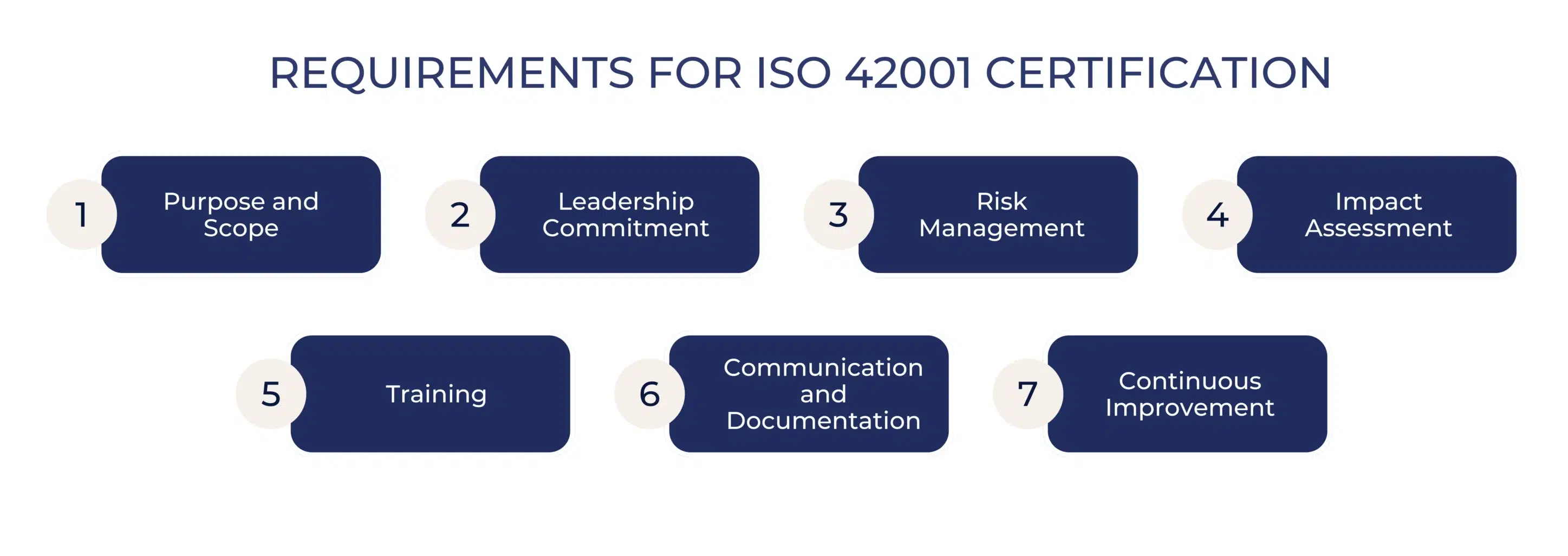
- ✓Organizational Context and Scope Requirements
- ✓Leadership, Policy, and Governance Requirements
- ✓Operational and Technical Requirements
ISO 42001 Certification Process
The ISO 42001 certification process follows a structured, sequenced audit methodology conducted by an independent third-party certification body. CertPro, as a Licensed CPA firm, performs each stage of the ISO 42001 audit in strict conformance with ISO/IEC 17021-1 accreditation requirements and ISO 42001-specific audit guidance. The process is designed to produce objective, evidence-based conclusions about AIMS conformance rather than relying on organizational assertions or self-assessments.
The certification process initiates with a formal scope definition exercise in which the organization’s AIMS boundary is established and submitted for audit review. The Stage 1 audit — also called the documentation review or off-site audit — evaluates whether the organization’s AIMS documentation is complete, coherent, and sufficient to support a Stage 2 conformance audit.
Auditors examine the AI policy, AIMS scope statement, risk assessment records, Statement of Applicability, AI impact assessments, and internal audit records to determine whether the documented AIMS meets ISO/IEC 42001:2023 requirements at the design level. Stage 1 findings are communicated in a formal report that identifies any documentation gaps or areas requiring clarification before Stage 2 proceeds.
The Stage 2 audit is the primary conformance evaluation, conducted on-site at the organization’s California facilities or remotely where approved. During Stage 2, CertPro auditors systematically evaluate each applicable AIMS requirement and Annex A control against objective evidence — documents, records, interview responses, system demonstrations, and process observations. The audit program covers all clauses of ISO/IEC 42001:2023 and all Annex A controls declared applicable in the Statement of Applicability.
Nonconformities identified during Stage 2 are classified as major or minor. Major nonconformities require corrective action and verification before ISO 42001 Certification can be awarded; minor nonconformities require corrective action plans to be submitted within a defined timeframe.
Evidence evaluation during the ISO 42001 audit engagement includes review of AI system technical documentation, training data records, model validation reports, deployment approval records, monitoring logs, incident records, and management review minutes. Auditors conduct structured interviews with AI system owners, data scientists, product managers, legal and compliance personnel, and executive leadership to verify that governance accountability flows from the AIMS policy to operational practice.
This multi-layered evidence collection methodology ensures that certification reflects actual operational conformance rather than documentation-only compliance.
Following Stage 2 audit completion, the lead auditor submits audit findings and a certification recommendation to CertPro’s independent certification decision function. The certification decision — separate from the audit team — reviews the audit report and either grants, withholds, or defers certification based on the evidence presented. When certification is granted, CertPro issues an ISO 42001 certificate specifying the organization’s name, certified scope, certification date, and certificate validity period.
ISO 42001 certificates are valid for three years, subject to annual surveillance audits conducted in Year 1 and Year 2 to verify continued AIMS conformance and improvement.
Recertification audits are conducted in Year 3, prior to certificate expiry, and evaluate the full AIMS scope to verify sustained conformance, AIMS maturity progression, and effective continual improvement. Organizations that maintain ISO 42001 Certification in California through successive three-year cycles demonstrate to the market, to regulators, and to enterprise customers that their AI governance is not a one-time project but an embedded, institutionalized management discipline.
This multi-year certification lifecycle is a defining characteristic that distinguishes ISO 42001 Certification from point-in-time compliance assessments and self-certification claims.
| Certification Stage | Activity | Typical Duration |
|---|---|---|
| Stage 1 Audit | Documentation review, AIMS design evaluation, scope confirmation | 1–3 days |
| Stage 2 Audit | On-site/remote conformance audit, evidence evaluation, nonconformity review | 2–5 days |
| Certification Decision | Independent review of audit report, certificate issuance | 1–2 weeks |
| Surveillance Audit (Year 1 & 2) | Ongoing AIMS conformance verification, improvement review | 1–2 days annually |
| Recertification Audit (Year 3) | Full AIMS re-evaluation, certificate renewal | 2–4 days |
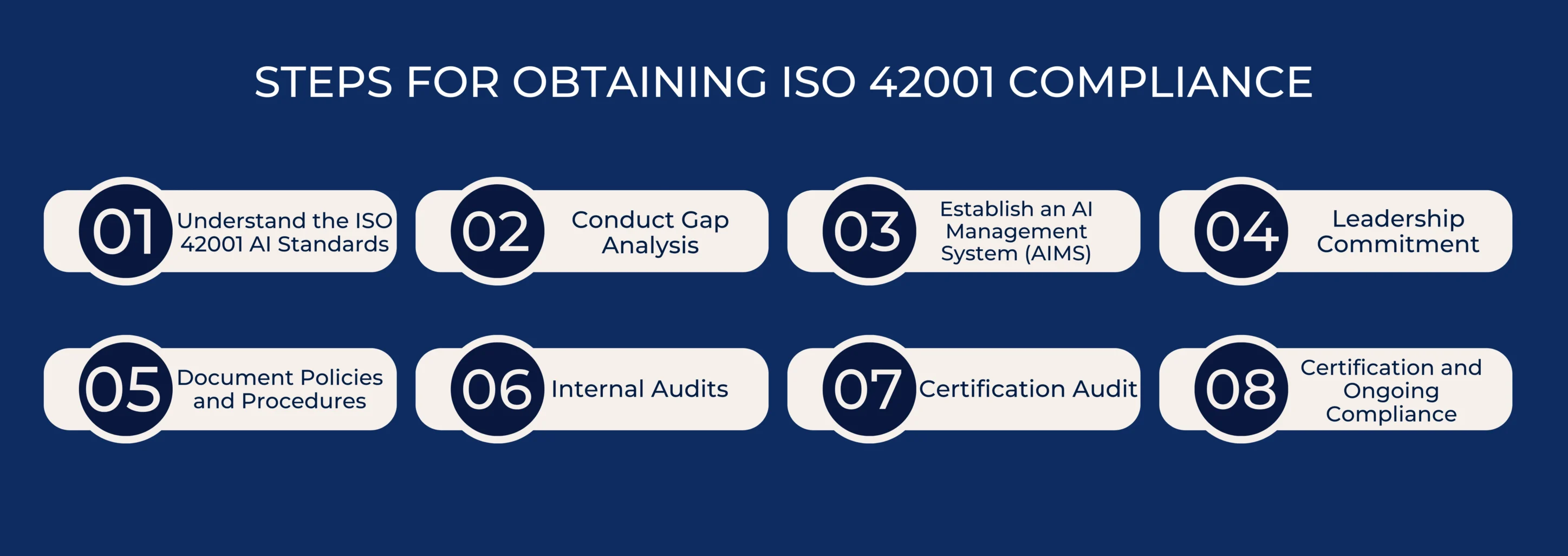
- ✓Stage 1: Scope Definition and Documentation Review
- ✓Stage 2: Conformance Audit and Evidence Evaluation
- ✓Certification Decision, Issuance, and Surveillance
Benefits of ISO 42001 Certification for California Organizations
ISO 42001 Certification in California delivers measurable, verifiable benefits across regulatory compliance, market positioning, operational governance, and organizational risk management. These benefits are directly attributable to the implementation of a certified AIMS and are validated through the independent audit process that underpins ISO 42001 compliance.
ISO 42001 compliance provides California organizations with documented evidence of responsible AI governance that is directly relevant to CCPA/CPRA automated decision-making disclosure obligations, California AI transparency statutes, and emerging U.S. federal AI governance frameworks. When regulators investigate AI-related complaints or conduct supervisory reviews, organizations holding ISO 42001 Certification in California can present independently verified governance documentation — audit reports, certified AIMS records, corrective action histories — that demonstrates good-faith compliance efforts.
This evidentiary record materially reduces regulatory liability exposure and supports favorable treatment in enforcement proceedings.
ISO 42001 Certification accelerates access to enterprise procurement channels for California tech companies that require third-party certified AI governance from their AI vendors and partners. Large enterprises — particularly in regulated industries such as financial services, healthcare, and government — require third-party certified AI governance as a condition of vendor qualification.
Organizations holding ISO AIMS certification can present their certificate as objective procurement qualification evidence, eliminating the need for customer-specific AI governance audits that would otherwise consume significant time and resources on both sides of the procurement relationship.
- ✓Independent third-party verification of AI governance credibility accepted by enterprise procurement functions
- ✓Demonstrated CCPA/CPRA alignment through documented AI impact assessments and data governance controls
- ✓Accelerated vendor qualification in regulated industry procurement cycles (financial services, healthcare, government)
- ✓Investor due diligence support through independently verified AI governance infrastructure
- ✓Reduced customer-specific AI audit burden through portable, recognized certification evidence
- ✓Enhanced board-level AI accountability through mandatory management review and top management commitment requirements
- ✓Structured AI risk identification and control framework reducing operational AI failures and associated costs
- ✓International market access facilitation through alignment with EU AI Act governance requirements
- ✓Reputational differentiation in California’s competitive AI market through recognized governance leadership
- ✓Continual improvement mandate driving sustained AIMS maturity and organizational AI governance capability
The AIMS controls required for ISO 42001 compliance directly reduce the operational risk of AI system failures, biased outcomes, and unauthorized AI deployments. Organizations that have implemented documented AI system impact assessments, training data quality controls, and deployment approval processes experience fewer AI-related incidents — because risks are identified and addressed before systems reach production.
For California fintech companies using AI for credit decisioning, fraud detection, or customer segmentation, these controls reduce fair lending violation risk, CFPB enforcement exposure, and the reputational damage associated with algorithmic discrimination findings.
The standard’s requirement for ongoing AI system monitoring — including performance metrics, bias indicators, and anomaly detection — ensures that governance does not end at deployment. Organizations must demonstrate during each ISO 42001 audit that their monitoring mechanisms are functioning, that findings are reviewed, and that corrective actions are taken when AI system performance deviates from established acceptable ranges.
This continuous monitoring requirement creates an operational safety net that self-certification frameworks and one-time compliance assessments cannot replicate. It provides sustained protection against the AI governance failures that have resulted in regulatory penalties and class-action litigation for organizations across California’s technology sector.
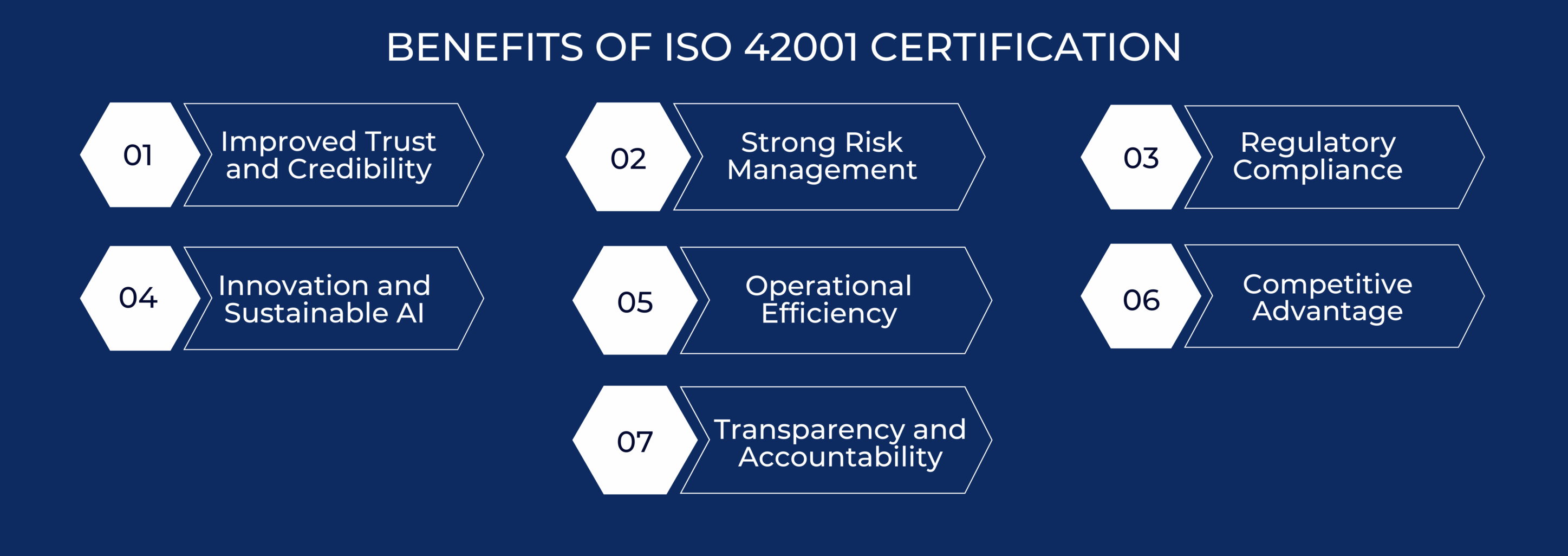
- ✓Regulatory Compliance and Liability Reduction
- ✓Market Access and Enterprise Procurement Advantage
- ✓Operational Risk Management and AI Failure Prevention
ISO 42001 Certification Cost in California
The cost of ISO 42001 Certification in California is determined by multiple factors including the scope of the AIMS, the number and complexity of AI systems within the certification boundary, the organization’s size and number of employees within scope, and the geographic distribution of audited operations. CertPro’s fixed-pricing model provides California organizations with cost certainty from the outset of the certification engagement, eliminating the variable billing uncertainty common in hourly-rate audit models.
Cost Factors and Scope Considerations
For small and mid-sized California AI companies — startups with fewer than 50 employees, focused SaaS providers, or organizations certifying a single AI application — the ISO 42001 certification cost is typically lower due to the limited scope of AIMS operation and the reduced audit day requirements. Enterprise organizations with multiple AI systems, complex data pipelines, and large internal AI development teams require more extensive audit programs that reflect the breadth and depth of the AIMS scope.
ISO 42001 Certification for California fintech organizations operating AI systems across multiple business lines — lending, payments, wealth management, and fraud detection — typically requires scope expansion that increases audit complexity and associated certification investment.
Annual surveillance audit costs are typically a fraction of the initial certification audit investment, as surveillance audits focus on AIMS areas identified for monitoring rather than a full-scope re-examination. The three-year certification cycle — comprising initial certification, two surveillance audits, and recertification — provides California organizations with a predictable, multi-year governance investment profile that can be planned and budgeted as a standard operational compliance expenditure.
Organizations that contact CertPro receive a detailed, scope-specific cost estimate based on their AIMS scope, AI system inventory, and organizational structure, ensuring that the ISO 42001 certification investment is transparent and proportionate to the governance value delivered.
Industries in California That Benefit from ISO 42001 Certification
AI management system certification in California is relevant across every sector that develops, deploys, or relies upon AI systems for business-critical operations. The following industries represent the highest concentration of ISO 42001 Certification in California demand, reflecting both the state’s AI-intensive economic profile and the sector-specific regulatory and commercial drivers that make certification strategically necessary.
California’s technology sector — encompassing enterprise software companies, AI platform providers, cloud infrastructure operators, and consumer technology firms headquartered across Silicon Valley, San Francisco, and Los Angeles — represents the largest single market for ISO 42001 Certification in California. SaaS providers that embed AI features into enterprise products face customer procurement requirements for third-party certified AI governance, particularly from financial services, healthcare, and government sector customers.
AI platform companies — those providing AI infrastructure, foundational models, or AI-as-a-service capabilities to downstream operators — benefit from ISO AIMS certification as a market credentialing mechanism that differentiates their governance posture from uncertified competitors.
California’s fintech ecosystem — concentrated in San Francisco’s Financial District and extending to Los Angeles and San Diego — operates AI systems for credit scoring, fraud detection, anti-money laundering, customer onboarding, robo-advisory, and algorithmic trading. These applications are subject to federal financial regulation (CFPB, OCC, FDIC), California financial regulation, and fair lending laws that impose specific AI governance requirements.
ISO 42001 Certification for California fintech organizations provides a structured governance framework that addresses the intersection of AI operational risk and financial regulatory compliance, supporting examiner relationships and reducing the compliance burden of responding to AI-related supervisory inquiries with independently verified governance documentation.
Healthcare organizations across California — from major academic medical centers in Los Angeles and San Francisco to digital health startups in San Diego’s biotech corridor — are deploying AI systems for diagnostic imaging analysis, clinical decision support, patient triage, drug discovery, and population health management. These AI applications are subject to FDA Software as a Medical Device (SaMD) regulations, HIPAA privacy requirements, and California Confidentiality of Medical Information Act (CMIA) obligations.
ISO 42001 compliance provides healthcare organizations with the documented AI risk management and impact assessment framework required to demonstrate responsible AI deployment to FDA reviewers, HIPAA auditors, and healthcare system procurement committees.
| Industry Sector | Primary AI Applications | Key Regulatory Driver |
|---|---|---|
| Technology / SaaS | ML-powered products, AI platforms, generative AI features | Enterprise procurement standards, CCPA |
| Fintech / Financial Services | Credit scoring, fraud detection, robo-advisory, AML | CFPB, fair lending laws, California DFI |
| Healthcare / Life Sciences | Diagnostic AI, clinical decision support, drug discovery | FDA SaMD, HIPAA, CMIA |
| Government / Public Sector | Predictive policing, benefits eligibility, public services AI | California ADSA, procurement mandates |
| Retail / E-Commerce | Recommendation engines, dynamic pricing, customer analytics | CCPA/CPRA, AB 2013 transparency requirements |
- ✓Technology, SaaS, and AI Platform Providers
- ✓Financial Services and Fintech
- ✓Healthcare, Life Sciences, and Pharmaceutical
CertPro: ISO 42001 Certification Body for California
CertPro is a Licensed CPA firm and independent third-party certification body conducting ISO 42001 audits for organizations across California. CertPro’s status as a Licensed CPA firm establishes institutional credibility rooted in professional accountability, regulatory oversight, and adherence to auditing standards — a foundation that distinguishes CertPro’s certification function from non-CPA certification entities.
CertPro conducts ISO 42001 audit engagements exclusively within an independent audit and certification framework, with no consulting, advisory, or implementation services provided, ensuring complete auditor independence and the integrity of the certification outcome.
Independent Audit Methodology and CPA Firm Authority
CertPro’s ISO 42001 audit methodology is built on evidence-based examination techniques derived from the firm’s Licensed CPA audit infrastructure. Every ISO 42001 audit is conducted by qualified auditors with domain expertise in AI systems governance, information security management, and California-specific regulatory requirements. Audit findings are documented in formal audit reports that identify conformances, nonconformities, and observations with specific reference to ISO/IEC 42001:2023 clause and control citations.
This audit report discipline ensures that certification decisions are traceable, defensible, and verifiable by external stakeholders including regulators, enterprise customers, and investment due diligence reviewers.
CertPro’s independence from advisory and implementation services is a structural characteristic of the firm’s certification practice rather than a procedural commitment. Because CertPro performs no ISO 42001 consulting, implementation support, or policy development services, there is no conflict of interest between audit findings and client relationship preservation. This structural independence is the foundation of certification credibility.
The ISO 42001 certificate issued by CertPro represents an objective audit conclusion, not a commercially influenced assessment. For California organizations seeking ISO AIMS certification that will withstand regulatory scrutiny, investor due diligence, and enterprise procurement review, this independence is the definitive differentiator.
California-Specific Audit Expertise
CertPro’s audit teams possess demonstrated expertise in the California-specific regulatory context that shapes ISO 42001 assessment for organizations in the state. Auditors evaluate AIMS controls not only against ISO/IEC 42001:2023 requirements but also examine the alignment of those controls with CCPA/CPRA automated decision-making obligations, California AI transparency statutes, and sector-specific California regulatory requirements.
This California-specific audit perspective ensures that the ISO 42001 assessment engagement produces certification documentation that serves both international standardization purposes and California regulatory compliance objectives simultaneously.
CertPro’s audit programs for ISO 42001 Certification in California are structured to accommodate the operational realities of the state’s technology-intensive organizations. This includes remote audit procedures for distributed workforces, hybrid audit methodologies for multi-site organizations with both California and international AI development functions, and accelerated surveillance audit scheduling that minimizes operational disruption for high-velocity technology companies.
The firm’s fixed-pricing model provides California organizations with complete cost transparency before audit engagement begins, supporting organizational budget planning without variable-cost uncertainty.
ISO 42001 and California Regulatory Alignment
ISO 42001 compliance in California operates within a complex, layered regulatory environment that includes state privacy law, sector-specific federal regulation, and evolving AI-specific statutory frameworks. Understanding how ISO 42001 AIMS controls map to California’s specific regulatory obligations is essential for organizations seeking to maximize the compliance value of their certification investment.
CCPA/CPRA and AIMS Control Alignment
The California Consumer Privacy Act, as amended by the California Privacy Rights Act, imposes specific obligations on organizations that use AI for automated decision-making affecting California residents. These obligations include disclosure requirements for automated decision-making logic, opt-out rights for decisions with significant effects, and data minimization requirements that directly affect AI training data governance.
ISO 42001’s Annex A controls addressing AI system transparency (Control 9.7), data governance for AI systems (Control 6.1.6), and AI system impact assessment (Control 8.4) map directly to CCPA/CPRA automated decision-making disclosure and opt-out requirements, enabling organizations to use their AIMS documentation as CCPA compliance evidence.
The CPRA’s data minimization requirement — using only the personal data necessary for the stated purpose — directly influences AI training data governance practices. ISO 42001 compliance requires organizations to document the data used to train AI systems, establish data quality and relevance criteria, and maintain records of data governance decisions throughout the AI system lifecycle.
These AIMS records satisfy CPRA data minimization documentation requirements and provide the audit trail necessary to respond to California Privacy Protection Agency (CPPA) enforcement inquiries. Organizations holding ISO 42001 Certification in California can present their certified AIMS documentation as evidence of systematic, institutionalized CPRA data governance rather than ad hoc compliance responses.
EU AI Act Alignment and Global Trade Facilitation
California’s technology companies that export AI products and services to the European Union must comply with the EU AI Act, which entered into force in August 2024 and imposes tiered obligations based on AI system risk classification. ISO 42001’s AIMS framework aligns with EU AI Act requirements for high-risk AI systems, including requirements for risk management systems (Article 9), data governance and management (Article 10), technical documentation (Article 11), transparency and information provision (Article 13), and human oversight (Article 14).
California organizations holding ISO 42001 Certification can leverage their certified AIMS documentation as evidence of EU AI Act compliance measures, reducing the duplicative compliance burden of satisfying both U.S. state requirements and European regulatory obligations.
Assessment and Certification Services by CertPro for ISO 42001 in California
CertPro’s ISO 42001 assessment and certification services for California are structured as a complete, independent certification lifecycle — from initial scope determination through certificate issuance and surveillance audit maintenance. Every service element is performed within CertPro’s Licensed CPA firm framework, ensuring that ISO 42001 audit engagements in California are conducted with the professional standards, documentation discipline, and institutional independence that defines credible third-party certification.
Initial Assessment and Scope Determination
CertPro’s initial ISO 42001 assessment engagement in California begins with a formal scope determination review in which auditors examine the organization’s AI system inventory, organizational structure, and AIMS boundary to confirm that the proposed certification scope is accurately defined and auditable. This assessment produces a scope confirmation document and an audit program that specifies the audit days, audit team composition, and evaluation methodology appropriate for the organization’s AIMS scope.
The initial assessment is the foundation for a credible certification audit program that produces defensible, certification-grade conclusions.
The ISO 42001 assessment process evaluates the organization’s AIMS maturity at the documentation level before advancing to operational conformance testing. This sequenced approach ensures that Stage 2 audit resources are focused on operational evidence evaluation rather than identifying fundamental documentation deficiencies that should be resolved before conformance testing begins.
Organizations that have completed internal audits, management reviews, and corrective action cycles prior to engaging CertPro are typically better positioned for efficient Stage 2 audit completion and timely certification award.
Ongoing Surveillance and Recertification Services
CertPro’s surveillance and recertification services maintain the validity of ISO 42001 Certification in California across the three-year certificate lifecycle. Annual surveillance audits confirm that the AIMS continues to operate in conformance with ISO/IEC 42001:2023 requirements, that nonconformities from previous audits have been effectively resolved, and that the organization’s AI governance practices have evolved to address changes in AI system scope, technology, and regulatory context.
Surveillance audits are coordinated with the organization’s operational calendar to minimize disruption while ensuring that the annual audit cadence required for certificate maintenance is met without interruption.
Secure Your ISO 42001 Certification in California with CertPro
ISO 42001 Certification in California is the internationally recognized standard of evidence that an organization governs its AI systems responsibly, accountably, and in conformance with the first global AI management system standard. For California’s technology companies, fintech organizations, healthcare providers, and public sector entities operating AI at scale, ISO 42001 Certification is the definitive governance credential — one that simultaneously satisfies regulatory expectations, enterprise procurement requirements, and institutional investor due diligence criteria.
CertPro, as a Licensed CPA firm and independent ISO 42001 certification body, conducts ISO 42001 audit engagements across California with institutional authority, professional independence, and California-specific regulatory expertise. The ISO 42001 assessment and certification services provided by CertPro deliver objective, third-party verified attestation of AIMS conformance — transforming organizational AI governance intentions into independently verified, internationally recognized certification status.
Organizations across California’s AI ecosystem — from Silicon Valley AI startups to established multinational enterprises — rely on CertPro’s ISO 42001 certification process to establish, verify, and maintain their AI governance credentials in one of the world’s most demanding and innovative technology markets.
To initiate the ISO 42001 certification process for your California organization, contact CertPro for a scope-specific assessment and fixed-price certification proposal. CertPro’s audit teams are available to conduct ISO 42001 audit engagements across the state, including on-site audits in the San Francisco Bay Area, Silicon Valley, Los Angeles, San Diego, Sacramento, and all other California markets.
The path to ISO 42001 Certification in California begins with a single, structured engagement with an independent, Licensed CPA certified audit body whose sole function is to verify your AI governance conformance with authority, credibility, and complete independence.
FAQ
▶
What is ISO 42001 certification and who needs it in California?
▶
How long does the ISO 42001 certification process take in California?
▶
What is the ISO 42001 audit process conducted by CertPro?
▶
How does ISO 42001 compliance support CCPA compliance in California?
▶
What does ISO AIMS certification mean and how does it differ from ISO 27001?
▶
Is ISO 42001 certification mandatory for California AI companies?
▶
How much does ISO 42001 certification cost for a California company?
▶
What is the difference between ISO 42001 assessment and ISO 42001 certification?
ISO 42001 CERTIFIED: WHY AI GOVERNANCE CERTIFICATION IS BECOMING A BOARD-LEVEL REQUIREMENT
AI is now an inevitable component of major business activities in the current corporate world. To elaborate, it is now part of product design, custome…

MindSec Launches AI Compliance for Law 25 & ISO 42001
Excerpt from Barchart Article, Published on December 3, 2025 Today, Canadian organizations face increasing pressure to comply with stringent privacy a…

UNDERSTANDING ISO 42001: A GUIDE FOR RESPONSIBLE AI MANAGEMENT SYSTEMS
The invention of artificial intelligence (AI) has changed the operational processes of many industries. However, the rapid growth of technology increa…
Get In Touch
have a question? let us get back to you.