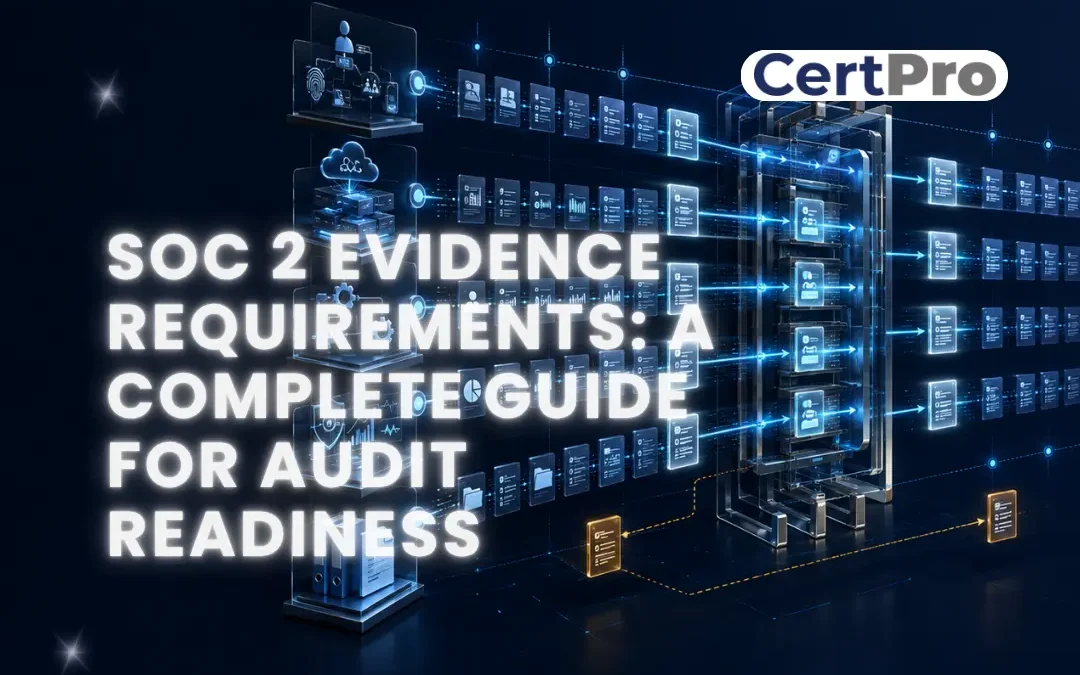

Ask any team that has been through a SOC 2 examination what surprised them most, and the answer is rarely the controls. It is the SOC 2 evidence requirements: how much material the auditor wanted, how specific the requests were, and how little a well-written policy counted for when the export behind it was missing.
SOC 2 evidence requirements are the practical translation of the framework: for every control management describes, the auditor must obtain records proving it operated. The AICPA's attestation standards do not prescribe a fixed document list; they require sufficient appropriate evidence for each in-scope Trust Services Criterion, gathered from complete populations and tested across the review period. What that means in practice is knowable, and preparing for it is the substance of audit readiness.
This guide sets out the SOC 2 evidence requirements auditors actually apply: what changes between Type 1 and Type 2, the evidence checklist organized by Trust Services Criteria, how evidence gets tested, and how to build the audit trail that carries an examination from kickoff to a clean report.

Concern
Teams preparing for SOC 2 consistently underestimate the evidence burden. Policies and screenshots assembled before fieldwork do not satisfy SOC 2 evidence requirements: auditors demand complete populations exported from source systems, records dated across the full review period, and an audit trail that survives skepticism. Evidence gaps discovered during fieldwork extend timelines, expand samples, and surface as exceptions in the final report that every prospective customer will read.
Overview
SOC 2 evidence requirements flow from the Trust Services Criteria in scope. A Type 1 examination requires evidence that controls were suitably designed as of a date; SOC 2 type 2 requirements add operating effectiveness, meaning dated records spanning a review window of typically three to twelve months. Evidence divides into governance records, control-generated records by criterion, and the population exports that make sampling possible. Auditors test it through inquiry, observation, inspection, and re-performance, weighted toward system-generated records.
Solution
Work from a SOC 2 evidence checklist mapped to your in-scope criteria: assign every control an evidence owner, generate records from source systems rather than manual assembly, preserve timestamps and complete populations, and run internal SOC 2 control testing quarterly so gaps surface while they are fixable. Organizations that operate this way meet the auditor's requests with exports, not explanations.
What Are SOC 2 Evidence Requirements?
SOC 2 evidence requirements are the records an independent CPA firm must obtain and evaluate to issue an opinion on a service organization's controls. Under AT-C Section 205, the auditor needs sufficient appropriate evidence for every in-scope Trust Services Criterion: sufficient in quantity relative to each control's risk, and appropriate in quality, meaning relevant to the criterion and reliable in how it was produced.
Two properties of SOC 2 evidence requirements follow directly. First, evidence must be attributable and dated, because an undated record cannot prove a control operated during the period. Second, it must come from complete populations: the auditor asks for every account created, every change deployed, every incident logged, exported from the source system, before selecting samples. A curated folder of favorable examples fails this test before testing begins.
These SOC 2 audit requirements are not unique inventions; they apply the general standards for audit evidence to the SOC 2 structure. What makes SOC 2 evidence requirements feel demanding is the combination of breadth, every criterion in scope, and depth, every control traced to records an outsider can verify.
SOC 2 Type 2 Requirements: Evidence Across the Period
SOC 2 evidence requirements change most sharply at the line between report types, and the gap between Type 1 and Type 2 is the gap between a snapshot and a film. A Type 1 examination evaluates whether controls are suitably designed as of a specified date. SOC 2 type 2 requirements add operating effectiveness: the auditor tests whether each control operated consistently across a review window, typically three to twelve months, and the report describes the tests performed and their results.
The consequence for SOC 2 evidence requirements is temporal. Records must exist from across the window, not just its final weeks, because the way SOC 2 auditors review evidence over time deliberately spreads samples across the period. A quarterly access review should leave four dated records; date clustering before fieldwork is read as a control that operates for audits rather than continuously.
This is where the audit trail becomes the organizing concept. An audit trail is the connected sequence of records that lets an auditor reconstruct what happened: who requested, who approved, who executed, and when, with each step timestamped in the system where it occurred. SOC 2 evidence requirements are, in effect, a demand that an audit trail exist for every in-scope control, and Type 2 extends that demand across the full review period.
The SOC 2 Requirements List: Evidence by Trust Services Criteria
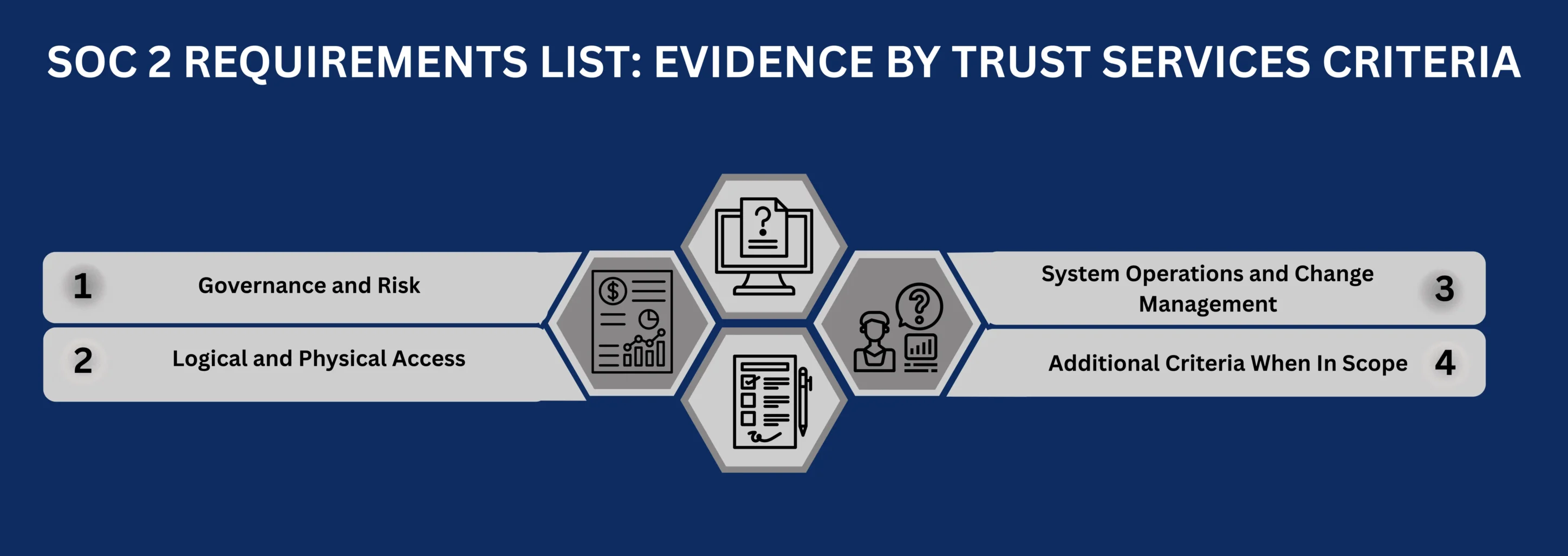
A practical SOC 2 requirements list organizes evidence around the Trust Services Criteria included in the examination. Security is required in every SOC 2 examination, while Availability, Processing Integrity, Confidentiality, and Privacy apply when relevant to the organization's commitments and scope. The following SOC 2 evidence checklist covers common evidence categories auditors examine.
Governance and Risk:
- Organizational charts, security policies with approval and review dates, and leadership oversight records
- Risk assessment results, treatment decisions, and assigned owners
- Security awareness training records, including new-hire completion within the required timeframe
- Vendor risk assessments and reviews for subservice organizations and critical suppliers
Logical and Physical Access:
- User listings for in-scope systems, with provisioning and deprovisioning records for sampled users
- Access review records with reviewer approval and documented remediation of flagged accounts
- Privileged access approvals, MFA configuration, and password or SSO settings
System Operations and Change Management:
- Change records showing required approval before deployment, including evidence of appropriate approval separation
- Vulnerability scan reports with remediation tracked against defined timelines
- Monitoring configurations, alert review records, and incident records with response documentation
- Backup configurations and restoration test results performed at the defined frequency
Additional Criteria When In Scope:
- Availability: capacity monitoring, business continuity records, and disaster recovery test results
- Processing Integrity: validation controls, processing exceptions, and error-handling records
- Confidentiality: data classification, encryption configurations, and secure disposal records
- Privacy: privacy notices, consent records, data subject request logs, and retention controls
Treat this SOC 2 evidence checklist as a starting point, not a universal document list. Actual SOC 2 evidence requirements depend on the examination scope, system description, applicable Trust Services Criteria, and controls management identifies. Each evidence item should trace to its control, source, date, and relevant population before an auditor selects samples.
How Auditors Test SOC 2 Compliance Evidence
SOC 2 compliance evidence is tested against the same SOC 2 evidence requirements it was collected for, not displayed. For each control, the auditor combines four methods: inquiry to understand the process, observation where operation can be watched, inspection of the records the control produced, and re-performance where independently re-executing the control is warranted by risk. Inspection of system-generated audit evidence carries most of the weight, and inquiry alone never supports a conclusion on operating effectiveness.
SOC 2 control testing then follows the sampling mechanic: define the population, size the sample by the control's frequency and risk, and verify each selected instance end to end against its audit trail. Deviations are evaluated for cause and projected to the population, which is why a single unrevoked account in a sample of twenty-five leavers becomes an exception in the report rather than a footnote.
Reliability cues decide how much corroboration a record needs. System exports with intact timestamps beat reconstructed spreadsheets; records from independent sources beat self-produced summaries; audit trail entries that cannot be edited after creation beat files that can. Evidence failing these cues triggers expanded samples and follow-up requests, and the examination slows exactly where the evidence is weakest.
Meeting SOC Compliance Requirements: Building Audit Readiness
SOC compliance requirements reward preparation that starts well before fieldwork. Operating effectiveness depends on evidence generated throughout the examination period. Four practices support a more predictable audit.
- Map Every Control to Its Evidence
For each control in the system description, identify the evidence that supports it, the source system, the control frequency, and the responsible owner. This creates a clear link between SOC 2 evidence requirements and the controls auditors will test.
- Generate Evidence at the Source
Automated evidence collection can pull records from identity, ticketing, vulnerability scanning, and cloud platforms on a defined schedule. Source-generated records preserve timestamps and populations while reducing manual evidence assembly.
- Test Controls Before Fieldwork
Run internal SOC 2 control testing using the same principles auditors apply. Test full populations where appropriate, select samples, trace activities end to end, and document exceptions. Early testing can expose broken audit trails while there is still time to address them.
- Close the Evidence Loop
A defined SOC 2 evidence collection strategy connects control mapping, evidence collection, and internal testing. This makes evidence collection a recurring operating process rather than a last-minute exercise before each examination.
Conclusion
SOC 2 evidence requirements look demanding from the outside and predictable from the inside. Auditors obtain populations, select samples, trace transactions and activities to supporting records, evaluate evidence from appropriate sources, and perform procedures across the examination period. What changes from one engagement to another is how well the organization can demonstrate its controls through complete, reliable evidence.
Meeting SOC 2 evidence requirements is a structural discipline: evidence mapped to controls, generated at the source, dated across the examination period, and subject to internal review using criteria consistent with the examination. When evidence exists as part of normal operations, organizations spend less time reconstructing records and can demonstrate how their controls operated throughout the period.
At CertPro, we conduct SOC 2 examinations worldwide as a licensed CPA firm enrolled in the AICPA Peer Review Program. Our auditors request populations, select and test samples, evaluate evidence against the applicable Trust Services Criteria, and document exceptions based on objective audit evidence. For organizations undergoing a SOC 2 Type 1 or Type 2 examination, CertPro provides independent attestation engagements performed in accordance with applicable AICPA standards.