
ISO 42001 Certification in Berlin
CertPro is a Licensed CPA Firm delivering ISO 42001 Certification in Berlin through structured audit programs, independent assessment, and formal certification decisions. CertPro evaluates Artificial Intelligence Management Systems (AIMS) against ISO/IEC 42001:2023 requirements for Berlin-based organizations that develop, deploy, or integrate AI systems across all sectors and industries.
OUR CLIENTS










What Is ISO 42001 Certification?
ISO/IEC 42001:2023 is the first international standard establishing requirements for an Artificial Intelligence Management System (AIMS). Published by the International Organization for Standardization (ISO) and the International Electrotechnical Commission (IEC) in December 2023, the standard defines how organizations must govern, operate, and continuously improve AI systems within a structured management framework. ISO 42001 Certification confirms that an organization’s AIMS conforms to the requirements of the standard through independent third-party audit and a formal certification decision.
The standard applies to any organization — regardless of size, sector, or geographic location — that develops, deploys, or uses AI-powered products and services. ISO 42001 Certification in Berlin is therefore relevant to technology startups building machine learning models, financial institutions deploying algorithmic decision-making tools, healthcare providers using AI-assisted diagnostics, and enterprise organizations integrating AI into supply chain or human resources functions.
ISO/IEC 42001:2023 Standard Structure
ISO/IEC 42001:2023 follows the ISO Annex SL High-Level Structure (HLS) — the same harmonized framework used by ISO 27001 (Information Security Management) and ISO 31000 (Risk Management). This structural alignment enables organizations already certified to ISO 27001 to integrate ISO 42001 requirements into existing management system documentation without duplicating effort. The standard is organized into ten clauses, with Clauses 4 through 10 containing the normative requirements subject to audit and certification. Annexes A through E provide additional normative and informative guidance on AI system impact assessment, data governance, and responsible AI objectives.
The AIMS framework defined within ISO/IEC 42001:2023 requires organizations to establish an AI policy, define the scope of the management system, assign roles and responsibilities for AI governance, conduct AI risk assessments, implement operational controls, and perform regular management reviews. ISO 42001 Certification is issued when an accredited certification body — such as CertPro as a Licensed CPA Firm — completes a two-stage audit process and determines that the organization’s AIMS conforms to all mandatory clauses of the standard.
Relationship Between ISO 42001, GDPR, and the EU AI Act
ISO 42001 compliance directly supports obligations under two major European regulatory frameworks: the General Data Protection Regulation (GDPR) and the EU Artificial Intelligence Act. The GDPR, enforced in Germany by the Federal Commissioner for Data Protection and Freedom of Information (BfDI), requires organizations to implement appropriate technical and organizational measures for automated decision-making processes. ISO 42001’s requirements for data governance, AI impact assessment, and accountability structures fulfill a significant portion of these GDPR obligations for AI-related processing activities.
The EU AI Act entered into force in August 2024 and applies progressively through 2027. It establishes a risk-based regulatory framework for AI systems operating in the European Union. High-risk AI systems as defined under Annex III of the EU AI Act require documented conformity assessment procedures, risk management systems, data governance practices, and transparency obligations. ISO 42001 Certification in Berlin provides organizations with a structured framework that maps directly to these EU AI Act requirements, enabling Berlin-based companies to demonstrate regulatory conformity through a recognized international standard.
ISO 42001 Versus Other AI Governance Frameworks
ISO 42001 differs from other AI governance frameworks by establishing certifiable, auditable requirements rather than voluntary guidelines. The NIST AI Risk Management Framework (AI RMF) and the OECD AI Principles provide guidance and recommendations but do not define requirements that can be independently verified through third-party audit. ISO 42001 Certification is a formal attestation issued by an accredited certification body following a structured audit process — making it the only internationally recognized credential that demonstrates conformance to a defined AI management standard.
| Framework | Type | Certifiable | Geographic Scope |
|---|---|---|---|
| ISO/IEC 42001:2023 | International Standard (AIMS) | Yes | Global |
| EU AI Act | Regulatory Requirement | No (compliance-based) | European Union |
| NIST AI RMF | Voluntary Guidance | No | United States (advisory globally) |
| OECD AI Principles | Policy Guidance | No | OECD Member Countries |
| IEEE Ethically Aligned Design | Guidelines | No | Global (voluntary) |

Why Berlin Organizations Need ISO 42001 Certification
Berlin occupies a unique position in the European AI landscape. As Germany’s capital and the continent’s most active startup ecosystem, Berlin is home to over 4,000 technology companies — including a rapidly expanding cluster of AI-focused firms, fintech enterprises, SaaS platforms, and multinational corporate technology divisions. This concentration of AI-active organizations places Berlin businesses at the intersection of significant regulatory scrutiny and substantial commercial opportunity, both of which ISO 42001 Certification in Berlin directly addresses.
Regulatory Drivers in Berlin’s AI Market
Germany enforces GDPR through two primary authorities: the BfDI at the federal level and the Berliner Beauftragte für Datenschutz und Informationsfreiheit (BlnBDI) at the state level. Both authorities have demonstrated active enforcement postures regarding automated decision-making and AI-related data processing. Berlin companies subject to GDPR Article 22 — covering automated decision-making including profiling — require documented accountability structures that ISO 42001 compliance directly provides. The BlnBDI has issued guidance linking responsible AI deployment to data protection by design principles, which ISO 42001 Certification operationalizes through mandatory AIMS requirements.
The EU AI Act introduces additional compliance obligations directly relevant to Berlin’s technology sector. Berlin-based companies operating AI systems classified as high-risk under EU AI Act Annex III — including systems used in employment decisions, credit scoring, biometric identification, and critical infrastructure management — face mandatory conformity assessment obligations. ISO 42001 audit procedures evaluate the same control domains that EU AI Act compliance requires, making ISO 42001 Certification in Berlin an efficient pathway to demonstrating regulatory readiness across both the standard and the regulation simultaneously.
ISO 42001 Certification for Berlin Tech Startups and Fintech Firms
ISO 42001 Certification for Berlin tech startups provides a competitive differentiator in procurement, investment, and partnership contexts. Venture capital firms and institutional investors increasingly require AI governance documentation as part of due diligence processes. ISO 42001 Certification in Berlin gives startups independently verified evidence of structured AI management, reducing investor risk perception and accelerating funding decisions. Berlin’s startup ecosystem — centered around districts such as Mitte, Kreuzberg, and Prenzlauer Berg — hosts organizations at every stage, from seed-funded AI ventures to Series C scale-ups where certification credibility directly influences valuation.
Berlin fintech organizations face particular pressure from both BaFin (Bundesanstalt für Finanzdienstleistungsaufsicht) and the European Banking Authority (EBA), which have issued guidelines on the use of machine learning in financial services. ISO 42001 Certification for Berlin AI companies operating in regulated financial services demonstrates that algorithmic models used in credit decisions, fraud detection, anti-money laundering, and customer risk profiling are subject to documented governance controls. This evidence base is increasingly required in BaFin supervisory examinations and EBA model risk management assessments.
Market Demand and Commercial Advantages in Berlin
Public sector procurement in Berlin increasingly requires AI governance certification as a condition of contract award for technology suppliers. The Berlin Senate Department for Economics, Energy and Public Enterprises has published AI strategy documentation referencing responsible AI procurement standards. ISO 42001 Certification positions Berlin companies to qualify for government and enterprise procurement frameworks that mandate independently verified AI governance credentials. For multinational enterprises with Berlin operations, ISO 42001 Certification satisfies group-level AI governance requirements while also meeting local regulatory expectations.
ISO 42001 Requirements
ISO 42001 certification requirements are defined in Clauses 4 through 10 of the standard. Each clause establishes specific, auditable obligations that organizations must satisfy to achieve certification. The requirements outlined below represent the core elements that a CertPro ISO 42001 audit evaluates during the certification process for Berlin-based organizations.
Clause 4 of ISO/IEC 42001:2023 requires organizations to determine internal and external factors relevant to AI governance, identify interested parties and their requirements, and define the scope of the AIMS. Scope definition must specify which AI systems, organizational units, geographic locations, and activities are included within the management system boundary. For Berlin-based organizations, scope documentation must reflect the organization’s specific AI use cases, the roles of relevant Berlin regulatory bodies, and any applicable EU regulatory requirements. The scope must be documented and maintained as a controlled document subject to audit review.
Clause 5 requires top management to demonstrate leadership commitment to the AIMS by establishing an AI policy, assigning roles and responsibilities, and ensuring resources are available for effective AI governance. The AI policy must state the organization’s commitment to responsible AI development and use, provide a framework for setting AI objectives, and commit to continual improvement of the AIMS. The policy must be documented, communicated to relevant personnel, and made available to interested parties. Leadership accountability for AI governance is a mandatory evaluation criterion under any ISO 42001 audit.
Clause 6 requires organizations to plan actions to address risks and opportunities, establish AI risk assessment processes, and conduct AI system impact assessments. The risk assessment process must identify risks associated with AI system development and deployment, evaluate their likelihood and consequences, and determine appropriate treatment actions. Annex A of the standard provides a reference control set of 38 controls organized across eight domains, which organizations must evaluate for applicability as part of the risk treatment planning process.
AI system impact assessments under Clause 6 evaluate the potential effects of AI systems on individuals, groups, and society. For Berlin organizations, impact assessments must address GDPR Data Protection Impact Assessment (DPIA) requirements where AI systems process personal data, as well as EU AI Act conformity assessment obligations for high-risk systems. The impact assessment must be documented, reviewed whenever AI systems change materially, and retained as evidence subject to ISO 42001 audit review.
Clauses 7, 8, and 9 establish requirements for support resources, operational planning and control, and performance evaluation. Key documentation requirements include: the AIMS scope document, AI policy, AI risk assessment records, AI system impact assessment records, AI objectives and plans, competence records for personnel with AI governance responsibilities, operational planning and control procedures, monitoring and measurement results, internal audit program and results, and management review records. All documented information must be controlled in accordance with Clause 7.5 requirements, which specify creation, approval, review, update, and retention protocols.
- ✓Documented AIMS scope defining included AI systems, locations, and organizational units
- ✓AI policy approved by top management and communicated across the organization
- ✓AI risk assessment process documentation with risk criteria and evaluation records
- ✓AI system impact assessment records for each in-scope AI application
- ✓Statement of Applicability referencing all 38 Annex A controls with justifications
- ✓Defined AI objectives with measurable targets and monitoring plans
- ✓Competence and awareness records for personnel with AI governance roles
- ✓Operational procedures for AI system development, testing, deployment, and monitoring
- ✓Internal audit program with completed audit reports and nonconformity records
- ✓Management review records documenting AIMS performance and improvement decisions
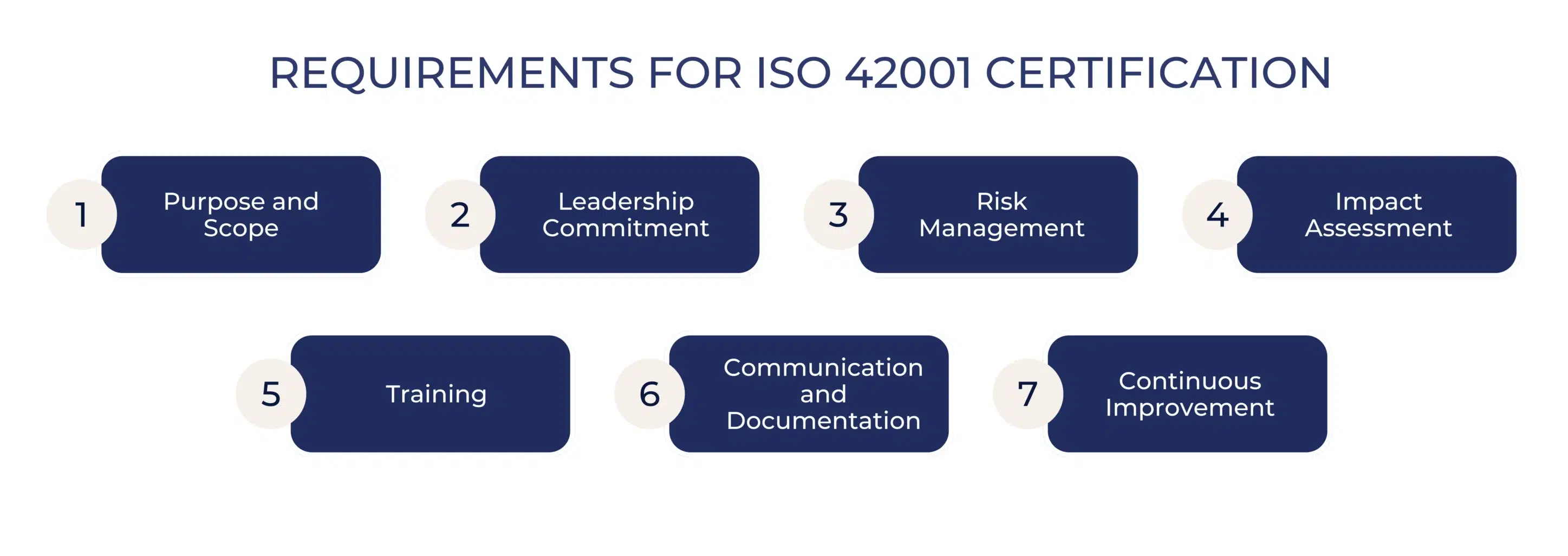
- ✓Organizational Context and Scope Requirements
- ✓Leadership and AI Policy Requirements
- ✓Risk Assessment and AI Impact Assessment Requirements
- ✓Operational Controls and Documentation Requirements
Artificial Intelligence Management System (AIMS) Framework
An Artificial Intelligence Management System (AIMS) is the structured set of policies, processes, procedures, and controls that an organization establishes, implements, maintains, and continually improves to govern AI-related activities. ISO/IEC 42001:2023 defines the requirements that an AIMS must satisfy to achieve certification. The AIMS framework is not a software platform or a technical tool — it is a governance structure that provides systematic oversight of how AI systems are developed, evaluated, deployed, monitored, and retired throughout their operational lifecycle.
Core Components of the AIMS Framework
The AIMS framework under ISO 42001 consists of six primary governance components. First, the AI governance structure defines organizational roles, responsibilities, accountabilities, and authorities for AI management decisions. This includes designation of an AI governance function, definition of the AI system owner role, and integration of AI oversight into existing board and executive governance structures. Second, the AI risk management component establishes how the organization identifies, assesses, treats, monitors, and reviews risks associated with AI systems across their full lifecycle. The risk management component integrates with Annex A controls to ensure that treatment measures are documented and verifiable.
Third, the data governance component addresses the quality, integrity, provenance, and management of data used to train, validate, and operate AI systems. Data governance under ISO 42001 compliance requirements includes documentation of data sources, data quality criteria, bias assessment procedures, and data retention and deletion protocols. Fourth, the AI lifecycle management component covers the systematic processes for AI system design, development, testing, validation, deployment, monitoring, and decommissioning. Each lifecycle phase must have defined entry criteria, exit criteria, and documented evidence of control execution.
Annex A Control Domains
Annex A of ISO/IEC 42001:2023 contains 38 reference controls organized across eight domains. These controls represent the specific technical and organizational measures that organizations must evaluate for applicability within their AIMS. The eight Annex A domains are: (1) Policies for AI, (2) Internal organization for AI governance, (3) Resources for AI systems, (4) Assessing impacts of AI systems, (5) AI system lifecycle, (6) Data for AI systems, (7) Third-party and customer relationships, and (8) Responsible use of AI. During an ISO 42001 audit, the certification body evaluates the organization’s Statement of Applicability against each of these 38 controls and verifies that applicable controls are implemented and effective.
AIMS Integration with Existing Management Systems
Because ISO/IEC 42001:2023 follows the Annex SL High-Level Structure, the AIMS framework integrates directly with existing ISO 27001 information security management systems, ISO 9001 quality management systems, and ISO 22301 business continuity management systems. Berlin organizations with existing ISO management system certifications can extend their current documentation frameworks to incorporate AIMS requirements without creating entirely separate systems. This integration reduces documentation overhead, simplifies internal audit programs, and enables combined audit approaches where a single audit team evaluates multiple standards simultaneously. For Berlin AI companies with existing ISO 27001 certification, the integration pathway to ISO 42001 Certification involves primarily adding AI-specific governance components to an already-audited management structure.
ISO 42001 Certification Process in Berlin
The ISO 42001 certification process in Berlin follows a structured, stage-based audit program conducted by CertPro as a Licensed CPA Firm. The process provides independent, objective verification of AIMS conformance through documented audit evidence, nonconformity identification, and a formal certification decision. The steps below define the complete certification pathway for Berlin-based organizations seeking ISO 42001 Certification.
- Scope Definition: The organization defines the AIMS boundary, identifying which AI systems, organizational units, and geographic locations are included within the certification scope.
- Application and Contract: The organization submits a formal certification application to CertPro. CertPro reviews the application, determines the audit program structure, and issues an audit contract.
- Stage 1 Audit (Documentation Review): CertPro auditors conduct an off-site review of the organization’s AIMS documentation, evaluating the AI policy, scope document, risk assessment records, and Statement of Applicability against ISO 42001 requirements.
- Stage 1 Findings Review: CertPro issues a Stage 1 audit report identifying areas of conformance, observations, and any significant gaps that must be addressed before Stage 2 audit commencement.
- Stage 2 Audit (On-Site Certification Audit): CertPro auditors conduct an on-site audit at the organization’s Berlin premises, evaluating the implementation and operational effectiveness of all in-scope AIMS controls and processes through interviews, observations, and document sampling.
- Nonconformity Review and Response: The organization addresses any nonconformities identified during Stage 2 audit. Major nonconformities must be closed before certification can be issued. Minor nonconformities require documented corrective action plans.
- Certification Decision: CertPro’s independent certification decision function reviews the complete audit record and issues a formal certification decision. Certification is granted when all mandatory requirements are confirmed as met.
- Certificate Issuance: CertPro issues the ISO/IEC 42001:2023 certificate, valid for a three-year certification cycle, specifying the certified scope, the organization’s name, and the certificate validity period.
- Surveillance Audits: Annual surveillance audits are conducted in Year 1 and Year 2 of the certification cycle to verify continued conformance and AIMS effectiveness.
- Recertification Audit: A full recertification audit is conducted in Year 3, prior to certificate expiry, to renew the certification for the next three-year cycle.
The Stage 1 audit conducted by CertPro evaluates the completeness and adequacy of the organization’s AIMS documentation relative to ISO/IEC 42001:2023 requirements. Auditors review the AI policy for alignment with Clause 5.2 requirements, the AIMS scope document for completeness and accuracy, the AI risk assessment methodology for conformance with Clause 6.1.2, and the Statement of Applicability for coverage of all 38 Annex A controls. The Stage 1 ISO 42001 audit does not evaluate operational effectiveness — this is reserved for Stage 2. The Stage 1 finding report identifies whether the organization is ready to proceed to Stage 2 and documents any deficiencies that require correction before the on-site audit begins.
The Stage 2 ISO 42001 audit is the primary certification audit event. CertPro auditors conduct an on-site evaluation at the organization’s Berlin location, examining objective evidence of AIMS implementation and operational effectiveness. Audit techniques include structured interviews with personnel holding AI governance responsibilities, observation of AI system management processes, sampling of records and documented information, and technical review of AI system documentation. Audit duration is proportional to the organization’s size, scope complexity, and number of in-scope AI systems. A Berlin technology company with five in-scope AI systems and 200 employees typically requires a two-to-three day on-site Stage 2 audit.
ISO 42001 Certification is valid for three years from the date of the certification decision. The three-year cycle includes mandatory annual surveillance audits in Years 1 and 2, and a full recertification audit in Year 3. Surveillance audits evaluate a subset of the AIMS, focusing on areas where changes have occurred, nonconformities identified in previous audits, and the organization’s continual improvement activities. Surveillance audits are typically shorter than the initial certification audit, lasting one to two days depending on scope. Failure to complete scheduled surveillance audits results in suspension or withdrawal of the ISO 42001 certificate.
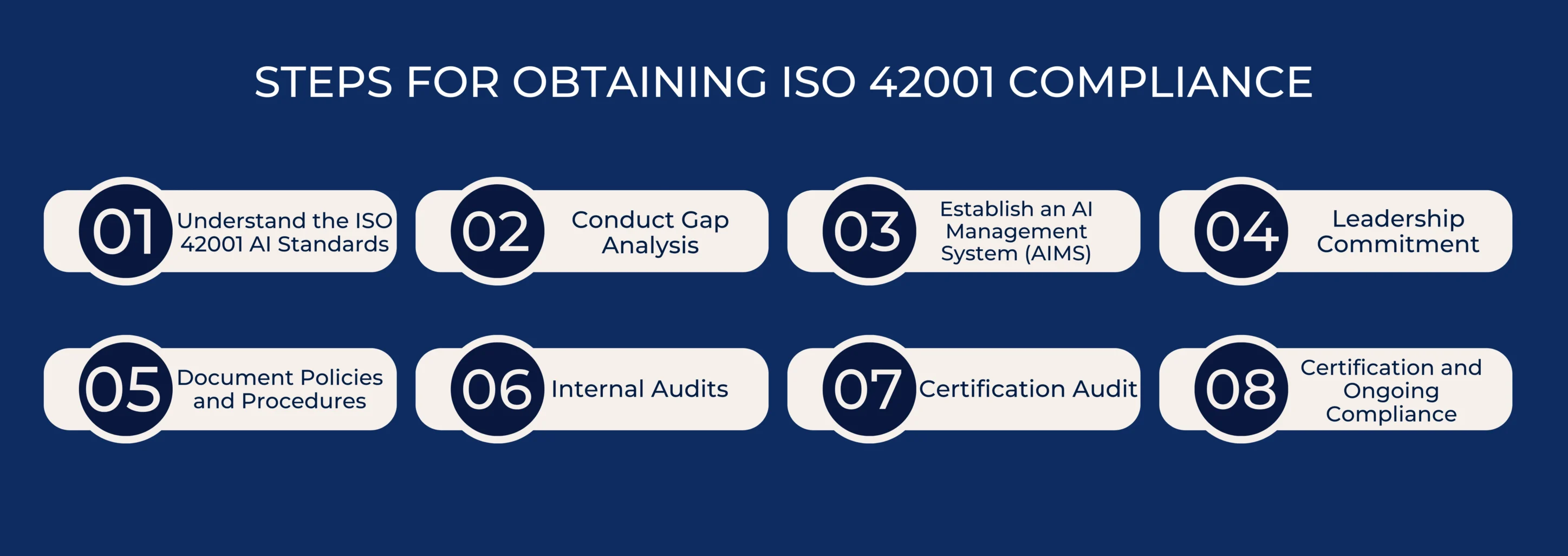
- ✓Stage 1 Audit: Documentation and Readiness Evaluation
- ✓Stage 2 Audit: Implementation and Effectiveness Verification
- ✓Certification Cycle and Surveillance Program
ISO 42001 Certification Cost in Berlin
The cost of ISO 42001 Certification in Berlin is determined by several structured factors that CertPro applies consistently across all client engagements. CertPro’s pricing model is transparent, fixed, and defined at the outset of the engagement based on auditable scope parameters. The primary cost determinants are organizational size (measured by number of employees and AI system users), the number of distinct AI systems within the certification scope, the complexity of AI governance structures, and the audit duration required to evaluate all in-scope AIMS elements.
Certification Cost Factors
ISO 42001 certification body pricing structures in Berlin account for audit time across both Stage 1 and Stage 2 phases. Larger organizations with multiple AI systems, complex organizational structures, or multi-site operations require more audit days than smaller, single-site organizations with a limited AI footprint. Berlin technology startups with one or two AI applications and fewer than 50 employees typically incur lower certification costs than established enterprises with large-scale AI deployments. Organizations with prior ISO certification — such as ISO 27001 — may benefit from a reduced audit scope where AIMS documentation integrates with existing management system records.
| Organization Size | Number of AI Systems | Estimated Audit Duration | Cost Range (EUR) |
|---|---|---|---|
| Small (up to 50 employees) | 1–2 AI systems | 2–3 audit days | 3,500 – 6,000 |
| Medium (50–250 employees) | 3–5 AI systems | 4–5 audit days | 6,000 – 12,000 |
| Large (250–1,000 employees) | 6–10 AI systems | 6–8 audit days | 12,000 – 22,000 |
| Enterprise (1,000+ employees) | 10+ AI systems | 9–12 audit days | 22,000 – 40,000+ |
| Multi-site Berlin operations | Variable | Site-dependent | Custom pricing |
Annual surveillance audit costs are typically 30 to 40 percent of the initial certification audit investment, reflecting the reduced scope of the surveillance program. Recertification audits in Year 3 are priced similarly to the initial certification audit, as they require full AIMS re-evaluation. All CertPro pricing for ISO 42001 Certification in Berlin is documented in a formal certification agreement prior to audit commencement, with no variable or unexpected charges introduced during the audit process. Travel and accommodation costs for on-site Berlin audits are included in CertPro’s fixed pricing structure for Berlin-based organizations.
Benefits of ISO 42001 Certification for Berlin Businesses
ISO 42001 Certification in Berlin delivers measurable operational, commercial, and regulatory benefits for organizations that develop, deploy, or use AI systems. These benefits extend across governance quality, market positioning, regulatory standing, and stakeholder confidence. The following outcomes are directly associated with achieving and maintaining ISO 42001 Certification as confirmed through independent audit by a Licensed CPA Firm.
- ✓Regulatory alignment: ISO 42001 compliance demonstrates conformance with EU AI Act risk management and conformity assessment requirements, reducing regulatory exposure for Berlin organizations operating high-risk AI systems.
- ✓GDPR support: The AIMS framework satisfies GDPR Article 22 accountability requirements for automated decision-making, supporting audit responses to BfDI and BlnBDI data protection inquiries.
- ✓Stakeholder confidence: ISO 42001 Certification provides independently verified evidence of responsible AI governance, increasing confidence among customers, investors, and business partners.
- ✓Procurement qualification: Public sector and enterprise procurement frameworks in Germany and the EU increasingly require AI governance certification as a contract qualification criterion.
- ✓Risk reduction: Structured AI risk assessment and treatment processes reduce the probability and impact of AI system failures, bias incidents, and adverse outcomes.
- ✓Operational efficiency: Documented AI lifecycle management processes reduce inconsistency in AI development and deployment, improving system reliability and governance auditability.
- ✓Investment readiness: ISO 42001 Certification provides due diligence evidence demanded by institutional investors and venture capital firms evaluating AI company portfolios.
- ✓Brand differentiation: ISO 42001 Certification in Berlin distinguishes certified organizations from uncertified competitors in a market where AI governance credentials are increasingly valued.
- ✓Integration with ISO 27001: Organizations with ISO 27001 certification can extend their existing management systems to incorporate AIMS requirements, leveraging existing audit infrastructure.
- ✓Continual improvement culture: The ISO 42001 management system model establishes ongoing monitoring, internal audit, and management review cycles that drive systematic improvement in AI governance quality over time.
ISO 42001 Certification provides Berlin organizations with documented evidence that AI governance controls are implemented and effective. This evidence base is directly relevant in regulatory investigations, supervisory examinations, and enforcement proceedings by the BfDI, BlnBDI, BaFin, and EU AI Act market surveillance authorities. Organizations that demonstrate certification body-verified conformance are positioned to respond to regulatory inquiries with structured audit evidence rather than ad-hoc documentation — materially reducing the time, cost, and reputational risk associated with regulatory engagement.
Under the EU AI Act, providers of high-risk AI systems must establish quality management systems covering risk management, data governance, technical documentation, human oversight, accuracy, robustness, and cybersecurity. ISO 42001 compliance requirements address each of these obligation areas within the AIMS framework. Berlin companies that achieve ISO 42001 Certification therefore possess documented evidence that their quality management system for AI satisfies EU AI Act Article 17 requirements — streamlining the conformity declaration process for regulated AI applications.
Berlin’s AI market is characterized by intense competition for enterprise clients, government contracts, and international partnerships. ISO 42001 Certification in Berlin enables certified organizations to differentiate their offerings on the basis of independently verified AI governance quality rather than self-declared commitments. Enterprise procurement teams evaluating AI vendors increasingly include AI governance certification as a vendor qualification criterion. Organizations without certification face disqualification from tender processes regardless of technical capability. ISO 42001 assessment confirmation by a recognized certification body such as CertPro provides the third-party verification required to satisfy these qualification criteria.
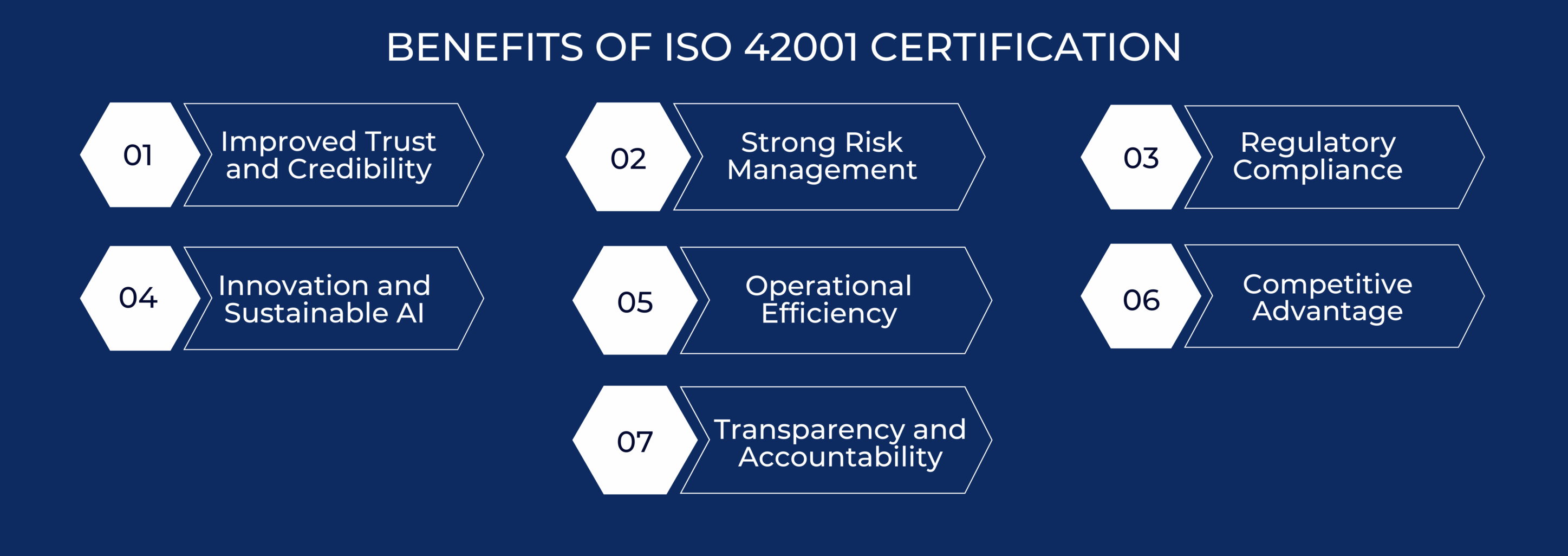
- ✓Regulatory and Legal Risk Mitigation
- ✓Commercial and Competitive Advantages in Berlin’s AI Market
ISO 42001 Certification Steps
Organizations pursuing ISO 42001 Certification in Berlin follow a defined sequence of activities that begins with AIMS scoping and concludes with certificate issuance. Each step has specific inputs, activities, and outputs that CertPro’s audit program evaluates. The structured steps below represent the complete organizational preparation and audit pathway for Berlin-based certification applicants.
The first step in the ISO 42001 certification process requires the organization to document a complete inventory of all AI systems in use, under development, or planned for deployment within the certification period. Each AI system must be characterized by its function, the data it processes, the decisions it influences or makes, the populations it affects, and the organizational units that own and operate it. The AIMS scope is then defined based on this inventory, specifying which AI systems and organizational boundaries are included within the certification. For Berlin organizations, scope documentation must also identify relevant regulatory frameworks applicable to each AI system — including EU AI Act risk classification and GDPR processing activity registration.
Top management must formally establish the AIMS governance structure by approving an AI policy, designating roles and responsibilities, and allocating resources for AIMS implementation and maintenance. The AI policy must be documented, communicated to all relevant personnel, and reviewed at defined intervals. Governance structure documentation must define the AI governance function, specify reporting lines to executive management, and establish decision-making authority for AI system approvals, risk acceptances, and incident responses. These governance elements are subject to direct evaluation in both the Stage 1 documentation review and the Stage 2 ISO 42001 audit.
AI risk assessment under Clause 6 requires the organization to apply a documented risk assessment methodology to each in-scope AI system. The methodology must define risk criteria, identify risk owners, and produce risk treatment plans that specify which of the 38 Annex A controls are applicable and how they are implemented. AI system impact assessments evaluate the potential effects on individuals and groups who are subject to or affected by AI system decisions. For Berlin organizations processing personal data through AI systems, the impact assessment must be coordinated with GDPR Data Protection Impact Assessment (DPIA) requirements under Article 35. Completed risk assessment and impact assessment records constitute primary ISO 42001 audit evidence.
Based on risk assessment outputs and the Statement of Applicability, the organization implements the selected Annex A controls and documents the associated operational procedures. Control implementation must be verifiable through objective evidence — including documented procedures, training records, system configurations, testing records, and monitoring outputs. Each implemented control must have an identified owner and a defined monitoring mechanism that generates records suitable for ISO 42001 assessment. Operational procedures for AI system development, testing, validation, deployment, and monitoring must be documented, approved, and accessible to all relevant personnel.
Before the Stage 2 certification audit, the organization must complete at least one cycle of internal AIMS audit and one formal management review. The internal audit program must cover all clauses of ISO/IEC 42001:2023 and produce documented audit reports with findings, nonconformities, and corrective action records. The management review must address AIMS performance data, audit results, risk assessment outcomes, and decisions about AIMS objectives and resources. These internal audit and management review records demonstrate the organization’s commitment to continual improvement and provide CertPro auditors with evidence of systematic AIMS operation over time — a mandatory evaluation criterion for ISO 42001 certification decisions.
- ✓Step 1: Define AI System Inventory and AIMS Scope
- ✓Step 2: Establish Governance Structure and AI Policy
- ✓Step 3: Conduct AI Risk Assessment and Impact Assessment
- ✓Step 4: Implement Controls and Operational Procedures
- ✓Step 5: Internal Audit and Management Review
CertPro’s ISO 42001 Certification Services in Berlin
CertPro is a Licensed CPA Firm delivering ISO 42001 Certification in Berlin through a structured, accreditation-based audit program. CertPro’s ISO 42001 certification body services in Berlin are exclusively focused on certification audit execution and formal certification decisions — not consulting, advisory, or implementation services. This institutional separation ensures that CertPro’s audit determinations are independent, objective, and free from any conflict of interest that could compromise certification integrity.
CertPro’s Audit Methodology for ISO 42001
CertPro’s ISO 42001 audit methodology applies a risk-based, evidence-driven approach to AIMS evaluation. Audit teams assigned to Berlin engagements consist of lead auditors with demonstrated competence in AI management systems, information security, and relevant sector knowledge specific to the client organization’s industry. For ISO 42001 certification of Berlin fintech firms, audit teams include auditors with financial services regulatory knowledge. For Berlin AI companies in healthcare, audit teams include auditors familiar with medical device regulation and health data governance requirements.
CertPro’s ISO 42001 audit program for Berlin engagements uses sampling-based evidence collection, ensuring that audit findings are representative of the organization’s AIMS performance rather than isolated observations. Audit evidence is documented in structured working papers that form the basis of audit reports and the certification decision record. All audit reports issued by CertPro identify conformances, observations, minor nonconformities, and major nonconformities in accordance with ISO/IEC 17021-1 requirements for certification body audit reporting.
CertPro’s Berlin-Specific Certification Expertise
CertPro maintains Berlin-based audit infrastructure to service ISO 42001 assessment engagements efficiently and without unnecessary client overhead. Berlin audit engagements are managed by locally based audit coordinators who are familiar with German regulatory requirements, BfDI and BlnBDI data protection frameworks, BaFin AI governance expectations, and the specific operational characteristics of Berlin’s technology sector. Advisory and consulting inquiries related to ISO 42001 compliance are directed to independent parties, as CertPro’s role is exclusively certification audit. This institutional clarity protects the validity of CertPro’s certification decisions under applicable accreditation standards.
CertPro’s ISO 42001 certification services cover all organization types within Berlin’s diverse AI ecosystem — from early-stage Berlin AI startups seeking certification as a market entry credential to established multinational enterprises requiring ISO 42001 compliance documentation for group governance reporting. CertPro’s structured certification program accommodates organizations at all stages of AIMS maturity, with Stage 1 audit findings providing a documented basis for understanding certification readiness before Stage 2 audit investment is committed.
Certification Timeline for Berlin Engagements
The typical timeline from application to certificate issuance for an ISO 42001 audit Berlin engagement ranges from three to six months, depending on the organization’s documentation readiness and responsiveness during the audit process. The Stage 1 audit is typically scheduled four to six weeks after application submission and review of initial documentation. The Stage 2 audit is scheduled four to eight weeks after Stage 1 completion, allowing time for any Stage 1 findings to be addressed. Following Stage 2 audit completion and nonconformity resolution, the certification decision is typically issued within two to three weeks, with the certificate following within five to ten business days of the decision.
ISO 42001 Compliance Berlin: Regulatory Context
ISO 42001 compliance in Berlin operates within a regulatory environment shaped by federal and state data protection law, EU-level AI regulation, and sector-specific governance requirements. Berlin organizations subject to GDPR, the EU AI Act, BaFin AI guidelines, or EBA machine learning guidance benefit from ISO 42001 compliance as a structured framework that addresses obligations across multiple regulatory instruments simultaneously. The overview below maps ISO 42001 AIMS requirements to the primary regulatory obligations applicable to Berlin-based AI operations.
GDPR and ISO 42001 Alignment
GDPR compliance for AI systems in Berlin requires organizations to satisfy obligations under Articles 5 (data quality and purpose limitation), 13–14 (transparency in automated processing), 22 (automated decision-making rights), 25 (data protection by design), and 35 (data protection impact assessments). ISO 42001’s data governance controls (Annex A Domain 6) directly address GDPR Articles 5 and 25 by requiring documented data quality criteria, data provenance controls, and data minimization procedures for AI training datasets. ISO 42001’s impact assessment requirements (Clause 6.1.2 and Annex C) provide a structured framework that satisfies GDPR Article 35 DPIA obligations for AI systems involving high-risk personal data processing.
EU AI Act and ISO 42001 Alignment
The EU AI Act classifies AI systems into four risk categories: unacceptable risk (prohibited), high risk (regulated), limited risk (transparency obligations), and minimal risk (no specific obligations). High-risk AI systems under Annex III include AI used in biometric identification, critical infrastructure, educational access, employment decisions, essential services, law enforcement, migration, and administration of justice. Berlin organizations deploying high-risk AI systems must establish conformant quality management systems under EU AI Act Article 17. ISO 42001 Certification provides the documented evidence base that satisfies Article 17 requirements — including risk management procedures (mapped to ISO 42001 Clause 6), data governance (mapped to Annex A Domain 6), technical documentation (mapped to ISO 42001 Clause 7.5), and human oversight measures (mapped to Annex A Domain 8).
| EU AI Act Requirement | ISO 42001 Mapping | Relevant Clause/Annex |
|---|---|---|
| Risk management system (Art. 9) | AI risk assessment and treatment | Clause 6.1.2, Annex A Domain 4 |
| Data governance (Art. 10) | Data governance controls | Annex A Domain 6 |
| Technical documentation (Art. 11) | Documented information requirements | Clause 7.5 |
| Human oversight (Art. 14) | Responsible use of AI controls | Annex A Domain 8 |
| Quality management system (Art. 17) | AIMS framework | Clauses 4–10 |
ISO 42001 Assessment in Berlin: What Auditors Evaluate
An ISO 42001 assessment conducted by CertPro in Berlin evaluates the organization’s AIMS against the normative requirements of ISO/IEC 42001:2023 using a structured audit program. The ISO 42001 assessment process in Berlin produces documented findings across five evaluation dimensions: documentation completeness, implementation evidence, operational effectiveness, continual improvement activities, and management system maturity. Each dimension contributes to the overall conformance determination that forms the basis of the certification decision.
Documentation and Policy Evaluation
During an ISO 42001 assessment, CertPro auditors evaluate all mandatory documented information required by ISO/IEC 42001:2023. Documentation evaluation confirms that required documents exist, are appropriately approved and controlled, reflect current organizational practices, and are accessible to personnel with responsibilities under the AIMS. Auditors cross-reference documentation against the requirements of each clause to identify gaps or inconsistencies. The AI policy is evaluated for alignment with Clause 5.2. Risk assessment records are evaluated against Clause 6.1.2 methodology requirements. Internal audit records are evaluated against Clause 9.2 program requirements. Each documentation evaluation finding is recorded in audit working papers and referenced in the Stage 1 or Stage 2 audit report.
Operational Effectiveness Testing
Operational effectiveness testing during an ISO 42001 assessment determines whether implemented controls are functioning as designed and producing the intended governance outcomes. CertPro auditors test effectiveness through structured interviews with AI system owners, data scientists, developers, and governance function personnel; observation of AI system management activities; and sampling of records generated by control operations. Effectiveness testing for data governance controls examines data quality records, data sourcing documentation, and bias assessment results for in-scope AI systems. Effectiveness testing for AI lifecycle controls examines testing and validation records, deployment authorization records, and post-deployment monitoring reports. ISO 42001 assessment findings from effectiveness testing in Berlin are rated against a severity scale of conformance, observation, minor nonconformity, or major nonconformity.
Secure ISO 42001 Certification in Berlin with CertPro
CertPro is the Licensed CPA Firm of choice for organizations seeking ISO 42001 Certification in Berlin. CertPro’s ISO 42001 certification body program delivers structured, independent audit services that produce credible, accreditation-based certification outcomes for Berlin’s AI-active organizations across all sectors and organizational scales. Achieving ISO 42001 Certification in Berlin through CertPro provides organizations with formally attested evidence of AIMS conformance, regulatory alignment documentation, and the institutional credibility associated with third-party certification from a recognized Licensed CPA Firm.
Berlin organizations in technology, financial services, healthcare, manufacturing, logistics, and public administration have engaged CertPro for ISO 42001 audit and certification services. CertPro’s ISO 42001 assessment program in Berlin is designed to deliver certification outcomes that withstand regulatory scrutiny, satisfy procurement qualification criteria, and provide the stakeholder assurance that Berlin’s competitive AI market demands. ISO 42001 Certification in Berlin through CertPro is a formal, structured, and evidence-based process conducted by an independent, qualified certification body — reflecting the institutional standards that define CertPro’s identity as a Licensed CPA Firm.
To initiate an ISO 42001 certification engagement in Berlin, organizations submit a completed certification application to CertPro specifying the proposed AIMS scope, the number and types of in-scope AI systems, organizational size, and current management system certifications. CertPro reviews the application, determines the appropriate audit program, and issues a formal certification agreement with fixed pricing, defined audit timelines, and documented audit team qualifications. This structured application process ensures that all Berlin organizations entering the ISO 42001 certification pathway have a clear, transparent view of the certification program before audit activities commence.
FAQ
▶
What is ISO 42001 and who needs it in Berlin?
▶
How long does the ISO 42001 certification audit process take in Berlin?
▶
What is the difference between ISO 42001 compliance and ISO 42001 certification?
▶
Does ISO 42001 certification satisfy EU AI Act requirements?
▶
How does ISO 42001 relate to ISO 27001 for Berlin organizations?
▶
What happens if nonconformities are found during the ISO 42001 audit?
▶
Is ISO 42001 certification mandatory for Berlin companies?
▶
How does CertPro differ from other ISO 42001 certification bodies in Berlin?
ISO 42001 CERTIFIED: WHY AI GOVERNANCE CERTIFICATION IS BECOMING A BOARD-LEVEL REQUIREMENT
AI is now an inevitable component of major business activities in the current corporate world. To elaborate, it is now part of product design, custome…

MindSec Launches AI Compliance for Law 25 & ISO 42001
Excerpt from Barchart Article, Published on December 3, 2025 Today, Canadian organizations face increasing pressure to comply with stringent privacy a…

UNDERSTANDING ISO 42001: A GUIDE FOR RESPONSIBLE AI MANAGEMENT SYSTEMS
The invention of artificial intelligence (AI) has changed the operational processes of many industries. However, the rapid growth of technology increa…
Get In Touch
have a question? let us get back to you.