
ISO 42001 Certification in Vancouver
CertPro is a Licensed CPA Firm delivering ISO 42001 Certification in Vancouver through structured audit evaluation, conformity assessment, and independent certification decisions. ISO 42001 Certification scope covers Artificial Intelligence Management Systems (AIMS) for organizations developing, deploying, or operating AI systems across British Columbia’s technology sector.
OUR CLIENTS










What Is ISO 42001 and Why It Matters for Vancouver Organizations
ISO 42001 Certification in Vancouver addresses one of the most pressing governance challenges facing modern enterprises: how to develop, deploy, and manage artificial intelligence systems responsibly, transparently, and in a manner that withstands independent audit scrutiny. Published in 2023 by the International Organization for Standardization and the International Electrotechnical Commission under the joint technical committee ISO/IEC JTC 1/SC 42, ISO/IEC 42001:2023 is the world’s first international standard specifically designed for Artificial Intelligence Management Systems.
For Vancouver-based organizations operating at the forefront of AI adoption, achieving this certification represents a measurable, verifiable commitment to AI governance that regulators, enterprise clients, and institutional partners increasingly demand.
Vancouver occupies a unique position in Canada’s AI landscape. The city hosts a dense concentration of AI-native startups, enterprise SaaS platforms, cloud infrastructure providers, and multinational technology firms employing thousands of AI practitioners. Organizations in sectors ranging from financial technology to digital health are integrating machine learning, large language models, and automated decision-making systems into core business functions.
As AI capabilities scale, so does regulatory and stakeholder scrutiny — making ISO 42001 compliance a strategic imperative rather than an optional governance exercise. ISO 42001 Certification in Vancouver provides organizations with the structured framework and third-party validation required to demonstrate ethical AI stewardship at an international level.
Defining ISO/IEC 42001:2023 — Scope and Structure
ISO/IEC 42001:2023 establishes requirements for an Artificial Intelligence Management System (AIMS), providing a systematic framework for organizations to govern AI-related risks, objectives, and operational controls. The standard’s full designation is ISO/IEC 42001:2023 — Information technology — Artificial intelligence — Management system, issued by ISO/IEC JTC 1/SC 42, the subcommittee specifically responsible for international AI standards.
The standard’s architecture follows Clauses 4 through 10, covering organizational context, leadership, planning, support, operation, performance evaluation, and continual improvement — the same logical sequence used across the ISO High-Level Structure family of standards.
The standard distinguishes between three primary organizational roles: AI developers, who design and build AI systems; AI deployers, who integrate and operate AI systems within business processes; and organizations that both develop and deploy AI systems simultaneously. ISO 42001 applies differentially across these roles, with specific requirements for risk assessment, impact analysis, and operational controls calibrated to the nature and extent of each organization’s involvement in the AI lifecycle.
For Vancouver companies operating across multiple roles — as is common among vertically integrated AI platforms — the standard’s role-based scoping ensures that AIMS coverage is both comprehensive and contextually accurate.
Annex A of ISO/IEC 42001:2023 provides a set of AI-specific controls addressing topics including AI system impact assessment, data governance, transparency, human oversight, and accountability. Annex B defines organizational objectives for responsible AI, while Annex C maps the standard’s requirements to internationally recognized responsible AI principles.
This annex structure enables ISO 42001 auditors to evaluate not only whether an organization has implemented procedural controls, but whether those controls are anchored to substantive AI ethics commitments that can be tested against observable evidence during certification audits.
ISO 42001 and the AI Governance Landscape in Vancouver
Vancouver organizations pursuing ISO 42001 compliance operate within a Canadian regulatory environment that is actively expanding its AI governance expectations. Canada’s Personal Information Protection and Electronic Documents Act (PIPEDA) imposes accountability obligations on organizations using automated decision-making systems that process personal data. The Office of the Privacy Commissioner of Canada has issued guidance explicitly identifying AI-driven profiling, scoring, and recommendation systems as areas of heightened scrutiny.
ISO 42001 Certification in Vancouver provides a structured response to these regulatory expectations by formalizing the policies, risk assessments, and oversight mechanisms that PIPEDA accountability obligations require.
Canada’s proposed Artificial Intelligence and Data Act (AIDA), introduced as part of Bill C-27, establishes binding requirements for high-impact AI systems — including obligations for impact assessments, risk mitigation, transparency, and monitoring. While AIDA’s legislative timeline continues to evolve, organizations that have achieved ISO 42001 Certification will be structurally positioned to demonstrate AIDA conformance when the legislation takes effect.
ISO 42001 assessment activities — including AI system impact analysis, risk classification, and control evaluation — directly map to the compliance activities anticipated under AIDA, making early certification a risk-reduction strategy as much as a governance investment for Vancouver technology companies.
Beyond domestic regulation, Vancouver’s AI sector operates in deeply internationalized commercial environments. Companies seeking enterprise contracts with European Union customers face the EU AI Act’s conformity requirements, which recognize ISO 42001 as a relevant harmonized standard for certain AI system categories.
Vancouver financial services firms, healthtech platforms, and SaaS providers serving global enterprise clients encounter AI governance requirements embedded in procurement frameworks, vendor due diligence questionnaires, and insurance underwriting criteria — all of which ISO 42001 Certification directly addresses through independently verified evidence of systematic AI risk management.
Relationship Between ISO 42001 and Other Management System Standards
ISO 42001 follows the High-Level Structure (HLS), previously known as Annex SL, that governs the architecture of ISO 9001, ISO 27001, ISO 14001, and ISO 31000. This structural alignment means that organizations already certified under ISO 27001 for information security or ISO 9001 for quality management can extend their existing management system infrastructure to incorporate AIMS requirements — without rebuilding governance documentation from the ground up.
The shared clause structure — covering context of the organization, risk and opportunity management, leadership and commitment, and internal audit programs — enables integrated management system audits that assess ISO 42001 compliance alongside existing certifications in a single, coordinated audit cycle.
For Vancouver technology companies already holding ISO 27001 certification — a common baseline in the city’s enterprise SaaS and cloud infrastructure sector — ISO 42001 integration presents a particularly efficient compliance pathway. The two standards share structural foundations and address overlapping risk domains: AI system data security, access controls, incident management, and supplier relationships.
An integrated ISO 27001 and ISO 42001 audit program allows organizations to evaluate these shared controls once against both standards, reducing audit resource requirements while producing a more comprehensive evidence base for both certification decisions. CertPro’s audit teams are structured to deliver integrated assessments for Vancouver organizations with existing management system certifications.

Requirements for ISO 42001 Certification in Vancouver
ISO 42001 Certification requires organizations to establish, implement, maintain, and continually improve an Artificial Intelligence Management System that satisfies the standard’s normative requirements across Clauses 4 through 10. Each clause imposes specific obligations that must be evidenced through documented policies, operational procedures, records of implementation, and measurable outcomes. For Vancouver organizations preparing for an ISO 42001 audit, understanding the full scope of these requirements is essential to building an AIMS that will withstand independent conformity evaluation.
Clause 4 requires organizations to define the internal and external context relevant to their AI activities, including identifying interested parties — regulators, customers, AI subjects, employees, and supply chain partners — and their AI governance expectations. For Vancouver organizations, this includes documenting alignment with PIPEDA, British Columbia’s Personal Information Protection Act (PIPA), and applicable industry-specific regulations. The organization must also define the boundaries of its AIMS scope, specifying which AI systems, processes, and organizational units are included within the certification boundary.
Clause 5 requires visible leadership commitment to the AIMS, including an AI policy that establishes organizational AI objectives, accountability structures, and commitments to ethical AI principles. Senior leadership must assign roles and responsibilities for AIMS management, ensuring that AI governance is integrated into organizational decision-making at the executive level — not delegated solely to technical teams.
For ISO 42001 audit purposes, evidence of leadership engagement includes board-level AI policy approvals, management review records, and resource allocation decisions that demonstrate commitment to AIMS effectiveness.
Clause 6 of ISO 42001 requires organizations to conduct systematic AI risk assessments that identify risks and opportunities associated with AI systems throughout their lifecycle — from design and development through deployment, monitoring, and decommissioning. AI risk assessments must evaluate potential harms to individuals, groups, and society resulting from AI system behavior, including risks of bias, discrimination, privacy violation, safety failure, and misuse.
For Vancouver AI companies operating in regulated industries such as financial services, healthcare, or employment technology, AI risk assessments must additionally address sector-specific harm scenarios identified by applicable regulatory guidance.
ISO 42001 specifically requires AI system impact assessments as a distinct activity from general organizational risk assessment. An AI system impact assessment evaluates the potential consequences of an AI system’s decisions or recommendations on individuals and groups who interact with or are affected by the system. This requirement reflects the standard’s recognition that AI systems can produce systemic harms at scale that traditional risk management frameworks do not adequately capture.
During an ISO 42001 audit, evaluators will examine whether impact assessments have been conducted for each in-scope AI system, whether findings have been integrated into design and deployment decisions, and whether residual risks have been accepted through appropriate authorization processes.
ISO 42001 Certification requires organizations to maintain documented information sufficient to demonstrate AIMS implementation and effectiveness. Required documentation includes the AI policy, AIMS scope definition, AI risk assessment methodology and results, AI system impact assessment records, treatment plans for identified risks, and evidence of monitoring and measurement activities.
Documentation must be controlled, version-managed, and readily accessible for audit review — a requirement that aligns with the documentation control expectations auditors apply across all ISO management system certifications.
Operational controls under Clause 8 require organizations to implement the plans and processes necessary to manage AI-related risks identified during the risk assessment process. For AI developers, operational controls include data governance procedures, model development standards, testing and validation protocols, and bias evaluation methodologies. For AI deployers, operational controls include AI system configuration management, human oversight procedures, incident detection and response processes, and supplier management requirements for third-party AI components.
ISO 42001 audit procedures evaluate whether operational controls have been implemented as documented and whether they are producing the intended risk reduction outcomes.
| ISO 42001 Clause | Requirement Area | Key Evidence for Audit |
|---|---|---|
| Clause 4 | Organizational Context & Scope | AIMS scope document, stakeholder register, context analysis |
| Clause 5 | Leadership & AI Policy | Signed AI policy, role assignments, management review minutes |
| Clause 6 | AI Risk Assessment & Planning | Risk assessment records, impact assessments, treatment plans |
| Clause 8 | Operational Controls | Data governance procedures, model validation records, oversight logs |
| Clause 9 | Performance Evaluation | Internal audit reports, monitoring metrics, management review outputs |
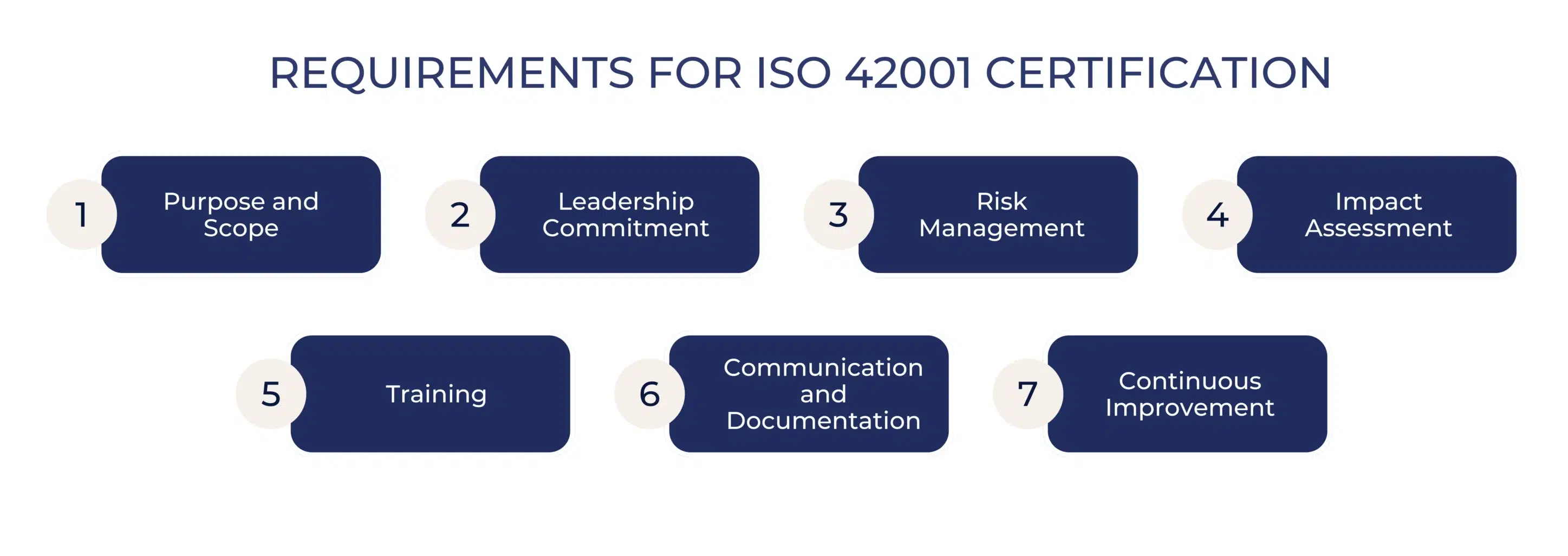
- ✓Organizational Context and Leadership Requirements
- ✓AI Risk Assessment and Impact Analysis Requirements
- ✓Documentation and Operational Control Requirements
The ISO 42001 Certification Process in Vancouver
The ISO 42001 Certification process in Vancouver follows a structured sequence of audit stages that evaluate AIMS design, implementation, and operational effectiveness. CertPro conducts ISO 42001 assessments as a Licensed CPA Firm, applying independent conformity evaluation procedures at each stage. Organizations progressing through the certification process can expect a clearly defined sequence of activities — from initial scope definition through final certification decision and ongoing surveillance.
The Stage 1 audit — also known as the documentation review or desktop audit — evaluates whether the organization’s AIMS documentation meets the structural requirements of ISO/IEC 42001:2023. Auditors examine the AI policy, AIMS scope statement, risk assessment methodology, documented procedures, and evidence of management commitment to determine whether the organization is substantively ready to proceed to Stage 2 field evaluation. Stage 1 findings are documented and communicated to the organization to inform final preparation activities before Stage 2 scheduling.
During Stage 1, auditors also confirm the certification boundary — establishing which AI systems, organizational units, sites, and processes are included within the AIMS scope. For Vancouver organizations with distributed AI operations across multiple teams or cloud environments, boundary definition is a critical Stage 1 activity that directly determines the scope and duration of the Stage 2 audit program.
Auditors may identify documentation gaps or scope ambiguities during Stage 1 that require resolution before the Stage 2 audit can proceed, ensuring that the subsequent field evaluation is focused and efficient.
The Stage 2 audit evaluates the implementation and operational effectiveness of the AIMS against ISO 42001 requirements. Audit activities include evidence-based interviews with AI system owners, data scientists, compliance personnel, and senior leadership; review of AI system documentation, training dataset metadata, model validation records, and incident logs; observation of AI-related operational processes; and sampling of AI impact assessment records and risk treatment implementation evidence.
Stage 2 auditors evaluate not only whether controls are documented but whether they are consistently applied and producing demonstrable risk management outcomes.
Nonconformities identified during Stage 2 are classified as major or minor based on their significance to AIMS integrity. Major nonconformities indicate the absence or systematic failure of a required AIMS element and must be resolved before certification can be issued. Minor nonconformities indicate isolated instances of noncompliance that do not undermine overall AIMS effectiveness, and may be resolved through documented corrective action plans accepted by the audit team.
Following Stage 2 completion, the audit team prepares a certification recommendation for review by CertPro’s independent certification decision function.
Following a positive audit recommendation, CertPro’s certification decision function conducts an independent review of the audit findings and evidence before issuing the ISO 42001 certificate. The certification decision is made by personnel not involved in the audit process, ensuring objectivity and conformance with accreditation requirements. Upon certification issuance, the organization receives a formal ISO 42001 certificate valid for three years, subject to annual surveillance audit requirements that verify ongoing AIMS conformance and continual improvement.
Annual surveillance audits maintain certification validity by evaluating AIMS performance, addressing changes to AI systems or organizational context, reviewing corrective actions from prior audit cycles, and confirming that the organization continues to meet ISO 42001 requirements. At the end of the three-year certification cycle, a recertification audit — similar in scope to the initial Stage 2 audit — is conducted to renew the certificate for a further three-year period.
Vancouver organizations should plan surveillance and recertification audit schedules into their AI governance calendars to maintain uninterrupted ISO 42001 Certification in Vancouver.
- Scope Definition — establish AI systems, organizational units, and processes within AIMS boundary
- AIMS Documentation Development — AI policy, risk assessment methodology, procedures, and controls
- AI Risk Assessment — systematic identification and evaluation of AI-related risks and opportunities
- AI System Impact Assessment — evaluation of potential harms to individuals and groups from AI decisions
- Control Implementation — operational controls for AI development, deployment, and monitoring
- Internal Audit — independent internal evaluation of AIMS conformance before external certification
- Management Review — senior leadership evaluation of AIMS performance and resource adequacy
- Stage 1 Audit — documentation review and scope validation by CertPro audit team
- Stage 2 Audit — operational conformity evaluation with evidence-based field assessment
- Certification Decision — independent review and issuance of ISO 42001 certificate
- Annual Surveillance — ongoing conformance verification during three-year certification cycle
- Recertification Audit — three-year renewal assessment for continued certification validity
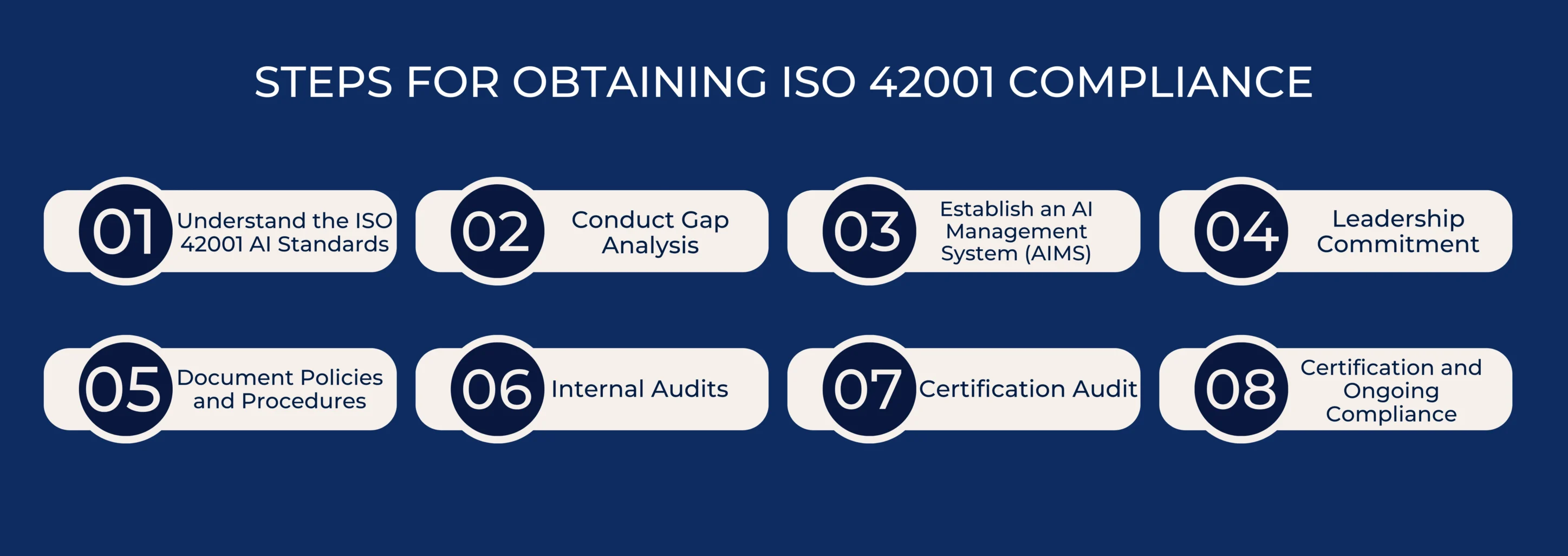
- ✓Stage 1 Audit — Documentation Review and Scope Validation
- ✓Stage 2 Audit — Operational Conformity Evaluation
- ✓Certification Decision, Issuance, and Surveillance
ISO 42001 Certification Cost in Vancouver
The cost of ISO 42001 Certification in Vancouver is determined by a combination of organizational factors that directly affect the scope and duration of the audit program. CertPro provides fixed-price certification engagements based on a structured assessment of these variables, enabling Vancouver organizations to plan certification budgets with certainty rather than facing open-ended hourly billing arrangements. Key cost determinants include the number of AI systems within the AIMS scope, organizational size, complexity of AI operations, and whether integration with existing certifications such as ISO 27001 is required.
Cost Factors for ISO 42001 Audit in Vancouver
Organizations with a narrow AIMS scope covering one or two discrete AI systems — such as a focused AI startup or a single-product SaaS company — typically require fewer audit days than large enterprises deploying AI across multiple business functions, geographic locations, or customer segments. Vancouver AI companies in growth stages with lean organizational structures often qualify for streamlined certification programs, whereas established enterprise platforms with complex AI ecosystems require more extensive evidence sampling and operational evaluation to satisfy ISO 42001 audit requirements. Audit day estimates are provided to each organization following scope definition, forming the basis of fixed-price certification proposals.
ISO 42001 Certification costs in Vancouver also reflect whether the engagement includes integrated audit coverage of related standards. Organizations combining ISO 42001 with ISO 27001 surveillance audits — or pursuing integrated ISO 42001 and ISO 27001 initial certification — achieve cost efficiencies relative to running independent certification programs. The shared clause structure of both standards means that evidence collected for one certification partially satisfies the requirements of the other, reducing total audit days compared to sequential separate certifications. CertPro’s fixed-price model for integrated programs provides Vancouver organizations with transparent cost clarity for multi-standard certification portfolios.
| Organization Profile | Typical AIMS Scope | Indicative Certification Timeline |
|---|---|---|
| Early-stage AI startup (under 50 employees) | 1–2 AI products or models | 3–5 months |
| Growth-stage SaaS platform (50–200 employees) | 3–5 AI features or services | 4–6 months |
| Mid-market technology firm (200–1000 employees) | Multiple AI systems across business units | 5–8 months |
| Enterprise AI organization (1000+ employees) | Enterprise-wide AIMS with multiple AI portfolios | 7–12 months |
Benefits of ISO 42001 Certification for Vancouver Companies
ISO 42001 Certification in Vancouver delivers measurable organizational value across commercial, regulatory, operational, and reputational dimensions. For Vancouver’s technology sector — where AI capability is increasingly a competitive differentiator and AI risk is an increasingly scrutinized liability — certification provides independently verified evidence that AI systems are governed by systematic, internationally recognized standards. The benefits of ISO 42001 Certification extend beyond compliance documentation to reshape how organizations build, evaluate, and improve their AI systems over time.
ISO 42001 Certification in Vancouver strengthens commercial positioning by providing enterprise customers, institutional partners, and government procurement bodies with independently verified evidence of responsible AI governance. Vancouver AI companies seeking contracts with large financial institutions, healthcare organizations, or public sector clients increasingly encounter AI governance requirements embedded in vendor qualification criteria and request-for-proposal specifications. ISO 42001 Certification provides a recognized, auditable response to these requirements — reducing procurement friction and shortening enterprise sales cycles for certified organizations.
For Vancouver AI startups and scaleups pursuing international expansion, ISO 42001 Certification provides market access credentials recognized in jurisdictions with active AI regulation, including the European Union, United Kingdom, Singapore, and Australia. The EU AI Act’s conformity framework recognizes ISO 42001 as relevant to demonstrating high-risk AI system compliance, making certification a prerequisite for market access in regulated EU sectors.
Vancouver companies targeting US federal government contracts or defense-adjacent markets similarly benefit from ISO 42001 Certification as AI governance standards in those procurement environments continue to tighten.
ISO 42001 compliance establishes a documented, audited evidence base that Vancouver organizations can present to regulators during AI-related investigations, privacy commissioner inquiries, or procurement evaluations. The systematic AI risk assessment and impact assessment activities required by ISO 42001 directly address the accountability obligations that PIPEDA imposes on organizations using automated decision-making systems. Certified organizations are demonstrably positioned to respond to Office of the Privacy Commissioner inquiries with structured documentation of AI governance practices, risk management decisions, and oversight mechanisms.
As Canada’s AIDA legislation progresses, ISO 42001 Certification will increasingly serve as a compliance baseline for organizations subject to high-impact AI system obligations. Organizations that achieve ISO 42001 Certification in Vancouver prior to AIDA’s commencement will have already implemented many of the governance structures the legislation requires — including AI impact assessments, risk classification, transparency documentation, and monitoring systems — positioning them ahead of competitors managing AIDA compliance reactively.
This proactive regulatory alignment reduces legal risk exposure and demonstrates governance maturity to insurance underwriters, board members, and institutional investors.
Beyond external certification value, ISO 42001 assessment activities generate internal operational improvements by systematically identifying AI-related risks, control gaps, and process inefficiencies that may not be visible through routine business operations. The structured AI risk assessment process required by ISO 42001 forces organizations to document their AI systems comprehensively, evaluate potential failure modes, and implement proportionate controls — a discipline that improves AI system reliability, reduces incident rates, and strengthens organizational resilience.
Vancouver AI companies that internalize ISO 42001 governance practices report improvements in AI model documentation quality, development process consistency, and cross-functional awareness of AI risk.
- ✓Independently verified AI governance credentials for enterprise procurement qualification
- ✓Structured AI risk management framework reducing operational and liability exposure
- ✓Regulatory alignment with PIPEDA, anticipated AIDA requirements, and international AI regulations
- ✓Competitive differentiation in Vancouver’s AI-intensive technology market
- ✓International market access credentials for EU AI Act, UK AI governance, and APAC compliance requirements
- ✓Improved AI system documentation quality and development process consistency
- ✓Enhanced stakeholder trust with customers, partners, investors, and regulators
- ✓Integration efficiency for organizations with existing ISO 27001 or ISO 9001 certifications
- ✓Reduced insurance premium exposure through documented AI risk management practices
- ✓Board-level AI governance accountability framework aligned with director liability expectations
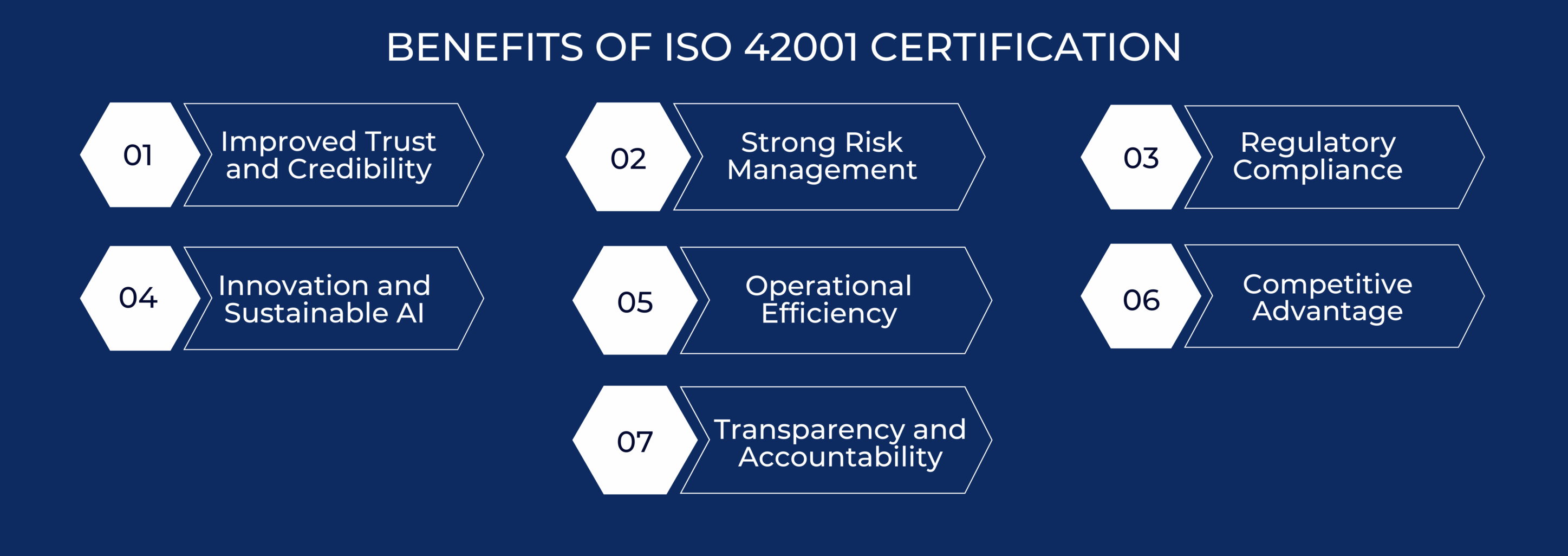
- ✓Commercial and Market Access Benefits
- ✓Regulatory Risk Reduction and Compliance Alignment
- ✓Operational and Organizational Benefits
ISO 42001 Certification for Vancouver Technology Sectors
ISO 42001 Certification in Vancouver is relevant across the city’s diverse technology economy. Certain sectors face particularly acute AI governance requirements, driven by the sensitivity of their data environments, the impact of their AI decisions on individuals, and the regulatory frameworks governing their industries. Understanding sector-specific ISO 42001 implications enables Vancouver organizations to calibrate their AIMS scope and control investments appropriately.
ISO 42001 Certification for Vancouver Tech Companies and AI Startups
ISO 42001 Certification for Vancouver tech companies serves as a foundational governance credential that enables AI product companies to demonstrate responsible AI practices from the earliest stages of commercialization. Vancouver AI startups operating in competitive B2B markets increasingly encounter enterprise customers who require evidence of AI governance maturity as a vendor qualification condition. ISO 42001 Certification provides this evidence in a format that is internationally recognized, independently audited, and structurally credible — distinguishing certified companies from competitors offering only self-assessed AI ethics commitments or unverified policy documents.
Vancouver’s AI startup ecosystem spans natural language processing, computer vision, predictive analytics, robotic process automation, and generative AI applications across multiple vertical markets. Each of these technology categories carries distinct AI governance considerations that ISO 42001 assessment addresses through its risk-based, system-specific evaluation approach.
An NLP platform processing personal communications data faces different impact assessment obligations than a computer vision system used in industrial inspection — and ISO 42001’s flexible, risk-proportionate framework accommodates this diversity while maintaining consistent audit standards across all AI system types.
ISO 42001 Certification for Vancouver Financial Services and Fintech
ISO 42001 Certification for Vancouver financial services organizations addresses the specific AI governance challenges of credit scoring, fraud detection, investment recommendation, regulatory compliance automation, and customer risk classification systems. Vancouver’s fintech sector — encompassing digital banking platforms, payment processors, wealth management technology providers, and insurance technology companies — operates AI systems that make or inform consequential financial decisions affecting individual customers.
These systems are subject to heightened regulatory scrutiny from the Financial Consumer Agency of Canada, OSFI, and provincial securities regulators, all of whom are increasingly focused on the explainability, fairness, and accountability of AI-driven financial decisions.
ISO 42001 compliance achieved through certification provides documented evidence that AI systems used in financial decision-making have been subjected to systematic impact assessment, bias evaluation, human oversight, and model validation controls. This evidence base is directly relevant to regulatory examinations by financial services supervisors and supports the model risk management frameworks that major financial institutions require of their technology vendors.
For Vancouver fintech companies seeking banking partnerships, payment network certifications, or enterprise financial institution contracts, ISO 42001 Certification provides essential governance credentials that differentiate responsible AI operators in a regulated market.
ISO 42001 Certification for Vancouver Healthcare and Digital Health AI
Vancouver’s digital health sector — including clinical decision support platforms, medical imaging AI, patient triage systems, and population health analytics companies — operates AI systems where governance failures can have direct patient safety implications. Health Canada’s Medical Devices Directorate regulates AI-enabled software as a medical device (SaMD) with requirements that include software lifecycle management, risk management, and post-market performance monitoring — requirements that ISO 42001 AIMS controls directly support.
ISO 42001 Certification in Vancouver provides digital health AI companies with an internationally recognized governance framework that complements Health Canada regulatory compliance and strengthens market positioning with healthcare institution procurement committees.
ISO 42001 Audit Process — Detailed Evaluation Framework
The ISO 42001 audit conducted by CertPro follows a structured evaluation framework designed to produce an objective, evidence-based conformity assessment of the organization’s AIMS. ISO 42001 audit procedures are calibrated to the specific characteristics of AI management systems, recognizing that AI governance controls involve both technical artifacts — such as model documentation, dataset provenance records, and algorithm testing protocols — and organizational processes including governance committees, escalation procedures, and human oversight mechanisms.
CertPro’s ISO 42001 audit program is structured around five primary evidence collection methods: documentation review, personnel interviews, process observation, record sampling, and technical artifact examination. Documentation review evaluates the adequacy and completeness of AIMS documentation against standard requirements. Personnel interviews assess organizational knowledge of AIMS policies, procedures, and responsibilities across roles including AI product managers, data scientists, legal and compliance officers, and C-suite AI governance sponsors. Process observation examines how AI development, validation, and deployment processes are executed in practice against documented procedures.
Record sampling during the ISO 42001 audit involves selecting and reviewing a representative set of AI system records — including risk assessments, impact assessments, model validation reports, incident records, and training logs — to evaluate whether operational controls are consistently applied across the AIMS scope. Technical artifact examination may include review of model cards, data governance documentation, algorithm audit reports, and monitoring dashboards to assess whether technical AI governance practices align with documented procedures.
Together, these five methods produce a comprehensive evidence base sufficient for the certification decision function to render an objective conformity determination.
ISO 42001 assessment includes specific evaluation of the organization’s implementation of Annex A controls, which address AI-specific governance requirements beyond the general management system clauses. Annex A controls cover areas including AI system categorization and classification, data quality and data governance, transparency and explainability mechanisms, human oversight and intervention capability, AI system testing and validation, monitoring of deployed AI systems, incident and anomaly management, and responsible AI supply chain management.
The organization’s Statement of Applicability — which documents which Annex A controls are applicable, which are implemented, and the justification for any controls excluded from scope — is a primary audit artifact that auditors use to structure Annex A evaluation activities.
During ISO 42001 assessment, auditors evaluate Annex A controls for both design adequacy — whether the control as designed would effectively address the relevant AI risk if properly implemented — and operating effectiveness — whether the control is consistently applied and producing the intended outcomes in practice. This two-dimensional evaluation approach distinguishes mature AI governance frameworks from those where controls exist on paper but are not operationally embedded.
Vancouver organizations with robust AI development processes, existing model governance infrastructure, and established data governance frameworks typically demonstrate stronger Annex A control effectiveness, supporting more straightforward certification outcomes.
- ✓Audit Program Structure and Evidence Collection Methods
- ✓Annex A Controls Evaluation in ISO 42001 Assessment
Why Choose CertPro for ISO 42001 Assessment and Certification in Vancouver
CertPro delivers ISO 42001 Certification in Vancouver as a Licensed CPA Firm with specialist expertise in AI management system audits. CertPro’s certification model is structured around independence, technical depth, and efficient audit execution — providing Vancouver organizations with a rigorous, credible certification experience that satisfies the expectations of enterprise clients, regulators, and international standard bodies. CertPro’s ISO 42001 audit teams combine management system audit expertise with technical knowledge of AI systems, enabling substantive evaluation of AI-specific governance controls rather than surface-level documentation review.
CertPro’s Audit Methodology and Technical AI Expertise
CertPro’s ISO 42001 audit methodology is built on the ISO 19011 guidelines for management system auditing, adapted for the technical characteristics of AI systems and the specific evidence requirements of ISO/IEC 42001:2023. Audit teams include professionals with expertise in machine learning system design, data governance, AI ethics frameworks, and management system certification — ensuring that audit findings reflect genuine technical understanding of AI governance challenges rather than generic compliance checklist evaluation.
This technical depth is particularly important for Vancouver AI companies whose systems involve sophisticated model architectures, complex data pipelines, or novel AI applications requiring nuanced governance assessment.
CertPro’s fixed-price certification model eliminates billing uncertainty that characterizes hourly-rate audit engagements, providing Vancouver organizations with complete cost certainty from scope definition through certificate issuance. Fixed pricing is established following an initial scope assessment that documents the organization’s AI system inventory, AIMS boundary, and relevant organizational context — enabling accurate audit day estimation and transparent fee proposals. Vancouver organizations can plan ISO 42001 Certification budgets with confidence, allocating resources to AIMS implementation priorities rather than managing open-ended audit cost risk.
Integrated Certification Programs for Vancouver Organizations
CertPro offers integrated certification programs that combine ISO 42001 audit activities with existing ISO 27001, ISO 9001, or ISO 27701 certification scopes. Vancouver technology companies holding existing management system certifications can achieve ISO 42001 Certification through an integrated audit program that leverages shared evidence, common audit activities, and coordinated documentation review — reducing total certification cost and organizational burden compared to independent certification programs for each standard. CertPro’s multi-standard audit teams are structured to conduct integrated assessments in a single coordinated audit cycle, delivering comprehensive certification coverage efficiently.
For Vancouver organizations pursuing ISO 42001 Certification across financial services, AI startups, or any other sector, CertPro’s local audit presence combined with national CPA Firm credentials provides both the geographic accessibility and institutional credibility that demanding enterprise clients and regulators require. CertPro maintains direct audit capability in Vancouver without the logistical overhead of remote-only audit models, enabling efficient on-site evaluation activities for organizations where in-person observation of AI development environments and operational processes is essential for complete evidence collection.
ISO 42001 Compliance — Ongoing Management After Certification
ISO 42001 compliance is not a one-time achievement but an ongoing organizational discipline requiring systematic management of the AIMS through annual surveillance cycles, continual improvement activities, and proactive adaptation to evolving AI technologies, regulatory developments, and organizational changes. Organizations that achieve ISO 42001 Certification in Vancouver must maintain active AIMS governance between audit cycles to ensure that certification remains valid and that the governance structures certified by auditors continue to operate effectively as AI systems evolve.
AIMS Continual Improvement Requirements
Clause 10 of ISO 42001 requires certified organizations to continually improve the suitability, adequacy, and effectiveness of their AIMS. Continual improvement activities must be driven by systematic performance data — including internal audit findings, management review outputs, AI system incident records, monitoring metrics, and nonconformity analyses — rather than ad hoc responses to individual events. Organizations must maintain documented evidence of continual improvement activities, including records of corrective actions taken in response to nonconformities and evidence that those corrective actions have been effective in preventing recurrence.
For Vancouver AI companies operating in rapidly evolving technology environments, AIMS continual improvement requirements create a governance mechanism for managing the organizational impact of AI system changes. When new AI models are deployed, existing systems are retrained on new data, or AI capabilities are extended to new use cases or customer segments, the AIMS must be updated to reflect the changed risk profile and organizational context.
ISO 42001 compliance documentation must accurately reflect the current state of AI operations, ensuring that audit evidence produced during surveillance cycles represents actual organizational AI governance practices.
Managing AI System Changes Within the Certified AIMS
ISO 42001 requires certified organizations to evaluate the impact of significant changes to AI systems, organizational structure, or operational context on the AIMS and its risk profile. Significant changes — such as the introduction of new AI systems, material modifications to existing models, expansion of AI use into new business functions, or changes to data sources and processing environments — must be assessed against AIMS requirements to determine whether updated risk assessments, additional controls, or scope revisions are needed. Organizations must document their change management decisions and maintain records of how AIMS governance has been adapted in response to material changes.
Vancouver’s AI sector is characterized by high rates of AI system evolution, with organizations continuously updating models, expanding capabilities, and deploying AI into new product areas. This pace of change makes robust AIMS change management procedures particularly important for maintaining the ISO 42001 compliance that Vancouver organizations rely on to sustain certification validity between surveillance audits.
CertPro’s surveillance audit procedures specifically evaluate change management effectiveness, examining whether significant AI system changes have been appropriately assessed and whether the AIMS has been updated to address the governance implications of those changes.
ISO 42001 vs. Other AI Governance Frameworks — Vancouver Context
Vancouver organizations evaluating AI governance frameworks frequently compare ISO 42001 to alternative approaches including NIST’s AI Risk Management Framework (AI RMF), the EU AI Act conformity requirements, and internal AI ethics policies developed by individual technology companies. Understanding how ISO 42001 Certification in Vancouver differs from and relates to these alternatives enables organizations to make informed decisions about governance framework selection and to understand the unique value that ISO 42001’s independent certification provides.
ISO 42001 Compared to NIST AI RMF and Internal AI Ethics Policies
The NIST AI Risk Management Framework, published in January 2023, provides a voluntary framework for managing AI risks organized around four core functions: Govern, Map, Measure, and Manage. While the NIST AI RMF and ISO 42001 address overlapping AI governance objectives, they differ fundamentally in one critical respect: ISO 42001 is a certifiable standard that enables third-party independent audit and certificate issuance, while the NIST AI RMF is a guidance framework without a certification pathway.
For Vancouver organizations needing to demonstrate AI governance to external stakeholders — including enterprise customers, regulators, and investors — ISO 42001 Certification provides verifiable, audited evidence that NIST AI RMF adoption alone cannot produce.
Internal AI ethics policies and voluntary AI principles commitments published by individual technology companies similarly lack the independent verification that ISO 42001 Certification provides. While internal AI governance policies are valuable as organizational commitments, they represent self-assessments that external stakeholders have limited ability to evaluate without independent audit access.
ISO 42001 Certification replaces unverifiable self-attestations with audit-verified conformity evidence, providing Vancouver organizations with governance credentials that stakeholders can rely on without conducting their own AI governance evaluations. This credibility differential is particularly significant for Vancouver AI companies seeking enterprise contracts where vendor AI governance is a key procurement evaluation criterion.
| Framework | Certification Available | Third-Party Audit | Regulatory Recognition | Vancouver Market Relevance |
|---|---|---|---|---|
| ISO 42001 | Yes — internationally recognized | Yes — independent certification body | EU AI Act, PIPEDA, AIDA alignment | Primary AI governance certification for enterprise B2B |
| NIST AI RMF | No formal certification | No independent audit pathway | US federal procurement guidance | Reference framework, not certifiable |
| EU AI Act Conformity | Yes — for high-risk AI systems | Yes — notified body assessment for some categories | EU market access requirement | Required for EU market entry |
| Internal AI Ethics Policy | No — self-attestation only | No independent verification | Not recognized by regulators | Insufficient for enterprise procurement |
FAQ
▶
What is ISO 42001 Certification and who issues it?
▶
Which Vancouver organizations require ISO 42001 Certification?
▶
How long does the ISO 42001 audit process take in Vancouver?
▶
What does an ISO 42001 audit evaluate?
▶
How does ISO 42001 relate to ISO 27001 for Vancouver technology companies?
▶
What is the difference between ISO 42001 compliance and ISO 42001 certification?
▶
What industries in Vancouver benefit most from ISO 42001 Certification?
▶
How does ISO 42001 Certification align with Canada’s AI regulatory requirements?

MindSec Launches AI Compliance for Law 25 & ISO 42001
Excerpt from Barchart Article, Published on December 3, 2025 Today, Canadian organizations face increasing pressure to comply with stringent privacy a…

UNDERSTANDING ISO 42001: A GUIDE FOR RESPONSIBLE AI MANAGEMENT SYSTEMS
The invention of artificial intelligence (AI) has changed the operational processes of many industries. However, the rapid growth of technology increa…
ENSURING AI DATA PRIVACY COMPLIANCE WITH ISO 42001
According to Stanford’s AI report, the private AI investment in the U.S. alone reached more than $109 billion last year, which is equal to 12 times th…
Get In Touch
have a question? let us get back to you.