
ISO 42001 Certification in Waterloo
AI governance, within the ISO 42001 context, refers to the organizational mechanisms — including accountability frameworks, oversight structures, escalation protocols, and risk treatment plans — that ensure AI systems operate transparently and within defined ethical and legal boundaries. AI risk, as defined under ISO 42001, encompasses the potential for AI systems to produce unintended, harmful, biased, or non-transparent outcomes affecting individuals, organizations, or broader society. Understanding these definitions is foundational to understanding the scope and purpose of ISO 42001 Certification.
OUR CLIENTS









What Is ISO 42001 Certification
ISO 42001 Certification is the formal, third-party attestation issued by an accredited certification body confirming that an organization’s Artificial Intelligence Management System (AIMS) conforms to the requirements of the ISO/IEC 42001:2023 standard. Published by the International Organization for Standardization, ISO 42001 is the world’s first internationally recognized management system standard dedicated exclusively to AI governance, risk treatment, and responsible AI deployment. ISO 42001 Certification in Waterloo applies to any organization — regardless of size, sector, or AI maturity — that develops, deploys, operates, or procures AI systems as part of its business activities.
An Artificial Intelligence Management System (AIMS), as defined under ISO 42001, is a structured set of policies, procedures, roles, responsibilities, and controls that governs the full lifecycle of AI systems within an organization. The AIMS encompasses AI strategy alignment, risk identification and treatment, transparency obligations, data governance, human oversight mechanisms, and continual performance evaluation. ISO 42001 requires organizations to establish, implement, maintain, and continually improve their AIMS — ensuring that AI operations remain aligned with ethical principles, applicable legislation, and stakeholder expectations.
AI governance, within the ISO 42001 context, refers to the organizational mechanisms — including accountability frameworks, oversight structures, escalation protocols, and risk treatment plans — that ensure AI systems operate transparently and within defined ethical and legal boundaries. AI risk, as defined under ISO 42001, encompasses the potential for AI systems to produce unintended, harmful, biased, or non-transparent outcomes affecting individuals, organizations, or broader society. Understanding these definitions is foundational to understanding the scope and purpose of ISO 42001 Certification.
The PDCA cycle — Plan, Do, Check, Act — underpins the structural methodology embedded in ISO 42001. In the Plan phase, organizations establish AI policy, define objectives, and conduct risk assessments. The Do phase covers implementation of controls, processes, and AI governance structures. The Check phase involves monitoring, measurement, internal auditing, and management review of AIMS performance. The Act phase drives corrective actions, nonconformity resolution, and continual improvement. This iterative framework ensures that AI governance evolves alongside organizational and technological change.
CertPro, a Licensed CPA Firm, conducts ISO 42001 audit engagements for organizations across Waterloo and the broader Ontario technology corridor. CertPro’s certification engagements are strictly audit-based — evaluating documented evidence, implemented controls, and management system conformance against the ISO 42001 standard’s explicit requirements. ISO 42001 Certification in Waterloo issued through CertPro reflects a rigorous, evidence-based conformance determination, not an advisory or consulting outcome.
ISO 42001 and the Artificial Intelligence Management System (AIMS) Framework
Core Components of the AIMS Framework
The Artificial Intelligence Management System framework defined in ISO 42001 is structured around ten clauses that mirror the High-Level Structure (HLS) common to all ISO management system standards, including ISO 27001 and ISO 9001. Clauses 1 through 3 define scope, normative references, and terms. Clauses 4 through 10 contain the operative requirements: Context of the Organization, Leadership, Planning, Support, Operation, Performance Evaluation, and Improvement. This alignment with HLS enables organizations that already hold ISO 27001 or ISO 9001 certifications to integrate their AIMS efficiently — reusing existing governance infrastructure, policy hierarchies, and audit evidence frameworks.
Clause 4 requires organizations to define the internal and external context of their AI activities, identify interested parties and their requirements, and determine the scope of the AIMS. For Waterloo-based organizations, this includes mapping AI systems against the requirements of Canada’s PIPEDA legislation, the Directive on Automated Decision-Making issued by the Treasury Board of Canada Secretariat, and evolving provincial privacy requirements. Context determination is not a one-time exercise — ISO 42001 mandates periodic review as the regulatory and technological environment shifts.
Leadership and AI Policy Requirements
Clause 5 of ISO 42001 establishes leadership accountability as a non-negotiable element of the AIMS. Top management must demonstrate commitment to the AIMS by establishing an AI policy, assigning roles and responsibilities, and ensuring that AIMS objectives are integrated into the organization’s strategic direction. The AI policy must include commitments to responsible AI use, compliance with applicable obligations, and continual improvement. In practice, Waterloo organizations seeking ISO 42001 Certification must produce documented evidence that executive leadership is actively engaged in AI governance — not merely nominally aware of it.
Roles and responsibilities under Clause 5 include the designation of an AI management function responsible for maintaining AIMS conformance and reporting performance to top management. For larger Waterloo technology firms and financial services organizations, this may align with existing Chief AI Officer, Chief Data Officer, or Chief Information Security Officer roles. For startups and smaller AI-native companies, these responsibilities may be consolidated. ISO 42001 does not prescribe a specific organizational structure — it requires that accountability be clearly defined, documented, and demonstrably operational.
Risk Assessment and AI Impact Evaluation
Clause 6 addresses planning, including risk assessment and AI impact evaluation. ISO 42001 requires organizations to identify risks and opportunities associated with their AI systems, assess the likelihood and severity of potential adverse outcomes, and establish risk treatment plans with defined controls. Annex A of ISO 42001 provides a reference control set of 38 controls organized across nine domains — covering AI system design, data management, transparency, human oversight, and third-party AI procurement. Organizations select applicable controls based on their risk assessment outcomes. Selected controls and justifications for exclusions are documented in a Statement of Applicability, a concept shared with ISO 27001.
AI impact evaluation under ISO 42001 extends beyond organizational risk to encompass societal and individual impacts. Organizations must assess whether their AI systems may produce discriminatory outcomes, erode individual privacy, generate misleading outputs, or operate without adequate human oversight. This societal impact framing is particularly relevant for Waterloo’s financial technology and health technology sectors, where AI-driven decisions carry direct consequences for customers and end users subject to Canadian privacy and human rights protections.
Why ISO 42001 Certification Matters for Waterloo Businesses
Waterloo as Canada’s AI Innovation Capital
Waterloo, Ontario, is widely recognized as one of Canada’s most concentrated technology and artificial intelligence research ecosystems. Home to globally influential academic institutions, the Waterloo region hosts hundreds of AI-focused startups, established SaaS platforms, financial technology firms, and enterprise technology operations. The presence of major technology employers alongside a dense startup pipeline creates a high-intensity AI deployment environment — one where governance, accountability, and risk management are competitive differentiators, not optional enhancements. ISO 42001 Certification in Waterloo directly addresses the governance demands that this innovation density creates.
Waterloo’s technology sector is increasingly subject to procurement requirements from enterprise clients, government agencies, and international partners that mandate demonstrable AI governance frameworks. Canadian federal agencies operating under the Directive on Automated Decision-Making, financial institutions subject to OSFI’s guidance on model risk management, and multinational corporations with EU AI Act compliance obligations are among the client groups requiring structured AI governance evidence from Waterloo-based technology suppliers. ISO 42001 Certification provides a recognized, internationally transferable mechanism to satisfy these requirements efficiently.
Regulatory Alignment: PIPEDA and Canadian AI Governance
ISO 42001 compliance in Waterloo intersects directly with Canada’s federal privacy framework under the Personal Information Protection and Electronic Documents Act (PIPEDA), overseen by the Office of the Privacy Commissioner of Canada. AI systems that process personal information — including AI-driven marketing platforms, automated lending decisions, HR screening tools, and predictive analytics — are subject to PIPEDA’s consent, accountability, and purpose-limitation principles. An implemented AIMS under ISO 42001 provides documented controls for data minimization, purpose specification, and AI transparency that directly support PIPEDA compliance obligations.
Canada’s proposed Artificial Intelligence and Data Act (AIDA), introduced as part of Bill C-27, signals a formal legislative shift toward mandatory AI governance requirements for high-impact AI systems. While AIDA’s final form remains subject to parliamentary process, the governance architecture it requires — including risk assessments, accountability frameworks, transparency measures, and bias testing — maps closely to the AIMS requirements in ISO 42001. Waterloo organizations that achieve ISO 42001 Certification today position themselves to transition into AIDA compliance with reduced structural and documentation effort when the legislation takes effect.
Competitive Advantage in AI-Driven Markets
ISO 42001 Certification in Waterloo delivers a measurable competitive advantage for technology companies, financial services firms, and AI-native startups operating in markets where AI governance is a procurement criterion. Certified organizations can present third-party attestation of their AI management practices to prospective clients, investors, and regulatory bodies — reducing due diligence friction and accelerating sales and partnership cycles. For Waterloo’s growing base of SaaS companies targeting enterprise and government clients, this certification is increasingly a threshold requirement rather than a differentiator in competitive evaluations.
ISO 42001 Certification Requirements
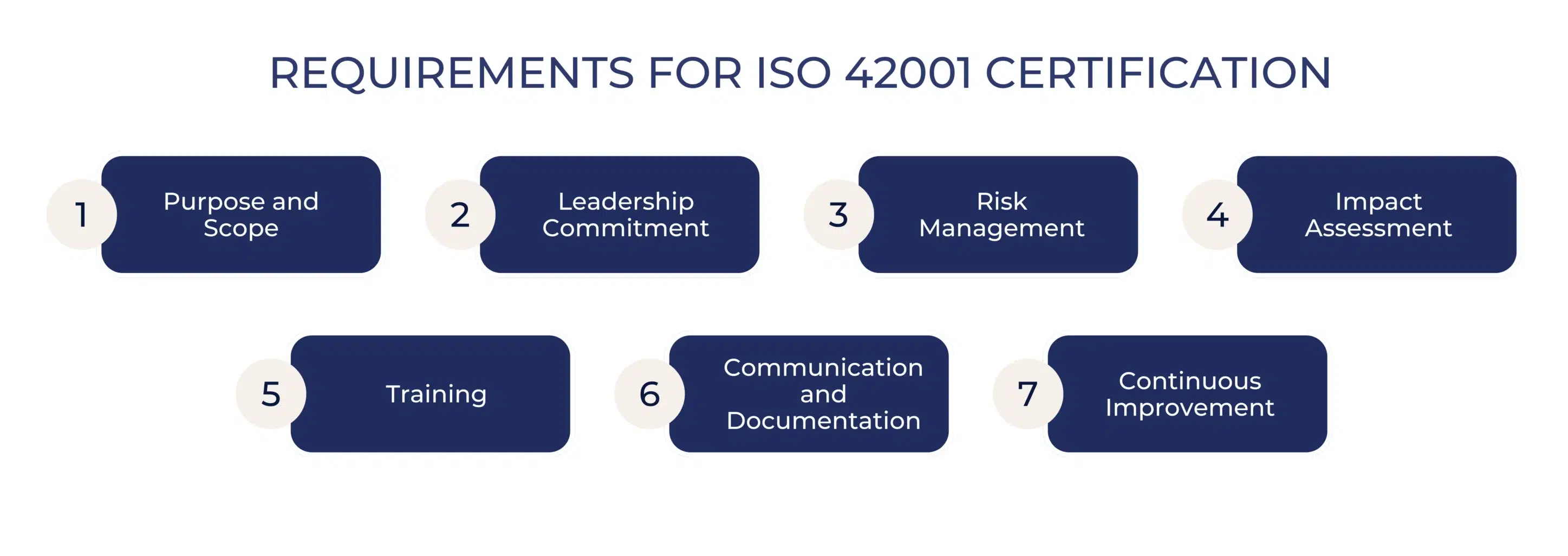
ISO 42001 Certification requires organizations to maintain a defined set of documented information as evidence of AIMS establishment and operation. Mandatory documented information includes the AIMS scope statement, AI policy, AI risk assessment methodology and results, risk treatment plan, Statement of Applicability for Annex A controls, AI impact assessment records, defined roles and responsibilities, operational procedures for AI lifecycle management, internal audit program and results, management review outputs, and records of nonconformities and corrective actions. The completeness and currency of this documented information is evaluated directly during the ISO 42001 audit conducted by CertPro.
The AI policy is a foundational document under ISO 42001. It must be authorized by top management, communicated internally and to relevant external parties, and reviewed periodically for continued appropriateness. The policy must express the organization’s commitment to responsible AI use, legal compliance, ethical principles, and continual improvement of the AIMS. For Waterloo organizations with multiple AI applications across different business units, the AI policy must be scoped to address all in-scope AI systems — with subsidiary operational procedures detailing implementation specifics for each context.
Technical requirements under ISO 42001 span the full AI system lifecycle. Organizations must establish controls covering AI system design and development practices, including specification of intended purpose, identification of potential harms, transparency measures, and bias testing protocols. Operational requirements extend to AI system deployment and monitoring — organizations must maintain processes for detecting performance degradation, unexpected outputs, and emergent risks in production AI systems. Data governance requirements mandate documentation of data sources, data quality standards, and data lineage for AI training and inference datasets.
- ✓Documented AIMS scope statement defining in-scope AI systems and organizational boundaries
- ✓AI policy authorized by top management and communicated organization-wide
- ✓AI risk assessment methodology with documented risk identification, analysis, and evaluation results
- ✓Risk treatment plan with selected Annex A controls and residual risk acceptance records
- ✓Statement of Applicability (SoA) for all 38 Annex A controls with inclusion and exclusion justifications
- ✓AI impact assessment records covering individual and societal impact evaluation
- ✓Defined roles and responsibilities for AIMS operation, including designated AI management accountability
- ✓Operational procedures for AI system design, development, deployment, and monitoring
- ✓Supplier and third-party AI governance requirements and evaluation records
- ✓Internal audit program, audit plans, and audit results documentation
- ✓Management review meeting records with inputs, outputs, and action items
- ✓Nonconformity register with root cause analyses and verified corrective action records
ISO 42001 places explicit requirements on human oversight of AI systems. Organizations must implement mechanisms that allow human review, intervention, and override of AI-driven decisions — particularly where those decisions carry significant consequences for individuals. Transparency requirements mandate that organizations be able to explain AI system behavior to the extent appropriate for the deployment context, including to affected individuals, regulators, and auditors. For Waterloo financial technology companies deploying AI in credit scoring, fraud detection, or customer communication, these transparency and oversight requirements intersect directly with both PIPEDA obligations and OSFI supervisory expectations.
- ✓Documentation and Policy Requirements
- ✓Technical and Operational Requirements
- ✓Human Oversight and Transparency Requirements
ISO 42001 Certification Process in Waterloo
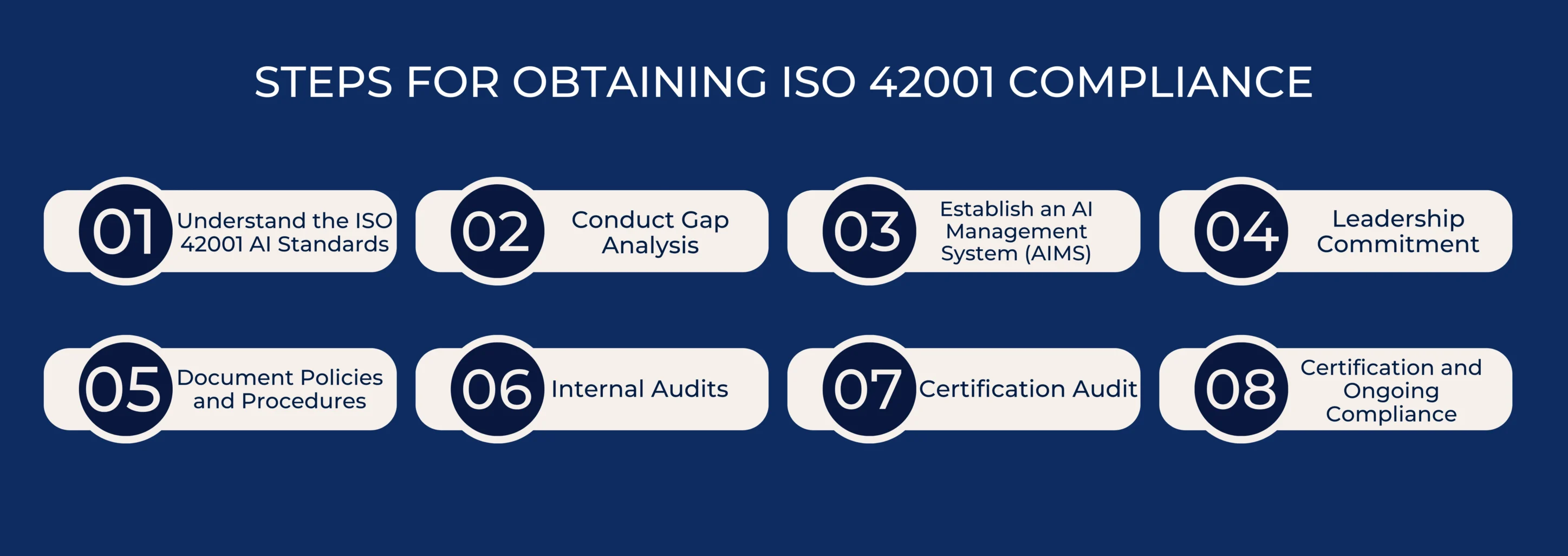
The ISO 42001 certification process in Waterloo follows a structured sequence of defined activities, from initial scope determination through certification decision and ongoing surveillance. CertPro, as a Licensed CPA Firm conducting ISO 42001 audit engagements, executes this process according to ISO/IEC 17021-1 conformity assessment principles — ensuring objectivity, competence, and impartiality at every stage. Organizations seeking ISO 42001 Certification in Waterloo progress through the following sequence:
- Scope Definition: The organization defines the boundaries of its AIMS, identifying which AI systems, business units, processes, and locations fall within the certification scope. CertPro reviews the proposed scope for completeness and alignment with the organization’s AI activities.
- AIMS Establishment and Documentation: The organization establishes its AIMS in accordance with ISO 42001 requirements, producing all mandatory documented information including AI policy, risk assessment records, risk treatment plan, Statement of Applicability, and operational procedures.
- Internal Audit Execution: The organization conducts a full internal audit of its AIMS against all applicable ISO 42001 requirements. Internal audit results are documented and reviewed by management, with identified nonconformities addressed through corrective action prior to the Stage 1 audit.
- Management Review: Top management conducts a formal management review of AIMS performance, using inputs from internal audits, risk assessments, AI incident records, and objective monitoring data. Management review outputs include decisions on resource allocation and AIMS improvement actions.
- Stage 1 Documentation Review: CertPro auditors conduct a desk-based review of the organization’s AIMS documentation, assessing the completeness, adequacy, and alignment of documented information with ISO 42001 requirements. Stage 1 findings are communicated to the organization prior to Stage 2.
- Stage 2 Certification Audit: CertPro auditors conduct an on-site or remote evidence-based ISO 42001 audit of the implemented AIMS, evaluating the effective operation of controls, processes, and governance structures across the defined scope. Stage 2 findings are classified as major nonconformities, minor nonconformities, or observations.
- Nonconformity Resolution: The organization submits corrective action plans for all identified nonconformities. CertPro evaluates the adequacy of proposed corrections and corrective actions before proceeding to the certification decision.
- Certification Decision: CertPro’s certification review function makes an independent determination of conformance based on audit evidence. Upon a positive determination, ISO 42001 Certification is issued with a three-year validity period.
- Surveillance Audits: Annual surveillance audits are conducted to verify the continued operation and improvement of the AIMS throughout the certification cycle. Surveillance scope focuses on AIMS effectiveness, corrective action follow-up, and material changes to the organization’s AI activities.
- Recertification Audit: At the conclusion of the three-year certification cycle, a full recertification audit is conducted to renew ISO 42001 Certification for a subsequent three-year period.
ISO 42001 Audit Process
The Stage 1 ISO 42001 audit is a documentation-focused evaluation conducted by CertPro auditors prior to the Stage 2 field audit. During Stage 1, auditors review the organization’s AIMS scope statement, AI policy, risk assessment documentation, Statement of Applicability, internal audit results, and management review records. The purpose of Stage 1 is to determine whether the organization’s documented AIMS is sufficiently established and complete to proceed to the operational conformance evaluation in Stage 2. Any Stage 1 findings identifying documentation gaps or material omissions must be addressed before the Stage 2 audit commences.
The Stage 1 ISO 42001 audit also includes a review of the organization’s understanding of its legal and regulatory context — including applicable Canadian AI governance requirements, PIPEDA obligations, and sector-specific regulatory requirements. For Waterloo technology companies with international operations or client bases, the Stage 1 documentation review covers the scope’s intersection with EU AI Act requirements, GDPR obligations, and other applicable international frameworks. These factors inform the organization’s AIMS risk landscape and control selection rationale.
The Stage 2 ISO 42001 audit constitutes the primary conformance evaluation of the organization’s implemented AIMS. CertPro auditors examine objective evidence of AIMS operation across all clauses of ISO 42001 and all applicable Annex A controls within the defined scope. Evidence evaluation methods include interviews with personnel holding defined AIMS roles, observation of AI governance processes in operation, review of operational records and monitoring data, and technical assessment of implemented AI system controls. The Stage 2 audit generates a formal audit report documenting findings, evidence examined, and the conformance status of each evaluated requirement.
Major nonconformities identified during Stage 2 represent failures to meet a requirement of ISO 42001 that are likely to result in the failure of the AIMS to achieve its intended outcomes. These must be resolved and verified before ISO 42001 Certification is issued. Minor nonconformities indicate partial fulfillment of a requirement or isolated lapses in implementation. Minor nonconformities require corrective action plans to be submitted and accepted before the certification decision, with verification completed during the first surveillance audit. Observations note potential improvement opportunities without constituting conformance failures.
ISO 42001 Certification carries a three-year validity period, during which CertPro conducts annual surveillance audits to verify the continued effectiveness of the AIMS. Surveillance audits evaluate areas of the AIMS most critical to ongoing conformance — including corrective action follow-up from prior audit findings, management review effectiveness, internal audit program operation, and the organization’s response to material changes in AI activities, risk landscape, or applicable legal requirements. Surveillance audit scope is determined by CertPro auditors based on the organization’s risk profile and certification history.
Recertification audits at the end of the three-year cycle replicate the scope and depth of the initial certification audit, evaluating the full AIMS against all applicable ISO 42001 requirements. Recertification provides organizations with an opportunity to demonstrate AIMS maturity and continual improvement achieved during the certification cycle. For Waterloo organizations operating in rapidly evolving AI deployment environments, the recertification cycle also addresses the currency and adequacy of risk assessments and controls against new AI technologies and updated regulatory requirements.
- ✓Stage 1 Audit: Documentation Review
- ✓Stage 2 Audit: Operational Conformance Evaluation
- ✓Surveillance and Recertification Audits
Benefits of ISO 42001 Certification
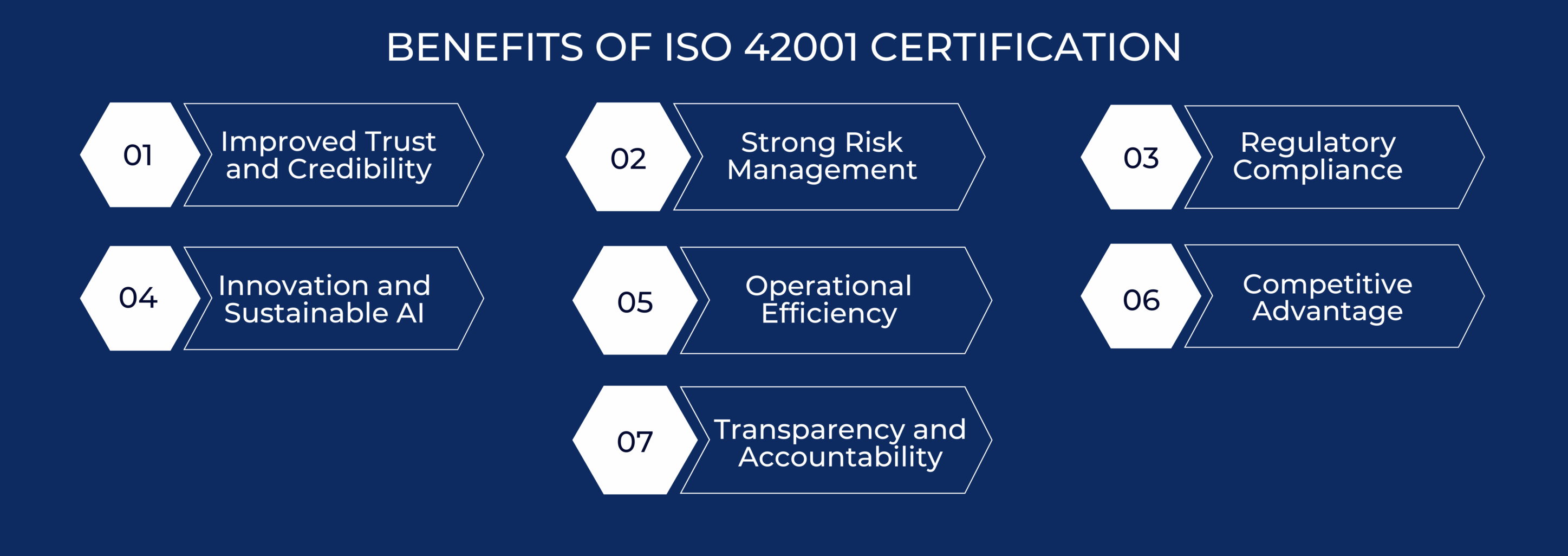
ISO 42001 Certification in Waterloo delivers measurable organizational benefits that extend across governance, operations, and strategic positioning. The structured AIMS framework establishes clear accountability for AI systems, reducing the risk of uncoordinated or undocumented AI deployments that create operational and legal exposure. Organizations that implement ISO 42001 typically observe improvements in AI project governance — including more rigorous requirements definition, clearer human oversight protocols, and more consistent documentation of AI system behavior and performance. These governance improvements reduce the frequency and severity of AI-related incidents and the organizational cost of responding to them.
The continual improvement mechanism embedded in ISO 42001’s PDCA cycle ensures that AI governance capabilities evolve alongside the organization’s AI deployment footprint. As Waterloo technology firms scale their AI operations — introducing new models, expanding deployment contexts, or acquiring AI capabilities through M&A — the AIMS provides a scalable governance framework that can be extended to cover new AI systems without reconstructing foundational governance structures from scratch. This scalability is a significant operational benefit for the high-growth AI companies characteristic of Waterloo’s technology ecosystem.
ISO 42001 compliance provides documented evidence of proactive AI risk management that is directly relevant in regulatory investigations, contract disputes, and litigation contexts. For Waterloo organizations subject to PIPEDA enforcement by the Office of the Privacy Commissioner of Canada, an implemented and certified AIMS demonstrates a systematic approach to privacy risk management in AI operations. This is a factor that regulatory bodies consider when assessing an organization’s compliance culture and determining the proportionality of any enforcement response. ISO 42001 assessment outcomes — including internal audit records and risk treatment documentation — constitute the type of contemporaneous compliance evidence that regulators prioritize.
- ✓Third-party attestation of AI governance conformance for regulatory, procurement, and investor audiences
- ✓Documented evidence of proactive AI risk identification and treatment for regulatory compliance purposes
- ✓Structured alignment with PIPEDA, Canada’s Directive on Automated Decision-Making, and evolving AIDA requirements
- ✓Reduced legal exposure from undocumented or ungoverned AI system deployments
- ✓Demonstrated EU AI Act alignment for Waterloo organizations with European market operations
- ✓Competitive differentiation in enterprise and government procurement processes requiring AI governance attestation
- ✓Investor confidence through structured AI ethics and risk management documentation
- ✓Improved supplier and third-party AI risk management through defined procurement governance requirements
- ✓Reduced AI incident frequency through systematic risk identification and control implementation
- ✓Enhanced organizational reputation as a responsible AI operator in Waterloo’s technology community
ISO 42001 Certification in Waterloo functions as a credible, internationally recognized signal of responsible AI governance to customers, partners, investors, and the public. As awareness of AI risk grows among enterprise buyers and government procurement officers, certification provides a standardized reference point that reduces the burden of bespoke AI governance due diligence. For Waterloo’s fintech and healthtech sectors — where AI decisions directly affect individual financial and health outcomes — ISO 42001 Certification supports customer trust and brand differentiation in markets where AI accountability is an active concern among end users and advocacy communities.
- ✓Organizational and Operational Benefits
- ✓Regulatory and Legal Risk Reduction
- ✓Market and Reputational Benefits
ISO 42001 Compliance and Canadian Regulatory Alignment
PIPEDA and AI Data Privacy Obligations
ISO 42001 compliance in Waterloo is deeply interconnected with Canada’s federal privacy legislation. PIPEDA’s ten fair information principles — including accountability, identifying purposes, consent, limiting collection, limiting use and disclosure, accuracy, safeguards, openness, individual access, and challenging compliance — translate directly into AIMS control requirements under ISO 42001. AI systems that process personal data for profiling, automated decision-making, or predictive analytics must have documented data governance controls that satisfy both PIPEDA requirements and ISO 42001’s data management specifications. The AIMS scope definition must explicitly address all personal data processing activities conducted by in-scope AI systems.
The Office of the Privacy Commissioner of Canada has published guidance on AI and privacy that emphasizes the importance of meaningful consent, algorithmic transparency, and human oversight in AI deployments processing personal information. ISO 42001’s AIMS control framework — including transparency controls, human oversight mechanisms, and bias assessment requirements — provides a structured basis for satisfying these regulatory expectations. Waterloo organizations that maintain ISO 42001 Certification have a documented basis for demonstrating PIPEDA compliance in the AI context that is both auditable and continuously maintained through the AIMS review cycle.
Canada’s Proposed AI Legislation and ISO 42001 Readiness
Canada’s proposed Artificial Intelligence and Data Act (AIDA) under Bill C-27 establishes obligations for operators of high-impact AI systems, including mandatory risk assessments, transparency requirements, bias mitigation measures, and incident reporting. The governance architecture required by AIDA — accountability frameworks, impact assessments, monitoring programs, and documentation requirements — maps directly to the AIMS components mandated by ISO 42001. Waterloo organizations that achieve ISO 42001 Certification establish a governance infrastructure that positions them to demonstrate AIDA compliance readiness with substantially reduced implementation effort when the legislation is enacted.
Integration with ISO 27001 and Other Management System Standards
ISO 42001 shares the High-Level Structure with ISO 27001 (information security) and ISO 9001 (quality management), enabling Waterloo organizations holding existing certifications to integrate their AIMS into a unified management system. Policies, roles, internal audit programs, management review processes, and documented information frameworks established for ISO 27001 can be extended to cover ISO 42001 requirements with targeted additions rather than parallel infrastructure. This integration benefit is significant for Waterloo’s technology sector, where ISO 27001 certification is already widely held as a requirement for enterprise software and cloud services procurement. An ISO 42001 audit can be conducted as part of an integrated program that evaluates both information security and AI governance conformance in a single engagement — reducing audit fatigue and total certification cost.
| Regulation / Framework | Relevant ISO 42001 AIMS Controls | Applicability to Waterloo Organizations |
|---|---|---|
| PIPEDA (Canada) | Data governance, transparency, human oversight, consent management | All organizations processing personal data in AI systems |
| Directive on Automated Decision-Making (Treasury Board) | AI impact assessment, human override, explainability | Federal agencies and government technology suppliers |
| Canada’s AIDA (Bill C-27, proposed) | Risk assessment, bias testing, incident reporting, accountability | Operators of high-impact AI systems |
| EU AI Act | Risk classification, conformity assessment, transparency | Waterloo organizations with EU market operations |
| ISO 27001:2022 | Integrated security and AI governance controls, unified audit program | Organizations holding or pursuing ISO 27001 certification |
Industries and Organizations in Waterloo That Need ISO 42001
Financial Technology and Financial Services
ISO 42001 compliance in Waterloo is particularly urgent for the region’s financial technology sector. Waterloo hosts a dense cluster of fintech companies deploying AI in credit decisioning, fraud detection, anti-money laundering screening, insurance underwriting, and customer service automation. These applications involve AI-driven decisions with direct financial consequences for individuals and businesses, creating regulatory and legal exposure that requires structured governance. ISO 42001 Certification in Waterloo for fintech companies addresses OSFI’s model risk management expectations, FINTRAC’s AML compliance requirements, and PIPEDA’s automated decision obligations simultaneously through a single, integrated AIMS framework.
Technology Companies and SaaS Platforms
For Waterloo tech companies that develop and sell AI-embedded software products, ISO 42001 Certification is increasingly a market access requirement rather than a voluntary governance enhancement. Enterprise buyers in healthcare, financial services, and government are actively requiring AI governance attestation as part of vendor qualification processes. SaaS companies in Waterloo that integrate machine learning, natural language processing, or automated decision capabilities into their products face procurement inquiries about AI governance frameworks, bias testing protocols, and human oversight mechanisms. ISO 42001 Certification directly addresses these buyer inquiries with a market-ready, third-party-verified response.
Health Technology and Life Sciences
Waterloo’s health technology sector deploys AI in clinical decision support, diagnostic imaging analysis, patient risk stratification, and remote monitoring applications. These deployments operate in a heavily regulated environment governed by Health Canada’s requirements for AI-based software as a medical device, provincial health authority procurement standards, and PIPEDA’s particularly stringent protections for health information. ISO 42001 Certification provides health technology companies with a documented AI governance framework that satisfies the traceability, transparency, and human oversight expectations of both Health Canada and hospital procurement authorities — supporting market access in Canada’s public health system.
Startups and AI-Native Companies
Waterloo’s startup ecosystem includes a large and growing cohort of AI-native companies building foundational AI capabilities, vertical AI applications, and AI infrastructure products. For early-stage companies, ISO 42001 Certification establishes investor confidence, demonstrates governance maturity to enterprise clients, and creates a documented AI governance foundation that scales with company growth. ISO 42001 Certification for Waterloo startups is typically scoped to the specific AI systems already in production, with the AIMS designed to accommodate future AI system additions as the product portfolio expands. CertPro’s structured audit process accommodates startup-scale organizations with efficient, right-sized certification engagements.
ISO 42001 Assessment and Certification Cost in Waterloo
The cost of ISO 42001 assessment and certification in Waterloo is determined by several measurable factors, including the size of the organization, the number and complexity of AI systems within the certification scope, the maturity of existing management system documentation, and whether the certification will be integrated with an existing ISO 27001 or ISO 9001 audit program. CertPro offers fixed pricing for ISO 42001 certification engagements, providing organizations with transparent, predictable cost structures that support budget planning and board-level certification investment decisions.
Organizations with established ISO 27001 certifications benefit from integration efficiencies that reduce the incremental cost of ISO 42001 Certification. Shared audit activities, unified document review, and consolidated management review processes reduce the total auditor time required for an integrated ISO 27001 and ISO 42001 audit program. Waterloo organizations integrating their AIMS with an existing information security management system should factor these integration economies into their ISO 42001 assessment cost planning. CertPro provides detailed cost breakdowns for both integrated and standalone ISO 42001 certification engagements to support informed procurement decisions.
| Organization Profile | Estimated Scope Complexity | Key Cost Drivers |
|---|---|---|
| AI-native startup (1-50 employees, 1-3 AI systems) | Low to Medium | Scope definition, initial documentation establishment, Stage 1 and Stage 2 audit days |
| Mid-size SaaS company (50-250 employees, 4-10 AI systems) | Medium to High | Multi-system scope, integration with ISO 27001, operational evidence volume |
| Enterprise technology firm (250+ employees, 10+ AI systems) | High | Multi-site scope, complex Annex A control set, integrated audit program management |
| Financial services organization with AI in regulated functions | High | Regulatory alignment documentation, OSFI model risk intersections, extended audit scope |
Why Choose CertPro for ISO 42001 Certification in Waterloo
Licensed CPA Firm with Certification Authority
CertPro is a Licensed CPA Firm providing ISO 42001 certification audits to organizations across Waterloo, Ontario, and Canada. As a certification body — not an advisory or consulting firm — CertPro’s mandate is the independent, objective evaluation of AIMS conformance against ISO 42001 requirements. CertPro’s auditors hold recognized competencies in AI management systems, information security, risk management, and the Canadian regulatory landscape applicable to AI operations. Organizations that engage CertPro for ISO 42001 Certification in Waterloo receive a certification outcome based on auditor-evaluated objective evidence, not a consulting-assisted compliance project.
CertPro’s institutional positioning as a Licensed CPA Firm distinguishes its ISO 42001 certification credentials from non-CPA certification bodies in the Canadian market. The CPA designation carries professional accountability, regulatory oversight, and recognized audit competence standards that reinforce the credibility of certifications issued. For Waterloo organizations presenting ISO 42001 Certification to enterprise clients, government procurement officers, or financial regulators, a CertPro-issued certificate reflects the professional standards and institutional accountability associated with the CPA credential.
Local Expertise and Sector-Specific Audit Competence
CertPro maintains audit teams with direct experience in Waterloo’s primary AI deployment sectors, including financial technology, enterprise SaaS, health technology, and AI research commercialization. This sector-specific competence enables CertPro auditors to evaluate AIMS controls in the operational context relevant to Waterloo organizations — applying accurate risk expectations for fintech AI applications, appropriate transparency standards for health AI systems, and relevant regulatory alignment criteria for enterprise software with government clients. Waterloo organizations require not a generalist auditor applying a generic template, but a technically competent evaluator familiar with the specific risk and regulatory environment of each industry sector.
Fixed Pricing and Transparent Certification Engagement
CertPro provides fixed-price ISO 42001 certification engagements for Waterloo organizations, eliminating the cost uncertainty that variable-rate audit structures create in certification budgeting. Fixed pricing is established at engagement commencement based on the defined scope, organization size, and audit program structure. This pricing transparency supports CFO and board-level investment decisions and ensures that ISO 42001 certification costs can be planned with confidence in annual operating budgets. CertPro’s fixed pricing model is available for standalone ISO 42001 Certification and for integrated audit programs combining ISO 42001 with ISO 27001, ISO 9001, or other applicable management system certifications.
- ✓Licensed CPA Firm status with recognized professional accountability and audit competence standards
- ✓ISO 42001-specific audit competence covering all clauses and Annex A control domains
- ✓Sector expertise across Waterloo’s fintech, SaaS, healthtech, and enterprise technology industries
- ✓Knowledge of Canadian AI governance requirements including PIPEDA, Directive on Automated Decision-Making, and AIDA
- ✓Fixed pricing for predictable ISO 42001 certification cost planning
- ✓Integration capability for combined ISO 27001 and ISO 42001 audit programs
- ✓Three-year certification lifecycle management including annual surveillance audits
- ✓Impartial, evidence-based certification determination free from advisory or consulting conflicts of interest
FAQ
▶
What is ISO 42001 certification and who needs it in Waterloo?
▶
How long does the ISO 42001 certification process take in Waterloo?
▶
What is the difference between an ISO 42001 audit and an ISO 42001 assessment?
▶
How does ISO 42001 relate to PIPEDA compliance for Waterloo organizations?
▶
Can ISO 42001 certification be integrated with an existing ISO 27001 certification in Waterloo?
▶
What AI systems must be included in the ISO 42001 certification scope for a Waterloo organization?
▶
What surveillance audit requirements apply after ISO 42001 certification is issued?
▶
Does ISO 42001 certification apply to Waterloo startups with a small number of AI systems?

MindSec Launches AI Compliance for Law 25 & ISO 42001
Excerpt from Barchart Article, Published on December 3, 2025 Today, Canadian organizations face increasing pressure to comply with stringent privacy a…

UNDERSTANDING ISO 42001: A GUIDE FOR RESPONSIBLE AI MANAGEMENT SYSTEMS
The invention of artificial intelligence (AI) has changed the operational processes of many industries. However, the rapid growth of technology increa…
ENSURING AI DATA PRIVACY COMPLIANCE WITH ISO 42001
According to Stanford’s AI report, the private AI investment in the U.S. alone reached more than $109 billion last year, which is equal to 12 times th…
Get In Touch
have a question? let us get back to you.