
SOC 2 Certification in Stockholm
CertPro, a Licensed CPA Firm, conducts independent SOC 2 audits and attestation examinations for organizations operating in Stockholm. Engagements are structured against the AICPA Trust Services Criteria, covering security, availability, processing integrity, confidentiality, and privacy. Audit scope encompasses SaaS platforms, cloud infrastructure providers, fintech systems, and technology-driven service organizations across the Stockholm region.
OUR CLIENTS



Introduction to SOC 2 Certification in Stockholm
SOC 2 Certification in Stockholm is the independent attestation standard applied to service organizations that store, process, or transmit customer data through cloud-based and technology-driven systems. Developed and governed by the American Institute of Certified Public Accountants (AICPA), SOC 2 examinations evaluate whether an organization’s internal controls meet the Trust Services Criteria across five defined categories: Security, Availability, Processing Integrity, Confidentiality, and Privacy. These criteria establish the foundational benchmarks against which an independent CPA firm assesses the design and operational effectiveness of organizational controls.
Stockholm has emerged as one of Europe’s most significant technology and innovation centers. The city is home to a dense concentration of SaaS companies, cloud infrastructure providers, fintech platforms, AI-driven enterprises, and digital health organizations. As institutional clients and enterprise buyers increasingly demand verified evidence of information security governance, SOC 2 Certification in Stockholm has become a standard prerequisite for vendor selection, contract execution, and ongoing third-party risk management programs. Organizations pursuing SOC 2 Certification here demonstrate a verifiable commitment to maintaining robust controls aligned with internationally recognized trust criteria.
The SOC 2 framework differs fundamentally from compliance checklists or internal self-assessments. SOC 2 compliance must be verified through an independent third-party examination conducted by a Licensed CPA Firm. The resulting SOC 2 attestation report is issued under professional standards established by the AICPA — specifically AT-C Section 205 for examination engagements. This independent examination structure provides stakeholders, customers, and enterprise clients with objective, professionally verified evidence of control effectiveness. That level of assurance is something internal certifications and vendor questionnaires simply cannot replicate.
The AICPA Trust Services Criteria Framework
The AICPA Trust Services Criteria (TSC) define the control requirements evaluated during every SOC 2 audit. The Security criterion — also referred to as the Common Criteria — is mandatory for all SOC 2 engagements. It addresses logical and physical access controls, system operations, change management, and risk mitigation processes. The Availability criterion evaluates whether systems are operational and accessible as committed or agreed upon in service level agreements. Processing Integrity examines whether system processing is complete, valid, accurate, timely, and authorized — a criterion particularly relevant for Stockholm fintech and payment processing organizations.
The Confidentiality criterion assesses whether information designated as confidential is collected, retained, used, disclosed, and destroyed in accordance with organizational policies and contractual commitments. The Privacy criterion evaluates the collection, use, retention, disclosure, and disposal of personal information in conformity with the organization’s privacy notice and the AICPA’s Generally Accepted Privacy Principles (GAPP). For Stockholm organizations operating under GDPR obligations, the Privacy criterion provides a structured mechanism to document and evaluate personal data handling practices within the context of an independent SOC 2 examination.
| Trust Services Criterion | Primary Focus | Mandatory / Optional |
|---|---|---|
| Security (Common Criteria) | Access controls, system operations, change management, risk mitigation | Mandatory |
| Availability | System uptime, performance monitoring, disaster recovery | Optional |
| Processing Integrity | Accurate, complete, timely, and authorized processing | Optional |
| Confidentiality | Protection of confidential information per policy and contract | Optional |
| Privacy | Personal data handling in conformity with GAPP and privacy notice | Optional |
SOC 2 Type 1 and SOC 2 Type 2: Definitions and Differences
SOC 2 examinations are issued in two distinct report types, each serving a different assurance purpose. A SOC 2 Type 1 report evaluates the design and implementation of an organization’s controls at a single point in time. The Type 1 report confirms that controls are suitably designed to meet the selected Trust Services Criteria as of a specific date. This report type is frequently used by organizations initiating their SOC 2 program in Stockholm, or by those seeking to demonstrate control design maturity before completing a full observation period.
A SOC 2 Type 2 report evaluates both the design and the operating effectiveness of controls over a defined observation period — typically a minimum of six months, and most commonly twelve months. Type 2 reports provide a higher level of assurance because the independent auditor tests whether controls operated consistently and effectively throughout the entire review period. Enterprise clients, financial institutions, and government-affiliated buyers in Stockholm standardly require SOC 2 Type 2 reports as a condition of vendor approval. The ongoing nature of Type 2 testing reflects operational reality far more accurately than a point-in-time assessment.
Stockholm’s Technology Ecosystem and SOC 2 Adoption
Stockholm ranks among Europe’s top five technology hubs by startup density, venture capital investment, and technology export volume. The city hosts globally recognized technology companies, multinational SaaS providers, financial services platforms, digital health organizations, and a growing cluster of AI-driven enterprises. This concentration of data-intensive service organizations creates significant demand for independent security assurance. Clients, investors, and enterprise procurement teams increasingly treat SOC 2 attestation as a baseline vendor qualification requirement — not merely a differentiating credential.
Stockholm’s fintech sector is particularly active in pursuing SOC 2 Certification. Payment processing platforms, open banking providers, lending technology companies, and digital investment services all handle sensitive financial and personal data at scale. For these organizations, SOC 2 Certification in Stockholm provides independently verified evidence that security, confidentiality, and privacy controls meet the standards expected by institutional partners, banking regulators, and enterprise clients. The intersection of Sweden’s strong data protection culture and the AICPA’s attestation framework makes SOC 2 compliance a natural alignment for technology-forward organizations in this market.

Why SOC 2 Certification Matters for Stockholm Organizations
SOC 2 Certification in Stockholm provides organizations with a formally documented, independently verified attestation of their information security controls. This attestation functions as objective evidence during enterprise procurement processes, regulatory inquiries, investor due diligence, and client onboarding. Unlike internal security policies or vendor-completed questionnaires, the SOC 2 attestation report is issued by an independent Licensed CPA Firm under AICPA professional standards — a distinction that carries significant weight in institutional and regulated market contexts.
SOC 2 Certification and Vendor Risk Management in Stockholm
Enterprise organizations in Stockholm operate formal vendor risk management programs that require third-party service providers to demonstrate security control effectiveness. SOC 2 attestation is the most widely accepted mechanism for satisfying these requirements in technology and cloud services contexts. When a Stockholm-based SaaS company, cloud infrastructure provider, or managed service organization presents a SOC 2 Type 2 report to an enterprise client, it replaces lengthy security questionnaire cycles with independently audited control evidence. This accelerates procurement timelines and reduces the administrative burden on both vendor and client organizations.
The Nordic financial services sector imposes particularly rigorous third-party assurance expectations. Banks, insurance companies, pension funds, and regulated financial institutions headquartered in Stockholm require their technology vendors to provide current SOC 2 reports as part of ongoing supplier governance programs. These requirements derive from internal risk policies, regulatory guidance from Finansinspektionen (Sweden’s financial supervisory authority), and European Banking Authority (EBA) guidelines on ICT risk management. SOC 2 compliance in Stockholm satisfies the independent assurance component of these third-party risk frameworks.
GDPR Alignment and SOC 2 Compliance Stockholm
SOC 2 compliance does not replace GDPR compliance obligations. GDPR is a legally binding regulation enforced by supervisory authorities — including Sweden’s Integritetsskyddsmyndigheten (IMY) — and imposes specific requirements on data controllers and processors operating within or targeting individuals in the European Union. SOC 2 attestation is a voluntary, independent examination conducted under AICPA professional standards. However, the Privacy criterion within the SOC 2 framework aligns substantially with core GDPR principles, including lawful basis for processing, data minimization, purpose limitation, retention constraints, and data subject rights management.
Organizations pursuing SOC 2 Certification in Stockholm that also process personal data subject to GDPR frequently find that the documentation and control structures developed for SOC 2 audit purposes support GDPR accountability obligations. Control evidence related to access management, encryption, data retention, incident response, and vendor management overlaps significantly between the two frameworks. This structural alignment means that a SOC 2 audit engagement conducted with Privacy criterion coverage can produce artifacts useful for demonstrating GDPR accountability — while recognizing that formal GDPR compliance requires separate regulatory assessment.
Competitive Positioning Through SOC 2 Attestation Stockholm
In Stockholm’s competitive SaaS and cloud services market, SOC 2 attestation serves as a visible differentiator during sales cycles targeting enterprise, financial services, healthcare, and public sector buyers. Procurement teams at large organizations routinely filter vendor shortlists based on the availability of current SOC 2 reports. Organizations that cannot produce a current SOC 2 attestation report are frequently eliminated from competitive evaluation before substantive product assessment begins. This commercial reality makes SOC 2 Certification a prerequisite for market access in specific enterprise segments — not merely a security enhancement.
- ✓Satisfies enterprise vendor security assessment and onboarding requirements
- ✓Replaces repetitive security questionnaires with independently audited reports
- ✓Supports regulatory third-party risk management obligations for financial services clients
- ✓Provides documented evidence for investor due diligence and financing processes
- ✓Aligns with GDPR accountability obligations through Privacy criterion coverage
- ✓Demonstrates operating effectiveness of security controls over time (Type 2)
- ✓Enables access to regulated-sector procurement cycles in Nordic markets
- ✓Strengthens internal control environments through structured audit methodology
- ✓Provides objective assurance to board-level governance and audit committees
- ✓Supports cross-border contract negotiations with US and EU enterprise clients
SOC 2 Audit Process for Stockholm Organizations
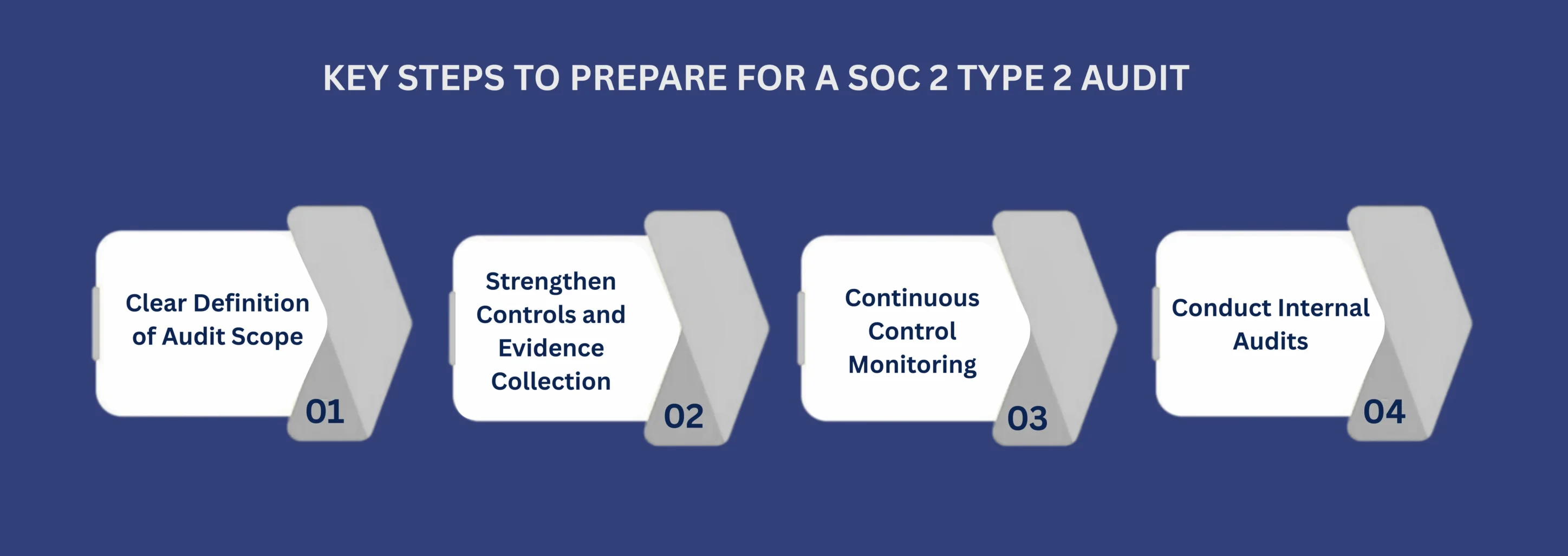
The SOC 2 audit process follows a structured examination methodology governed by AICPA attestation standards. Each stage produces documented findings evaluated against the applicable Trust Services Criteria and the organization’s own system description and service commitments. The sections below describe the complete SOC 2 audit process applied by CertPro during engagements with Stockholm organizations.
Scope definition is the first and most foundational stage of every SOC 2 examination. During this stage, the auditor and the organization establish the boundaries of the system subject to examination — including the infrastructure, software, people, procedures, and data involved in delivering the in-scope services. The system description, prepared by management, documents these components and forms the basis against which the auditor evaluates control design. Accurate scope definition ensures that the resulting SOC 2 attestation report reflects the actual operating environment of the service organization.
For Stockholm organizations, scope definition typically encompasses cloud hosting environments (AWS, Azure, GCP), application-layer security controls, identity and access management systems, data processing pipelines, third-party subservice organizations, and vendor management controls. The selection of applicable Trust Services Criteria occurs during this stage, based on services offered, contractual commitments made to customers, and the nature of the data processed. SOC 2 Certification for Stockholm companies typically includes at minimum the Security (Common Criteria) category, with Availability and Confidentiality added for cloud and SaaS providers.
Following scope definition, the Licensed CPA Firm develops the audit program — a structured plan detailing the specific control tests, evidence collection procedures, sampling methodologies, and evaluation criteria to be applied throughout the engagement. The audit program is tailored to the organization’s control environment, system architecture, and selected Trust Services Criteria. For a SOC 2 Type 2 engagement, the audit program also defines the observation period and the frequency of control testing required to evaluate operating effectiveness across the full review window.
Audit program determination includes identifying the population of controls, the evidence types required to support each control objective, and the testing approach — inquiry, observation, inspection, or re-performance — appropriate for each control. For Stockholm organizations operating complex cloud environments, the audit program incorporates technical testing of infrastructure controls alongside procedural testing of governance, change management, and incident response processes. This planning stage establishes the evidentiary foundation for the entire SOC 2 examination.
For organizations pursuing a SOC 2 Type 1 examination in Stockholm, the audit evaluates whether controls are suitably designed and implemented to meet the applicable Trust Services Criteria as of a specified date. The auditor reviews control documentation, system configuration evidence, policy and procedure records, organizational charts, and relevant configuration screenshots or system-generated reports to assess design adequacy. The Type 1 opinion addresses design only — it does not evaluate whether controls operated effectively over a period of time.
The SOC 2 Type 1 report is particularly relevant for Stockholm organizations that are new to formal attestation programs and want to establish a baseline of control design maturity before committing to a full observation period. Organizations in early scaling stages, those that have recently undergone significant infrastructure changes, or those responding to specific client requests for initial assurance may pursue Type 1 as a structured starting point. While the Type 1 report does not substitute for a Type 2 report in most enterprise procurement contexts, it demonstrates a verifiable first step in the attestation program.
SOC 2 Type 2 certification in Stockholm requires the auditor to evaluate both design adequacy and operating effectiveness of controls throughout the defined observation period. Operating effectiveness testing involves reviewing samples of evidence drawn from across the observation period to determine whether each control operated as described consistently over time. Evidence types evaluated during Type 2 testing include access provisioning logs, change request approvals, security incident records, vulnerability scan reports, backup verification logs, and system monitoring alerts.
The minimum observation period for a SOC 2 Type 2 examination is six months. However, twelve-month periods are most common and are preferred by enterprise clients and financial services organizations in Stockholm. During the observation period, the auditor collects and evaluates evidence demonstrating that security, availability, confidentiality, processing integrity, and privacy controls operated effectively and without material exceptions. Where control exceptions are identified, these are documented in the SOC 2 report along with management’s response and any compensating controls in place.
Following completion of control testing, the audit team conducts a structured nonconformity review to evaluate the significance of any identified control exceptions or deviations. Each exception is assessed against the applicable Trust Services Criterion to determine whether it represents a deviation from the criterion’s requirements, whether a compensating control exists, or whether the exception affects the auditor’s overall opinion on the control environment. This review stage ensures that the final SOC 2 attestation report accurately reflects the organization’s control posture.
The attestation decision determines the opinion issued in the SOC 2 report. Possible outcomes include an unqualified opinion (controls are suitably designed and/or operating effectively), a qualified opinion (exceptions exist but are limited in scope), or an adverse opinion (controls are not suitably designed or operating effectively). For the vast majority of SOC 2 examinations conducted by CertPro in Stockholm, organizations that have maintained appropriate control environments throughout the observation period receive unqualified opinions. Issuance of the SOC 2 attestation report concludes the active audit phase.
- ✓Stage 1: Scope Definition and System Description
- ✓Stage 2: Audit Program Determination and Planning
- ✓Stage 3: Type 1 Assessment — Design Evaluation
- ✓Stage 4: Type 2 Assessment — Operating Effectiveness Testing
- ✓Stage 5: Nonconformity Review and Attestation Decision
SOC 2 Certification Requirements for Stockholm Companies
Meeting the requirements for SOC 2 Certification in Stockholm demands that service organizations establish, document, and maintain a comprehensive set of controls aligned with the AICPA Trust Services Criteria. Requirements span organizational governance, technical security architecture, operational procedures, and evidence management practices. The following sections detail the key requirement categories evaluated during a SOC 2 audit.
SOC 2 Certification requires organizations to maintain formally documented information security policies covering all areas addressed by the selected Trust Services Criteria. Required policy documentation includes an information security policy, acceptable use policy, access control policy, change management policy, incident response policy, vendor management policy, and business continuity and disaster recovery policy. These documents must be approved by management, communicated to relevant personnel, and reviewed at defined intervals — typically annually. Evidence of policy review, approval, and distribution is collected during the SOC 2 audit.
Governance requirements also extend to organizational structure and accountability. The auditor evaluates whether the organization has defined roles and responsibilities for information security, whether a risk assessment process exists and produces documented outputs, and whether management oversight mechanisms are in place to monitor control effectiveness. For Stockholm organizations, this governance layer frequently interfaces with existing ISO 27001 management system structures or GDPR accountability frameworks — creating natural overlap that the SOC 2 audit team can reference and evaluate against the applicable Trust Services Criteria.
Technical security controls form the operational core of SOC 2 compliance. The Security criterion’s Common Criteria require organizations to implement and maintain logical access controls restricting system and data access to authorized individuals. These controls include multi-factor authentication, role-based access provisioning and de-provisioning procedures, privileged access management, and periodic access reviews. During the SOC 2 audit, the auditor evaluates technical configuration evidence, access review records, and provisioning logs to assess whether these controls are properly designed and operating effectively.
Additional technical requirements include encryption of data in transit and at rest, vulnerability management programs with regular scanning and defined remediation timelines, network segmentation and firewall configuration management, intrusion detection and monitoring capabilities, and logging and alerting systems that detect and respond to anomalous activity. For Stockholm-based cloud providers and SaaS organizations, these technical controls typically span both cloud-native security services — such as AWS Security Hub or Azure Defender — and application-layer controls implemented by the organization’s engineering and security teams.
Effective evidence collection is critical to a successful SOC 2 audit. Organizations must systematically collect, organize, and retain evidence demonstrating that controls operated as described throughout the observation period. Evidence types include system-generated logs, approval records, configuration screenshots, personnel training completion records, vulnerability scan outputs, backup verification logs, incident response tickets, and third-party vendor assessment records. A common failure mode in SOC 2 engagements occurs when organizations implement controls but fail to generate or retain adequate evidence of those controls’ operation — making collection planning concurrent with control implementation essential.
Log aggregation platforms, configuration management tools, identity governance systems, and ticketing platforms each generate categories of evidence directly relevant to the SOC 2 audit. Stockholm organizations should establish structured evidence repositories — whether through dedicated GRC platforms or organized document management systems — that enable efficient evidence retrieval during the audit. Evidence must be retained for periods sufficient to cover the audit observation period plus any requested extension periods, typically a minimum of twelve months from the end of the review period.
- ✓Formally documented and management-approved information security policies
- ✓Role-based access control implementation with provisioning and de-provisioning records
- ✓Multi-factor authentication configured across all in-scope systems
- ✓Encryption of data in transit and at rest with configuration evidence
- ✓Vulnerability management program with scanning records and remediation tracking
- ✓Incident response policy and documented incident records for the observation period
- ✓Business continuity and disaster recovery plans with documented testing evidence
- ✓Vendor and subservice organization management program with current assessments
- ✓Security awareness training records for all personnel with system access
- ✓Change management process with documented approvals for in-scope system changes

- ✓Governance and Policy Documentation Requirements
- ✓Technical Security Control Requirements
- ✓Evidence Collection and Records Management Requirements
SOC 2 Certification Cost in Stockholm
The cost of SOC 2 Certification in Stockholm is determined by a combination of factors including organizational size and complexity, the number of Trust Services Criteria selected, the examination type (Type 1 or Type 2), the duration of the observation period, the maturity of existing controls, and the volume of in-scope systems and personnel. Organizations with well-documented control environments and established evidence management practices typically require fewer audit hours than those undergoing their first SOC 2 audit with limited prior control documentation.
Cost Factors for SOC 2 Audit Services Stockholm Sweden
Audit scope complexity is the primary driver of SOC 2 certification cost. Organizations with a single product, limited cloud infrastructure footprint, and a small number of in-scope personnel present a more contained audit scope than multinational SaaS enterprises operating across multiple cloud environments with complex microservices architectures. Each additional Trust Services Criterion selected adds incremental testing requirements and associated audit hours. The Processing Integrity and Privacy criteria typically add the most complexity due to the specificity of evidence required to evaluate those control areas.
The observation period length for SOC 2 Type 2 engagements affects cost directly — a twelve-month observation period requires larger evidence samples and more extensive testing than a six-month period. Subservice organization coverage also influences scope; organizations that rely on cloud providers, co-location facilities, or third-party software vendors must document and evaluate the controls provided by these entities, either through inclusive scope or carve-out treatment with supporting documentation. CertPro provides fixed-fee engagement pricing for SOC 2 audit services in Stockholm, Sweden, to eliminate budget uncertainty for organizations planning their certification investment.
| Cost Factor | Lower Cost Profile | Higher Cost Profile |
|---|---|---|
| Organization Size | Small team, single product | Large enterprise, multi-product |
| Trust Services Criteria | Security (Common Criteria) only | All five criteria selected |
| Audit Type | Type 1 (point in time) | Type 2 (12-month observation) |
| Infrastructure Complexity | Single cloud environment | Multi-cloud, hybrid infrastructure |
| Control Maturity | Documented, established controls | First-time audit, limited documentation |
Return on Investment from SOC 2 Compliance Stockholm
The financial return from SOC 2 compliance in Stockholm extends well beyond the direct cost of the audit engagement. Organizations that obtain SOC 2 attestation reports frequently report reduced sales cycle lengths when targeting enterprise clients, elimination of repetitive and resource-intensive security questionnaire processes, and access to procurement opportunities in regulated sectors that require verified third-party assurance. For Stockholm SaaS and cloud services companies targeting US enterprise clients or Nordic financial institutions, the revenue access enabled by a current SOC 2 attestation often significantly exceeds the annual cost of the audit program.
Benefits of SOC 2 Certification in Stockholm
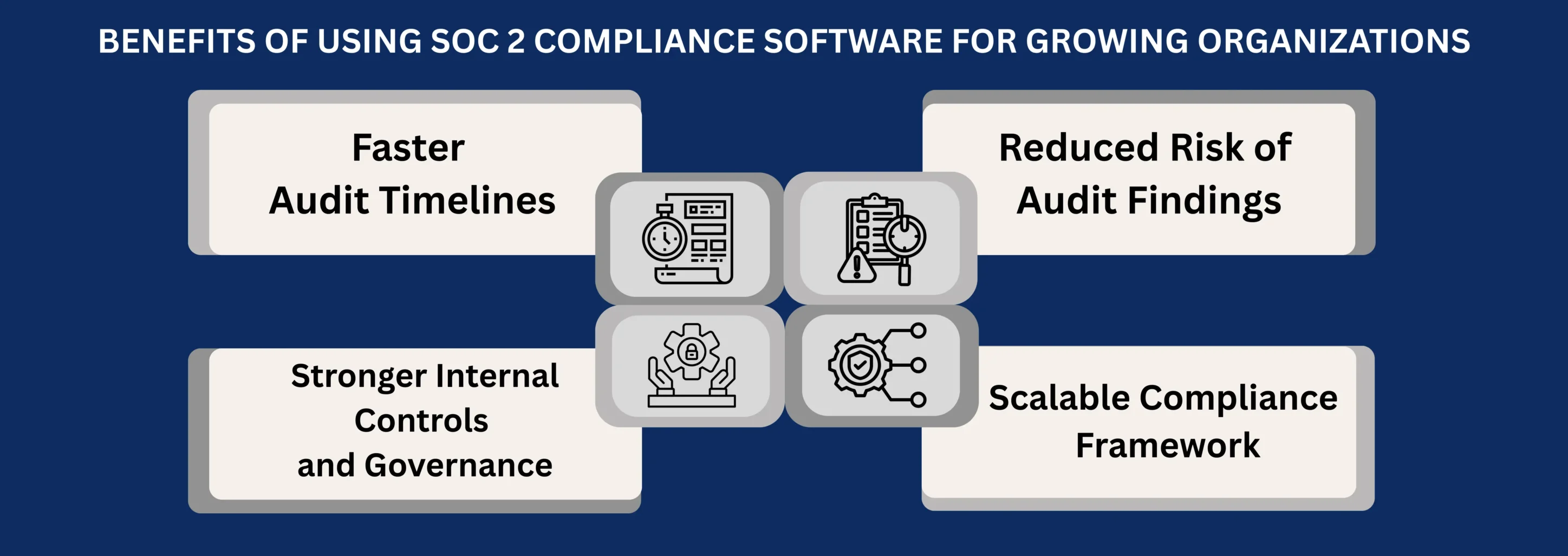
SOC 2 Certification in Stockholm delivers a structured set of operational, commercial, and risk management benefits for service organizations that complete independent attestation examinations. These benefits are realized across customer relationships, internal governance, regulatory positioning, and market access dimensions. The following sections detail the principal benefit categories associated with achieving and maintaining SOC 2 attestation.
A current SOC 2 attestation report functions as independently verified evidence of security control effectiveness that enterprise clients can rely upon without conducting their own security assessments. In Stockholm’s competitive SaaS market, organizations with current SOC 2 reports eliminate a major friction point in enterprise sales processes. Security and compliance reviews — which can extend sales cycles by weeks or months — are substantially shortened when a vendor can provide a current SOC 2 report in response to vendor assessment requests. This acceleration directly impacts revenue recognition timelines and sales productivity metrics.
Customer trust built through SOC 2 attestation is qualitatively different from trust built through marketing claims or internal security certifications. The independence of the SOC 2 audit — conducted by a Licensed CPA Firm under AICPA professional standards — means that clients can rely on the report’s findings as objective third-party verification. In an environment where data breaches, security incidents, and vendor-related risks are prominent concerns, this objective verification carries significant weight in procurement decision-making and ongoing vendor relationship management.
The SOC 2 audit process itself produces internal governance benefits that are independent of the attestation report. The structured examination methodology requires organizations to document their control environments comprehensively, identify control gaps, and implement remediation actions where deficiencies are found. This internal discipline — driven by the requirements of an independent audit rather than internal preference — typically results in measurably improved control environments, clearer accountability structures, and more consistent operational procedures across information security, change management, and incident response functions.
For Stockholm technology organizations in growth phases, the SOC 2 audit provides a structured mechanism for scaling security governance alongside technical and organizational growth. Organizations that establish SOC 2-aligned control frameworks during scaling phases tend to experience fewer security incidents, more efficient onboarding of enterprise clients, and stronger positions in financing and acquisition due diligence processes. The documented control environment produced through SOC 2 Certification also supports board-level reporting on information security risk — an area of increasing governance emphasis in Swedish corporate contexts.
SOC 2 attestation in Stockholm provides organizations with documented evidence of their information security and privacy control posture that is relevant to regulatory compliance obligations across multiple frameworks. For Stockholm organizations subject to GDPR, NIS2 Directive requirements, or sector-specific regulations such as the Swedish Financial Supervisory Authority’s ICT risk guidelines, the control documentation and evidence produced through a SOC 2 audit overlaps significantly with regulatory accountability requirements. This overlap reduces duplicated compliance effort and creates a shared evidence base across multiple compliance programs.
- ✓Provides independently audited evidence satisfying enterprise vendor security assessments
- ✓Accelerates enterprise sales cycles by replacing lengthy security questionnaire processes
- ✓Enables access to regulated-sector procurement requiring third-party assurance
- ✓Supports GDPR accountability documentation through Privacy criterion coverage
- ✓Reduces third-party risk exposure through vendor management control evaluation
- ✓Strengthens board and executive reporting on information security governance
- ✓Demonstrates operating effectiveness of controls over time through Type 2 examination
- ✓Provides objective assurance to investors during financing and acquisition processes
- ✓Aligns with NIS2 Directive security obligations relevant to Stockholm technology operators
- ✓Positions Stockholm fintech and SaaS companies for US enterprise market entry
- ✓Customer Trust and Enterprise Sales Enablement
- ✓Internal Control Strengthening Through SOC 2 Audit
- ✓Regulatory Alignment and Risk Reduction Benefits
Steps to Obtain SOC 2 Certification in Stockholm
Achieving SOC 2 Certification in Stockholm follows a defined sequence of steps, each producing specific documented outputs required for the independent audit examination. The numbered process below reflects the standard engagement structure applied by CertPro for SOC 2 audit engagements with Stockholm organizations.
- Determine applicable Trust Services Criteria based on services offered, customer commitments, and data types processed
- Define the audit scope including in-scope systems, infrastructure, personnel, and third-party subservice organizations
- Document and formalize the system description covering infrastructure, software, people, processes, and data
- Establish and document all required policies, procedures, and governance structures aligned with selected Trust Services Criteria
- Implement technical security controls covering access management, encryption, monitoring, and vulnerability management
- Establish evidence collection processes and repositories to capture and retain control operation records throughout the observation period
- Engage CertPro as the Licensed CPA Firm to conduct the independent SOC 2 audit examination
- Complete Stage 1 control design evaluation (required for both Type 1 and Type 2 engagements)
- Complete the observation period with consistent control operation and evidence collection (required for Type 2)
- Review and respond to audit findings, exceptions, and management letter observations
- Receive the final SOC 2 attestation report issued by CertPro upon completion of the examination
- Distribute the SOC 2 report to customers, prospects, and third-party stakeholders under appropriate confidentiality terms
SOC 2 audit timelines in Stockholm vary based on examination type and organizational complexity. A SOC 2 Type 1 engagement — from scope definition through report issuance — typically requires two to four months for organizations with established control environments. This timeline reflects the scoping and planning phase (two to four weeks), the fieldwork and evidence collection phase (four to eight weeks), and the reporting and review phase (two to four weeks). Organizations undertaking their first formal audit may require additional time to compile documentation and evidence for the initial examination.
A SOC 2 Type 2 engagement requires a minimum six-month observation period plus the scoping, fieldwork, and reporting phases. A twelve-month observation period engagement therefore spans approximately fourteen to sixteen months from initial engagement through final report issuance. Organizations in Stockholm that initiate Type 2 engagements with a six-month observation period can typically receive their initial Type 2 report within eight to ten months of engagement commencement. Subsequent annual renewal engagements follow a more streamlined process given the established audit relationship and documentation infrastructure already in place.
| Engagement Type | Observation Period | Typical Timeline to Report |
|---|---|---|
| SOC 2 Type 1 | Not applicable (point in time) | 2–4 months from engagement start |
| SOC 2 Type 2 (6-month) | 6 months minimum | 8–10 months from engagement start |
| SOC 2 Type 2 (12-month) | 12 months standard | 14–16 months from engagement start |
| Annual SOC 2 Renewal | 12 months (continuous) | Streamlined; aligned with report expiry cycle |
- ✓Timelines for SOC 2 Audit Engagements in Stockholm
SOC 2 Certification for Stockholm Fintech and SaaS Organizations
Stockholm’s fintech and SaaS sectors represent the highest-volume categories of SOC 2 certification activity in the Nordic region. These organizations process significant volumes of sensitive financial, personal, and operational data on behalf of enterprise clients, and operate in competitive markets where third-party assurance requirements are enforced as standard procurement conditions. SOC 2 Certification in Stockholm has become a defining characteristic of credible, enterprise-ready vendors across these market segments.
SOC 2 Certification Stockholm Financial Services Providers
SOC 2 Certification for Stockholm financial services organizations applies to payment technology providers, lending platforms, investment management software companies, open banking infrastructure providers, and digital asset service organizations. These companies face both commercial demand for SOC 2 attestation from institutional clients and regulatory expectations from Finansinspektionen and applicable European regulatory frameworks — including PSD2, MiFID II, and the Digital Operational Resilience Act (DORA). SOC 2 audit examinations for financial services technology organizations in Stockholm typically prioritize the Security, Availability, and Processing Integrity criteria.
The Processing Integrity criterion is of particular relevance for Stockholm financial technology organizations. This criterion evaluates whether system processing is complete, valid, accurate, timely, and authorized — directly addressing the operational assurance requirements of payment processing, trade execution, loan origination, and financial data aggregation systems. Evidence evaluated under this criterion includes transaction processing logs, reconciliation records, exception handling procedures, and authorized processing confirmation mechanisms. A SOC 2 audit covering Processing Integrity provides financial services clients with objective assurance regarding the accuracy and completeness of data processed on their behalf.
SOC 2 Compliance Stockholm Tech Companies and Cloud Providers
SOC 2 compliance for Stockholm tech companies spans a broad range of technology service categories including cloud infrastructure services, managed security services, software development platforms, data analytics services, AI and machine learning platforms, and enterprise software vendors. For cloud infrastructure and SaaS providers, the Availability criterion is frequently included alongside Security to provide customers with verified assurance regarding system uptime commitments, disaster recovery capabilities, and incident response performance. The Confidentiality criterion is added where organizations handle customer data classified as confidential under contractual terms.
Stockholm’s growing AI and machine learning technology sector presents specific control considerations for SOC 2 examinations. Organizations that process customer data through AI models must address data lineage, processing authorization, model governance, and output accuracy controls within their SOC 2 scope. The SOC 2 framework’s principle-based structure accommodates these emerging technology control areas by focusing on outcomes — whether processing is authorized, complete, and accurate — rather than prescribing specific technology implementations. This flexibility makes SOC 2 attestation applicable and relevant for Stockholm’s most innovative technology organizations.
CertPro’s SOC 2 Audit Services for Stockholm Organizations
CertPro is a Licensed CPA Firm conducting independent SOC 2 audits and attestation examinations for service organizations across Stockholm and the broader Nordic region. CertPro’s audit practice is structured exclusively around independent examination and attestation activities, performed under AICPA professional standards for attestation engagements (AT-C Section 205). SOC 2 audit engagements in Stockholm are conducted by experienced audit professionals with direct expertise in cloud security controls, fintech operating environments, and AICPA Trust Services Criteria evaluation.
Independent Attestation Methodology and Professional Standards
CertPro’s SOC 2 examination methodology follows the AICPA’s Guide for SOC 2 Examinations and the AT-C Section 205 professional standards governing attestation engagements. All examination opinions are issued by Licensed CPA professionals authorized to perform and sign attestation reports under applicable professional licensing requirements. This professional licensing requirement distinguishes independent SOC 2 attestation from internal audits, vendor assessments, or certification body evaluations performed by non-CPA entities — a distinction that matters significantly to enterprise clients and regulated-sector buyers evaluating the credibility of vendor SOC 2 reports.
CertPro’s audit teams bring sector-specific knowledge relevant to Stockholm’s primary technology industries. Audit professionals assigned to Stockholm engagements are familiar with cloud-native security architectures, API security controls, containerized infrastructure environments, DevSecOps processes, and data pipeline security — the technical domains most commonly in scope for SOC 2 audits of Stockholm’s SaaS and cloud technology organizations. This technical familiarity enables efficient, accurate evaluation of control effectiveness without the extended orientation periods that can add time and cost to engagements conducted by generalist audit teams.
Ongoing Surveillance and SOC 2 Recertification
SOC 2 attestation reports are valid for the period covered by the examination — typically twelve months for Type 2 reports. Organizations must complete annual audit cycles to maintain current certified status and meet customer expectations. Enterprise clients and regulated-sector buyers commonly require vendors to provide updated SOC 2 reports annually as a condition of ongoing vendor approval. CertPro structures annual SOC 2 recertification engagements to maintain continuity with the prior year’s scope and evidence base, enabling efficient renewal cycles that meet the annual reporting requirements expected by customers.
Between annual SOC 2 audit cycles, organizations are responsible for maintaining the control environment evaluated in the prior year’s examination. Significant changes to in-scope systems, infrastructure, or organizational structure during the gap period between reports should be documented and flagged for discussion with the audit team at the start of the next engagement. Material changes — such as acquisition of new infrastructure environments, significant personnel changes in key control roles, or adoption of new data processing systems — may affect the scope or focus of the subsequent SOC 2 examination.
SOC 2 vs. ISO 27001: Considerations for Stockholm Organizations
Stockholm organizations evaluating information security certification options frequently consider both SOC 2 and ISO 27001. These frameworks serve different purposes, target different stakeholder audiences, and are governed by different standards bodies and evaluation methodologies. Understanding the distinctions helps organizations prioritize their certification investments based on their specific market, customer base, and compliance requirements.
Framework Comparison: SOC 2 and ISO 27001
SOC 2 is an attestation standard governed by the AICPA and performed exclusively by Licensed CPA Firms. It evaluates service organizations against the Trust Services Criteria, producing a detailed attestation report that describes the control environment, the audit procedures performed, and the auditor’s opinion on control effectiveness. SOC 2 reports are primarily used by US-headquartered enterprise clients and organizations with global operations that include significant US business. The report format is standardized and recognized across North American enterprise procurement contexts.
ISO 27001 is an international management system standard published by the International Organization for Standardization (ISO) and evaluated by accredited certification bodies. ISO 27001 certification demonstrates that an organization has implemented an Information Security Management System (ISMS) conforming to the standard’s requirements. ISO 27001 is widely recognized across European, Middle Eastern, and Asian markets and is often preferred in European enterprise procurement contexts. For Stockholm organizations targeting primarily European clients, ISO 27001 may be the primary certification demand. Those targeting North American or global enterprise markets typically require SOC 2 Certification in addition to — or instead of — ISO 27001.
| Dimension | SOC 2 Certification | ISO 27001 Certification |
|---|---|---|
| Governing Body | AICPA (American Institute of CPAs) | ISO/IEC (International Organization for Standardization) |
| Conducted By | Licensed CPA Firm only | Accredited ISO certification body |
| Output | Attestation report with auditor opinion | Certificate of conformity |
| Market Recognition | US enterprise, global cloud/SaaS clients | European, global enterprise markets |
| Detail Level | Tests specific controls against TSC and service commitments | Evaluates management system conformity |
The decision between SOC 2 and ISO 27001 — or the decision to pursue both — should be driven primarily by customer requirements and target market composition. Stockholm organizations with significant US enterprise client bases, or those serving US-headquartered multinationals, should prioritize SOC 2 Certification. Organizations whose primary markets are European enterprise, public sector, or regulated financial services clients may prioritize ISO 27001 and layer SOC 2 as their US business grows. Both certifications can coexist and leverage overlapping control documentation, reducing duplicated compliance effort when both are required.
Achieving SOC 2 Compliance in Stockholm with CertPro
Achieving SOC 2 compliance in Stockholm through an independent attestation examination with CertPro positions service organizations to meet the assurance expectations of enterprise clients, financial institutions, and regulated-sector buyers operating across Stockholm and broader European and North American markets. SOC 2 Certification in Stockholm is conducted by CertPro under a structured, professional audit methodology that produces attestation reports recognized across institutional procurement, regulatory review, and investor due diligence contexts.
Stockholm’s technology, fintech, and cloud services ecosystem continues to mature as a globally significant innovation hub. As organizational scale increases, customer profiles grow more institutional, and regulatory expectations for third-party security assurance intensify, SOC 2 attestation transitions from a competitive differentiator to a market access requirement. Organizations that establish SOC 2 audit programs early in their growth trajectory build the control documentation infrastructure and evidence management practices that enable efficient, uninterrupted annual audit cycles — maintaining the current attestation status that enterprise clients and regulated-sector buyers require.
CertPro’s engagement model for SOC 2 Certification in Stockholm is structured around independent examination activities — scope definition, control testing, nonconformity review, and attestation reporting — performed under AICPA professional standards by Licensed CPA professionals. Fixed-fee engagement pricing provides budget certainty for organizations planning their SOC 2 certification investment. Organizations seeking to initiate or renew SOC 2 audit engagements in Stockholm are invited to contact CertPro to discuss scope, timeline, and engagement structure.
FAQ
▶
What is SOC 2 Certification and why is it required in Stockholm?
▶
What is the difference between SOC 2 Type 1 and SOC 2 Type 2 in Stockholm?
▶
How long does a SOC 2 audit in Stockholm take?
▶
Does SOC 2 compliance replace GDPR compliance for Stockholm organizations?
▶
Which Trust Services Criteria should Stockholm SaaS companies select?
▶
What is the difference between SOC 2 certified and SOC 2 compliant?
▶
How frequently must SOC 2 audits be conducted in Stockholm?
▶
What types of Stockholm organizations benefit most from SOC 2 Certification?
SOC 1 VS SOC 2: WHICH REPORT YOUR CUSTOMERS ACTUALLY ASK FOR
If you sell SaaS or provide outsourced services, you have likely been asked for a SOC report. However, the follow-up question is rarely easy to answer…
SOC 2 Certified: What Does It Mean for Your Business
For companies that handle sensitive data or run cloud-based services, the question “Can you provide your SOC 2 report?” carries enormous weight. Yet, …

NEW BLOG DESIGN
Ethical Hacking for SOC 2, ISO 27001, HIPAA Audit Readiness | CertPro CPA LLC HERO Dark bg, full width, padded Image as rounded card LEFT | Info panel…
Get In Touch
have a question? let us get back to you.