
SOC 2 Certification in Sweden
The SOC 2 audit process in Sweden follows a defined sequence of stages established under AICPA attestation standards. Each stage produces specific outputs that feed into subsequent stages, and the overall process is governed by professional auditing standards applicable to a Licensed CPA Firm conducting an attestation engagement. Understanding the stages of the SOC 2 examination helps Swedish organizations anticipate evidence requirements, internal resource commitments, and timeline expectations before engaging in a formal audit.
OUR CLIENTS



What SOC 2 Certification Means for Organizations in Sweden
SOC 2 Certification in Sweden is a formal attestation issued exclusively by a Licensed CPA Firm following an independent examination conducted under the American Institute of Certified Public Accountants (AICPA) attestation standards — specifically AT-C Section 205. The certification confirms that an organization’s information security controls have been independently examined and found to meet the AICPA Trust Services Criteria (TSC). For Swedish organizations, SOC 2 attestation means that tested controls — not merely implemented ones — have been evaluated against defined criteria by an independent auditor operating under professional standards. The resulting SOC 2 report provides customers, business partners, regulators, and stakeholders with documented, auditor-verified evidence of an organization’s control environment.
Sweden’s technology and services economy ranks among the most advanced in Europe. Stockholm, Gothenburg, Malmö, and Uppsala are home to a dense concentration of SaaS providers, fintech companies, AI businesses, cloud service providers, cybersecurity firms, gaming companies, telecommunications providers, healthcare and life sciences organizations, data center operators, and enterprises managing significant volumes of sensitive data. As these organizations increasingly serve customers across the European Union, the United States, and global markets, demand for independent, auditor-issued control assurance has grown substantially. SOC 2 Certification in Sweden directly addresses this demand by providing a standardized, internationally recognized attestation that communicates control effectiveness to sophisticated buyers and enterprise procurement teams.
The AICPA Trust Services Criteria establish the evaluative framework applied during a SOC 2 examination. The Security criterion — also referred to as the Common Criteria — is mandatory for all SOC 2 engagements. Organizations may additionally elect to include Availability, Processing Integrity, Confidentiality, and Privacy criteria based on the nature of their services and customer expectations. Each selected criterion is evaluated through documented control objectives, control activities, and evidence collected over a defined period. Swedish organizations operating under frameworks such as the EU General Data Protection Regulation (GDPR), the Swedish Data Protection Act (Dataskyddslagen), the NIS2 Directive, or the Digital Operational Resilience Act (DORA) may find that SOC 2 examination evidence overlaps with certain documentation requirements under these regulations. However, SOC 2 attestation does not independently establish compliance with Swedish, EU, or industry-specific legal requirements.
SOC 2 Certification is issued in two report types: SOC 2 Type 1 and SOC 2 Type 2. A SOC 2 Type 1 report evaluates the design and implementation of controls at a specific point in time, confirming that controls are suitably designed to meet the applicable Trust Services Criteria. A SOC 2 Type 2 report evaluates both the design and the operating effectiveness of controls over an observation period — typically six to twelve months — providing a higher level of assurance. Many enterprise customers in Sweden and internationally require SOC 2 Type 2 reports as a condition of vendor onboarding, particularly in financial services, healthcare, and cloud infrastructure sectors. Understanding the distinction between Type 1 and Type 2 is essential for Swedish organizations planning their attestation strategy and communicating assurance levels to customers and auditors.
CertPro operates as a Licensed CPA Firm authorized to conduct SOC 2 examinations and issue SOC 2 attestation reports under AICPA standards. The firm’s SOC 2 audit Sweden engagements follow a structured methodology encompassing scope definition, criteria selection, control identification, evidence collection, control testing, observation period management, nonconformity review, and report issuance. Organizations that complete the SOC 2 examination receive a formal attestation report they can share with customers, prospects, regulators, and auditors as documented evidence of their control environment. SOC 2 Certification in Sweden positions organizations to meet vendor assurance requirements, satisfy third-party risk management requests, and demonstrate information security governance across domestic and international markets.

ENQUIRE NOW
Related Resources
Related Services in Sweden
What Is SOC 2 Certification?
SOC 2 Certification is an independent attestation of an organization’s information security controls, issued by a Licensed CPA Firm following a formal SOC 2 examination conducted under AICPA AT-C Section 205 attestation standards. The term “SOC” stands for System and Organization Controls. The SOC 2 framework specifically addresses controls relevant to security, availability, processing integrity, confidentiality, and privacy — collectively defined through the AICPA Trust Services Criteria. Unlike self-declared compliance frameworks, SOC 2 attestation requires independent auditor evaluation of actual control design and operation, producing a formal report that can be shared with relying parties. It is important to note that SOC 2 compliance alone — without independent auditor examination — does not produce a SOC 2 certification or attestation report.
Trust Services Criteria: The Evaluative Framework
The AICPA Trust Services Criteria define the specific control objectives and points of focus against which an organization’s controls are evaluated during a SOC 2 examination. The Security criterion (CC series) is mandatory and covers logical and physical access controls, system operations, change management, risk mitigation, and monitoring activities. The Availability criterion addresses system uptime and performance commitments. Processing Integrity evaluates whether systems process data completely, accurately, and on time. Confidentiality covers controls protecting information designated as confidential. The Privacy criterion addresses the collection, use, retention, disclosure, and disposal of personal information consistent with the organization’s privacy notice. Swedish organizations selecting criteria should align their choices with actual service commitments and customer contractual expectations — not speculative scope expansion.
Each Trust Services Criterion is structured around control objectives and specific points of focus that guide auditor evaluation. The auditor assesses whether management’s description of the system is fairly presented, whether controls are suitably designed, and — in a Type 2 SOC 2 examination — whether controls operated effectively throughout the observation period. Evidence collected during the SOC 2 audit may include configuration documentation, access logs, change management records, incident reports, vendor contracts, penetration test results, and personnel records. The auditor applies professional judgment to determine whether the aggregate body of evidence supports the assertion that controls meet the applicable criteria. This structured evaluative approach clearly distinguishes SOC 2 attestation from internal audits, self-assessments, or questionnaire-based assurance methods.
SOC 2 Type 1 and SOC 2 Type 2: Key Distinctions
SOC 2 Type 1 Sweden engagements evaluate the suitability of control design at a specific point in time. The auditor examines whether the organization has implemented controls that are logically designed to meet the applicable Trust Services Criteria, but does not test whether those controls operated consistently over time. Type 1 reports are often pursued by organizations seeking initial attestation to satisfy customer requests or enter new markets — particularly when an observation period has not yet elapsed. SOC 2 Type 1 provides a meaningful baseline of assurance and serves as an appropriate first step for Swedish organizations that have recently implemented a structured control environment.
SOC 2 Type 2 Sweden engagements examine both the design and operating effectiveness of controls over an observation period that typically spans six to twelve months. The auditor tests controls at multiple points during the observation period, evaluates whether exceptions or control failures occurred, and assesses the overall pattern of control operation. Type 2 reports carry a higher level of assurance than Type 1 because they demonstrate that controls functioned consistently under real operating conditions — not just at a single point in time. Enterprise customers in financial services, healthcare, and cloud infrastructure — sectors with significant presence across Stockholm, Gothenburg, and Malmö — typically require SOC 2 Type 2 reports as a condition of vendor risk assessments and procurement approvals.
| Attribute | SOC 2 Type 1 | SOC 2 Type 2 |
|---|---|---|
| Evaluation Scope | Control design at a point in time | Control design and operating effectiveness over a defined period |
| Observation Period | Not applicable | Typically 6–12 months |
| Assurance Level | Design suitability confirmed | Design and operational effectiveness verified |
| Common Use Case | Initial attestation and new market entry | Vendor due diligence and enterprise procurement |
| Report Output | Point-in-time SOC 2 attestation report | Period-based attestation report with full control testing results |
SOC 2 Certification Audit Process in Sweden
The SOC 2 audit process in Sweden follows a defined sequence of stages established under AICPA attestation standards. Each stage produces specific outputs that feed into subsequent stages, and the overall process is governed by professional auditing standards applicable to a Licensed CPA Firm conducting an attestation engagement. Understanding the stages of the SOC 2 examination helps Swedish organizations anticipate evidence requirements, internal resource commitments, and timeline expectations before engaging in a formal audit.
- Scope Definition: The auditor and organization define the systems, processes, and Trust Services Criteria subject to examination, establishing the boundaries of the SOC 2 report.
- System Description Review: Management prepares a description of the system under examination; the auditor evaluates whether it is fairly presented in accordance with AICPA description criteria.
- Audit Program Determination: The auditor develops testing procedures tailored to the selected criteria, the organization’s control environment, and the nature of its services.
- Control Identification and Mapping: Controls relevant to each Trust Services Criterion are identified and mapped to specific control objectives and points of focus.
- Evidence Collection: The auditor requests and evaluates documentation, configurations, logs, contracts, and other evidence supporting control design and operation.
- Control Testing (Type 2): For Type 2 SOC 2 engagements, the auditor tests controls at multiple points during the observation period to assess operating effectiveness.
- Nonconformity and Exception Review: Identified control deficiencies, exceptions, or deviations are evaluated for materiality and potential impact on the auditor’s opinion.
- Report Drafting and Management Response: The auditor drafts the SOC 2 report; management reviews and provides responses where applicable.
- Attestation Issuance: The Licensed CPA Firm issues the final SOC 2 attestation report, including the auditor’s opinion on whether controls meet the applicable Trust Services Criteria.
Evidence collection is a foundational component of the SOC 2 audit. The auditor evaluates a range of evidence types to form an opinion on control design and — in Type 2 engagements — operating effectiveness. Common evidence categories include access control configurations and user access reviews, change management records and approval documentation, security incident logs and response records, backup and recovery test results, vendor management agreements, penetration testing reports, and employee security training completion records. The auditor applies inquiry, observation, inspection, and re-performance procedures to evaluate whether evidence substantiates the organization’s control assertions. The quality and completeness of evidence directly affect the auditor’s ability to form an unqualified opinion in the final SOC 2 attestation report.
For Swedish organizations with distributed operations across Stockholm, Gothenburg, Malmö, and Uppsala — or with cloud infrastructure hosted in Nordic or European data centers — evidence collection may span multiple systems, environments, and vendors. The auditor will assess controls applicable to subservice organizations where relevant, and may issue a SOC 2 report with carve-out or inclusive treatment of subservice organizations depending on the agreed scope. Organizations relying on cloud providers such as AWS, Microsoft Azure, or Google Cloud should be prepared to demonstrate how their application-layer controls interact with infrastructure-level controls operated by the cloud provider. This consideration is particularly relevant for SaaS businesses, AI companies, and data-intensive enterprises active in the Swedish market.
- ✓Stages of the SOC 2 Examination
- ✓Evidence Requirements and Auditor Evaluation
SOC 2 Certification Requirements in Sweden
SOC 2 Certification requirements are defined by the AICPA Trust Services Criteria and the attestation standards governing the SOC 2 examination. Organizations seeking SOC 2 Certification in Sweden must satisfy requirements across several dimensions: organizational readiness, documentation, technical controls, and management responsibilities. Meeting these requirements is a prerequisite for the auditor to form an opinion and issue a SOC 2 attestation report.
SOC 2 compliance requires organizations to maintain documented policies, procedures, and control descriptions that correspond to the applicable Trust Services Criteria. At a minimum, organizations must have documented an information security policy, acceptable use policy, access control procedures, change management procedures, incident response procedures, business continuity and disaster recovery plans, vendor management procedures, and a risk assessment process. These documents must reflect actual organizational practice — auditors evaluate whether documented procedures align with observed operations during the examination. For Swedish organizations subject to GDPR and the Swedish Data Protection Act, existing privacy policies and data processing records may provide relevant documentation inputs to the SOC 2 examination, particularly where the Privacy criterion has been selected.
The system description required for a SOC 2 report is a management-prepared narrative describing the services provided, the infrastructure components, software, people, processes, and data included within scope, the applicable Trust Services Criteria, and the controls management has implemented to address those criteria. The system description must be fairly presented in accordance with AICPA description criteria. Auditors evaluate the accuracy and completeness of the system description as part of the SOC 2 examination, and material omissions or inaccuracies can affect the auditor’s opinion. Organizations with complex system environments — such as multi-cloud architectures or hybrid on-premises and cloud deployments common among Stockholm-based technology firms — should invest appropriate effort in accurately describing system boundaries and subservice organization relationships.
Technical controls evaluated during a SOC 2 examination cover the systems and mechanisms an organization uses to enforce security, availability, processing integrity, confidentiality, and privacy commitments. Key technical control areas evaluated under the Security (Common Criteria) include logical access controls using role-based access principles and multi-factor authentication, network segmentation and perimeter controls, encryption of data in transit and at rest, vulnerability management and patch procedures, system monitoring and centralized log management, and physical security over relevant infrastructure. The auditor evaluates whether these controls are suitably designed to meet the applicable criteria and — in Type 2 SOC 2 engagements — whether they operated consistently throughout the observation period without material exceptions.
- ✓Logical access controls with documented access provisioning, review, and deprovisioning procedures
- ✓Multi-factor authentication for privileged and remote access to in-scope systems
- ✓Encryption standards applied to sensitive data in transit and at rest
- ✓Centralized logging and monitoring with alert configurations and documented review procedures
- ✓Vulnerability scanning and penetration testing with documented remediation tracking
- ✓Change management controls with documented approval, testing, and deployment records
- ✓Incident response procedures with defined escalation paths and post-incident review documentation
- ✓Vendor and subservice organization management with risk-based due diligence records
- ✓Documentation and Policy Requirements
- ✓Technical Control Requirements
Benefits of SOC 2 Certification for Sweden-Based Organizations
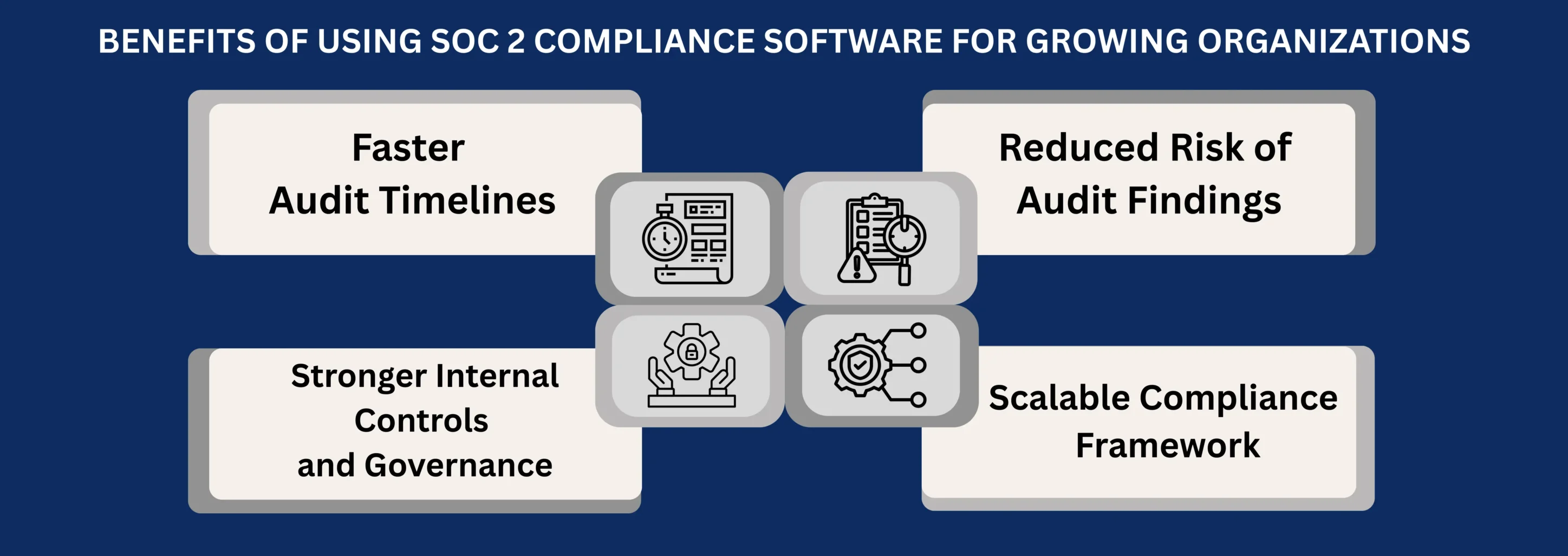
SOC 2 Certification in Sweden delivers measurable business and operational benefits across multiple dimensions. For organizations operating in competitive technology, financial services, healthcare, and cloud services markets, the attestation report functions as documented evidence of control effectiveness. It can be shared with customers, auditors, and regulators without disclosing sensitive internal system details. The following benefits reflect the direct outcomes of a successfully completed SOC 2 examination.
Enterprise customers in Sweden and internationally — particularly in financial services, healthcare, and regulated industries — require documented evidence of vendor security controls as part of their third-party risk management programs. SOC 2 attestation provides a standardized, auditor-issued report that satisfies vendor due diligence requests without requiring the organization to grant direct access to its systems or security configurations. Swedish SaaS providers, fintech companies, and cloud service providers holding SOC 2 certification can respond to customer security questionnaires by referencing their attestation report — streamlining the sales and procurement process. SOC 2 examination reports are widely recognized by procurement and risk teams across the United States, European Union, and global enterprise markets, making them especially valuable for Swedish organizations with international customer bases.
The SOC 2 attestation report is also directly relevant to organizations subject to vendor management requirements under the NIS2 Directive and the Digital Operational Resilience Act (DORA). Financial entities and operators of essential services subject to these regulations must assess the security and operational resilience of their third-party providers. A SOC 2 Type 2 report issued by a Licensed CPA Firm provides auditor-verified evidence that a vendor’s controls have been tested for operating effectiveness — directly relevant to the third-party risk management obligations imposed by these frameworks. Organizations in Sweden providing services to financial institutions or essential service operators will increasingly find SOC 2 attestation referenced in contractual vendor assurance requirements.
SOC 2 Certification in Sweden provides a meaningful competitive advantage for organizations pursuing enterprise contracts in security-sensitive markets. Many large enterprises in financial services, healthcare, and government-adjacent sectors maintain vendor lists that require SOC 2 Type 2 attestation as a baseline qualification criterion. Swedish technology companies — including those developing AI platforms, cybersecurity tools, and cloud-native applications — that hold SOC 2 certification are positioned to enter procurement processes unavailable to unattested competitors. The attestation report signals to prospective customers that the organization’s control environment has been independently verified, reducing the due diligence burden on the customer and accelerating the sales cycle for contracts that would otherwise require extensive security review.
- ✓Satisfies enterprise vendor security questionnaires with auditor-issued SOC 2 attestation evidence
- ✓Enables entry into regulated industry procurement processes requiring independent assurance
- ✓Supports NIS2 and DORA third-party risk management vendor assessment requirements
- ✓Demonstrates control maturity to customers across EU, US, and international markets
- ✓Reduces customer-side due diligence burden and shortens vendor approval timelines
- ✓Provides documented control evidence relevant to GDPR data processor assurance expectations
- ✓Strengthens organizational credibility in competitive tenders and enterprise RFP responses
- ✓Customer Assurance and Vendor Due Diligence
- ✓Competitive Positioning and Market Access
SOC 2 Certification Timeline in Sweden
The SOC 2 certification timeline in Sweden varies based on report type, the maturity of the organization’s existing control environment, the complexity of the in-scope system, and the number of Trust Services Criteria selected. Organizations should plan their SOC 2 audit Sweden engagement with realistic timeline expectations to avoid delays in meeting customer commitments or procurement deadlines.
Type 1 vs. Type 2 Timeline Considerations
A SOC 2 Type 1 examination can typically be completed within four to eight weeks from the commencement of auditor fieldwork, assuming the organization’s control documentation is complete and evidence is readily accessible. The absence of an observation period means that Type 1 engagements can reach attestation issuance relatively quickly once scope and documentation are confirmed. Organizations in Stockholm or Gothenburg seeking initial SOC 2 attestation ahead of a product launch or enterprise sales cycle often pursue Type 1 as the first step, with plans to transition to a Type 2 engagement following a six-to-twelve-month observation period. The Type 1 attestation report is a formal Licensed CPA Firm document that can be shared with customers during the interval before Type 2 certification is obtained.
A SOC 2 Type 2 examination requires a defined observation period during which the auditor evaluates the operating effectiveness of controls. The observation period for a SOC 2 Type 2 report is typically six months for an initial engagement and twelve months for subsequent annual audits. Following the conclusion of the observation period, auditor fieldwork, evidence review, control testing, and report drafting typically require an additional four to twelve weeks depending on engagement complexity and the volume of exceptions identified. Swedish organizations planning SOC 2 Type 2 Sweden engagements should establish the observation period start date in coordination with their auditor and maintain consistent control operation throughout the period, as evidence gaps during the observation window directly affect the auditor’s ability to issue an unqualified opinion.
| Report Type | Observation Period | Fieldwork Duration | Estimated Total Timeline |
|---|---|---|---|
| SOC 2 Type 1 | None (point in time) | 4–8 weeks | 4–8 weeks from engagement start |
| SOC 2 Type 2 (Initial) | 6 months minimum | 4–12 weeks post-period | 7–9 months from observation start |
| SOC 2 Type 2 (Annual) | 12 months | 4–12 weeks post-period | 13–15 months from observation start |
SOC 2 Compliance: Ongoing Obligations and Annual Recertification
SOC 2 compliance is not a one-time event. Organizations that obtain SOC 2 Certification in Sweden must maintain their control environment on an ongoing basis and undergo annual recertification examinations to retain current attestation status. The SOC 2 attestation report issued following a Type 2 examination reflects the observation period covered by that specific engagement — typically a twelve-month window — and does not represent a permanent certification. Customers and relying parties expect organizations to maintain current, annual SOC 2 reports. Lapsed attestation can trigger vendor risk review processes or contract compliance issues.
Continuous Control Monitoring Between Audit Cycles
Between SOC 2 audit cycles, organizations must maintain active control operation across all areas covered by the attestation. This includes continuing to perform user access reviews on a defined schedule, maintaining change management approval records, conducting periodic vulnerability scans with remediation tracking, reviewing security incidents and documenting response activities, and monitoring vendor security status. Control monitoring activities must be documented consistently throughout the year. The subsequent Type 2 examination will cover the full twelve-month period — including months that elapsed between the prior report’s issuance and the commencement of auditor fieldwork for the next cycle. Gaps in control execution during this interim period are subject to auditor testing and can result in qualified opinions or noted exceptions in the next report.
Swedish organizations maintaining SOC 2 compliance across annual cycles should establish internal control calendars that align control operation activities with the observation period covered by their engagement. Activities such as penetration testing, business continuity testing, security training completion, and vendor reviews should be scheduled and documented within the observation window to ensure evidence is available for auditor review. Organizations that experience significant changes to their systems — such as migrating to new cloud infrastructure, acquiring another company, or substantially changing their service offerings — should communicate these changes to their auditor promptly. Material changes may affect the scope of the next examination and the completeness of the system description.
Management Responsibilities and Control Ownership
Management bears primary responsibility for the design, implementation, and operation of controls evaluated in a SOC 2 examination. The auditor’s role is limited to independent evaluation — management cannot delegate responsibility for control effectiveness to the auditor. In the context of SOC 2 Certification in Sweden, management must formally assert that the system description is fairly presented, that controls are suitably designed, and — for Type 2 engagements — that controls operated effectively during the observation period. This management assertion is a required component of the SOC 2 report and carries professional and reputational accountability. Organizations should designate clear internal ownership for each control category to ensure accountability and consistent execution throughout the audit cycle.
SOC 2 Certification in Sweden: Sector-Specific Considerations
SOC 2 Certification in Sweden is pursued across a broad range of industry sectors, reflecting the depth and diversity of Sweden’s technology, financial services, and knowledge economy. Each sector presents distinct control considerations, customer assurance expectations, and regulatory alignment factors that influence how the SOC 2 examination is scoped and executed.
Fintech, Financial Services, and Healthcare
SOC 2 certification Sweden fintech engagements are among the most common in the Swedish market. Fintech companies providing payment processing, open banking, lending platforms, digital wallets, and financial data aggregation services face intense vendor scrutiny from banking partners, institutional investors, and regulatory bodies. SOC 2 Type 2 attestation provides fintech organizations with a standardized report that can be shared in response to due diligence requests from banks and financial institutions subject to DORA third-party risk management requirements. Financial institutions themselves may pursue SOC 2 examination to demonstrate control assurance to auditors, regulators, and institutional clients — particularly when operating technology platforms or data services that fall outside the scope of traditional banking supervision.
Healthcare and life sciences organizations in Sweden — including providers of electronic health record systems, clinical data management platforms, telemedicine services, and medical device software — frequently encounter SOC 2 attestation requirements from hospital networks, pharmaceutical companies, and research institutions. The Confidentiality and Privacy Trust Services Criteria are particularly relevant for healthcare organizations, given the sensitivity of patient data and the data protection expectations established by GDPR and the Swedish Data Protection Act. Swedish gaming companies, telecommunications providers, and AI businesses also pursue SOC 2 certification to address vendor assurance requirements from enterprise customers and to demonstrate data handling controls relevant to their service commitments and contractual obligations.
SaaS Providers, Cloud Services, and AI Companies
SaaS providers and cloud service organizations headquartered in Stockholm, Gothenburg, and Malmö represent a substantial portion of SOC 2 audit Sweden engagements. These organizations typically serve enterprise customers who require independent control assurance as a condition of vendor onboarding. The Security and Availability criteria are most commonly selected by SaaS providers, reflecting customer expectations around data security and service uptime commitments. Cloud-native organizations with multi-tenant architectures must pay particular attention to logical separation controls and the treatment of subservice organization relationships in their system descriptions. AI companies handling customer training data, model outputs, and inference logs face increasing scrutiny over data handling controls — making SOC 2 certification a relevant assurance mechanism for demonstrating responsible data management practices.
Steps to Obtain SOC 2 Certification in Sweden
Obtaining SOC 2 Certification in Sweden involves a defined sequence of activities that the organization and the Licensed CPA Firm execute in coordination. Each step produces specific outputs required for the subsequent stage of the SOC 2 examination. The following steps reflect the standard pathway from initial engagement through attestation issuance.
- Engagement Scoping: Define the systems, services, and Trust Services Criteria to be included in the SOC 2 examination; establish report type (Type 1 or Type 2) and observation period dates.
- System Description Preparation: Management prepares a complete description of the in-scope system, including infrastructure components, software, people, processes, and data flows.
- Control Identification: Identify and document controls relevant to each selected Trust Services Criterion, mapping control activities to specific points of focus within the AICPA framework.
- Evidence Preparation: Compile documentation, configurations, access logs, vendor agreements, testing records, and other evidence categories required for auditor evaluation.
- Auditor Fieldwork (Design Evaluation): The Licensed CPA Firm evaluates control design suitability against the applicable Trust Services Criteria and the fairness of the system description.
- Observation Period Monitoring (Type 2 Only): Maintain consistent control operation throughout the observation period and document all activities as they occur for subsequent auditor testing.
- Control Testing (Type 2 Only): The auditor selects and tests controls at multiple points during the observation period, evaluating operating effectiveness and identifying exceptions.
- Nonconformity Resolution and Report Drafting: Identified exceptions are reviewed; the auditor drafts the SOC 2 report including findings, management’s description, and the auditor’s opinion.
- Attestation Report Issuance: The Licensed CPA Firm issues the final SOC 2 attestation report, which the organization may share with customers, regulators, and relying parties.
Scope definition is among the most consequential decisions in a SOC 2 engagement. A scope that is too narrow may not satisfy customer expectations or cover systems material to service delivery; a scope that is too broad increases the evidence burden and extends examination timelines. Organizations should define scope based on the systems that directly support service commitments to customers, the locations and infrastructure components that process or store in-scope data, and the controls management has implemented to address the applicable Trust Services Criteria. For Swedish organizations with European data center operations or hybrid cloud environments, scope should explicitly address whether data center infrastructure, network perimeter controls, and cloud provider services are included, excluded, or treated as subservice organizations under the SOC 2 examination.
- ✓Engagement Initiation Through Attestation Issuance
- ✓Scope Decisions and Criteria Selection
CertPro: Licensed CPA Firm for SOC 2 Audit Sweden
CertPro is a Licensed CPA Firm authorized to conduct SOC 2 examinations and issue SOC 2 attestation reports under AICPA AT-C Section 205 attestation standards. CertPro conducts SOC 2 audit Sweden engagements for organizations across the Swedish and European technology ecosystem — including SaaS providers, fintech companies, AI businesses, cloud service organizations, healthcare IT providers, cybersecurity firms, and data center operators. The firm’s examination methodology is structured around the AICPA Trust Services Criteria and the professional auditing standards governing attestation engagements.
Attestation Methodology and Professional Standards
CertPro’s SOC 2 examination methodology follows the structured stages of a formal attestation engagement: scope definition, system description evaluation, audit program determination, control identification, evidence collection, control testing, nonconformity review, and attestation issuance. The firm’s auditors apply professional judgment in accordance with AICPA standards throughout each stage. The resulting SOC 2 attestation report reflects an independent auditor’s opinion on whether the organization’s controls meet the applicable Trust Services Criteria. CertPro does not provide consulting, advisory, or implementation services in connection with SOC 2 engagements — the firm operates exclusively as an independent auditor and attestation provider, maintaining the objectivity required under professional standards for Licensed CPA Firm attestation engagements.
SOC 2 examination reports issued by CertPro are recognized by enterprise customers, institutional investors, regulatory bodies, and third-party risk management programs across the United States, European Union, and international markets. Swedish organizations that complete a SOC 2 examination with CertPro receive a formal attestation report — including the auditor’s opinion, system description, description of tests of controls (Type 2), and results of testing — that can be shared with relying parties under a Non-Disclosure Agreement or with existing customers under contractual terms. The report is valid for the period covered by the examination and is typically renewed annually through a subsequent SOC 2 Type 2 engagement covering the following twelve-month observation period.
SOC 2 vs. ISO 27001: Choosing the Right Framework
Swedish organizations frequently evaluate SOC 2 certification against ISO 27001 certification when determining which framework best addresses customer and market requirements. SOC 2 and ISO 27001 differ in several material respects. SOC 2 is an attestation framework developed by the AICPA, primarily recognized in North American markets and widely adopted by enterprise technology buyers globally; its SOC 2 audit tests specific controls against the Trust Services Criteria and service commitments. ISO 27001 is a certification standard developed by the International Organization for Standardization, with strong recognition across European and international markets; it certifies the existence of an information security management system (ISMS) rather than testing specific controls against defined criteria. Organizations with US-centric customer bases or North American expansion plans often prioritize SOC 2 examination; organizations with European regulatory or procurement requirements may prioritize ISO 27001. Many Swedish organizations maintain both certifications to address the full spectrum of customer assurance expectations across their target markets.
FAQ
▶
What is SOC 2 Certification in Sweden?
▶
What is SOC 2 certification and who issues it?
▶
What is the difference between SOC 2 certified and SOC 2 compliant?
▶
How long does SOC 2 certification take in Sweden?
▶
Which Trust Services Criteria should a Swedish organization select?
▶
Is SOC 2 certification required by Swedish or EU law?
▶
How long is a SOC 2 attestation report valid?
▶
Can a Swedish organization share its SOC 2 report publicly?
SOC 1 VS SOC 2: WHICH REPORT YOUR CUSTOMERS ACTUALLY ASK FOR
If you sell SaaS or provide outsourced services, you have likely been asked for a SOC report. However, the follow-up question is rarely easy to answer…

AICPA Issues New Guidance for Peer Reviewers Evaluating SOC 2 Engagements
AICPA SOC 2 guidance has been issued to help peer reviewers identify quality risks associated with SOC 2 engagements as the use of compliance automati…
SOC 2 Certified: What Does It Mean for Your Business
For companies that handle sensitive data or run cloud-based services, the question “Can you provide your SOC 2 report?” carries enormous weight. Yet, …
Get In Touch
have a question? let us get back to you.