
ISO 42001 Certification in Stockholm
CertPro provides ISO 42001 certification engagements under a fixed-price model that gives Stockholm organizations cost certainty from engagement initiation through certificate issuance. The fixed-price structure eliminates the variable cost exposure associated with time-and-materials certification engagements, enabling accurate budget planning for certification activities. CertPro’s pricing is determined at engagement commencement based on documented scope parameters — AIMS scope, number of AI systems in scope, organizational size, and audit complexity — and remains fixed throughout the certification cycle absent material scope changes.
OUR CLIENTS


What Is ISO 42001 Certification?
ISO 42001 certification in Stockholm refers to the formal attestation process by which an accredited certification body or Licensed CPA Firm evaluates an organization’s Artificial Intelligence Management System (AIMS) against the requirements of ISO/IEC 42001:2023 and issues a certificate of conformance upon satisfactory determination. The standard was published by the International Organization for Standardization (ISO) in 2023 as the first globally recognized framework dedicated exclusively to AI governance and management system controls. ISO 42001 certification establishes that an organization has implemented documented, repeatable, and auditable processes for responsible AI development, deployment, and operational oversight — making it a foundational credential for any Stockholm organization operating AI systems at scale.
Definition and Scope of ISO/IEC 42001:2023
ISO/IEC 42001:2023 is an international standard that specifies requirements for establishing, implementing, maintaining, and continually improving an Artificial Intelligence Management System (AIMS) within organizations of any size and sector. The standard applies to any organization that develops, provides, or uses AI-based products and services. This makes it directly relevant to Stockholm’s expanding ecosystem of technology firms, fintech operators, healthcare providers, and public sector entities. The scope of ISO 42001 encompasses the entire AI lifecycle — from initial system design and data governance through model training, validation, deployment, and post-deployment monitoring.
The standard’s framework is structured around core management system principles consistent with other ISO high-level structure (HLS) standards. This enables organizations that hold certifications such as ISO 27001 or ISO 9001 to integrate AIMS controls into existing governance structures without duplicating policy infrastructure. ISO 42001 compliance requires organizations to define AI-specific objectives, assign accountability roles, document risk treatment processes, and establish internal audit and management review mechanisms. This architecture ensures that AI governance is embedded into organizational strategy rather than treated as a standalone technical function.
Structured Definitions for AI Governance Concepts
| Term | Definition |
|---|---|
| ISO 42001 | ISO/IEC 42001:2023 is an international standard specifying requirements for establishing, implementing, maintaining, and continually improving an Artificial Intelligence Management System (AIMS). It provides a governance framework for responsible AI development and operational control, published by ISO in 2023. |
| AIMS | An Artificial Intelligence Management System (AIMS) is the structured set of policies, processes, controls, and governance mechanisms an organization uses to manage AI-related risks, objectives, and accountability, as defined under ISO/IEC 42001:2023. |
| AI Governance | AI governance refers to the organizational structures, accountability mechanisms, and control processes that oversee the ethical, safe, and transparent use of artificial intelligence systems, aligned to standards such as ISO 42001. |
| Certification Audit | A certification audit is a formal, evidence-based evaluation conducted by a Licensed CPA Firm or accredited certification body to assess an organization’s conformance to a defined standard, resulting in the issuance of a certificate of conformance upon satisfactory determination. |
| ISO 42001 Compliance | ISO 42001 compliance is the state in which an organization’s AIMS policies, procedures, and controls demonstrably satisfy all applicable requirements of ISO/IEC 42001:2023 as verified through documented evidence during a formal certification audit. |
Who ISO 42001 Applies To in Stockholm
ISO 42001 certification in Stockholm applies to any organization that develops AI algorithms, deploys machine learning models in operational processes, procures AI-enabled software from third parties, or uses automated decision-making systems that affect customers, employees, or regulated activities. Stockholm’s technology sector includes a high concentration of AI-native startups, established fintech platforms, e-commerce operators, and multinational enterprises with regional headquarters — all of which fall within the scope of ISO 42001. Financial services firms operating under Finansinspektionen oversight, healthcare organizations subject to patient data regulations, and logistics platforms employing predictive routing systems are all within the standard’s applicability perimeter.
The ISO 42001 standard explicitly states that it is applicable regardless of organization size, sector, or the maturity of AI adoption. A Stockholm-based startup deploying a single AI-powered recommendation engine and a large enterprise operating multiple AI systems across business units are equally within scope. The key determinant is whether the organization exerts control over or derives operational benefit from AI systems — not the scale or sophistication of those systems. This broad applicability makes ISO 42001 assessment a relevant governance consideration for virtually any Stockholm business operating in the digital economy.
The AIMS Framework Explained
The Artificial Intelligence Management System (AIMS) framework defined in ISO 42001 operates across seven structural domains: organizational context, leadership and commitment, planning, support and resources, operational processes, performance evaluation, and continual improvement. Each domain contains specific requirements that an organization must satisfy to achieve and maintain ISO 42001 compliance. The context domain requires organizations to define the internal and external factors affecting AI governance — including regulatory obligations, stakeholder expectations, and organizational risk appetite. The planning domain requires documented AI risk assessments and the establishment of measurable AI governance objectives aligned with business strategy.
The operational domain within AIMS is particularly significant for Stockholm organizations because it governs the actual design, development, testing, and deployment of AI systems. ISO 42001 requires organizations to maintain documented criteria for AI system validation, data quality controls, bias detection processes, and human oversight mechanisms. Performance evaluation under AIMS includes internal audit programs, management reviews, and monitoring of AI system behavior against defined objectives. Continual improvement requirements ensure that the AIMS evolves as AI technologies, regulatory expectations, and organizational AI portfolios change over time — establishing a dynamic governance posture rather than a static compliance checkpoint.

ISO 42001 Requirements for Stockholm Organizations
ISO 42001 compliance requires Stockholm organizations to satisfy a defined set of mandatory requirements organized across the standard’s clause structure. These requirements span documentation, governance, technical controls, risk management, and operational processes. Organizations pursuing ISO 42001 certification in Stockholm must demonstrate conformance across all applicable clauses through documented evidence reviewed during the certification audit. The requirements are not prescriptive in dictating specific technical architectures. Instead, they define the outcomes and control objectives that an AIMS must achieve — giving organizations flexibility to implement controls appropriate to their specific AI use cases and organizational context.
ISO 42001 requires organizations to maintain documented information that demonstrates the establishment and operation of the AIMS. Mandatory documented information includes the AIMS scope statement, AI governance policy, AI risk assessment records, AI objectives and plans, evidence of competence for personnel performing AI governance roles, and records from internal audits and management reviews. For Stockholm organizations, documentation must also capture the regulatory context relevant to AIMS operations — including references to GDPR obligations, EU AI Act applicability determinations, and any sector-specific requirements from Swedish financial or healthcare regulators.
Documentation requirements under ISO 42001 extend to AI system-level records. Organizations must maintain documentation describing each AI system within scope, including its intended purpose, data inputs, model architecture decisions, validation test results, and known limitations. This system-level documentation serves as the evidential foundation for ISO 42001 audit evaluation — auditors assess whether documented controls correspond to actual operational practices. Stockholm organizations with complex multi-system AI portfolios must structure their documentation management to ensure version control, access controls, and retention schedules comply with both ISO 42001 requirements and applicable data protection obligations.
ISO 42001 requires demonstrable top management commitment to the AIMS through defined leadership actions. Top management must establish an AI governance policy, assign roles and responsibilities for AIMS operation, ensure AIMS objectives are integrated with organizational strategic direction, and allocate sufficient resources for ongoing AIMS maintenance. For Stockholm enterprises operating in the AI-intensive fintech and technology sectors, this requirement often translates into formal AI governance committee structures, Chief AI Officer or equivalent role definitions, and board-level reporting on AI risk exposure and AIMS performance metrics.
The governance requirements in ISO 42001 specifically address accountability for AI-related decisions and outcomes. Organizations must define who holds responsibility for AI system performance, who has authority to approve new AI deployments, and who is accountable for responding to AI-related incidents or stakeholder concerns. This accountability mapping is a critical ISO 42001 audit evaluation area — auditors examine whether documented roles correspond to actual decision-making authority and whether accountable individuals possess the competence to fulfill their governance responsibilities. Stockholm organizations with distributed AI development teams across multiple departments or subsidiaries must establish clear accountability frameworks that span organizational boundaries.
ISO 42001 requires organizations to conduct and document AI-specific risk assessments that identify risks associated with AI system development, deployment, and operation. The risk assessment process must evaluate risks to individuals, groups, organizations, and society — extending beyond traditional operational risk categories to encompass AI-specific concerns including algorithmic bias, explainability failures, data quality degradation, model drift, and unintended AI system behavior. Risk assessments must be linked to specific AI systems or use cases within scope and must be reviewed when significant changes occur in AI system design, data inputs, or deployment context.
Risk treatment under ISO 42001 requires organizations to select and implement controls from Annex A of the standard, which contains 38 controls organized across eight control domains. These domains address AI system impact assessment, AI data governance, AI system lifecycle controls, third-party AI provider management, incident response, and human oversight mechanisms. Stockholm organizations must document their selection of applicable controls and provide justification for any controls declared not applicable — a Statement of Applicability (SoA) requirement that mirrors the approach used in ISO 27001 certification. The SoA becomes a key audit document during ISO 42001 assessment.
- ✓Defined AIMS scope statement covering all AI systems and organizational boundaries
- ✓Documented AI governance policy approved by top management
- ✓Assigned roles, responsibilities, and accountability for AIMS operation
- ✓Completed AI risk assessments with documented treatment decisions
- ✓Statement of Applicability covering all 38 Annex A controls
- ✓Documented AI system inventory with purpose, data, and validation records
- ✓Internal audit program with documented audit findings and corrective actions
- ✓Management review records demonstrating periodic AIMS performance evaluation
- ✓Competence records for personnel with AI governance responsibilities
- ✓Documented AI incident management procedures and response records
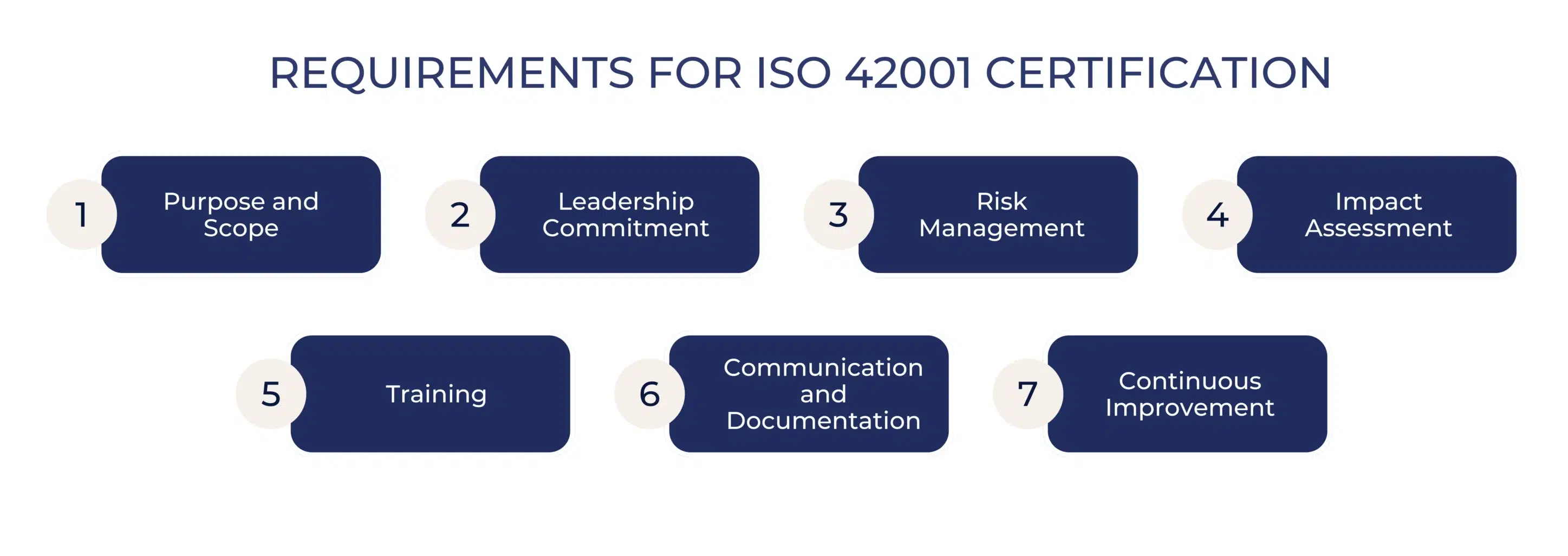
- ✓Documentation Requirements
- ✓Leadership and Governance Requirements
- ✓AI Risk Assessment and Treatment Requirements
- ✓Core ISO 42001 Requirements Summary
ISO 42001 Certification Process in Stockholm
The ISO 42001 certification process in Stockholm follows a structured audit sequence that progresses from initial scope determination through formal assessment stages to certificate issuance and ongoing surveillance. Organizations pursuing ISO 42001 certification in Stockholm engage with a Licensed CPA Firm or accredited certification body to initiate the process. The process is designed to provide objective, evidence-based evaluation of AIMS conformance — not advisory input or implementation guidance. Each stage of the certification process produces documented outputs that form the basis for the final certification decision.
The certification process begins with scope definition, during which the organization formally documents the boundaries of its AIMS and the AI systems subject to certification. Scope definition must identify the organizational units, geographic locations, AI system categories, and business processes included within the AIMS perimeter. For Stockholm organizations operating across multiple legal entities or with AI systems deployed in cloud environments hosted outside Sweden, scope definition must address how cross-boundary AI governance controls are documented and enforced. The scope statement becomes a contractual element of the certification engagement and determines the overall audit program structure.
Following scope definition, the audit program is determined based on the complexity of the AIMS, the number and risk profile of AI systems in scope, organizational size, and the extent of third-party AI integrations. The audit program specifies the audit team composition, audit duration, audit techniques to be employed, and the scheduling of Stage 1 and Stage 2 activities. Stockholm organizations with high-risk AI applications — such as automated credit decisioning systems in fintech or AI-assisted clinical decision tools in healthcare — typically require more extensive audit programs than organizations with lower-risk AI deployments.
The Stage 1 audit is a documentation-focused evaluation that assesses whether the organization’s AIMS documentation satisfies ISO 42001 requirements and whether the organization is ready to proceed to the Stage 2 on-site audit. During Stage 1, auditors review the AIMS scope statement, governance policy, risk assessment documentation, Statement of Applicability, AI system inventory, and internal audit records. The Stage 1 audit produces a formal report identifying any areas where documentation requires strengthening before Stage 2 activities commence. This evaluation may be conducted remotely or on-site at the auditor’s discretion.
Stage 1 audit findings are classified according to their potential impact on the Stage 2 audit. Major deficiencies in AIMS documentation — such as absent risk assessments, undefined AI system scope, or a missing Statement of Applicability — result in mandatory remediation before Stage 2 proceeds. Minor observations or opportunities for improvement are documented but do not block Stage 2 progression. Stockholm organizations that have thoroughly completed AIMS documentation prior to Stage 1 typically advance to Stage 2 with minimal delay, as the Stage 1 review serves primarily as a readiness confirmation rather than a corrective intervention.
The Stage 2 audit is an on-site, evidence-based evaluation in which auditors assess whether the organization’s AIMS is effectively implemented and operating in conformance with ISO 42001 requirements. Control testing during Stage 2 includes interviews with personnel holding AI governance roles, observation of operational AI management processes, examination of AI system records and monitoring logs, review of incident response documentation, and testing of internal audit effectiveness. Auditors evaluate whether documented controls correspond to actual operational practices — a key distinction in ISO 42001 audit methodology that separates genuine operational AIMS maturity from documentation completeness alone.
During the Stage 2 ISO 42001 audit, auditors specifically evaluate the quality of the organization’s AI risk assessments, the effectiveness of implemented Annex A controls, the competence of personnel fulfilling AI governance roles, and the organization’s capacity for ongoing AIMS improvement. Nonconformities identified during Stage 2 are classified as major or minor. Major nonconformities — such as the absence of operational AI risk treatment processes or evidence that documented controls are not being followed — must be resolved through documented corrective action before ISO 42001 certification can be issued. Minor nonconformities require corrective action within an agreed timeframe but do not prevent certificate issuance.
Following satisfactory resolution of any identified nonconformities, the certification body conducts a formal certification decision review. This decision is made by an independent reviewer who was not part of the audit team, ensuring objectivity in the conformance determination. Upon a positive certification decision, the organization receives a formal ISO 42001 certificate of conformance specifying the certification scope, the standard and version audited, the certification body’s identity, the certificate issue date, and the certificate validity period. ISO 42001 certificates are typically issued for a three-year certification cycle, subject to annual surveillance audits.
Annual surveillance audits during the three-year certification cycle verify that the AIMS remains operational and continues to conform to ISO 42001 requirements. Surveillance audits focus on internal audit results, management review outputs, handling of AI-related incidents, and implementation of previously identified improvement actions. Recertification audits at the end of the three-year cycle constitute a full reassessment of AIMS conformance. Stockholm organizations must plan for surveillance audit scheduling as part of their AIMS calendar to maintain continuous certification status and avoid gaps in their certified AI governance posture.
- Scope Definition: Document AIMS boundaries, AI systems in scope, and organizational units covered
- Audit Program Determination: Establish audit team, duration, techniques, and stage scheduling based on AIMS complexity
- Stage 1 Documentation Audit: Review AIMS documentation for conformance with ISO 42001 structural requirements
- Stage 1 Findings Resolution: Address any documentation deficiencies identified before Stage 2 proceeds
- Stage 2 On-Site Audit: Evidence-based evaluation of AIMS implementation, control effectiveness, and operational conformance
- Nonconformity Review: Classify and document any major or minor nonconformities identified during Stage 2
- Corrective Action: Resolve major nonconformities through documented corrective action plans with supporting evidence
- Certification Decision: Independent review of audit findings and conformance determination
- Certificate Issuance: Formal ISO 42001 certificate issued specifying scope, validity, and certification body
- Annual Surveillance Audits: Ongoing AIMS conformance verification during the three-year certification cycle
- Recertification Audit: Full reassessment at three-year cycle completion to renew certification
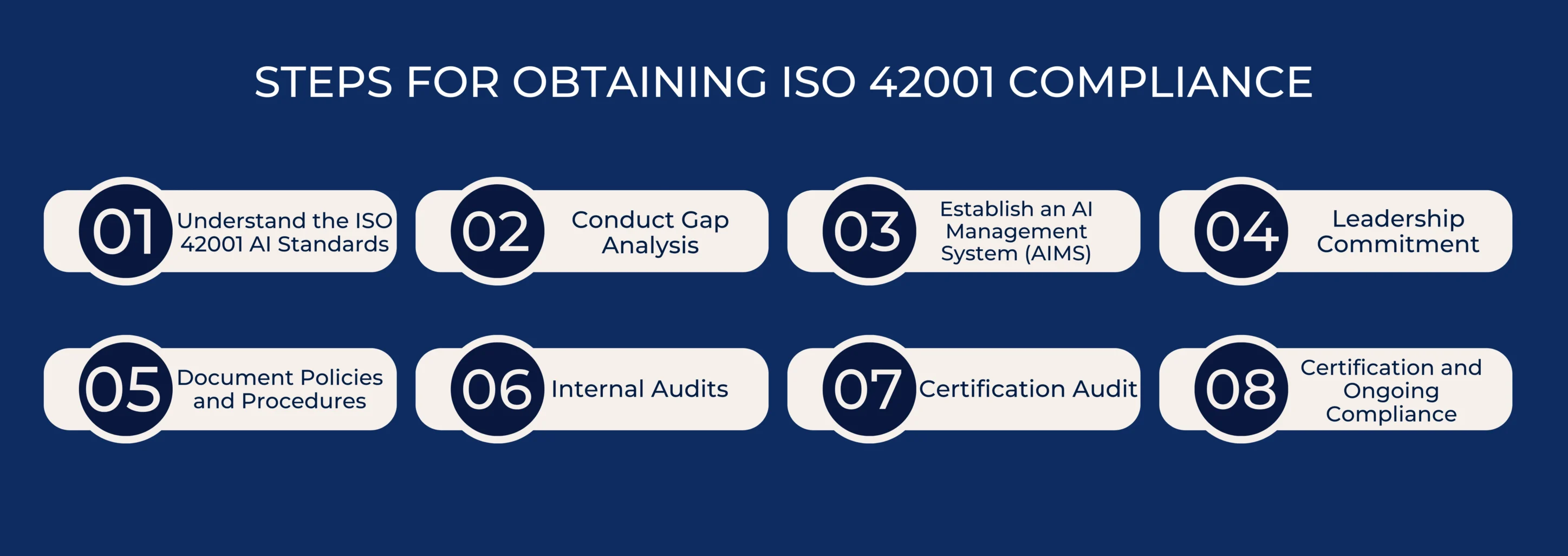
- ✓Stage 1: Scope Definition and Audit Program Determination
- ✓Stage 2: Documentation Review and Stage 1 Audit
- ✓Stage 3: On-Site ISO 42001 Audit and Control Testing
- ✓Stage 4: Certification Decision, Issuance, and Surveillance
- ✓ISO 42001 Certification Process — Step-by-Step Summary
AIMS Framework and AI Control Assessment in Stockholm
The AI control assessment component of ISO 42001 certification evaluates the design and operational effectiveness of controls an organization has implemented to govern its AI systems. ISO 42001 assessment in Stockholm encompasses evaluation of all 38 Annex A controls, organized across eight domains that address the full spectrum of AI governance risk. The assessment methodology requires auditors to examine both the existence of control documentation and evidence of controls operating effectively in practice. Control effectiveness evaluation is the defining characteristic of ISO 42001 assessment — distinguishing it from self-declaration or maturity model approaches that do not require independent verification.
Annex A Control Domains and Assessment Criteria
ISO 42001’s Annex A organizes AI governance controls across eight domains. The AI system impact assessment domain requires organizations to evaluate and document the potential impacts of AI systems on individuals, groups, and society before deployment — a control directly relevant to Stockholm organizations deploying AI in regulated sectors such as financial services, healthcare, or employment processes. The AI data governance domain requires controls addressing data quality, provenance, bias detection in training data, and data lifecycle management. This is critical for Stockholm fintech operators whose AI models depend on large volumes of customer financial data subject to GDPR.
The AI system lifecycle control domain covers controls governing design, development, testing, validation, deployment, and decommissioning of AI systems. ISO 42001 assessment of this domain examines whether organizations maintain documented validation criteria, conduct adversarial testing, monitor deployed model performance for drift, and have defined processes for responding to model degradation. For Stockholm technology companies deploying continuously learning AI systems, this domain is particularly significant — auditors evaluate whether automated model updates are subject to governance review or deployed without human oversight, which would represent a control gap under ISO 42001 requirements.
Human Oversight and Explainability Controls
ISO 42001 places explicit requirements on human oversight mechanisms for AI systems, particularly those making or influencing consequential decisions affecting individuals. The standard requires organizations to define the level of human involvement appropriate to each AI use case, document human override procedures, and maintain evidence that human oversight processes are operational. For Stockholm organizations in financial services or healthcare — where automated AI decisions may affect credit access, insurance pricing, or clinical pathways — human oversight controls are among the highest-priority assessment areas during an ISO 42001 audit.
Explainability requirements under ISO 42001 require organizations to provide meaningful explanations of AI system outputs to affected individuals and to internal oversight functions. While the standard does not prescribe specific technical explainability methods such as LIME or SHAP, it requires organizations to maintain documented approaches to explainability appropriate to the risk level and context of each AI system. During ISO 42001 assessment in Stockholm, auditors evaluate whether explainability documentation is sufficient to satisfy both the standard’s requirements and applicable regulatory obligations — including GDPR’s provisions on automated decision-making under Article 22.
Third-Party AI Provider Management Controls
Many Stockholm organizations procure AI capabilities from third-party providers — including cloud-based machine learning platforms, AI-as-a-service vendors, and embedded AI components in enterprise software. ISO 42001 requires organizations to manage AI governance risks associated with these third-party providers through documented supplier evaluation, contractual AI governance requirements, and ongoing monitoring of third-party AI system performance. The AI control assessment examines whether organizations have conducted supplier assessments, included AI governance obligations in procurement contracts, and maintained oversight of third-party AI behavior within their operational environment.
Third-party AI provider management is a particularly complex control domain for Stockholm organizations that rely on large international AI platform providers. ISO 42001 assessment evaluates whether organizations can demonstrate adequate oversight of AI systems where model training, infrastructure, and operational control reside with a third party. Organizations that cannot obtain sufficient information from third-party AI providers to satisfy ISO 42001 control requirements may need to document compensating controls, accept residual risks through the risk treatment process, or exclude specific third-party AI systems from the certification scope. Auditors evaluate the adequacy of these decisions during the ISO 42001 assessment process.
Benefits of ISO 42001 Certification for Stockholm Organizations
ISO 42001 certification in Stockholm delivers measurable organizational benefits across regulatory compliance, competitive positioning, operational governance, and stakeholder trust. As Stockholm’s technology and AI ecosystem continues to expand — with the city consistently ranking among Europe’s top innovation hubs — ISO 42001 certification provides a verifiable signal of AI governance maturity to customers, investors, regulators, and enterprise procurement teams. The benefits extend well beyond regulatory compliance, encompassing operational risk reduction, improved AI system reliability, and accelerated access to markets that require demonstrated AI governance standards.
ISO 42001 compliance provides Stockholm organizations with a structured framework that addresses key requirements of the EU AI Act, which establishes risk-based obligations for AI system providers and deployers operating in the European Union. The EU AI Act, which entered into force in 2024, requires organizations deploying high-risk AI systems to implement risk management systems, data governance practices, transparency mechanisms, and human oversight procedures — requirements that substantially overlap with ISO 42001’s AIMS framework. Organizations holding ISO 42001 certification in Stockholm can demonstrate to EU AI Act compliance authorities that their AI governance processes have been independently verified against an internationally recognized standard.
ISO 42001 certification also supports GDPR compliance for Stockholm organizations whose AI systems process personal data. The Swedish Authority for Privacy Protection (IMY) enforces GDPR in Sweden and has demonstrated an active enforcement posture in areas including automated decision-making, AI-driven profiling, and data minimization in AI systems. ISO 42001 compliance generates documented evidence of data governance controls within the AIMS that can be referenced in GDPR compliance assessments, Data Protection Impact Assessments (DPIAs), and responses to IMY inquiries. This alignment reduces the risk of regulatory penalties and demonstrates proactive governance to Swedish and European data protection authorities.
ISO 42001 certification in Stockholm provides a verifiable competitive differentiator in enterprise sales processes and public sector procurement. Large Swedish enterprises and government entities increasingly include AI governance requirements in vendor qualification criteria — requiring suppliers to demonstrate that their AI systems operate under documented governance frameworks. ISO 42001 certification satisfies these requirements with independently verified evidence, reducing the burden of answering lengthy AI governance questionnaires in RFP processes. For Stockholm fintech companies seeking partnerships with major Nordic banks, ISO 42001 certification has become an increasingly relevant qualification criterion alongside ISO 27001 and SOC 2 attestations.
International market access is a significant commercial benefit of ISO 42001 certification for Stockholm tech companies pursuing expansion into regulated markets across Europe, North America, and Asia-Pacific. Many enterprise buyers and regulated-industry customers in these markets require AI suppliers to demonstrate internationally recognized governance certifications. ISO 42001, as the first global standard specifically addressing AI management systems, is increasingly recognized as the baseline governance credential for AI-enabled products and services. Stockholm organizations that obtain ISO 42001 certification gain a credentialing advantage in international procurement processes that is difficult to replicate through internal policy documentation alone.
The AIMS framework established through ISO 42001 compliance generates direct operational benefits by creating structured processes for AI risk identification, control implementation, and incident response. Organizations that complete ISO 42001 assessment and establish functional AIMS frameworks report improved visibility into AI system performance, earlier detection of model degradation or unexpected AI behavior, and more systematic approaches to AI incident management. These operational improvements reduce the frequency and severity of AI-related disruptions that can damage customer relationships, trigger regulatory scrutiny, or generate reputational harm — outcomes that represent quantifiable risk reduction value for Stockholm enterprises.
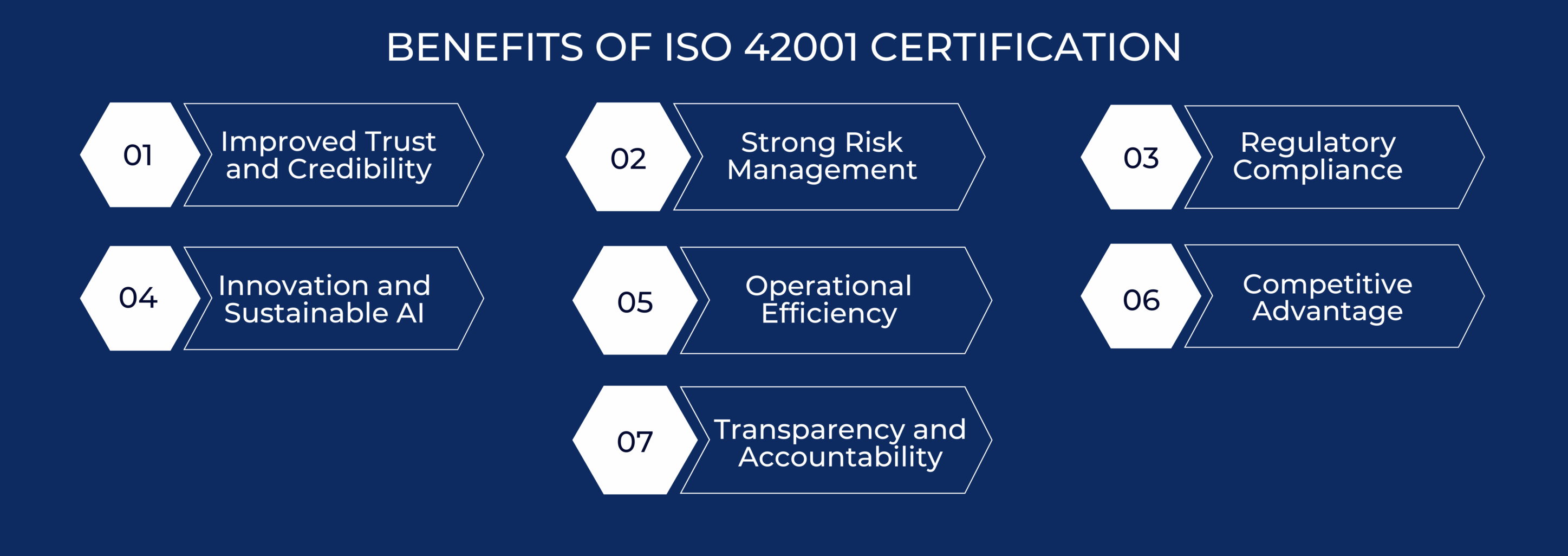
- ✓Independently verified AI governance credentials recognized internationally and within European regulatory frameworks
- ✓Structured alignment with EU AI Act risk management and transparency requirements
- ✓Documented evidence base supporting GDPR compliance and IMY regulatory inquiries in Stockholm
- ✓Competitive qualification advantage in enterprise procurement and public sector tendering
- ✓Accelerated access to international markets requiring AI governance certification
- ✓Operational AI risk reduction through systematic AIMS controls and monitoring
- ✓Improved AI incident detection and response through defined management processes
- ✓Enhanced stakeholder and investor confidence in AI governance maturity
- ✓Integration with existing ISO 27001 or ISO 9001 management systems for governance efficiency
- ✓Foundation for ongoing AI governance improvement through structured continual improvement requirements
- ✓Regulatory Compliance Benefits
- ✓Competitive and Commercial Benefits
- ✓Operational and Risk Management Benefits
- ✓ISO 42001 Certification Benefits — Summary
ISO 42001 and Stockholm’s Regulatory Landscape
Stockholm operates within one of Europe’s most developed digital regulatory environments. Swedish organizations are subject to GDPR enforcement by IMY, sector-specific AI governance expectations from Finansinspektionen and other sectoral authorities, and the overarching requirements of the EU AI Act as it enters full application. The AI management system Stockholm organizations need aligns directly with this regulatory context. ISO 42001’s AIMS framework addresses the governance, risk management, transparency, and accountability requirements common across these regulatory instruments — providing a unified governance architecture that satisfies multiple regulatory obligations through a single, audited management system.
EU AI Act Alignment for Stockholm Businesses
The EU AI Act establishes four risk categories for AI systems: unacceptable risk (prohibited), high risk (subject to mandatory requirements), limited risk (transparency obligations), and minimal risk (no mandatory requirements). Stockholm organizations operating high-risk AI systems — defined under Annex III of the EU AI Act to include AI used in critical infrastructure, employment decisions, credit scoring, biometric identification, and essential private services — face the most significant compliance obligations. ISO 42001 compliance directly addresses these requirements, including risk management systems, data governance, technical documentation, transparency, accuracy, robustness, and human oversight.
The European Commission has signaled that ISO 42001 and related harmonized standards will play a role in demonstrating EU AI Act conformance, particularly for high-risk AI system providers. While the EU AI Act does not mandate ISO 42001 certification as the only pathway to compliance, organizations holding ISO 42001 certification in Stockholm can use their certified AIMS documentation as evidence of conformance with applicable EU AI Act requirements. This creates a practical compliance pathway that reduces the burden of EU AI Act documentation obligations for Stockholm organizations that have already invested in ISO 42001 certification.
GDPR and IMY Enforcement Context
Sweden’s IMY has issued guidance and enforcement decisions addressing AI-related GDPR concerns, including automated decision-making under Article 22, data minimization in AI training datasets, and accountability obligations for AI system operators. ISO 42001 compliance Stockholm organizations achieve through certification generates documented evidence of data governance controls that directly address these IMY concern areas. Specifically, AIMS documentation required under ISO 42001 — including AI impact assessments, data quality controls, and human oversight procedures — corresponds to the accountability documentation that IMY expects organizations to maintain for AI systems processing personal data.
The intersection of ISO 42001 and GDPR is particularly significant for Stockholm’s fintech sector, where AI systems routinely process sensitive financial and behavioral data to power credit decisions, fraud detection, and customer segmentation. ISO 42001 requires organizations to conduct AI system impact assessments that, when AI systems process personal data, should be coordinated with GDPR Data Protection Impact Assessment (DPIA) processes. Organizations that integrate ISO 42001 AIMS requirements with their GDPR compliance programs achieve documentation efficiencies — a single impact assessment process satisfying both ISO 42001 and GDPR DPIA requirements — while strengthening their overall AI governance posture.
Stockholm’s AI Ecosystem and Governance Expectations
Stockholm consistently ranks among Europe’s top technology hubs, home to unicorn companies, major fintech platforms, internationally recognized AI research institutions, and regional headquarters of global technology enterprises. This concentration of AI-intensive business activity creates a distinct governance environment where AI management practices are subject to heightened scrutiny from enterprise customers, institutional investors, regulators, and civil society organizations. ISO 42001 certification Stockholm financial services firms, technology companies, and AI startups pursue reflects the city’s position as a European leader in responsible AI innovation — a reputational asset that requires verifiable governance credentials rather than self-declared commitments.
Stockholm’s digital infrastructure ecosystem provides both opportunities and governance challenges for ISO 42001 compliance. The city’s high-quality connectivity, cloud infrastructure density, and access to large multilingual datasets support sophisticated AI development. However, these capabilities also enable AI deployments at scale and speed that can outpace governance frameworks unless proactive AIMS structures are in place. The ISO 42001 AI management system Stockholm organizations implement establishes the governance infrastructure needed to maintain responsible AI practices as AI capabilities and deployment scale grow — ensuring that Stockholm’s AI innovation leadership is matched by equivalent AI governance maturity.
Why CertPro for ISO 42001 Certification in Stockholm
CertPro is a Licensed CPA Firm with specialized audit expertise in AI management system standards and the regulatory environment applicable to Stockholm-based organizations. ISO 42001 certification in Stockholm delivered by CertPro is grounded in formal audit methodology, evidence-based evaluation, and independence principles consistent with professional certification body standards. CertPro’s engagement model is strictly limited to certification audit and assessment activities — the firm does not provide implementation consulting, gap analysis advisory services, or AIMS development support. This boundary maintains the auditor independence required for credible, objective ISO 42001 certification decisions.
Licensed CPA Firm Positioning and Audit Expertise
CertPro’s status as a Licensed CPA Firm distinguishes its ISO 42001 assessment and certification services from non-licensed certification bodies. Licensed CPA Firm status requires adherence to professional standards governing audit independence, evidence evaluation, and reporting — standards that provide additional assurance to certificate recipients and their stakeholders that the certification decision was reached through a rigorous, objective process. For Stockholm organizations presenting ISO 42001 certifications to enterprise customers, regulators, or investors, CertPro’s Licensed CPA Firm positioning adds a meaningful layer of credibility to the certification credential.
CertPro’s audit teams possess domain expertise in AI governance frameworks, AI system architecture, data science operational practices, and the regulatory landscape applicable to ISO 42001 certification for Stockholm financial services, technology, and AI-native organizations. This technical depth enables auditors to evaluate AIMS controls in substantive context — not merely confirming the existence of documentation but assessing whether controls are technically adequate to address the AI risks they are designed to mitigate. CertPro’s ISO 42001 audit methodology incorporates assessment of AI system technical characteristics alongside AIMS documentation review, providing comprehensive certification coverage.
Fixed Pricing and Transparent Engagement Model
CertPro provides ISO 42001 certification engagements under a fixed-price model that gives Stockholm organizations cost certainty from engagement initiation through certificate issuance. The fixed-price structure eliminates the variable cost exposure associated with time-and-materials certification engagements, enabling accurate budget planning for certification activities. CertPro’s pricing is determined at engagement commencement based on documented scope parameters — AIMS scope, number of AI systems in scope, organizational size, and audit complexity — and remains fixed throughout the certification cycle absent material scope changes.
The transparent engagement model employed by CertPro for ISO 42001 audit services in Stockholm specifies deliverables, audit stage timelines, nonconformity resolution procedures, and certificate issuance processes in the engagement agreement. Stockholm organizations receive formal audit reports at each stage of the certification process, documented nonconformity records with required resolution evidence specifications, and formal certification decision documentation. CertPro maintains audit records in accordance with professional certification body requirements — providing Stockholm certificate holders with documentation suitable for submission to regulators, customers, or partners as evidence of independent AI governance verification.
Integration with Multi-Standard Certification Programs
Many Stockholm organizations pursuing ISO 42001 certification already hold or are pursuing certifications under ISO 27001, ISO 9001, or SOC 2. CertPro has experience designing integrated audit programs that evaluate multiple standards simultaneously, leveraging the common structural elements of ISO high-level structure standards to reduce total audit burden. ISO 42001 shares the same policy, risk management, internal audit, and management review framework as ISO 27001 — meaning that audit evidence gathered for one standard can frequently be applied to the evaluation of the other. CertPro’s integrated audit capability reduces total engagement duration and cost for Stockholm organizations maintaining multi-standard certification portfolios.
ISO 42001 Certification Cost and Timeline in Stockholm
The cost of ISO 42001 certification in Stockholm is determined by several organizational and engagement-specific factors assessed at the outset of each certification engagement. Unlike advisory engagements where scope and effort can expand unpredictably, CertPro’s fixed-price certification model anchors cost to defined scope parameters established at engagement initiation. Organizations in Stockholm seeking ISO 42001 certification should anticipate that both cost and timeline are functions of AIMS complexity, AI system portfolio size, organizational scale, and the maturity of existing documentation at the time certification activities commence.
Cost Determinants for ISO 42001 Certification
The primary cost determinants for ISO 42001 certification in Stockholm include: the number of AI systems within the defined AIMS scope; the risk classification of those AI systems (with higher-risk systems requiring more extensive audit evidence evaluation); organizational size measured by personnel involved in AI governance roles; the geographic and operational complexity of the AIMS (single-site versus multi-site certifications); and the extent of third-party AI provider integrations requiring supplier assessment evidence. Organizations with mature, pre-existing management system infrastructure — such as those already certified to ISO 27001 — typically incur lower total certification costs because substantial documentation infrastructure already exists.
| Cost Factor | Lower Cost Scenario | Higher Cost Scenario |
|---|---|---|
| AI Systems in Scope | 1–3 AI systems with limited complexity | 10+ AI systems with high-risk classifications |
| Organizational Size | SME with focused AI governance team | Large enterprise with distributed AI functions |
| Existing Management System | ISO 27001 or ISO 9001 certified | No existing management system framework |
| Third-Party AI Providers | Minimal third-party AI dependencies | Extensive AI-as-a-service provider ecosystem |
| AIMS Documentation Maturity | Well-documented AIMS at audit initiation | AIMS documentation requiring significant development |
Certification Timeline Expectations
The timeline for completing ISO 42001 certification in Stockholm from engagement initiation to certificate issuance typically ranges from three to nine months, depending on AIMS documentation maturity and the speed at which any identified nonconformities are resolved. Organizations with mature existing management systems and well-documented AIMS frameworks can complete the Stage 1 and Stage 2 audit sequence within three to five months. Organizations commencing the certification process from a lower documentation maturity baseline — or those required to develop new AI governance infrastructure prior to audit — should plan for timelines of six to nine months from engagement commencement to certificate issuance.
Following initial certification, the three-year cycle includes annual surveillance audits scheduled approximately 12 and 24 months after initial certificate issuance. Surveillance audits are typically shorter in duration than initial certification audits, focusing on specific AIMS elements such as internal audit results, management review outputs, corrective action completion, and any significant changes to AI systems or organizational context since the previous audit. Recertification audits at the end of the three-year cycle are comprehensive reassessments that reset the certification cycle upon satisfactory determination of continued AIMS conformance.
ISO 42001 Certification for Stockholm Tech Companies and Fintech
Stockholm’s position as one of Europe’s leading technology ecosystems means that ISO 42001 certification Stockholm tech companies pursue operates in a distinct competitive and regulatory context. The city’s technology sector includes globally recognized unicorn companies, major fintech platforms, AI research spinouts from leading Swedish universities, and regional headquarters of global enterprise software providers. ISO 42001 certification Stockholm fintech firms seek addresses the specific AI governance obligations that arise from operating automated financial systems subject to Finansinspektionen oversight, EU AI Act high-risk classification, and GDPR data processing obligations simultaneously.
Fintech AI Governance Requirements
Stockholm’s fintech sector deploys AI systems across a wide range of high-impact use cases including credit scoring, fraud detection, anti-money laundering transaction monitoring, customer risk profiling, algorithmic trading, and automated customer service. Many of these applications fall within the EU AI Act’s high-risk AI system classification under Annex III, imposing mandatory risk management, transparency, and human oversight requirements. ISO 42001 certification provides Stockholm fintech organizations with a documented, independently verified governance framework that addresses these obligations — enabling compliance demonstrability to Finansinspektionen, European Banking Authority guidelines, and enterprise customer due diligence requirements.
The AI management system Stockholm fintech companies implement under ISO 42001 must specifically address model risk governance — the processes by which AI models used in financial decision-making are validated, approved, monitored, and decommissioned. ISO 42001’s AIMS framework provides the governance architecture for model risk management through its AI system lifecycle controls, risk assessment requirements, human oversight specifications, and internal audit obligations. For Stockholm fintech firms subject to regulatory model risk management expectations, ISO 42001 assessment provides independent verification that model governance processes meet international standards — a credential increasingly valued by Nordic institutional investors and enterprise banking partners.
Technology Companies and AI Platform Providers
Stockholm technology companies that develop and sell AI-enabled software products face distinct ISO 42001 compliance considerations compared to organizations that solely deploy AI systems internally. As AI product providers, these companies are responsible not only for governing their own AI development processes but also for enabling their customers’ AI governance programs. ISO 42001 certification for Stockholm AI product providers demonstrates that the company’s own AIMS governs responsible AI development practices — including data quality, bias testing, explainability design, and security — which in turn supports customer confidence in the AI products they procure.
ISO 42001 certification Stockholm tech companies hold increasingly appears in enterprise software procurement requirements as buyers seek to verify that AI product suppliers have independently verified governance programs. This procurement criterion is most prevalent in public sector tenders, financial services supplier qualification processes, and healthcare technology procurement — sectors where Stockholm technology companies have significant market presence. ISO 42001 certification positions Stockholm technology firms as governance-mature AI suppliers, reducing the compliance burden on their customers while providing a verifiable market differentiator that supports enterprise sales cycles.
ISO 42001 Assessment and Certification Services by CertPro in Stockholm
CertPro delivers ISO 42001 assessment and certification services to Stockholm organizations through a structured, methodology-driven audit process that evaluates AIMS conformance against ISO/IEC 42001:2023 requirements. As a Licensed CPA Firm, CertPro’s certification engagements are conducted under professional audit standards that govern independence, evidence evaluation, documentation, and reporting. CertPro’s ISO 42001 certification services in Stockholm cover the complete certification lifecycle — from initial scope determination and audit program design through Stage 1 documentation review, Stage 2 on-site audit, nonconformity resolution, certification decision, and annual surveillance audits.
Scope of ISO 42001 Audit Services
CertPro’s ISO 42001 audit services in Stockholm encompass evaluation of all clauses and Annex A controls within the defined certification scope. Audit activities include documentation review, personnel interviews, process observation, AI system record examination, and technical control testing appropriate to the AI systems in scope. The ISO 42001 audit produces formal written reports at each stage, documenting audit findings, conformance determinations, identified nonconformities with classification, and required corrective action specifications. These formal audit reports satisfy the documentation requirements of professional certification body standards and provide Stockholm certificate holders with comprehensive evidence records suitable for regulatory or customer submission.
ISO 42001 assessment in Stockholm conducted by CertPro addresses both the design adequacy and operating effectiveness of AIMS controls. Design adequacy assessment evaluates whether documented controls, if operating as described, would be sufficient to address the AI risks they are designed to mitigate. Operating effectiveness assessment evaluates whether controls are actually functioning as documented — using evidence from AI system records, monitoring logs, incident reports, management review minutes, and internal audit findings. This dual-layer approach ensures that ISO 42001 certification reflects genuine operational AI governance capability rather than documentation completeness alone.
CertPro’s Stockholm Engagement Capabilities
CertPro conducts ISO 42001 certification engagements in Stockholm with audit teams that combine ISO 42001 standard expertise, AI system technical knowledge, and familiarity with the Swedish and European regulatory environment. Audit activities can be conducted on-site at Stockholm organizational premises, remotely using secure document review platforms, or in hybrid format depending on audit program requirements and client operational preferences. CertPro’s audit methodology is consistent across all delivery modes — remote and on-site audits apply identical evidence evaluation standards, ensuring that certification decisions are never influenced by audit delivery modality.
FAQ
▶
What is ISO 42001 Certification and why does it matter for Stockholm businesses?
▶
How long does it take to obtain ISO 42001 Certification in Stockholm?
▶
What are the key requirements for ISO 42001 compliance in Stockholm?
▶
How does ISO 42001 relate to the EU AI Act for Stockholm organizations?
▶
Which Stockholm industries benefit most from ISO 42001 Certification?
▶
What is the difference between ISO 42001 and ISO 27001 for Stockholm organizations?
▶
How does the ISO 42001 audit process work at CertPro?
▶
Can ISO 42001 Certification be integrated with existing certifications at a Stockholm organization?
ISO 42001 CERTIFIED: WHY AI GOVERNANCE CERTIFICATION IS BECOMING A BOARD-LEVEL REQUIREMENT
AI is now an inevitable component of major business activities in the current corporate world. To elaborate, it is now part of product design, custome…

MindSec Launches AI Compliance for Law 25 & ISO 42001
Excerpt from Barchart Article, Published on December 3, 2025 Today, Canadian organizations face increasing pressure to comply with stringent privacy a…

UNDERSTANDING ISO 42001: A GUIDE FOR RESPONSIBLE AI MANAGEMENT SYSTEMS
The invention of artificial intelligence (AI) has changed the operational processes of many industries. However, the rapid growth of technology increa…
Get In Touch
have a question? let us get back to you.