
ISO 42001 Certification in Toronto | CertPro Licensed CPA Firm
ISO 42001 is to AI governance what ISO 27001 is to information security management. Just as ISO 27001 provides the definitive management system framework for protecting information assets, ISO 42001 provides the authoritative governance framework for managing AI-related risks, obligations, and accountability structures. Organizations that achieve ISO 42001 Certification demonstrate to regulators, clients, and the public that their AI systems are governed by internationally recognized standards — not informal policies or ad hoc controls.
OUR CLIENTS










What Is ISO 42001?
ISO 42001 is the international standard for Artificial Intelligence Management Systems (AIMS), published jointly by the International Organization for Standardization (ISO) and the International Electrotechnical Commission (IEC) in 2023. It establishes a structured framework of requirements that organizations must implement to govern, monitor, and continuously improve the development, deployment, and use of AI systems in a responsible, transparent, and ethical manner. ISO 42001 compliance is increasingly recognized as a baseline expectation for organizations that rely on AI in regulated or high-stakes environments.
ISO 42001 is to AI governance what ISO 27001 is to information security management. Just as ISO 27001 provides the definitive management system framework for protecting information assets, ISO 42001 provides the authoritative governance framework for managing AI-related risks, obligations, and accountability structures. Organizations that achieve ISO 42001 Certification demonstrate to regulators, clients, and the public that their AI systems are governed by internationally recognized standards — not informal policies or ad hoc controls.
The standard applies to any organization — regardless of size, sector, or geography — that develops, deploys, procures, or manages AI systems. This includes technology companies building AI products, financial institutions using AI-driven decisioning, healthcare organizations deploying diagnostic AI tools, and public-sector bodies automating service delivery. ISO 42001 Certification in Toronto is particularly relevant given the city’s role as a major technology and AI research hub, where hundreds of organizations across fintech, healthtech, and enterprise software sectors rely on AI systems in critical business functions.
ISO 42001 is structured in alignment with the ISO High Level Structure (HLS), which means it integrates seamlessly with other management system standards such as ISO 27001 (information security), ISO 9001 (quality management), and ISO 31000 (risk management). Organizations that have already implemented these standards can leverage existing policies, roles, and governance processes — reducing duplication of effort. The standard is organized around core management system elements including context setting, leadership commitment, planning, support, operations, performance evaluation, and continual improvement.
ISO 42001 Scope and Applicability
The scope of ISO 42001 encompasses the full lifecycle of AI systems within an organization, including design, data governance, algorithm selection, model training, testing, deployment, monitoring, and decommissioning. The standard requires organizations to clearly define the boundaries of their AI management system — identifying which AI applications, processes, and organizational units fall within the certified scope. This scope definition is a foundational element of the ISO 42001 assessment and must be formally documented and approved at the executive level.
ISO 42001 explicitly addresses the unique characteristics of AI systems that distinguish them from conventional software: their capacity to learn from data, produce probabilistic outputs, and generate unintended consequences at scale. The standard introduces AI-specific risk concepts including algorithmic bias, model drift, lack of explainability, and unintended automation effects. By requiring organizations to systematically identify, assess, and treat these risks, ISO 42001 establishes AI governance as a structured, auditable management discipline — rather than a theoretical exercise.
ISO 42001 vs. Other AI Governance Frameworks
ISO 42001 is the only internationally recognized management system standard specifically designed for AI governance. While frameworks such as the NIST AI Risk Management Framework (AI RMF), the EU AI Act, and OECD AI Principles provide valuable guidance and regulatory requirements, none offers the structured, certifiable management system architecture that ISO 42001 delivers. ISO 42001 Certification provides an independent, third-party-verified attestation that an organization’s AI governance practices meet internationally defined requirements — a distinction that voluntary frameworks simply cannot provide.
Organizations pursuing ISO 42001 compliance gain a significant structural advantage when responding to regulatory inquiries, client due diligence requests, and procurement requirements. The certification provides auditable evidence that AI risk management is embedded in organizational processes — not simply documented in policy statements. For Toronto-based organizations operating in regulated sectors such as financial services, insurance, and healthcare, this distinction is increasingly material to business relationships and regulatory standing.

What Is an AI Management System (AIMS)?
An AI Management System (AIMS) is a structured organizational framework that establishes the policies, processes, controls, roles, and governance mechanisms required to manage AI systems responsibly and consistently. An AIMS defines how an organization identifies AI-related risks and opportunities, assigns accountability for AI governance decisions, implements controls to mitigate identified risks, monitors AI system performance over time, and continually improves its AI governance practices. ISO AIMS certification provides independent verification that an organization’s AI Management System meets the full requirements of ISO 42001.
The AIMS framework under ISO 42001 is built around several interconnected components. The organizational context component requires leadership to understand internal and external factors that affect AI governance — including regulatory obligations, stakeholder expectations, and the organization’s AI maturity level. The risk management component requires systematic identification and treatment of AI-specific risks, including risks related to data quality, model performance, privacy impacts, and societal effects. The operational control component requires documented processes for AI system design, development, and deployment that embed ethical and technical safeguards at each stage of the lifecycle.
Core Components of an ISO 42001-Compliant AIMS
- ✓AI governance policy and objectives formally documented and approved by senior leadership
- ✓Organizational roles and responsibilities for AI oversight clearly defined and assigned
- ✓AI risk register with documented identification, assessment, and treatment of AI-specific risks
- ✓Data governance procedures covering data quality, provenance, and privacy in AI training and inference
- ✓AI system lifecycle controls from design through deployment, monitoring, and decommissioning
- ✓Stakeholder engagement processes addressing transparency, explainability, and accountability obligations
- ✓Internal audit program for ongoing evaluation of AIMS effectiveness and control performance
- ✓Management review process for evaluating AIMS performance and directing continual improvement
- ✓Incident and nonconformity management procedures specific to AI system failures or ethical breaches
- ✓Documentation and records management system supporting auditability of all AIMS activities
An effective AIMS under ISO 42001 is not a static documentation exercise — it is a living governance system that evolves alongside the organization’s AI portfolio, regulatory environment, and stakeholder expectations. The standard requires organizations to establish measurable AI governance objectives, monitor performance against those objectives using defined metrics, and report results to senior leadership through structured management reviews. This creates an evidence-based governance cycle that supports both internal accountability and external ISO 42001 audit processes conducted by an accredited certification body.
AIMS and Organizational AI Maturity
ISO 42001 is designed to be applicable to organizations at varying levels of AI maturity — from those deploying a single AI application to enterprises managing complex, enterprise-wide AI ecosystems. The standard does not prescribe specific technical architectures or AI methodologies. Instead, it requires organizations to implement governance controls proportionate to the risks and complexity of their AI systems. This scalability makes ISO AIMS certification accessible to startups and large enterprises alike, including the diverse range of AI-active organizations pursuing ISO 42001 Certification in Toronto.
Organizations with existing ISO 27001 or ISO 9001 management systems will find significant structural overlap with ISO 42001 AIMS requirements. Leadership commitment, documented objectives, internal audit programs, and management review processes are common requirements across all ISO High Level Structure standards. Toronto companies that have already invested in ISO management system infrastructure can extend their existing governance frameworks to incorporate AIMS-specific controls — rather than building a separate governance structure from the ground up.
ISO 42001 Certification Requirements
ISO 42001 certification requirements are organized across ten clauses of the standard, with Clauses 4 through 10 containing the normative requirements that organizations must satisfy to achieve and maintain certification. These requirements establish a comprehensive governance architecture spanning organizational context, leadership, planning, support, operations, performance evaluation, and continual improvement. ISO 42001 compliance requires that all applicable requirements be implemented, documented, and demonstrably operational — not merely planned or partially deployed — at the time of the certification audit.
ISO 42001 requires organizations to maintain a defined set of documented information as evidence of AIMS implementation and operational effectiveness. Mandatory documented information includes the AI governance policy, AI objectives, scope of the AIMS, risk assessment and treatment documentation, AI system inventory, competence records for personnel with AI governance responsibilities, and results of internal audits and management reviews. All documented information must be controlled through a formal document management process that ensures currency, accessibility, and integrity.
Documentation requirements under ISO 42001 extend well beyond policy documents to include operational records that provide evidence of control execution. For example, organizations must maintain records of AI risk assessments conducted for each AI system in scope, records of stakeholder consultations where transparency or explainability obligations apply, and records of AI system performance monitoring results. These operational records are critical inputs to both the internal audit process and the external ISO 42001 audit conducted by a certification body such as CertPro.
ISO 42001 places explicit requirements on senior leadership to demonstrate active commitment to the AIMS. Top management must establish and communicate an AI governance policy that is appropriate to the organization’s AI activities, sets clear objectives, and commits to continual improvement. Leadership must also assign roles and responsibilities for AI governance, ensure adequate resources are allocated to AIMS implementation, and actively participate in management review processes that evaluate AIMS performance and direct corrective actions. This leadership mandate reflects the standard’s recognition that effective AI governance requires executive accountability — not just technical controls.
The standard requires organizations to establish an AI governance committee or equivalent oversight structure with defined authority and reporting lines to senior management. This governance body is responsible for overseeing AI risk management decisions, approving AI system deployments that exceed defined risk thresholds, and ensuring that AI governance practices remain aligned with evolving regulatory requirements and organizational strategy. For Toronto organizations subject to financial services regulation or healthcare oversight, this governance structure directly supports compliance with sector-specific AI accountability requirements.
ISO 42001 operational requirements govern how organizations design, develop, deploy, and monitor AI systems within the certified scope. These requirements include establishing criteria for AI system classification based on risk level, implementing data governance controls that address quality, bias, and privacy in training data, and deploying monitoring mechanisms that detect model drift, performance degradation, or unintended outputs during live operation. Organizations must also establish clear procedures for responding to AI system incidents — including escalation paths, root cause analysis, and corrective action processes.
| ISO 42001 Requirement Area | Key Obligations | Audit Evidence Required |
|---|---|---|
| Organizational Context | Define internal/external factors, stakeholder needs, AIMS scope | Scope document, context analysis records |
| Leadership | AI governance policy, assigned roles, management review | Policy document, role assignments, review minutes |
| Risk Management | AI risk register, treatment plans, residual risk acceptance | Risk assessment records, treatment documentation |
| Operations | AI lifecycle controls, data governance, incident management | Operational procedures, incident records, monitoring logs |
| Performance Evaluation | Internal audits, KPIs, management review results | Audit reports, metrics dashboards, review records |
ISO 42001 requires organizations to conduct formal AI risk assessments for all AI systems within the certified scope. These assessments must identify AI-specific risks including algorithmic bias and discrimination, privacy violations through inference or data leakage, lack of transparency and explainability, autonomous decision-making errors, cybersecurity vulnerabilities specific to AI models, and societal or reputational impacts. Each identified risk must be evaluated against defined likelihood and consequence criteria. Risk treatment decisions must be formally documented with assigned ownership and target completion dates.
The ISO 42001 assessment process conducted by a certification body evaluates the completeness, rigor, and operational effectiveness of the organization’s AI risk management practices. Auditors examine whether risk assessments are conducted consistently across all in-scope AI systems, whether treatment controls are implemented as documented, and whether residual risk levels have been formally accepted by authorized personnel. For Toronto organizations in financial services or healthcare, risk assessment records also serve as supporting evidence during regulatory examinations under OSFI guidelines or provincial health privacy legislation.
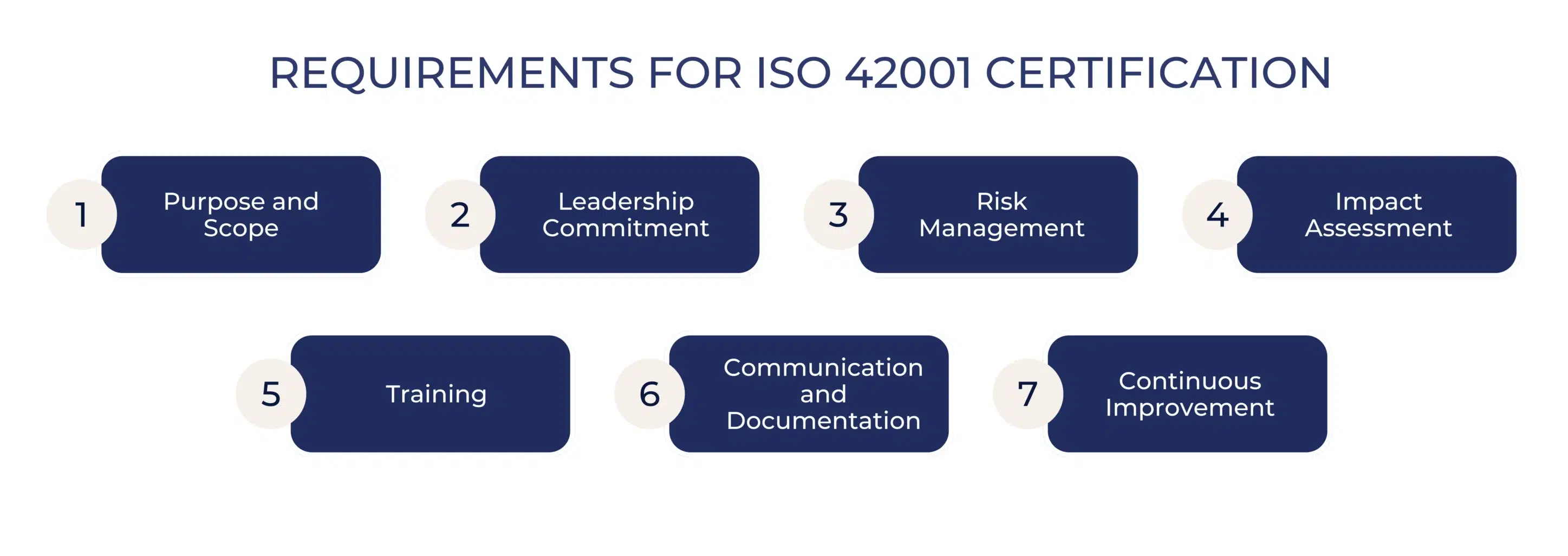
- ✓Documentation Requirements
- ✓Leadership and Governance Requirements
- ✓Technical and Operational Requirements
- ✓AI Risk Assessment Requirements
ISO 42001 AIMS Assessment Process
The ISO 42001 AIMS assessment is a structured evaluation conducted by an accredited certification body to determine whether an organization’s AI Management System meets the requirements of the ISO 42001 standard. CertPro, as a Licensed CPA Firm, conducts ISO 42001 assessments in Toronto through a defined, multi-stage process that evaluates both the design adequacy and operational effectiveness of the organization’s AIMS. The assessment produces an independent, evidence-based determination of conformity that forms the basis for ISO AIMS certification decisions.
The Stage 1 ISO 42001 assessment focuses on reviewing the organization’s AIMS documentation to determine whether the system has been adequately designed to meet ISO 42001 requirements. Auditors examine the AIMS scope document, AI governance policy, risk assessment methodology, documented procedures, and supporting records to assess whether the documented system is complete and internally consistent. The Stage 1 assessment also evaluates the organization’s understanding of its own AI activities, risk landscape, and regulatory obligations — providing a clear baseline for the more intensive Stage 2 field audit.
Stage 1 findings are documented in a formal report that identifies any areas where the documented AIMS does not meet ISO 42001 requirements or where insufficient evidence exists to confirm compliance. Major nonconformities identified at Stage 1 must be resolved before proceeding to Stage 2. Minor observations may be addressed during Stage 2. The Stage 1 assessment is typically conducted remotely, though on-site review may be required for organizations with complex AI infrastructure or large certification scopes. For ISO 42001 Certification in Toronto, CertPro conducts Stage 1 assessments with experienced auditors who are familiar with the Toronto technology and financial services landscape.
The Stage 2 ISO 42001 audit is an on-site or virtual operational effectiveness assessment that evaluates whether the organization’s AIMS is implemented, operational, and effective in practice. Auditors conduct interviews with personnel at all levels of the organization — from senior leadership to AI development teams — to verify that documented procedures are understood, followed, and producing the intended governance outcomes. Evidence review during Stage 2 includes examination of risk assessment records, AI system monitoring data, internal audit reports, management review minutes, and incident management records.
Stage 2 ISO 42001 audit findings are classified as major nonconformities, minor nonconformities, or opportunities for improvement. Major nonconformities represent failures to meet mandatory ISO 42001 requirements or systematic breakdowns in AIMS implementation that prevent the system from achieving its intended outcomes. Minor nonconformities represent isolated gaps or documentation deficiencies that do not prevent the AIMS from functioning effectively. Organizations must submit corrective action plans for all nonconformities identified during Stage 2 within a defined timeframe. Evidence of remediation is reviewed by the certification body before the certification decision is finalized.
Following successful completion of Stage 2 and resolution of any identified nonconformities, the certification body conducts a formal certification review. This review is performed by a qualified reviewer independent of the audit team to ensure objectivity and consistency with certification standards. Upon a positive certification decision, the organization receives an ISO 42001 certificate specifying the certified scope, the certification standard version, the issuing body, and the certificate validity period. ISO 42001 certificates are valid for three years, subject to satisfactory annual surveillance audits.
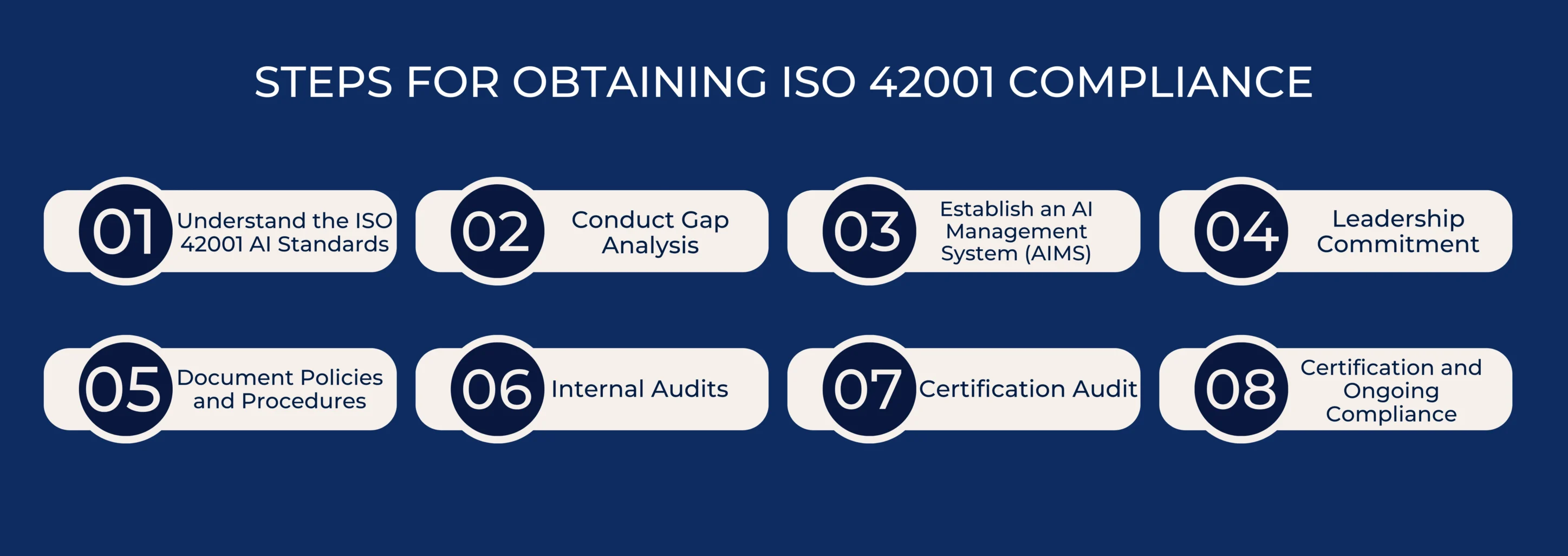
- ✓Stage 1: Documentation Review and Scope Assessment
- ✓Stage 2: Operational Effectiveness Audit
- ✓Certification Decision and Issuance
ISO 42001 Certification and Audit Process
The ISO 42001 certification and audit process follows a structured sequence of defined activities that progress from initial scope definition through certificate issuance and ongoing surveillance. CertPro’s ISO 42001 audit process in Toronto is designed to deliver rigorous, evidence-based certification evaluations that produce reliable and defensible outcomes. The numbered steps below reflect the standard audit lifecycle for ISO 42001 Certification in Toronto — from engagement initiation to recertification.
- Scope Definition: The organization defines the boundaries of the AIMS, identifying AI systems, organizational units, and processes to be included in the certified scope. The scope statement is formally documented and must accurately reflect the organization’s AI activities.
- Audit Program Determination: CertPro determines the audit program based on the defined scope, organizational size, AI system complexity, and applicable risk factors. The audit program specifies the number of audit days, audit team composition, and assessment schedule for Stage 1 and Stage 2.
- Stage 1 Documentation Review: CertPro auditors conduct a systematic review of AIMS documentation to assess design adequacy against ISO 42001 requirements. A Stage 1 report is issued identifying readiness status and any areas requiring attention before Stage 2.
- Stage 2 Operational Effectiveness Audit: On-site or virtual audit evaluating AIMS implementation and operational effectiveness through interviews, process walkthroughs, and evidence sampling across all in-scope AI systems and governance functions.
- Nonconformity Review: All audit findings are documented, classified (major or minor), and presented to the organization. Corrective action plans must be submitted and reviewed within agreed timelines before ISO 42001 certification can proceed.
- Certification Decision: An independent reviewer at CertPro conducts a formal certification review of all audit documentation and corrective action evidence. The certification decision is made objectively based on audit evidence.
- Issuance of ISO 42001 Certificate: Upon a positive certification decision, the ISO 42001 certificate is issued specifying the certified scope, standard version, issuing body, and three-year validity period.
- Annual Surveillance Audits: CertPro conducts annual surveillance audits during the three-year certification cycle to verify that the AIMS continues to operate effectively and that any changes to AI systems or governance practices are appropriately controlled.
- Recertification Audit: At the end of the three-year certification cycle, a full recertification audit is conducted to renew the ISO 42001 certificate for a further three-year period.
The typical timeline for completing an initial ISO 42001 certification audit — from scope definition to certificate issuance — ranges from 8 to 16 weeks. This range depends on the organization’s AIMS maturity, the complexity of its AI portfolio, and the responsiveness of the organization in addressing any nonconformities identified during the audit process. Organizations with well-documented, operational AIMS frameworks that have already completed internal audit cycles generally progress through the certification process more quickly than those completing the initial AIMS build-out concurrently with the audit.
CertPro’s ISO 42001 audit Toronto engagements are scheduled based on auditor availability and organizational readiness. The Stage 1 documentation review is typically completed within two to three weeks of engagement initiation. Stage 2 audit duration varies based on scope size — a single-application scope may require two to three audit days, while an enterprise-wide AIMS covering multiple AI systems across multiple business units may require five to eight audit days. Nonconformity resolution periods are defined in the audit agreement, with major nonconformities typically requiring resolution within 90 days of identification.
ISO 42001 certification requires ongoing maintenance through annual surveillance audits conducted in Years 1 and 2 of the three-year certification cycle, followed by a full recertification audit in Year 3. Surveillance audits evaluate a subset of AIMS requirements to verify that the certified system remains operational and effective, that identified nonconformities from prior audits have been addressed, and that significant changes to AI systems or governance structures have been appropriately managed. Failure to successfully complete a surveillance audit may result in suspension or withdrawal of certification.
Organizations undergoing significant changes to their AI portfolio — such as deploying new AI systems, entering new AI application domains, or making material changes to AI governance structures — must notify CertPro as the certification body. Depending on the nature and scope of changes, an unscheduled audit or scope extension review may be required to maintain the integrity of the certification. This requirement reflects ISO 42001’s emphasis on dynamic, responsive governance rather than static ISO 42001 compliance attestation.
- ✓ISO 42001 Audit Timeline
- ✓Surveillance and Recertification
Benefits of ISO 42001 Certification in Toronto
ISO 42001 Certification in Toronto delivers measurable organizational benefits across regulatory compliance, business development, risk management, and operational governance. For Toronto-based organizations operating in technology, financial services, healthcare, and the public sector, the strategic and commercial value of ISO AIMS certification is substantial — and increasingly recognized by enterprise procurement functions, regulatory bodies, and institutional investors.
ISO 42001 Certification provides a verifiable, internationally recognized differentiator in competitive markets where AI governance credentials are increasingly evaluated during procurement and partner selection. Toronto’s enterprise technology sector — which includes major financial institutions, global professional services firms, and government procurement agencies — increasingly requires third-party evidence of AI risk management practices from vendors and service providers. ISO 42001 Certification satisfies these requirements through an independent, audit-backed attestation that cannot be matched by self-assessed compliance claims or policy documentation alone.
For Toronto-based AI companies pursuing international market expansion, ISO 42001 Certification provides a universally recognized governance credential that facilitates market entry in jurisdictions with formal AI governance requirements. The EU AI Act — which applies to organizations offering AI systems in the European market — recognizes compliance with international AI standards as relevant evidence for conformity assessment under its risk-based regulatory framework. Organizations holding ISO AIMS certification in Toronto are better positioned to demonstrate EU AI Act alignment than those without a certified governance framework.
ISO 42001 compliance establishes a systematic approach to identifying and managing AI-specific risks — reducing the likelihood and impact of AI system failures, ethical breaches, and regulatory enforcement actions. Organizations that implement a certified AIMS framework develop structured processes for detecting model drift, bias amplification, and data quality degradation before these issues produce material harm or reputational damage. The documented, auditable nature of ISO 42001 risk management also strengthens an organization’s defensibility in litigation or regulatory proceedings involving AI system outcomes.
ISO 42001 certification also drives internal governance improvements that generate operational value beyond the certification itself. The AIMS implementation process requires organizations to inventory their AI systems, document intended uses and limitations, assign governance ownership, and establish monitoring mechanisms. These activities often reveal previously unrecognized AI systems or governance gaps. The resulting documentation of AI assets and controls improves organizational visibility into risk exposures and supports more informed strategic decisions about AI investment and risk tolerance.
ISO 42001 certification signals to customers, partners, regulators, and the public that the organization manages AI systems with demonstrable accountability and transparency. In Toronto’s financial services sector — where consumer trust is a foundational competitive asset — the ability to demonstrate certified AI governance practices supports customer confidence in AI-driven products such as credit scoring, fraud detection, and personalized financial planning tools. Institutional clients and large enterprise customers increasingly require certified AI governance as a vendor qualification criterion, making ISO AIMS certification Toronto a direct business enablement tool.
- ✓Independent third-party verification of AI governance practices that exceeds self-assessment or policy documentation
- ✓Competitive differentiation in enterprise procurement, partnership, and investment contexts
- ✓Demonstrated alignment with international AI governance standards recognized by regulators globally
- ✓Systematic reduction of AI-related operational, legal, and reputational risks through structured controls
- ✓Strengthened regulatory compliance posture for PIPEDA, sector-specific AI guidelines, and emerging Canadian AI legislation
- ✓Enhanced organizational visibility into AI system inventory, risks, and control effectiveness
- ✓Improved customer and stakeholder trust through transparent, accountable AI governance practices
- ✓Facilitated market access in jurisdictions with formal AI governance requirements including the EU
- ✓Integration with existing ISO management systems reducing governance duplication and administrative burden
- ✓Board-level AI accountability framework that satisfies institutional investor and governance reporting expectations
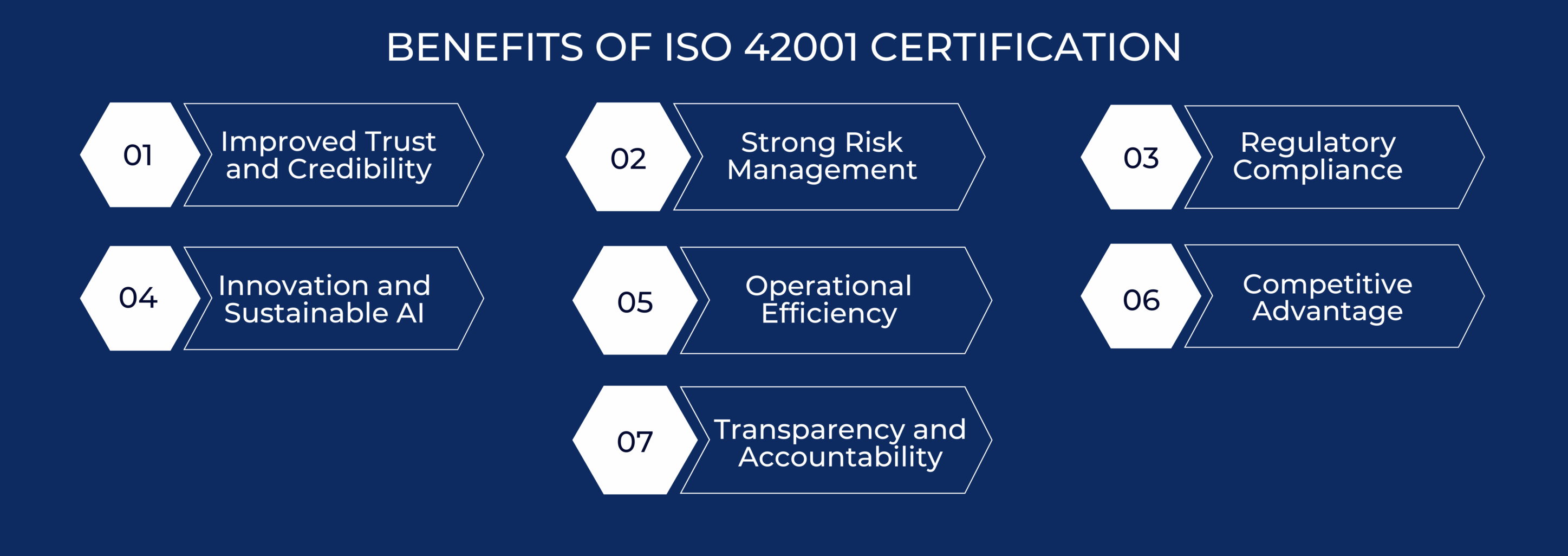
- ✓Competitive and Commercial Benefits
- ✓Risk Reduction and Governance Benefits
- ✓Stakeholder Trust and Transparency Benefits
ISO 42001 and the Canadian Regulatory Context
ISO 42001 compliance is directly relevant to the Canadian regulatory environment governing data privacy, AI accountability, and responsible technology use. Toronto organizations subject to federal and provincial privacy legislation, financial services regulation, and sector-specific AI guidelines can use ISO 42001 certification as a structured mechanism for demonstrating regulatory alignment. This is not a substitute for legal compliance — rather, it provides auditable evidence that governance practices are implemented and maintained at a defined standard of rigor.
PIPEDA and Privacy Compliance Alignment
The Personal Information Protection and Electronic Documents Act (PIPEDA) governs how private-sector organizations in Canada collect, use, and disclose personal information — including personal information processed by AI systems. ISO 42001’s data governance requirements mandate controls over data quality, data provenance, and privacy impacts in AI training and inference. These requirements are directly aligned with PIPEDA’s accountability principle, which requires organizations to implement policies and practices protecting personal information under their control. Organizations that achieve ISO 42001 Certification in Toronto can demonstrate structured, auditable compliance with PIPEDA’s accountability obligations as they apply to AI-driven data processing.
The Office of the Privacy Commissioner of Canada (OPC) has issued guidance indicating that organizations using AI systems for decisions affecting individuals have heightened obligations under PIPEDA to ensure accuracy, transparency, and individual access rights. ISO 42001’s requirements for AI system transparency, explainability documentation, and individual impact assessments directly support compliance with these OPC guidance expectations. For Toronto financial services organizations using AI in credit decisioning, fraud detection, or customer segmentation, this alignment is particularly material to regulatory standing.
Canada’s Artificial Intelligence and Data Act (AIDA)
Canada’s proposed Artificial Intelligence and Data Act (AIDA), introduced as part of Bill C-27, establishes risk-based obligations for organizations developing and deploying high-impact AI systems. Although AIDA’s legislative status continued to evolve as of 2025, its proposed framework requires organizations to assess and mitigate risks of physical, psychological, or financial harm from AI systems, maintain records of assessments and mitigation measures, and report AI incidents to a designated AI and Data Commissioner. ISO 42001 Certification provides a structured governance framework that directly supports compliance with AIDA’s proposed requirements — positioning certified organizations ahead of formal legislative obligations.
Toronto organizations in sectors designated as high-impact under AIDA’s proposed framework — including financial services, healthcare, and transportation — have the strongest incentive to pursue ISO 42001 Certification now. Early adoption of a certified AIMS demonstrates proactive regulatory engagement and provides operational infrastructure that can be extended to meet formal AIDA obligations without requiring significant restructuring. CertPro’s ISO 42001 audit Toronto engagements are structured to evaluate AIMS controls against both the current ISO 42001 standard and the broader Canadian AI regulatory landscape.
Financial Services Regulatory Alignment
The Office of the Superintendent of Financial Institutions (OSFI) has issued guidance and risk advisories addressing AI governance expectations for federally regulated financial institutions in Canada. OSFI’s technology and cyber risk guidance increasingly references AI-specific risk management obligations — including model risk management, algorithmic fairness, and operational resilience of AI-driven processes. ISO 42001 Certification provides federally regulated institutions, including banks, insurance companies, and pension funds headquartered or operating in Toronto, with a formally audited AI governance framework that can be referenced in regulatory submissions and examination responses.
ISO 42001 certification for Toronto financial services organizations also benefits from the standard’s alignment with model risk management principles established by global financial regulators. The AIMS framework’s requirements for AI system documentation, performance monitoring, and change management directly mirror model risk management best practices codified in guidance such as the US Federal Reserve’s SR 11-7 model risk management guidance — widely adopted as an industry benchmark by Canadian financial institutions managing complex AI and statistical model portfolios.
Why Toronto Organizations Need ISO 42001
Toronto is Canada’s largest city and one of North America’s most significant technology and financial services hubs. The city is home to more than 17,000 technology companies, five of Canada’s six major banks, and a rapidly growing AI research and development ecosystem anchored by the Vector Institute for Artificial Intelligence, MaRS Discovery District, and the University of Toronto’s AI programs. This concentration of AI-active organizations across multiple sectors creates both heightened AI governance obligations and strong competitive incentives for ISO 42001 Certification in Toronto.
Toronto’s AI Ecosystem and Governance Expectations
Toronto’s AI ecosystem spans a diverse range of sectors and organization types — from early-stage startups developing AI products to global enterprises deploying AI at scale in financial decisioning, healthcare diagnostics, and supply chain optimization. This diversity means that ISO 42001 assessment and certification requirements must be applied across a wide spectrum of organizational contexts: from a 20-person AI startup with a single production model to a major bank operating hundreds of AI systems across retail, commercial, and capital markets functions. CertPro’s ISO 42001 audit methodology is calibrated to address this full range, with assessment approaches tailored to organizational scale and AI complexity.
The Vector Institute for Artificial Intelligence, headquartered in Toronto, has established Canada’s largest concentration of AI researchers and talent — attracting global investment and making Toronto one of the world’s top three AI research cities alongside London and San Francisco. This research intensity drives rapid AI commercialization by Toronto-based companies, increasing the pace at which new AI applications enter production environments and creating governance challenges that structured AIMS frameworks are designed to address. Organizations connected to or commercializing research from Toronto’s AI ecosystem have a particular need for ISO 42001 Certification to demonstrate that research-originated AI systems are governed by production-grade standards before market deployment.
Fintech and Financial Services AI Governance
Toronto’s fintech sector is one of the most active AI adoption environments in Canada, with organizations using machine learning for credit risk assessment, anti-money laundering detection, algorithmic trading, insurance underwriting, and personalized financial product recommendations. These high-stakes AI applications operate in heavily regulated environments where errors, biases, or governance failures carry significant legal, financial, and reputational consequences. ISO 42001 certification for Toronto companies in the financial sector provides a structured governance framework that demonstrates regulatory accountability and supports simultaneous compliance with OSFI guidance, PIPEDA obligations, and emerging AIDA requirements.
Enterprise procurement processes within Toronto’s financial services sector increasingly include AI governance due diligence requirements for technology vendors and managed service providers. Major financial institutions are requiring third-party AI governance certifications from vendors whose AI systems interact with customer data, execute financial decisions, or operate within regulated processes. ISO AIMS certification Toronto provides qualifying vendors with the independent attestation required to meet these procurement criteria — opening access to major financial institution contracts that would otherwise require extensive bilateral due diligence processes.
Healthtech, AI Research, and Public Sector Applications
Toronto’s healthtech sector includes organizations developing AI systems for medical imaging analysis, clinical decision support, patient risk stratification, and hospital operations optimization. These applications involve highly sensitive personal health information and life-affecting decisions — making robust AI governance a patient safety and regulatory imperative, not merely a competitive consideration. ISO 42001 Certification provides healthtech organizations with a structured framework for governing AI systems in compliance with Personal Health Information Protection Act (PHIPA) requirements and Health Canada’s evolving guidance on AI-enabled medical devices and clinical decision support tools.
Toronto’s public sector — including municipal government agencies, provincial ministries, and public institutions such as hospitals and universities — is increasingly deploying AI systems for service delivery optimization, fraud detection, and administrative automation. These public-sector AI deployments carry unique accountability obligations, as they are subject to access to information legislation, public interest scrutiny, and political accountability for algorithmic decision-making outcomes affecting residents. ISO 42001 assessment and certification provides public sector organizations with an independently verified governance framework that supports responsible AI deployment and public accountability reporting.
CertPro’s ISO 42001 Certification Services in Toronto
CertPro is a Licensed CPA Firm providing ISO 42001 Certification in Toronto through a structured, audit-based process that evaluates AI Management Systems against the full requirements of the ISO 42001 standard. CertPro’s ISO 42001 services are delivered exclusively as certification and audit activities — not as consulting, advisory, or implementation services. The firm’s engagement model is built on institutional independence, evidence-based evaluation, and fixed-pricing transparency that distinguishes CertPro’s certification approach from traditional consulting-led certification programs.
CertPro’s ISO 42001 Audit Methodology
CertPro’s ISO 42001 audit methodology is structured around the ISO 42001 standard’s normative requirements and ISO 17021-1 certification body requirements for management system certification. Audits are conducted by qualified ISO 42001 lead auditors with demonstrated competence in AI governance, risk management, and management system auditing. The audit team’s assessment approach emphasizes evidence-based evaluation — drawing on document review, personnel interviews, process observation, and records sampling — to reach objective, defensible conclusions about AIMS conformity and effectiveness.
CertPro’s ISO 42001 assessment Toronto engagements are scoped based on the organization’s AI system inventory, organizational size, and risk profile. The firm’s audit program design process includes a structured scoping discussion with the organization’s leadership team to define audit objectives, confirm AIMS boundaries, identify key personnel for interview, and establish the evidence collection plan. This structured scoping approach ensures that audit effort is directed at the highest-risk areas of the AIMS — and that audit findings provide maximum value to the organization’s governance decision-making.
Fixed Pricing and Engagement Transparency
CertPro provides ISO 42001 Certification in Toronto at fixed, transparent pricing that is defined at engagement initiation and does not vary based on audit findings or organizational response to nonconformities. This fixed-pricing model gives organizations cost certainty throughout the certification process and eliminates the fee escalation dynamics that can arise in variable-fee certification programs. CertPro’s pricing is structured around scope-based tiers, with fees determined by the number of AI systems in scope, organizational size, and audit day requirements — not by engagement duration or nonconformity volume.
The fixed-pricing model also reinforces CertPro’s institutional independence as a certification body. Because CertPro’s fees are not contingent on the outcome of audit findings or the volume of corrective actions required, there is no financial incentive for auditors to generate nonconformities or extend engagement timelines. This structural independence is a defining characteristic of CertPro’s ISO 42001 audit Toronto model and is consistent with the certification body independence requirements of ISO 17021-1 and the broader accreditation framework governing management system certification.
CertPro’s ISO 42001 Certification Scope Coverage
CertPro’s ISO 42001 certification services in Toronto cover organizations across all sectors and AI application domains, including financial services, healthcare, technology, retail, manufacturing, and the public sector. The firm’s certification scope includes both initial certification audits and ongoing surveillance and recertification audits for organizations maintaining active ISO 42001 certificates. CertPro also conducts scope extension audits for organizations that expand their certified AIMS to include additional AI systems or organizational units after initial certification.
| Service | Description | Delivery Format |
|---|---|---|
| Initial ISO 42001 Certification Audit | Stage 1 documentation review and Stage 2 operational effectiveness audit for first-time certification | Remote and on-site |
| Annual Surveillance Audit | Year 1 and Year 2 surveillance evaluation of AIMS operational continuity and control effectiveness | Remote or on-site |
| Recertification Audit | Full AIMS re-evaluation at end of three-year certification cycle for certificate renewal | Remote and on-site |
| Scope Extension Audit | Assessment of additional AI systems or organizational units for inclusion in certified AIMS scope | Remote or on-site |
| ISO 42001 Assessment | Targeted evaluation of AIMS design adequacy and documentation completeness against ISO 42001 requirements | Remote |
Qualifications and Institutional Credentials
CertPro’s status as a Licensed CPA Firm distinguishes its ISO 42001 certification practice from non-CPA certification providers. The CPA designation reflects rigorous professional standards for audit practice, independence, evidence evaluation, and professional judgment — standards that are directly applicable to the management system certification context. CertPro’s audit teams combine CPA professional qualifications with ISO 42001 lead auditor certifications, creating a certification practice that meets both professional accounting standards and international management system auditing requirements. This dual qualification is particularly relevant for ISO 42001 Certification in Toronto’s financial services sector, where clients expect both technical AI governance expertise and rigorous audit professional standards.
ISO 42001 Certification Requirements Checklist for Toronto Organizations
Organizations preparing for ISO 42001 Certification in Toronto should ensure the following foundational elements are in place before initiating the formal certification audit process. This checklist reflects the core requirements of the ISO 42001 standard evaluated during the Stage 1 documentation review and Stage 2 operational effectiveness audit. The presence of each element does not guarantee certification — auditors assess not only whether elements exist but whether they are adequate, operational, and producing the intended governance outcomes.
- Documented AIMS scope statement defining the AI systems, organizational units, and processes included in certification
- Formally approved AI governance policy signed by senior leadership and communicated throughout the organization
- Completed AI system inventory cataloguing all AI applications within the certified scope with relevant technical and operational metadata
- Documented AI risk assessment methodology and completed risk assessments for all in-scope AI systems
- Risk treatment plans with assigned ownership, implementation status, and residual risk acceptance records
- Documented procedures for AI system lifecycle management including design, development, testing, deployment, monitoring, and retirement
- Data governance procedures addressing training data quality, bias assessment, and privacy impact evaluation
- Defined AI governance roles with documented responsibilities, authorities, and reporting lines
- Competence records confirming that personnel with AI governance responsibilities have appropriate qualifications and training
- Internal audit program with at least one completed internal audit cycle covering all AIMS requirements
- Management review records documenting executive evaluation of AIMS performance and improvement decisions
- Incident and nonconformity management procedures with records of any AI-related incidents identified and managed
ISO 42001 Certification in Toronto: Key Takeaways
ISO 42001 Certification in Toronto is the definitive mechanism for organizations to demonstrate independently verified, internationally recognized AI governance. As artificial intelligence becomes embedded in critical business, financial, and public-sector processes across the city, the governance expectations of regulators, enterprise clients, institutional investors, and the public continue to escalate. ISO 42001 Certification provides a structured, auditable framework for meeting these expectations through a management system approach that embeds AI accountability into organizational processes — not just policy statements.
CertPro’s ISO 42001 certification services in Toronto deliver rigorous, evidence-based certification audits conducted by qualified lead auditors with expertise in AI governance and management system certification. As a Licensed CPA Firm, CertPro brings institutional audit standards, professional independence, and fixed-pricing transparency to every ISO 42001 engagement. Organizations seeking ISO AIMS certification Toronto can rely on CertPro’s structured audit process to produce ISO 42001 certificates that are credible, defensible, and recognized by regulators, clients, and partners both domestically and internationally.
ISO 42001 compliance is not a one-time achievement — it is a continuous governance commitment maintained through annual surveillance audits, ongoing AIMS improvement, and responsive management of AI system changes. Toronto organizations that invest in ISO 42001 Certification build the governance infrastructure required to scale AI responsibly, navigate an evolving Canadian regulatory landscape, and maintain the stakeholder trust that underpins long-term AI-enabled business growth. CertPro’s ISO 42001 audit and certification practice provides the independent evaluation framework that makes this governance commitment credible and verifiable.
FAQ
▶
What is ISO 42001 certification and who needs it?
▶
How long does ISO 42001 certification take in Toronto?
▶
What is the difference between ISO 42001 assessment and ISO 42001 certification?
▶
Does ISO 42001 certification satisfy PIPEDA compliance obligations?
▶
Can a Toronto startup achieve ISO 42001 certification?
▶
How does ISO 42001 relate to ISO 27001 for organizations with both certifications?
▶
What evidence does CertPro examine during an ISO 42001 audit?
▶
What happens if nonconformities are identified during the ISO 42001 audit?
ISO 42001 CERTIFIED: WHY AI GOVERNANCE CERTIFICATION IS BECOMING A BOARD-LEVEL REQUIREMENT
AI is now an inevitable component of major business activities in the current corporate world. To elaborate, it is now part of product design, custome…

MindSec Launches AI Compliance for Law 25 & ISO 42001
Excerpt from Barchart Article, Published on December 3, 2025 Today, Canadian organizations face increasing pressure to comply with stringent privacy a…

UNDERSTANDING ISO 42001: A GUIDE FOR RESPONSIBLE AI MANAGEMENT SYSTEMS
The invention of artificial intelligence (AI) has changed the operational processes of many industries. However, the rapid growth of technology increa…
Get In Touch
have a question? let us get back to you.