
ISO 42001 Certification in Montreal
ISO/IEC 42001:2023 is organized around the Plan-Do-Check-Act (PDCA) management cycle and contains ten normative clauses. Clauses 1 through 3 cover scope, normative references, and terms and definitions. Clauses 4 through 10 contain the actionable management system requirements that organizations must fulfill to achieve and maintain ISO 42001 compliance. An ISO 42001 AIMS assessment evaluates conformity with each of these clauses through document review, process evaluation, personnel interviews, and control testing activities conducted by the certification auditor.
OUR CLIENTS










What Is ISO 42001 Certification?
ISO 42001 Certification is the formal third-party attestation that an organization’s Artificial Intelligence Management System (AIMS) conforms to the requirements specified in ISO/IEC 42001:2023 — the world’s first international standard dedicated exclusively to AI management systems. Published in December 2023 by the International Organization for Standardization (ISO) and the International Electrotechnical Commission (IEC), the standard establishes a comprehensive framework for responsible AI development, deployment, and oversight within organizational contexts. ISO 42001 Certification is awarded following a successful independent audit conducted by an accredited certification body such as CertPro, confirming that the organization’s AI governance practices meet globally recognized benchmarks.
Defining AIMS: The Artificial Intelligence Management System
An Artificial Intelligence Management System (AIMS) is the structured set of policies, processes, governance structures, roles, responsibilities, and controls that an organization uses to direct, monitor, and continually improve how it develops and uses AI systems. Under ISO/IEC 42001:2023, an AIMS is not a software platform or a single AI risk tool — it is an integrated management system that spans the organization’s entire AI lifecycle, from data acquisition and model training through to deployment, monitoring, and decommissioning. The AIMS must be documented, implemented, maintained, and subject to continual improvement based on audit findings and performance evaluation outcomes.
ISO 42001 Certification formally attests that an organization’s AIMS meets the normative requirements of the standard. This attestation is issued by an independent, accredited third-party auditor following completion of Stage 1 (documentation review) and Stage 2 (on-site or remote audit) assessment activities. The certification is valid for three years, subject to annual surveillance audits and a three-year recertification cycle. Organizations that achieve ISO AIMS certification demonstrate to regulators, clients, partners, and the public that their AI governance practices conform to internationally recognized benchmarks — making ISO 42001 compliance a meaningful organizational credential.
How ISO 42001 Differs from ISO 27001 and ISO 9001
ISO 42001 is specifically scoped to AI management systems and the unique risks, ethical considerations, and governance obligations that AI introduces. It shares the High-Level Structure (HLS) common to ISO management system standards, which means it is architecturally compatible with ISO 27001 (Information Security Management) and ISO 9001 (Quality Management). However, ISO 42001 addresses concerns distinct from both: algorithmic bias, explainability, AI impact assessments, human oversight mechanisms, and the ethical responsibilities of AI providers and deployers. While ISO 27001 focuses on protecting information assets from security threats and ISO 9001 focuses on product and service quality, ISO 42001 focuses on the responsible lifecycle governance of AI systems themselves.
Because ISO 42001 shares its High-Level Structure with ISO 27001 and ISO 31000 (Risk Management), organizations that already maintain one of these certifications can leverage existing policies, management review processes, and internal audit programs when building their AIMS. This structural compatibility means that achieving ISO 42001 compliance does not require building governance infrastructure from scratch — it extends and specializes existing management system frameworks to address AI-specific obligations. For Montreal organizations already holding ISO 27001 certification, the incremental effort required to achieve ISO 42001 Certification in Montreal is substantially reduced.
Who ISO 42001 Applies To
ISO/IEC 42001:2023 applies to any organization — regardless of size, industry, or sector — that develops, deploys, or uses AI systems in any capacity. This includes AI developers and technology vendors, organizations that integrate third-party AI into their operations, and public-sector bodies using AI for decision-making. The standard explicitly addresses two distinct roles: AI providers (organizations that develop AI systems) and AI deployers (organizations that use AI systems developed by others). Both roles carry distinct AIMS obligations, and the ISO 42001 audit scope can be defined to reflect either or both roles depending on the organization’s AI footprint.
In the Montreal context, ISO 42001 Certification is directly relevant to AI research institutions, technology startups, gaming companies using AI-driven content personalization and testing, fintech firms deploying algorithmic decision-making, healthtech organizations using AI diagnostics and predictive tools, and any enterprise integrating AI into customer-facing or operational processes. The standard is sector-agnostic and scalable, making it applicable to both early-stage AI startups and large enterprises with complex AI portfolios. The ISO 42001 AIMS assessment covers all in-scope AI systems regardless of whether they were built internally or sourced from external providers.

ISO 42001 Requirements and AIMS Framework
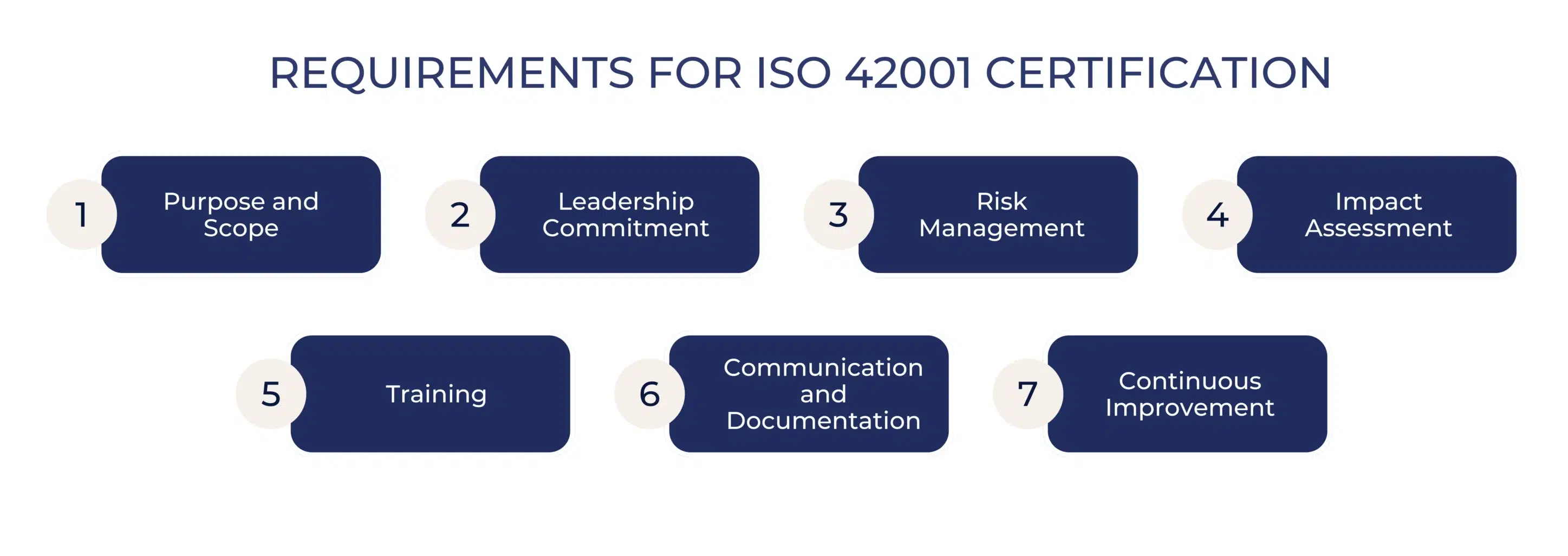
ISO/IEC 42001:2023 is organized around the Plan-Do-Check-Act (PDCA) management cycle and contains ten normative clauses. Clauses 1 through 3 cover scope, normative references, and terms and definitions. Clauses 4 through 10 contain the actionable management system requirements that organizations must fulfill to achieve and maintain ISO 42001 compliance. An ISO 42001 AIMS assessment evaluates conformity with each of these clauses through document review, process evaluation, personnel interviews, and control testing activities conducted by the certification auditor.
Clause 4 requires organizations to determine the internal and external context relevant to their AI activities. This includes identifying regulatory requirements, stakeholder expectations, and the nature and purpose of their AI systems. Organizations must identify which AI systems fall within the AIMS scope, understand the interests of affected parties (employees, customers, regulators, communities), and document the AIMS boundaries. For Montreal organizations, the context analysis must account for Canadian federal AI governance expectations, Quebec’s Act Respecting the Protection of Personal Information in the Private Sector (Law 25), and any sector-specific regulations governing AI use in healthcare, financial services, or public administration.
Clause 5 establishes leadership and commitment obligations. Senior management must demonstrate active commitment to the AIMS by establishing an AI policy, defining organizational roles and responsibilities for AI governance, and ensuring that AIMS objectives are integrated with the organization’s strategic direction. The AI policy must address the organization’s AI principles, ethical commitments, and compliance obligations. Leadership accountability is a non-negotiable requirement under ISO 42001 compliance — the standard explicitly rejects delegation of AI governance responsibility to technical teams alone. During the ISO 42001 audit, evaluators assess whether top management actively governs the AIMS or whether AI governance is treated merely as a lower-level technical function.
Clause 6 requires organizations to conduct systematic AI risk assessments and establish AIMS objectives. The AI risk management process must identify risks associated with AI systems — including risks to individuals, groups, and society — and implement controls proportionate to those risks. Annex A of ISO/IEC 42001:2023 provides a reference control set covering 38 controls across nine control categories, including AI system impact assessment, data governance, transparency, human oversight, and AI lifecycle management. Organizations must document their Statement of Applicability (SoA), identifying which Annex A controls are applicable and providing justification for any exclusions.
AI impact assessments are a core component of ISO 42001 compliance. These assessments evaluate the potential consequences of AI system decisions and outputs on affected individuals and communities — particularly in high-risk use cases such as credit scoring, hiring, medical diagnosis, or predictive policing. The assessment process must be documented, repeatable, and integrated into the AI system development lifecycle. For organizations undergoing an ISO 42001 audit, evidence of completed AI impact assessments for all in-scope systems is a mandatory audit artifact. The auditor evaluates whether assessments are thorough, current, and acted upon through appropriate risk treatment measures.
Clause 8 covers operational planning and control, including the implementation of Annex A controls related to data governance, model transparency, and human oversight. Data governance requirements under the AIMS mandate that organizations document the provenance, quality, and intended use of training data, establish procedures for detecting and addressing data bias, and maintain records of data governance decisions throughout the AI lifecycle. Transparency obligations require organizations to explain AI system outputs in terms appropriate to the affected parties. This does not necessarily require mathematical explainability of every model parameter, but does require that affected individuals can understand the basis of decisions that affect them.
Human oversight is one of the most operationally significant requirements in ISO 42001. The standard requires that organizations establish mechanisms by which humans can review, override, or suspend AI system outputs where necessary — particularly in high-stakes decision contexts. The ISO 42001 audit evaluates whether human oversight mechanisms are documented, tested, and operational — not merely stated as policy. Operational evidence such as incident logs, override records, and escalation procedures is required to demonstrate conformity. Organizations that rely entirely on automated AI decision-making without documented human review processes are unlikely to achieve ISO 42001 Certification without first addressing these control gaps.
| ISO 42001 Clause | Requirement Area | Key Audit Evidence |
|---|---|---|
| Clause 4 | Organizational Context & AIMS Scope | Context analysis documentation, stakeholder register, scope statement |
| Clause 5 | Leadership & AI Policy | Signed AI policy, role assignments, management review records |
| Clause 6 | AI Risk Assessment & AIMS Objectives | Risk register, Statement of Applicability, AI impact assessments |
| Clause 8 | Operational Controls | Data governance records, transparency documentation, human oversight logs |
| Clause 9–10 | Performance Evaluation & Improvement | Internal audit reports, nonconformity records, management review minutes |
- ✓Organizational Context and Leadership Requirements
- ✓AI Risk Management and Impact Assessment
- ✓Operational Controls: Data Governance, Transparency, and Human Oversight
ISO 42001 Certification in Montreal: The Local AI Governance Context
ISO 42001 Certification in Montreal carries particular significance given the city’s standing as one of the world’s premier AI research and technology hubs. Montreal is home to Mila (Quebec Artificial Intelligence Institute), the Université de Montréal’s AI research programs, McGill University’s machine learning research groups, and a dense ecosystem of AI-focused startups and scale-ups. The city’s AI ecosystem spans sectors including gaming (Ubisoft Montreal, EA Montreal), fintech, healthtech, autonomous systems, natural language processing, and computer vision. Organizations operating within this ecosystem face growing AI governance expectations from clients, investors, government procurement authorities, and international partners — making ISO 42001 Certification in Montreal an increasingly strategic priority.
Montreal’s AI Research and Technology Ecosystem
The Mile-Ex district in Montreal has emerged as a recognized AI innovation cluster, hosting Mila, Element AI alumni companies, and numerous AI-native startups focused on deep learning, reinforcement learning, and generative AI applications. Montreal’s AI ecosystem benefits from world-class academic research output, a multilingual talent pool, and substantial federal and provincial government investment through programs such as the Pan-Canadian AI Strategy. This concentration of AI activity means that Montreal organizations — from research institutions commercializing AI discoveries to established enterprises integrating AI into business operations — face a unique combination of innovation-driven AI adoption and growing governance accountability obligations that ISO 42001 compliance directly addresses.
Gaming companies such as Ubisoft Montreal and Electronic Arts’ Montreal studio use AI extensively for procedural content generation, player behavior analytics, quality assurance automation, and in-game AI agents. Fintech companies operating from Montreal’s growing financial technology corridor use AI for credit risk modeling, fraud detection, algorithmic trading, and customer onboarding. Each of these applications carries distinct AI risk profiles and governance obligations that ISO 42001 Certification systematically addresses. Achieving ISO 42001 Certification in Montreal provides companies in these sectors with a structured framework for documenting, auditing, and demonstrating responsible AI use to regulators, institutional clients, and international partners.
Canadian Regulatory Context: PIPEDA, Law 25, and AIDA
ISO 42001 compliance in Montreal intersects with several layers of Canadian and Quebec privacy and AI governance regulation. At the federal level, the Personal Information Protection and Electronic Documents Act (PIPEDA) governs how private-sector organizations collect, use, and disclose personal information — including personal data used in AI training datasets and AI-driven decision processes. The Office of the Privacy Commissioner of Canada (OPC) has published guidance on automated decision-making and AI accountability that aligns closely with ISO 42001’s requirements for transparency, human oversight, and impact assessment.
At the provincial level, Quebec’s Law 25 (Act to Modernize Legislative Provisions Respecting the Protection of Personal Information) introduced mandatory AI transparency obligations for Quebec organizations as of September 2023. Law 25 requires organizations to inform individuals when automated decisions are made about them based on personal information processing, and to provide an opportunity for human review of such decisions. These obligations directly mirror ISO 42001’s human oversight and transparency control requirements, making ISO AIMS certification a practical mechanism for demonstrating Law 25 compliance readiness. Montreal organizations subject to Law 25 that pursue ISO 42001 Certification create a documented, audited evidence base for their AI transparency and human review obligations.
At the federal legislative level, Canada’s proposed Artificial Intelligence and Data Act (AIDA) — part of Bill C-27 — would establish mandatory requirements for high-impact AI systems, including risk assessments, transparency measures, human oversight, and regulatory reporting. While AIDA has not yet been enacted into law, its requirements closely parallel ISO 42001’s AIMS framework. Montreal organizations that achieve ISO 42001 Certification are therefore proactively positioning their AI governance infrastructure for AIDA compliance readiness. ISO 42001 audit assessments conducted by CertPro evaluate controls relevant across all three regulatory layers: PIPEDA, Law 25, and anticipated AIDA requirements.
Industry-Specific ISO 42001 Relevance for Montreal Sectors
Montreal’s healthtech sector presents one of the most compelling ISO 42001 use cases. AI systems used in medical imaging analysis, clinical decision support, patient triage, and drug discovery carry high-stakes risk profiles that demand rigorous governance. Health Canada and Quebec’s Ministère de la Santé et des Services sociaux are increasing scrutiny of AI-enabled medical devices and clinical AI tools. ISO 42001 Certification for Montreal healthtech companies provides an internationally recognized audit trail demonstrating that AI systems used in clinical contexts are governed by documented risk management processes, data quality controls, and human oversight mechanisms — all requirements audited under the ISO 42001 AIMS assessment framework.
ISO 42001 Certification is equally critical for Montreal financial services organizations. Financial institutions and fintech companies operating under OSFI (Office of the Superintendent of Financial Institutions) guidance on model risk management are increasingly expected to demonstrate structured AI governance. OSFI’s guidance on the use of artificial intelligence and machine learning in federally regulated financial institutions aligns with ISO 42001’s requirements for AI risk assessment, model documentation, performance monitoring, and transparency. ISO 42001 Certification provides financial services organizations with an audited evidence base that satisfies both internal model risk governance requirements and external regulatory expectations — making ISO 42001 compliance a strategic priority for Montreal’s fintech sector.
ISO 42001 Certification Process
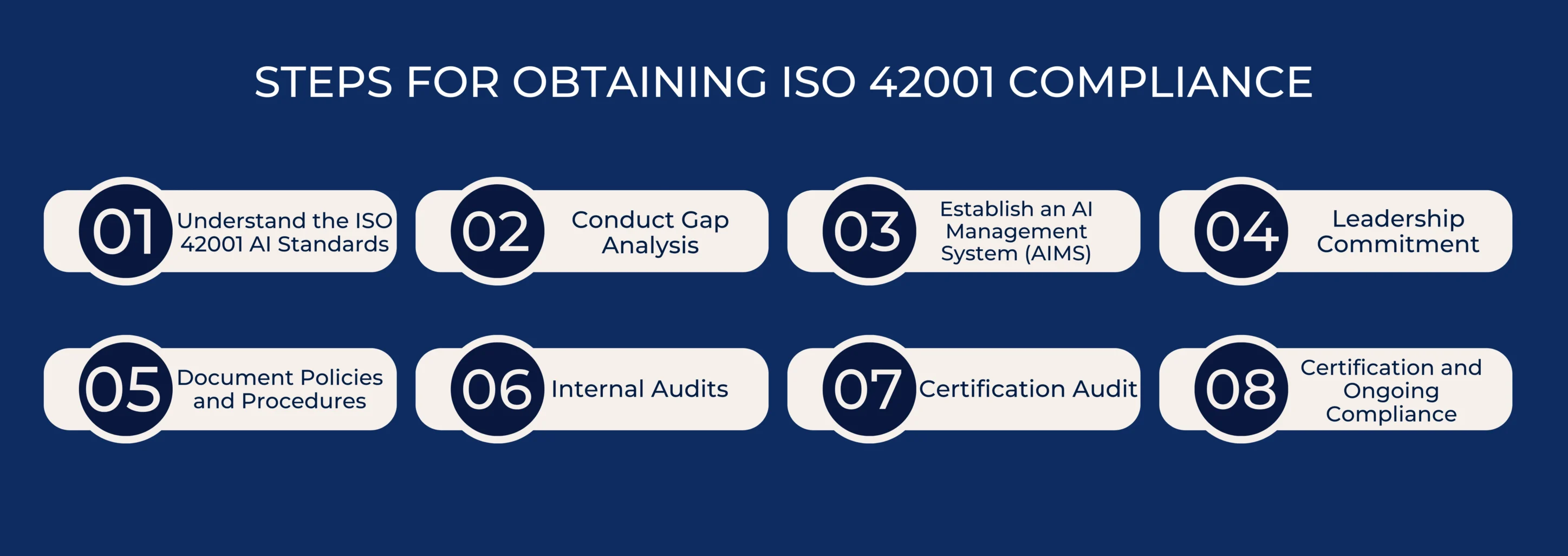
The ISO 42001 certification process conducted by CertPro follows a structured, multi-stage audit program consistent with ISO/IEC 17021-1 accreditation requirements for management system certification bodies. The process is designed to evaluate objective conformity of the organization’s AIMS against ISO/IEC 42001:2023 requirements — not to provide advice, consulting, or implementation support. Each stage produces documented audit findings that form the basis for the certification decision. The following overview outlines the complete process for achieving ISO 42001 Certification in Montreal through CertPro.
- Scope Definition and Application: The organization defines the AIMS scope — identifying in-scope AI systems, organizational boundaries, and applicable ISO 42001 requirements. CertPro reviews the scope application to determine audit program parameters.
- Audit Program Determination: CertPro determines the audit program including audit duration, team composition, and methodology based on AIMS scope complexity, number of in-scope AI systems, and organizational size.
- Stage 1 Audit — Documentation Review: The CertPro audit team conducts a systematic review of the organization’s AIMS documentation including the AI policy, risk register, Statement of Applicability, AI impact assessment records, and supporting procedures. Stage 1 identifies documentation gaps and confirms readiness for Stage 2.
- Stage 1 Findings Communication: CertPro issues Stage 1 findings to the organization, identifying areas of nonconformity or concern in documentation before the Stage 2 on-site audit. The organization addresses identified issues before proceeding.
- Stage 2 Audit — On-Site or Remote Assessment: The CertPro audit team conducts an evidence-based evaluation of AIMS implementation effectiveness. This includes interviews with key personnel, observation of AI governance processes, review of operational records, and testing of controls across all applicable ISO 42001 clauses.
- Nonconformity Review and Corrective Action: Any major or minor nonconformities identified during Stage 2 must be addressed through documented corrective actions. Major nonconformities must be resolved before ISO 42001 Certification can be issued; minor nonconformities must have documented resolution plans.
- Certification Decision: The CertPro certification decision is made by an independent reviewer who was not part of the audit team, ensuring objectivity. The decision is based solely on audit findings and evidence of conformity with ISO/IEC 42001:2023.
- Issuance of ISO 42001 Certification: Upon a positive certification decision, CertPro issues the ISO 42001 certification document specifying the certified AIMS scope, certification date, and validity period (three years from issue date).
- Surveillance Audits: Annual surveillance audits are conducted in Years 1 and 2 of the certification cycle to verify continued conformity with ISO/IEC 42001:2023 requirements and evaluate AIMS continual improvement activities.
- Recertification Audit: A full recertification audit is conducted before the three-year certification expiry to re-evaluate complete AIMS conformity and issue a new three-year certification cycle.
The Stage 1 ISO 42001 audit is a documentation-focused evaluation that assesses whether the organization has established the foundational elements of its AIMS in documented form. The CertPro audit team reviews the AI policy for completeness and alignment with ISO 42001 leadership requirements, evaluates the AIMS scope statement for appropriate boundary definition, and assesses whether risk assessment documentation reflects a systematic, criteria-based methodology. The Statement of Applicability is reviewed to confirm that all 38 Annex A controls have been evaluated for applicability and that exclusion justifications are adequately documented. Stage 1 is typically conducted remotely for Montreal organizations, although on-site reviews can be arranged upon request.
Stage 1 audit findings are classified as: areas of conformity (no action required), observations (noted for improvement consideration), minor nonconformities (documented corrective action required), or major nonconformities (must be resolved before Stage 2 can proceed). The Stage 1 report issued by CertPro provides the organization with a clear, objective assessment of documentation readiness for the Stage 2 ISO 42001 AIMS assessment. Organizations that receive major nonconformities at Stage 1 are given a defined timeframe to address documentation deficiencies before the Stage 2 audit is scheduled. This structured approach ensures that the Stage 2 on-site audit can focus efficiently on implementation effectiveness rather than documentation gaps.
The Stage 2 ISO 42001 audit is the primary certification audit, evaluating whether the AIMS has been effectively implemented and is operating as documented. CertPro auditors conduct structured interviews with personnel responsible for AI governance, AI development, data management, risk management, and senior leadership. Interview questions are designed to elicit objective evidence of process understanding, role clarity, and operational control effectiveness — not to assess technical AI competence. Audit evidence collected during Stage 2 includes governance meeting minutes, AI impact assessment reports, training records, incident and anomaly logs, human oversight records, and performance monitoring dashboards.
During the Stage 2 ISO 42001 audit for Montreal organizations, the CertPro team evaluates the operational effectiveness of Annex A controls across all in-scope AI systems. This includes assessing whether AI impact assessments have been completed for each in-scope system, whether data governance procedures are being followed in practice, whether human oversight mechanisms are operational and documented, and whether the organization’s internal audit and management review processes are functioning as required under Clauses 9 and 10. The audit team produces a detailed Stage 2 report documenting all findings, evidence reviewed, and any nonconformities identified — forming the basis for the final certification decision.
- ✓Stage 1 Audit: Documentation and Readiness Evaluation
- ✓Stage 2 Audit: Implementation Effectiveness Assessment
ISO 42001 Audit Requirements: What Organizations Must Demonstrate
The ISO 42001 audit conducted by CertPro evaluates objective evidence of conformity across all applicable clauses of ISO/IEC 42001:2023. Organizations preparing for the ISO 42001 AIMS assessment must be able to produce documented evidence for each requirement area. The following requirements represent the core audit evidence obligations that Montreal organizations must fulfill to achieve ISO 42001 Certification.
- ✓Documented AIMS scope statement clearly defining in-scope AI systems, organizational boundaries, and exclusion justifications
- ✓Signed and current AI policy demonstrating top management commitment to responsible AI governance and ISO 42001 compliance
- ✓Completed AI risk assessment covering all in-scope AI systems, documented using a defined risk assessment methodology with explicit criteria for risk likelihood and impact
- ✓Statement of Applicability (SoA) documenting the applicability or exclusion of each of the 38 Annex A controls with written justifications
- ✓AI impact assessments completed for all in-scope AI systems, with evidence of risk treatment decisions and residual risk acceptance by authorized management
- ✓Data governance records documenting training data provenance, quality controls, bias assessment procedures, and data handling obligations
- ✓Transparency documentation demonstrating how AI system outputs are explained to affected individuals and how human review can be requested
- ✓Human oversight records including override logs, escalation records, and documented procedures for suspending AI system outputs in high-risk scenarios
- ✓Internal audit reports covering the AIMS, with evidence of corrective actions taken for identified nonconformities
- ✓Management review records documenting senior leadership’s periodic review of AIMS performance, audit findings, and continual improvement decisions
- ✓Competence and awareness records demonstrating that personnel with AI governance responsibilities have been assessed for competence and have completed required training
- ✓Supplier and third-party AI governance records where AI systems are sourced from external providers, including due diligence documentation and contractual obligations
ISO 42001 compliance requires a robust documentation framework that serves as the evidentiary foundation for the certification audit. At minimum, the documented information required by the standard includes: the AI policy, AIMS scope, risk assessment and risk treatment records, Statement of Applicability, AI system inventory covering all in-scope systems, AI impact assessment reports, data governance procedures, operational monitoring records, internal audit program and audit reports, and management review minutes. Each document must be version-controlled, reviewed and approved by authorized personnel, and retained for a period sufficient to demonstrate AIMS operational history to the certification auditor.
For ISO 42001 audit purposes, documentation must reflect actual organizational practice — not aspirational policies. Auditors assess the alignment between documented procedures and operational evidence, so documentation that describes controls not yet implemented will generate nonconformity findings. Montreal organizations should ensure that all required documentation is reviewed, updated to reflect current practice, and accessible to personnel responsible for AIMS implementation before the ISO 42001 audit commences. CertPro’s Stage 1 documentation review specifically evaluates this alignment and provides objective feedback on documentation completeness prior to the Stage 2 on-site assessment.
Beyond documentation, the ISO 42001 AIMS assessment requires operational evidence demonstrating that controls are functioning as documented. This includes system-level evidence such as AI model performance monitoring dashboards, data quality validation logs, anomaly detection alerts and response records, and version control records for AI models deployed in production environments. Operational evidence requirements are proportionate to the risk level of in-scope AI systems. Organizations deploying high-impact AI in areas such as healthcare, credit decisioning, or hiring will face more rigorous evidence requirements than organizations using AI for low-risk applications such as internal scheduling or document management.
Human oversight is one of the most frequently assessed operational controls during the ISO 42001 audit. Auditors evaluate not only whether an override process is documented, but whether it has been used, whether personnel understand it, and whether it is genuinely accessible in operational contexts. Organizations where human oversight processes exist only on paper — without evidence of operational activation, testing, or personnel awareness — typically receive nonconformity findings in this area. Montreal tech startups and AI-native companies that rely heavily on automated processes with minimal human review should pay particular attention to building operationally demonstrable human oversight mechanisms before initiating the ISO 42001 certification process.
- ✓Documentation Requirements for ISO 42001 Compliance
- ✓Technical and Operational Evidence Requirements
Benefits of ISO 42001 Certification for Montreal Organizations
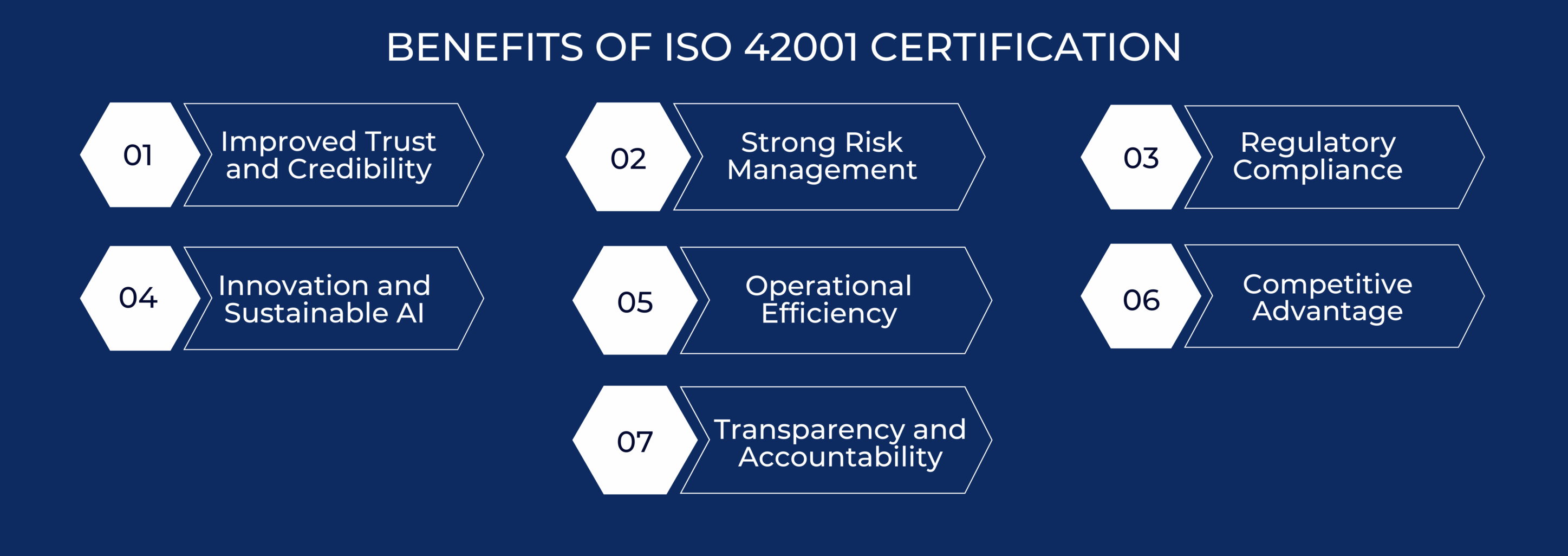
ISO 42001 Certification in Montreal delivers measurable organizational benefits across regulatory compliance, commercial competitiveness, risk management, and stakeholder trust dimensions. The following benefits represent documented outcomes for organizations that achieve and maintain ISO AIMS certification under the ISO/IEC 42001:2023 standard.
- ✓Regulatory Alignment: ISO 42001 Certification provides documented conformity evidence that directly supports compliance with Canadian federal AI governance expectations (AIDA), Quebec’s Law 25 transparency obligations, PIPEDA automated decision-making requirements, and OSFI model risk guidance for financial institutions.
- ✓AI Risk Mitigation: The AIMS framework requires systematic identification, assessment, and treatment of AI-specific risks including algorithmic bias, model drift, data poisoning, and unintended discriminatory outcomes — reducing the likelihood and impact of AI-related incidents.
- ✓Competitive Differentiation: ISO 42001 Certification signals to enterprise clients, government procurement authorities, and international partners that AI operations meet internationally recognized governance standards, creating a credible differentiator in competitive procurement processes.
- ✓Stakeholder and Public Trust: The third-party audit process underlying ISO 42001 Certification provides independent verification of AI governance claims, significantly increasing credibility with customers, employees, regulators, and communities affected by AI-driven decisions.
- ✓International Market Access: ISO 42001 Certification is recognized globally and increasingly required by enterprise buyers in regulated sectors across the EU, UK, US, and Asia-Pacific, enabling Montreal companies to access international markets where AI governance certification is a procurement requirement.
- ✓Alignment with EU AI Act Expectations: The EU Artificial Intelligence Act (effective August 2024 with phased requirements through 2026) imposes conformity assessment obligations on high-risk AI systems. ISO 42001 AIMS controls align with EU AI Act requirements, supporting market access for Montreal companies serving European clients.
- ✓Operational Accountability and Incident Response: AIMS implementation requires clear ownership of AI governance obligations, documented incident response procedures, and structured performance monitoring — improving organizational accountability and reducing the time to identify and respond to AI-related operational incidents.
- ✓Board-Level AI Governance Readiness: ISO 42001 Certification structures AI governance as a board-level management discipline with documented policies, management review processes, and performance metrics — aligning with growing expectations from institutional investors and ESG raters that AI governance be demonstrably managed at the executive level.
- ✓Insurance and Liability Risk Reduction: Documented AI risk management processes and governance controls provide insurance underwriters and legal counsel with evidence that the organization has exercised reasonable duty of care in AI deployment, potentially reducing AI-related liability exposure.
- ✓Continual Improvement Framework: The AIMS continual improvement obligations embedded in ISO 42001 ensure that AI governance evolves in response to changing AI system capabilities, emerging risks, and new regulatory requirements — avoiding governance stagnation as AI technology advances.
For Montreal tech startups, ISO 42001 Certification serves a distinct commercial purpose beyond regulatory compliance. Early-stage AI companies seeking Series A or B venture investment increasingly face due diligence questions about AI governance from institutional investors who are themselves subject to ESG reporting obligations. ISO 42001 Certification provides startups with an audited AI governance credential that strengthens investor confidence, reduces the burden of responding to ad hoc governance questionnaires, and signals organizational maturity to potential acquirers. The structured AIMS framework also helps AI startups build governance infrastructure that scales with the business — establishing policies, processes, and controls that remain relevant as the company grows.
Enterprise clients in regulated sectors such as banking, insurance, and healthcare increasingly include AI governance certification requirements in vendor qualification processes. Montreal AI companies pursuing government contracts — a growing market given federal and provincial government AI adoption — will increasingly encounter ISO 42001 or equivalent AI governance requirements in RFP criteria. Achieving ISO 42001 Certification in Montreal ahead of procurement requirements positions these companies favorably in competitive bidding processes and reduces the compliance burden at contract award. Montreal AI companies serving large enterprise or government clients should treat ISO 42001 Certification as a strategic commercial asset, not merely a compliance checkbox.
- ✓ISO 42001 and Montreal’s AI Startup Ecosystem
ISO 42001 Certification Cost and Timeline in Montreal
CertPro provides ISO 42001 Certification in Montreal under a transparent, fixed-pricing model. The total certification cost is determined by a defined set of factors assessed at the time of scope application. Fixed pricing eliminates ambiguity in budgeting and ensures that certification costs do not escalate due to scope creep or open-ended hourly billing arrangements. The primary cost drivers for ISO 42001 Certification are: the number of in-scope AI systems, the risk classification of those systems (high-risk, limited-risk, or minimal-risk), organizational headcount within the AIMS scope, and the complexity of the data governance and operational control environment.
Cost Factors for ISO 42001 Certification in Montreal
| Organization Profile | Estimated Audit Duration | Indicative Cost Range (CAD) | Key Cost Drivers |
|---|---|---|---|
| Small AI startup (1–3 AI systems, <50 employees) | 3–5 audit days | $8,000–$15,000 | Limited scope, low complexity, fewer Annex A controls applicable |
| Mid-size tech company (4–10 AI systems, 50–250 employees) | 6–10 audit days | $15,000–$30,000 | Multiple AI systems, mixed risk classifications, broader data governance scope |
| Large enterprise (10+ AI systems, 250+ employees) | 10–20+ audit days | $30,000–$60,000+ | High system count, high-risk AI applications, complex organizational structure, multi-site |
The indicative cost ranges above reflect CertPro’s audit fees for the initial certification cycle (Stage 1 and Stage 2 audits plus certification issuance). Annual surveillance audit fees are separate and are agreed as part of the multi-year certification agreement. Organizations that hold existing ISO 27001 or ISO 9001 certification may qualify for reduced audit durations where integrated management system audits are feasible, as documented processes and controls shared across management systems require less independent verification. CertPro provides a written fixed-price quote for ISO 42001 Certification in Montreal following a scope review, ensuring complete cost transparency before any audit activities commence.
ISO 42001 Certification Timeline for Montreal Organizations
The timeline for achieving ISO 42001 Certification in Montreal depends on the organization’s starting state — specifically, whether an AIMS has already been established and documented, or whether AIMS development is concurrent with the certification process. Organizations with existing AI governance frameworks aligned with ISO 42001 requirements can typically complete Stage 1 and Stage 2 audits and achieve certification within three to six months from scope application. Organizations building their AIMS from a lower starting point should anticipate six to twelve months to allow adequate time for documentation development, internal audit completion, and nonconformity resolution before the Stage 2 audit.
The certification timeline is driven by the time required to: complete AIMS documentation to Stage 1 readiness (typically four to eight weeks for organizations with existing governance frameworks), address any Stage 1 nonconformities (two to six weeks depending on severity), schedule and complete the Stage 2 on-site audit (typically two to four weeks after Stage 1 clearance), address any Stage 2 nonconformities (four to eight weeks for major nonconformities), and complete the certification decision review (typically one to two weeks). For Montreal organizations with firm commercial deadlines — such as government tender requirements or enterprise client onboarding timelines — CertPro can discuss accelerated audit scheduling where resource availability permits.
Why Choose CertPro for ISO 42001 Certification in Montreal?
CertPro is a Licensed CPA firm and accredited independent third-party certification body specializing in management system audits and certification services across Canada. CertPro’s ISO 42001 audit practice in Montreal combines technical expertise in AI governance frameworks with rigorous, evidence-based audit methodology consistent with ISO/IEC 17021-1 accreditation requirements. CertPro does not provide AI governance consulting, implementation services, or advisory support — the firm’s exclusive focus on independent certification audit services ensures complete independence between audit and non-audit activities, preserving the integrity and credibility of every ISO 42001 Certification issued.
Licensed CPA Firm and Accredited Certification Body
CertPro’s Licensed CPA firm status provides an additional layer of professional accountability and regulatory oversight that distinguishes it from non-CPA certification bodies. As a Licensed CPA firm, CertPro is subject to professional standards obligations including independence requirements, quality management standards, and disciplinary oversight — all of which reinforce the credibility of ISO 42001 Certifications issued. For Montreal organizations operating in regulated industries such as banking, insurance, healthcare, and the public sector, selecting a Licensed CPA firm for ISO 42001 Certification provides an additional level of institutional confidence that the audit was conducted with professional rigour and independence.
CertPro’s Montreal market expertise is a significant asset for organizations pursuing ISO AIMS certification in Quebec. The firm’s audit professionals are familiar with the specific regulatory context that Montreal organizations operate within — including Law 25, Quebec’s privacy commissioner (Commission d’accès à l’information), federal PIPEDA obligations, and OSFI guidance for financial institutions. This regulatory familiarity ensures that the ISO 42001 audit process accurately evaluates controls against the full spectrum of applicable requirements, rather than applying a generic international template that overlooks local regulatory nuances.
Fixed Pricing, Transparent Scope, and Independent Audit Integrity
CertPro’s fixed-pricing model for ISO 42001 Certification in Montreal ensures that organizations can accurately budget for certification costs without exposure to open-ended hourly billing or scope creep. The fixed price is agreed in writing before audit activities commence and covers all audit stages within the defined scope. Scope changes that materially affect audit duration are subject to written amendment — there are no unilateral price adjustments during the certification cycle. This pricing transparency is particularly valued by Montreal tech startups and scale-ups managing tight operational budgets and investor-scrutinized cost structures.
CertPro maintains strict independence between its ISO 42001 audit activities and any non-audit services. The firm does not provide AI management system documentation, process design, or governance framework development services to the organizations it certifies. This independence policy ensures that CertPro’s certification decisions are based solely on objective audit evidence — not on the auditor’s familiarity with or investment in the organization’s governance approach. For enterprise clients and regulated organizations subject to third-party independence requirements, CertPro’s exclusive focus on independent certification audit services satisfies the independence criteria increasingly specified in procurement and vendor qualification processes.
CertPro’s ISO 42001 Audit Expertise and Methodology
CertPro’s ISO 42001 audit team includes professionals with combined expertise in AI governance, information security management (ISO 27001), privacy compliance, and risk management. Audit team members are trained in ISO/IEC 42001:2023 requirements, ISO/IEC 17021-1 audit methodology, and the application of Annex A controls across diverse AI use cases including machine learning, natural language processing, computer vision, and generative AI systems. This cross-disciplinary expertise ensures that the ISO 42001 AIMS assessment covers both the management system governance layer and the AI system-specific technical evidence layer that together constitute a complete certification audit.
CertPro has conducted ISO 42001 compliance assessments for organizations across Montreal’s key AI sectors including technology, gaming, financial services, and healthcare. This sector breadth means that audit team members understand the distinct AI risk profiles, data governance challenges, and regulatory contexts that characterize different industry verticals — enabling more precise and relevant audit questioning, evidence evaluation, and nonconformity characterization. Organizations that choose CertPro for ISO 42001 Certification in Montreal benefit from an audit process that is both technically credible and commercially relevant to their specific industry context.
ISO 42001 Certification Requirements Checklist for Montreal Companies
Organizations pursuing ISO 42001 Certification in Montreal should evaluate their AIMS readiness against the following key requirements before initiating the formal certification audit process. This checklist is structured to reflect the ISO/IEC 42001:2023 clause requirements and Annex A control categories that the ISO 42001 audit will evaluate. The checklist is informational — it does not constitute an official pre-audit assessment, which can only be performed by an accredited certification body auditor conducting a formal ISO 42001 AIMS assessment.
- ✓AIMS Scope Defined: In-scope AI systems are identified and documented; organizational boundaries are established; exclusions from scope are justified in writing
- ✓AI Policy Established: A top-management-approved AI policy exists that addresses the organization’s AI principles, ethical commitments, and ISO 42001 compliance objectives
- ✓AI System Inventory Complete: All AI systems within the AIMS scope are catalogued with documentation of their purpose, data inputs, outputs, affected parties, and risk classification
- ✓Risk Assessment Methodology Documented: A defined, criteria-based AI risk assessment methodology is documented and has been applied to all in-scope AI systems
- ✓Statement of Applicability (SoA) Completed: All 38 Annex A controls have been evaluated for applicability; exclusions are documented with written justifications
- ✓AI Impact Assessments Completed: Impact assessments have been conducted for all in-scope AI systems; risk treatment decisions have been made and documented by authorized management
- ✓Data Governance Procedures Operational: Procedures for training data provenance, quality management, bias assessment, and data handling are documented and implemented
- ✓Transparency Mechanisms Established: Procedures exist for informing affected individuals about AI-driven decisions and for providing explanations of AI system outputs
- ✓Human Oversight Processes Operational: Mechanisms for human review, override, or suspension of AI system outputs are documented and demonstrably operational
- ✓Internal Audit Cycle Completed: At least one internal AIMS audit has been completed and documented; nonconformities have been addressed with corrective actions
- ✓Management Review Conducted: At least one formal management review of AIMS performance has been conducted and documented with records of decisions made
- ✓Competence Records Maintained: Personnel with AI governance responsibilities have documented role competence requirements and training completion records
FAQ
▶
What is ISO 42001 certification and what does it certify?
▶
Is ISO 42001 certification recognized in Canada and Montreal?
▶
How long does the ISO 42001 certification process take in Montreal?
▶
What is the cost of ISO 42001 certification in Montreal?
▶
Which Montreal industries are most likely to need ISO 42001 certification?
▶
How does ISO 42001 relate to Quebec’s Law 25 and PIPEDA?
▶
Can a small AI startup in Montreal achieve ISO 42001 certification?
▶
What is the difference between an ISO 42001 audit and an ISO 42001 AIMS assessment?
ISO 42001 CERTIFIED: WHY AI GOVERNANCE CERTIFICATION IS BECOMING A BOARD-LEVEL REQUIREMENT
AI is now an inevitable component of major business activities in the current corporate world. To elaborate, it is now part of product design, custome…

MindSec Launches AI Compliance for Law 25 & ISO 42001
Excerpt from Barchart Article, Published on December 3, 2025 Today, Canadian organizations face increasing pressure to comply with stringent privacy a…

UNDERSTANDING ISO 42001: A GUIDE FOR RESPONSIBLE AI MANAGEMENT SYSTEMS
The invention of artificial intelligence (AI) has changed the operational processes of many industries. However, the rapid growth of technology increa…
Get In Touch
have a question? let us get back to you.